

Corporate Tax Registration Requirements in UAE: The 2026 Compliance Guide
Could a single missed administrative deadline cost your business AED 10,000 before you’ve even filed your first return? For many entrepreneurs in the Emirates, this isn’t a hypothetical risk but a looming reality under the current tax regime. We understand that keeping up with the evolving corporate tax registration requirements uae mandates can feel overwhelming. Whether you’re operating in a Free Zone or on the Mainland, the pressure to decipher complex FTA regulations while managing your daily operations is a significant burden. You deserve a clear path that prioritizes your business growth over administrative hurdles.
You don’t have to navigate the EmaraTax portal alone or risk heavy penalties for late submission. This guide provides the expert clarity you need to achieve 100% compliance with total confidence and efficiency. We’ll break down the essential document checklist, clarify specific registration deadlines based on your license issuance date, and outline a streamlined path to securing your Tax Registration Number. Read on to master the registration process and ensure your business remains on the right side of the law without the stress.
Key Takeaways
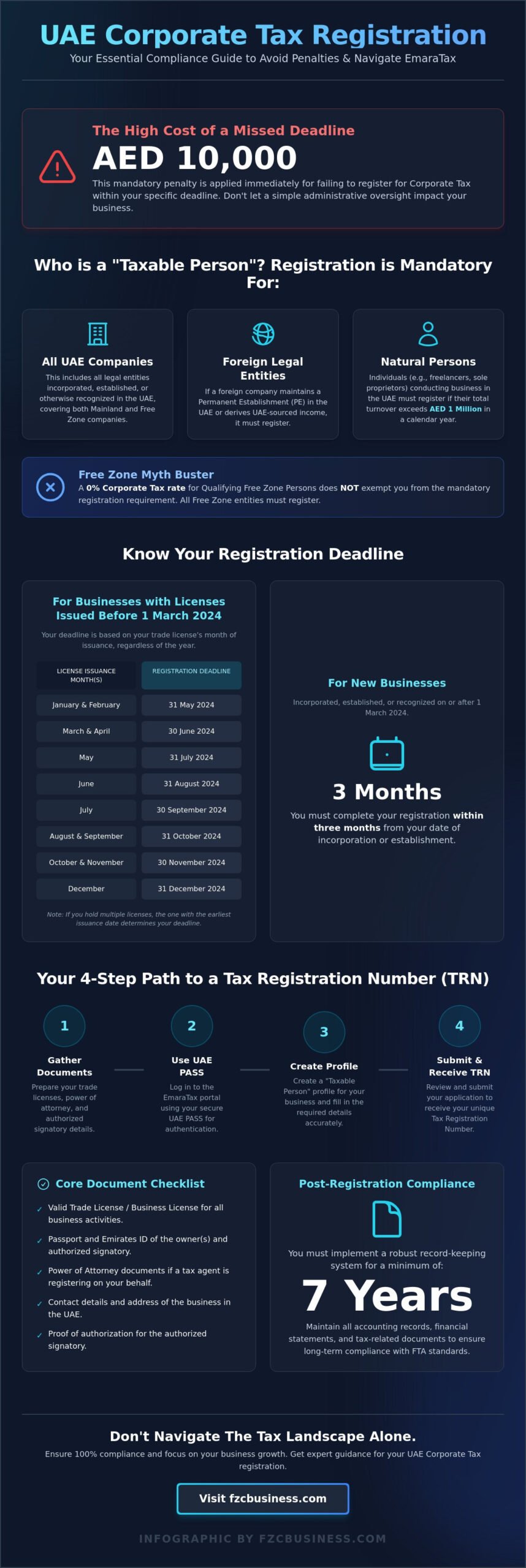
- Identify your specific registration timeline based on your license issuance date to avoid the mandatory AED 10,000 late penalty.
- Understand that corporate tax registration requirements uae apply to all legal entities, including those operating within Free Zones and those eligible for a 0% tax rate.
- Prepare a comprehensive document checklist, including valid trade licenses and power of attorney details, to ensure a seamless application process.
- Utilize your UAEPass for secure authentication on the EmaraTax portal to create your Taxable Person profile efficiently.
- Implement a robust 7-year record-keeping system for all accounting and tax-related documents to maintain long-term compliance with FTA standards.
Understanding UAE Corporate Tax Registration Deadlines in 2026
Federal Decree-Law No. 47 of 2022 established the foundation for the current UAE Corporate Tax System. While the law was introduced earlier, 2026 marks a critical compliance year for many entities. You must understand that registration isn’t an optional task; it’s a mandatory requirement for all taxable persons. The Federal Tax Authority (FTA) has moved from an introductory phase to strict enforcement, making it vital to verify your status today.
Missing your specific window results in an immediate AED 10,000 penalty. This fine is fixed and applies the moment the deadline passes. To ensure your business stays compliant, you must align your internal administrative calendar with the FTA’s specific timeline. Understanding the corporate tax registration requirements uae is the only way to safeguard your company’s financial health and focus on your core objectives.
To better understand this concept, watch this helpful video:
FTA Decision No. 3 of 2024 redefined the landscape by linking registration deadlines to the month your trade license was issued. This approach ensures a staggered and manageable flow of applications through the EmaraTax portal. It’s not about when your financial year ends, but rather when your business was legally born in the eyes of the licensing authority. This distinction is where many business owners face confusion.
Deadline Schedule by License Issuance Month
If your license was issued in January or February, regardless of the year of issuance, your deadline has likely already passed or is imminent in the 2026 cycle. You must act immediately if you haven’t secured your Tax Registration Number (TRN). For entrepreneurs holding multiple trade licenses, the FTA clarifies that the license with the earliest issuance date dictates your overall registration deadline. If you’re a natural person conducting business without a formal trade license, your deadline is typically linked to the end of the calendar year in which your turnover exceeded the AED 1 million threshold.
New Business Setups: Registration Rules for 2026
For those embarking on a Dubai Mainland license setup in 2026, the rules are even more direct. Any legal entity incorporated on or after March 1, 2024, must complete its registration within three months from the date of incorporation. This three-month grace period is designed to integrate tax compliance into your initial startup phase. Don’t wait until your first tax return is due to start this process. Early registration ensures you can open corporate bank accounts and fulfill other corporate tax registration requirements uae mandates without administrative delays.
Who Must Register? Taxable Persons and Exemptions
Under the UAE corporate tax regime, the term “Taxable Person” encompasses a broad range of entities and individuals. All companies incorporated in the UAE, including those in the Mainland and Free Zones, must comply with the corporate tax registration requirements uae. This mandate extends to foreign legal entities if they maintain a Permanent Establishment (PE) in the Emirates or earn UAE-sourced income. The FTA requires every business to identify its status early to avoid the administrative bottlenecks associated with late filings.
The distinction between a legal entity and a natural person is vital for compliance. While all legal entities must register regardless of their income level, natural persons, such as freelancers or individual traders, only enter the tax net under specific conditions. If you’re an individual conducting business under a commercial license, your registration requirement is triggered once your total turnover exceeds AED 1 million within a single calendar year. This threshold provides a safeguard for small-scale entrepreneurs while ensuring larger individual operations contribute to the national economy.
Free Zone Companies: The Registration Myth
One of the most common misconceptions is that a 0% tax rate exempts a company from registration. This is incorrect. Even if your business qualifies as a “Qualifying Free Zone Person” (QFZP) and benefits from the preferential 0% rate on qualifying income, you must still register with the FTA. Registration is the mandatory first step to claiming these benefits. To maintain this status, you must also maintain adequate substance in the UAE and prepare audited financial statements. If you are currently utilizing a Free Zone Company Setup Guide to launch your venture, ensure tax compliance is integrated into your initial strategy.
Exempt Entities and Non-Resident Requirements
Certain entities are exempt from corporate tax, but this doesn’t always mean they’re exempt from the registration process. Government bodies and extractive businesses involved in the UAE’s natural resource sector are typically exempt by law. However, charities, qualifying public benefit entities, and pension funds are not automatically exempt; they must submit a formal application to the FTA to secure and maintain their status. For non-resident entities, the requirement to register depends on whether they have a “nexus” in the UAE. This often includes earning income from immovable property or operating through a Permanent Establishment that exercises authority to conclude contracts in the company’s name.
Managing these nuanced distinctions requires precision and expert oversight. If you’re unsure about your specific taxable status, seeking professional VAT and Corporate Tax Assistance can prevent costly errors and streamline your compliance journey. Identifying your obligations now ensures you can focus on scaling your business without the threat of unexpected penalties.
Core Document Requirements for Corporate Tax Registration
Success in meeting corporate tax registration requirements uae begins with administrative precision. The EmaraTax portal is designed to cross-reference your application with existing government databases in real time. Any discrepancy between your uploaded documents and your official trade license records can lead to an immediate application rejection. You must prepare your digital files in high-resolution PDF or JPEG formats, ensuring each file stays within the portal’s size limits, which typically cap at 5MB per document. This technical preparation is just as important as the data itself.
Your documentation must reflect the current legal structure of your entity. If you’ve recently updated your trade license or changed partners, ensure these changes are reflected across all supporting papers before starting the upload process. The Federal Tax Authority requires a high level of transparency, and having a complete, organized digital folder will save you hours of troubleshooting during the submission phase.
The Essential Documentation Checklist
The primary document required is a valid Trade License. Whether you operate on the Mainland, in a Free Zone, or as an Offshore entity, this document serves as the foundation of your tax profile. For Free Zone entities, you may also need to provide a Certificate of Incorporation or a Certificate of Good Standing if your specific jurisdiction issues them separately from the license. Additionally, you must provide clear passport copies and Emirates ID scans for all owners and directors listed on the license. For legal entities, the Memorandum of Association (MOA) or Articles of Association (AOA) must be uploaded to verify the shareholding structure and the powers granted to the management team.
Proof of Authorization and Signatory Details
Identifying the Authorized Signatory is a critical step that many businesses overlook. The person submitting the application must have the legal authority to bind the company. You’ll need to provide documentary evidence of this authority, such as a Board Resolution or a notarized Power of Attorney. This individual must also have a verified UAEPass account, as the EmaraTax portal uses this for secure authentication and digital signatures. You’ll also need to provide a verified UAE mobile number and a dedicated corporate email address for all future FTA correspondence.
Many entrepreneurs find that opening a corporate bank account before starting the tax registration process is a strategic move. The rigorous Know Your Customer (KYC) checks performed by UAE banks often help you identify and rectify document inconsistencies early. This ensures that the data you present to the FTA is already verified by a financial institution, making the corporate tax registration requirements uae much easier to satisfy. Once your documents are in order, you’re ready to navigate the digital portal with confidence.
Step-by-Step Guide to Registering on EmaraTax
Executing your registration on the EmaraTax portal is the final technical hurdle in your compliance journey. The Federal Tax Authority (FTA) has streamlined this digital environment to act as a single point of truth for all tax matters. However, the system is rigorous. You must approach the five-stage application process with meticulous attention to detail to ensure your submission moves quickly from “Pending” to “Approved.” Understanding the digital interface is now a core part of the corporate tax registration requirements uae mandates for every business owner.
Your UAEPass is the primary key to accessing these digital services. It doesn’t just provide a login; it serves as your digital signature and identity verification. Before you begin, ensure your UAEPass is upgraded to the “Verified” status through a Dubai Now kiosk or your banking app. This small preparation prevents session timeouts and authentication errors that often plague unprepared applicants. Once you’re inside, the dashboard provides a clear overview of your tax obligations and active applications.
Phase 1: Portal Access and Profile Setup
Log in to EmaraTax using your UAEPass credentials to create or access your “Taxable Person” profile. You’ll need to select whether you’re registering as a “Legal Person” for a company or a “Natural Person” for individual business activities. If your entity is already registered for VAT, the system may auto-populate certain fields. Verify this data against your current trade license immediately. Any outdated information from previous VAT filings can cause a mismatch, leading the FTA to flag your application for manual review, which significantly extends the approval timeline.
Phase 2: Data Entry and Document Upload
The core of the application involves entering your financial year-end dates. This is a critical decision point. This date determines your first tax period and your subsequent filing deadlines. Most UAE companies align this with the calendar year ending December 31. In the “Business Activities” section, select codes that match your trade license exactly. Avoid the temptation to select broad categories that don’t reflect your actual operations, as this can trigger additional inquiries. Review the summary page carefully before the final declaration. This is your last chance to catch typos in passport numbers or email addresses before the data is encrypted and sent to the FTA.
The digital registration process can be complex, but you don’t have to manage it alone. If you want to ensure your application is perfect the first time, book a consultation for VAT and Corporate Tax Assistance today. Our experts will guide you through the EmaraTax dashboard, helping you satisfy all corporate tax registration requirements uae has established for 2026. Once submitted, monitor your dashboard for a “Taxable Person Registered” status, which confirms your TRN has been generated and your business is officially compliant.
Post-Registration Compliance and Professional Support
Securing your Tax Registration Number (TRN) is a significant milestone, but it’s only the beginning of your long-term compliance journey. Once registered, your TRN must be integrated into your official business documents, including tax invoices and credit notes. The Federal Tax Authority (FTA) transition from registration to active monitoring means your business must now operate with a tax-first mindset. This involves more than just periodic filings; it requires a systematic approach to every financial transaction your company executes.
Compliance hinges on your ability to produce accurate data upon request. You’re legally required to maintain all accounting records, supporting documents, and tax filings for at least 7 years from the end of the tax period. This 7-year record retention rule is absolute. Whether you’re a Mainland entity or a Free Zone company, your digital and physical archives must be audit-ready at all times. Failure to produce these records during an FTA inspection can lead to severe administrative penalties that far exceed the initial cost of proper bookkeeping.
The annual Corporate Tax Return is the culmination of your yearly accounting cycle. You must file this return and pay any due tax within 9 months of the end of your relevant tax period. For businesses with a financial year ending December 31, 2025, the filing deadline is September 30, 2026. Understanding these specific timelines is a core part of the corporate tax registration requirements uae mandates. This 9-month window is generous, but it requires you to close your books and, in many cases, complete an external audit well before the submission date.
Ongoing Accounting and Audit Obligations
Your accounting practices must be robust enough to support your tax positions. If you followed a structured business setup in Dubai, you likely have the foundational elements in place. However, certain revenue thresholds and specific statuses, such as being a Qualifying Free Zone Person, trigger the requirement for audited financial statements. Group tax registration is another strategic consideration; it allows parent companies to consolidate the tax profiles of multiple subsidiaries, potentially offsetting profits against losses and simplifying the overall filing process.
Why Professional Tax Assistance is Essential
The complexity of the UAE tax landscape makes professional oversight a necessity rather than a luxury. An expert-led approach ensures you don’t fall victim to the AED 10,000 late registration fine or miss critical updates to FTA decisions. We specialize in aligning your operations with the latest corporate tax registration requirements uae has established, providing the clarity you need to scale without fear of regulatory pushback. Our team ensures that Free Zone entities maintain their “Qualifying” status through meticulous documentation and substance verification. Contact Fast Zone Business for expert Corporate Tax assistance and secure your company’s future in the UAE market today.
Secure Your Business Future with Expert Tax Compliance
Mastering the corporate tax registration requirements uae is a foundational step for every entrepreneur in 2026. You now understand that your trade license issuance month dictates your specific deadline and that even 0% Free Zone entities must secure a TRN. Success depends on precise documentation and a flawless EmaraTax submission. By aligning your administrative processes with FTA standards today, you protect your company from the AED 10,000 late registration penalty and ensure long-term operational stability.
Don’t leave your regulatory standing to chance. Our FTA-aligned compliance experts provide a seamless UAEPass and EmaraTax integration to handle your application from start to finish. We offer a zero-penalty guarantee for all managed registrations, giving you the peace of mind to focus on your core growth objectives. Secure Your Business Compliance with Fast Zone Tax Services and ensure your venture remains a leader in the competitive UAE market. Tax compliance is the gateway to long-term scalability; with the right partner, this transition becomes a streamlined part of your professional journey.
Frequently Asked Questions
What is the deadline for corporate tax registration in UAE for 2026?
The deadline depends on your trade license issuance month as per FTA Decision No. 3 of 2024. For businesses established on or after March 1, 2024, you must register within three months of your incorporation date. Existing businesses must follow the staggered schedule based on their license month. Failing to meet these dates triggers a fixed penalty of AED 10,000.
Is corporate tax registration mandatory for Free Zone companies?
Yes, every Free Zone entity must complete the registration process regardless of whether they qualify for the 0% tax rate. Registration is a prerequisite to claiming any Free Zone tax incentives. You must fulfill the corporate tax registration requirements uae has set to maintain your “Qualifying Free Zone Person” status and avoid administrative fines or loss of benefits.
What are the penalties for late corporate tax registration in the UAE?
The Federal Tax Authority imposes a fixed penalty of AED 10,000 for failing to submit a registration application within the specified timeframe. This penalty is non-negotiable and applies immediately once the deadline passes. Prompt action is the only way to safeguard your company’s financial resources and ensure your business remains in good standing with the regulatory authorities during the 2026 compliance cycle.
Can I register for corporate tax without a UAEPass?
No, a verified UAEPass account is the mandatory authentication method for accessing the EmaraTax portal. It serves as your digital identity and allows you to sign documents electronically. You should upgrade your UAEPass to the “Verified” status at a physical kiosk or through your banking app before starting the application to ensure a frictionless and secure registration experience on the official portal.
Do I need to register for corporate tax if my profit is below AED 375,000?
Yes, registration is mandatory for all taxable persons regardless of their annual profit or turnover. While the 9% tax rate only applies to taxable income exceeding AED 375,000, the requirement to register and file returns applies to everyone. Meeting the corporate tax registration requirements uae ensures you can legally claim the 0% rate on your first AED 375,000 of taxable income.
How long does it take to get a Corporate Tax Registration Number (TRN)?
Most applicants receive their Tax Registration Number (TRN) within 20 business days after the FTA receives the completed application. However, the timeline can vary based on the accuracy of your documentation and the current volume of submissions. Providing high-resolution document scans and ensuring all data matches your trade license exactly can significantly speed up the approval and issuance process.
What documents are required for a freelancer to register for corporate tax?
Freelancers must register if their total turnover from business activities in the UAE exceeds AED 1 million in a calendar year. Required documents include a valid freelance or commercial license, a clear passport copy, and your Emirates ID. You’ll also need to provide a verified UAE mobile number and a dedicated email address to receive official correspondence and notifications from the Federal Tax Authority.
Can I use the same portal for VAT and Corporate Tax registration?
Yes, the EmaraTax portal is the unified digital platform for managing both VAT and Corporate Tax obligations. If you’re already registered for VAT, you can use your existing credentials to access the dashboard and add a “Corporate Tax” profile. This integration simplifies your administrative tasks by housing all your tax records, returns, and payment history in one secure and centralized digital location.
