

UAE Labor Law for Small Business: The 2026 Compliance Guide
A single oversight in your hiring process could result in a fine of AED 108,000 as of January 2026. For most entrepreneurs, the complexity of the uae labor law for small business feels like a constant shadow over their daily operations. You started your company to innovate and serve clients, not to spend your weekends calculating end-of-service gratuity or worrying about the latest Emiratisation quotas.
It’s completely normal to feel overwhelmed by shifting MOHRE requirements. We provide the expert guidance you need to master 2026 compliance, from understanding fixed-term contracts to meeting the new AED 6,000 minimum wage for Emirati staff. This guide walks you through a practical checklist of employer duties, explains the nuances of the Wages Protection System (WPS), and provides the peace of mind that your business is legally secure. Our focus is on making these administrative hurdles frictionless, so you can prioritize your long term growth.
Key Takeaways
- Understand the core requirements of Federal Decree Law No. 33 of 2021 to ensure your small business meets the same regulatory standards as major corporations.
- Implement mandatory fixed-term contracts and explore flexible work models that align with the latest uae labor law for small business requirements.
- Streamline your payroll through the Wages Protection System (WPS) and accurately calculate leave entitlements to avoid costly MOHRE penalties.
- Identify common compliance pitfalls and learn how to resolve employee grievances internally before they escalate to official labor disputes.
- Discover how outsourcing labor management to professional PRO services can secure your work permits and labor cards while you focus on growth.
The Foundation of UAE Labor Law for Small Businesses in 2026
Federal Decree-Law No. 33 of 2021 remains the bedrock of employment relations across the Emirates in 2026. Don’t assume your small team is exempt from these rigorous standards because of your company size. The UAE government views compliance as a universal requirement. This means your boutique agency must follow the same payroll and contract protocols as a global bank. Central to this system is the Ministry of Human Resources and Emiratisation (MoHRE), which monitors everything from your hiring practices to your monthly salary transfers. While government employees and domestic workers follow separate rules, the standard uae labor law for small business covers almost every other professional scenario in the private sector.
To better understand how these regulations shape your daily operations, watch this helpful video:
Key Regulatory Changes SMEs Must Know for 2026
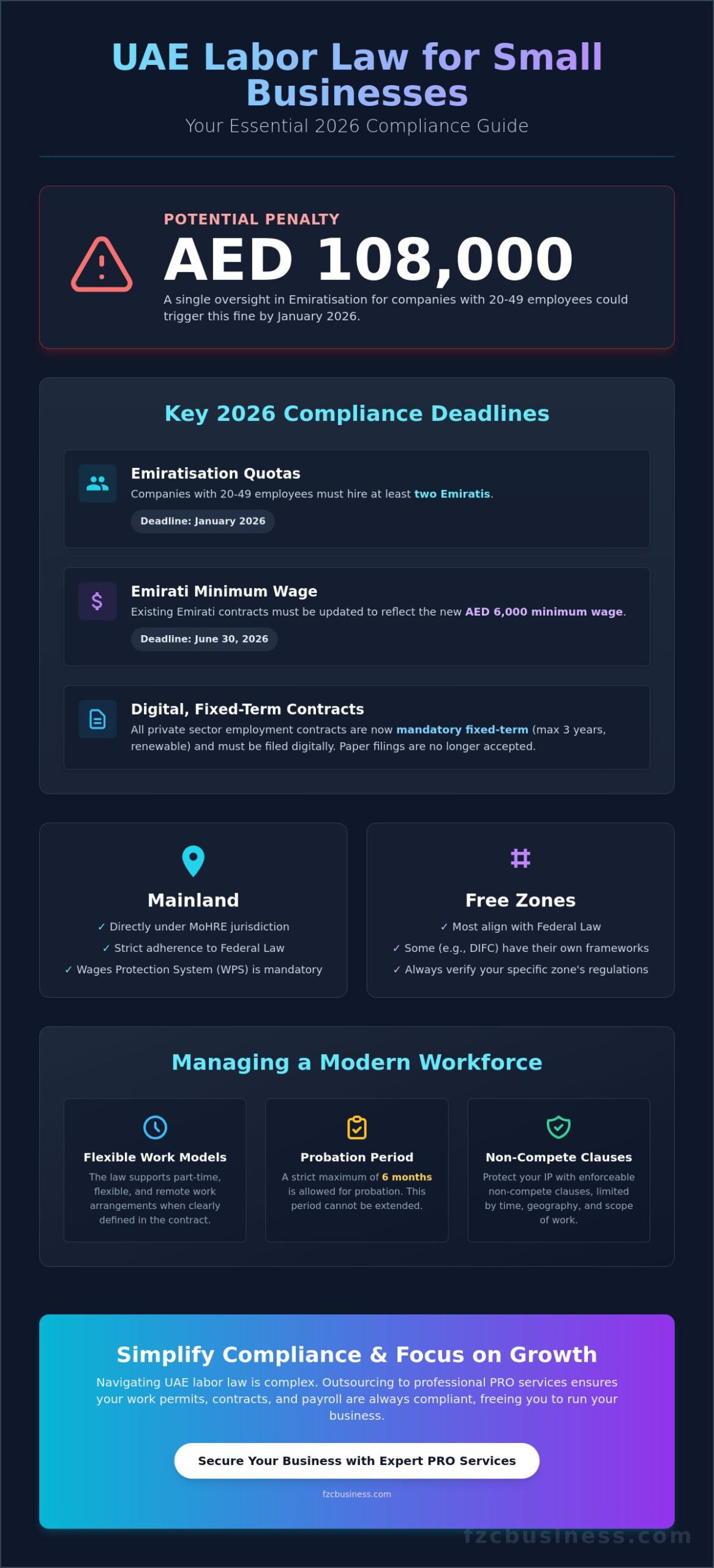
Compliance has moved entirely online. You can’t rely on paper filings anymore. All employment contracts are now digital and must be fixed-term to ensure clarity for both parties. By January 2026, companies with 20 to 49 employees that failed to hire two Emiratis face a substantial fine of AED 108,000. Additionally, you have until June 30, 2026, to update existing Emirati contracts to reflect the new AED 6,000 minimum wage. These aren’t suggestions; they’re mandatory benchmarks for staying operational in the current market. Using the uae labor law for small business as a framework protects you from these sudden financial shocks.
Mainland vs. Free Zone Labor Jurisdictions
The location of your license determines which authority oversees your staff. Most Free Zones align their regulations with Federal Law, but some, like the Dubai International Financial Centre (DIFC), operate under their own common law framework. If you’ve opted for a business setup in Dubai mainland, you’re directly under the jurisdiction of MoHRE. This requires a strict adherence to federal standards and the Wages Protection System. Understanding these nuances is critical. A mistake in jurisdiction can lead to invalid contracts and expensive legal delays that your small business doesn’t need. Clear, authoritative guidance ensures you choose the right path from day one.
Managing Employment Contracts and Work Models
Modernizing your workforce starts with the right paperwork. All private sector employees must now be on fixed-term contracts. These agreements have a maximum duration of three years but remain fully renewable upon expiry. This structure provides the stability needed for long term planning while allowing for periodic reassessment of your business needs. It’s a core component of the uae labor law for small business that ensures both parties understand their commitment from the outset. Using these standardized contracts helps you avoid the legal ambiguity that often plagued older, unlimited-term agreements.
Small teams often thrive on flexibility. The current legal framework supports this through various work models, including part-time, flexible, and remote arrangements. You can hire specialists for specific hours or allow your core team to work from home, provided the contract clearly defines these terms. To safeguard your startup’s intellectual property, ensure you include specific non-compete clauses. These clauses must be limited in time, geographical area, and the nature of the work to be legally enforceable. They’re essential tools for protecting your competitive advantage in a fast moving market.
Don’t confuse an offer letter with the official MoHRE labor contract. While an offer letter is a binding preliminary agreement, the MoHRE contract is the definitive legal document that governs the relationship. If you’re unsure about the nuances of these documents, securing professional PRO services can help you manage these filings accurately and efficiently. This ensures your digital records match your physical agreements, leaving no room for administrative errors.
Probation Periods and Notice Requirements
The law sets a strict maximum of six months for probation. You can’t extend this period once it concludes. If an employee chooses to resign during probation to join another employer in the UAE, they must provide at least one month’s notice. However, if they’re leaving the country, a 14-day notice is required. For termination, employers must provide a notice period of 30 to 90 days, depending on the specific contract terms agreed upon at the start of employment.
Working Hours, Overtime, and Break Regulations
Standard working hours are capped at 8 hours per day or 48 hours per week. If your business requires extra effort, overtime is calculated at 125% of the basic hourly wage. If work happens between 10 PM and 4 AM, this rate increases to 150%. Small businesses must also respect the mid-day break during summer months and reduced hours during Ramadan. These rules are vital for maintaining compliance and ensuring the wellbeing of your staff, which directly impacts your long term retention rates.
Financial Obligations: Wages, Leaves, and Gratuity
Managing your company’s finances involves more than just balancing the books. It requires a precise understanding of the uae labor law for small business to ensure every dirham paid to your staff meets federal standards. Compliance in this area isn’t optional. The UAE government has implemented digital systems to monitor every transaction, making it easier for compliant businesses to operate while penalizing those who fall behind. By mastering these financial duties, you protect your company from administrative blocks and build a reputation as a reliable employer.
Mastering the Wages Protection System (WPS)
Even if you only have one or two employees, you must use the Wages Protection System (WPS). This electronic salary transfer system ensures that workers receive their pay in full and on time. You’re required to pay salaries within 15 days of their due date. If you fail to meet this deadline, MoHRE can impose fines of up to AED 50,000 and suspend your ability to issue new work permits. To get started, you’ll need a corporate account that supports SIF (Salary Information File) generation. You can find a detailed guide on how to open a bank account in the UAE to ensure your banking setup is fully compatible with WPS requirements from day one.
Beyond wages, you must manage various leave entitlements. Your staff is entitled to 30 calendar days of paid annual leave after one year of service. Sick leave allows for up to 90 days per year, with the first 15 days at full pay and the next 30 at half pay. Maternity leave is now 60 days total, with 45 days at full pay. Additionally, while you don’t pay for your employees’ Unemployment Insurance (ILOE), you’re responsible for ensuring they’re aware of the requirement to subscribe to avoid personal fines.
Calculating Gratuity for Departing Employees
When an employment relationship ends, you must settle all end-of-service benefits within 14 days of the employee’s last day. Gratuity is calculated using the employee’s basic salary, not their total package. For the first five years of service, the rate is 21 days of basic salary for each year worked. Once an employee surpasses the five year mark, they earn 30 days for every year of service beyond that fifth year.
It’s vital to note that under the 2026 regulations, the total gratuity payout cannot exceed two years’ worth of salary. Some small businesses are now moving toward voluntary alternative end-of-service savings schemes. These schemes allow you to make monthly contributions into a managed investment fund rather than paying a large lump sum when an employee leaves. This can significantly improve your cash flow management and reduce the financial impact of staff turnover.
Staying Compliant: Avoiding Fines and Labor Disputes
Compliance isn’t just about following rules; it’s about protecting your cash flow and operational freedom. Small business owners often trip over administrative details like missing a WPS transfer or failing to update a digital contract. These minor errors trigger automatic flags in the MoHRE system. Once flagged, your company might face a labor ban, which stops you from hiring new talent or renewing current visas. Mastering the uae labor law for small business requires a shift from reactive problem-solving to proactive record-keeping.
Maintaining digital records is your best defense. If an inspector visits your office or co-working space, they’ll ask for your digital employment contracts and proof of salary payments through the WPS. They want to see that you’re adhering to the maximum 48-hour work week and providing the mandatory 30 days of annual leave. Keeping these files organized in a cloud-based system ensures you’re always ready for an unannounced audit. If you find the administrative burden too heavy, our PRO services can manage these filings for you, ensuring your company remains in good standing with the authorities.
Navigating MOHRE Enquiry Services and Inspections
The MoHRE mobile app is an essential tool for every entrepreneur. It provides a real-time compliance score that shows exactly where your business stands. If you see a dip in your score, it’s usually a sign of a pending fine or an expired document. If you receive a block on your file, you must act immediately to resolve the underlying issue, whether it’s a late salary payment or a missing Emiratisation target. For companies with 20 to 49 employees, failing to meet these targets resulted in a fine of AED 108,000 in January 2026. Stay ahead of these deadlines to keep your work permits active.
Resolving Disputes and the Role of the Labor Court
Disputes are stressful but manageable if you follow the legal hierarchy. Every labor complaint starts with MoHRE mediation. The Ministry attempts to settle the matter amicably before it ever reaches a judge. In 2026, MoHRE has the authority to issue final decisions on smaller financial claims, typically those under AED 50,000, without requiring a full court hearing. This speeds up the process for both parties. To protect your business from frivolous claims, always document performance issues and internal disciplinary actions in writing. This paper trail is your most powerful evidence during mediation.
Simplifying Labor Law with Fast Zone Business PRO Services
Managing a growing team shouldn’t come at the expense of your core business objectives. For many entrepreneurs, the administrative weight of the uae labor law for small business becomes a distraction that slows down innovation. This is where professional outsourcing shifts from a luxury to a strategic necessity. By partnering with Fast Zone Business, you ensure that every work permit, labor card, and contract renewal is handled with precision and speed. Expert guidance allows you to navigate the 2026 regulatory landscape with absolute confidence.
Fast Zone Business acts as your dedicated PRO department. We take full responsibility for your MOHRE file, ensuring your company maintains its “Green” status. This status is vital; it signals to authorities that you’re a low-risk, compliant employer. We monitor your Wages Protection System (WPS) transfers and alert you to any potential discrepancies before they trigger a system block or an administrative fine. Our goal is to provide a frictionless experience that allows you to focus on scaling your operations while we manage the regulatory complexities in the background.
The Fast Zone Business Advantage for Small Business Growth
Our services extend beyond simple document filing. We provide comprehensive support for everything from initial visa processing to complex labor renewals. If you’re just beginning your journey, our guide on how to start a business in Dubai offers a clear roadmap for your first steps. Fast Zone Business specializes in making the transition from a solo entrepreneur to a team leader as smooth as possible.
We understand the specific pressures small teams face. For example, we recently assisted a 5-person tech startup that was selected for a random MOHRE labor audit. By ensuring their digital records were perfectly organized and their WPS history was spotless, we helped them pass the inspection without a single penalty. This level of preparation turns a potentially stressful audit into a routine confirmation of your professional standards. Using the uae labor law for small business as a protective shield ensures your growth remains uninterrupted.
Next Steps for Your Business Compliance
Don’t wait for a system block to address your compliance needs. The regulatory landscape of 2026 demands a proactive approach to team management. Schedule a consultation with the experts at Fast Zone Business to review your current setup and identify any potential risks. We offer a custom compliance audit for your existing team to ensure every contract and wage payment aligns with current federal standards. Take the first step toward a more secure and efficient business model. Contact Fast Zone Business for expert PRO and labor support today. Our team is ready to provide the clarity and reliability you need to succeed in the UAE’s competitive market.
Securing Your Company’s Future in the UAE
Compliance is a competitive edge. Mastering the uae labor law for small business ensures your company remains agile, protected from sudden fines, and ready to attract top talent. From implementing mandatory fixed-term contracts to managing the complexities of the Wages Protection System, every step you take toward regulatory alignment secures your long term growth. You don’t have to navigate these administrative hurdles alone.
Our Specialized SME Compliance Team brings deep expertise in both Dubai Mainland and Free Zone regulations. We maintain a 100% success rate in labor documentation, giving you the freedom to focus on your core objectives while we handle the fine print. It’s time to replace regulatory anxiety with professional clarity. Secure Your Business with Expert PRO Services from Fast Zone Business and take the next step toward a frictionless operational future. Your entrepreneurial journey deserves the support of a reliable partner who understands the local market inside and out.
Frequently Asked Questions
Is the UAE Labor Law the same for Free Zone and Mainland companies?
Federal Decree-Law No. 33 of 2021 serves as the primary legislation for the private sector across most of the UAE. While Mainland companies fall directly under the jurisdiction of MoHRE, most Free Zones have adopted these federal standards as their baseline. Financial hubs like the DIFC and ADGM are the exceptions, as they operate under their own independent legal frameworks. It’s vital to check your specific Free Zone’s regulations to see where they might differ from federal standards.
What is the minimum salary for employees under UAE Labor Law in 2026?
A mandatory minimum monthly wage of AED 6,000 is required for Emirati employees in the private sector as of January 1, 2026. There is currently no fixed universal minimum wage for expatriate workers under the uae labor law for small business. Instead, salaries for expat staff are determined by the terms of the employment contract, provided they are sufficient to meet basic needs and are paid through the Wages Protection System.
Can I terminate an employee during their probation period without notice?
You cannot terminate an employee during their probation period without giving at least 14 days of written notice. This requirement applies to all employers and is designed to provide a fair transition period. If the employee wishes to resign during probation to join another employer within the UAE, they are required to give you 30 days of notice. If they are leaving the country, their notice period is also 14 days.
What happens if I fail to pay my employees through the WPS?
Failing to use the Wages Protection System (WPS) triggers immediate administrative penalties from MoHRE. Your company could face fines up to AED 50,000 and a complete suspension of your ability to issue or renew work permits. The system monitors every transaction in real time, so any delay beyond 15 days from the due date will likely result in an automatic block on your company file.
How do I calculate end-of-service gratuity for a part-time employee?
Gratuity for part-time staff is calculated on a pro-rata basis. You first determine the amount a full-time employee would receive for the same period and then apply a percentage based on the actual hours worked by the part-time staff member. This ensures that benefits are proportional to the employee’s contribution. All calculations should be based on the basic salary and must be settled within 14 days of the employee’s final working day.
Are small businesses exempt from Emiratisation targets in 2026?
Small businesses with 20 to 49 employees in 14 specific economic sectors are not exempt from targets. These companies were required to have hired at least two Emirati employees by the end of 2025. If your business falls into this category and failed to meet the target, you will face a fine of AED 108,000 starting in January 2026. Companies with 50 or more employees face even stricter annual 2% increases.
What is the maximum number of working hours allowed per week?
The maximum standard working hours are 8 hours per day or 48 hours per week. This limit is central to the uae labor law for small business and must be respected to avoid labor disputes. During Ramadan, these daily hours are reduced by two for all employees. Any hours worked beyond these limits are classified as overtime and require additional compensation at rates of 125% or 150% of the basic hourly wage.
Do I need to provide health insurance for my employees in Dubai?
You are legally mandated to provide health insurance for every employee under your sponsorship in Dubai. This coverage must meet or exceed the Essential Benefits Plan (EBP) as defined by the Dubai Health Authority. You cannot deduct the cost of this insurance from the employee’s salary. Failure to provide valid insurance will result in monthly fines and will prevent you from processing or renewing any residency visas for your team.
