

What to Do After Getting Your UAE Trade License: The 2026 Operational Roadmap
Your trade license is merely your company’s birth certificate, not its operating system. If you think the hard part is over, you might be surprised to find that you still can’t hire staff or sign a commercial lease. Many entrepreneurs feel stuck wondering exactly what to do after getting uae trade license when the bank rejects their application or the visa portal remains locked. It’s a common hurdle, but in 2026, the margin for error is thinner than ever.
We understand the frustration of holding a fresh license while facing unexpected delays in corporate banking or confusion over Establishment Cards. This guide provides the exact 90-day roadmap to move from a piece of paper to a fully operational entity. You’ll learn how to register for corporate tax within the mandatory 3-month window to avoid the AED 10,000 penalty. We also break down the 60-day UBO filing requirement and the specific sequence for successful partner visa issuance. You’ll gain a clear, step-by-step plan to secure your functional corporate bank account and stay compliant with the latest UAE regulations.
Key Takeaways
- Master the transition from license holder to employer by securing your Establishment Card and e-channel registration for immigration access.
- Follow a clear sequence for residency permits to ensure a smooth visa issuance process for partners, employees, and family members.
- Learn exactly what to do after getting uae trade license to streamline corporate bank account opening and mandatory Federal Tax Authority registrations.
- Build a compliant operational foundation by registering with the Ministry of Human Resources and Emiratisation (MOHRE) for legal staff management.
- Minimize the risk of administrative penalties by utilizing expert PRO services to handle complex 2026 regulatory filings and renewals.
The Immediate Post-License Essentials: Setting Up Your Administrative Foundation
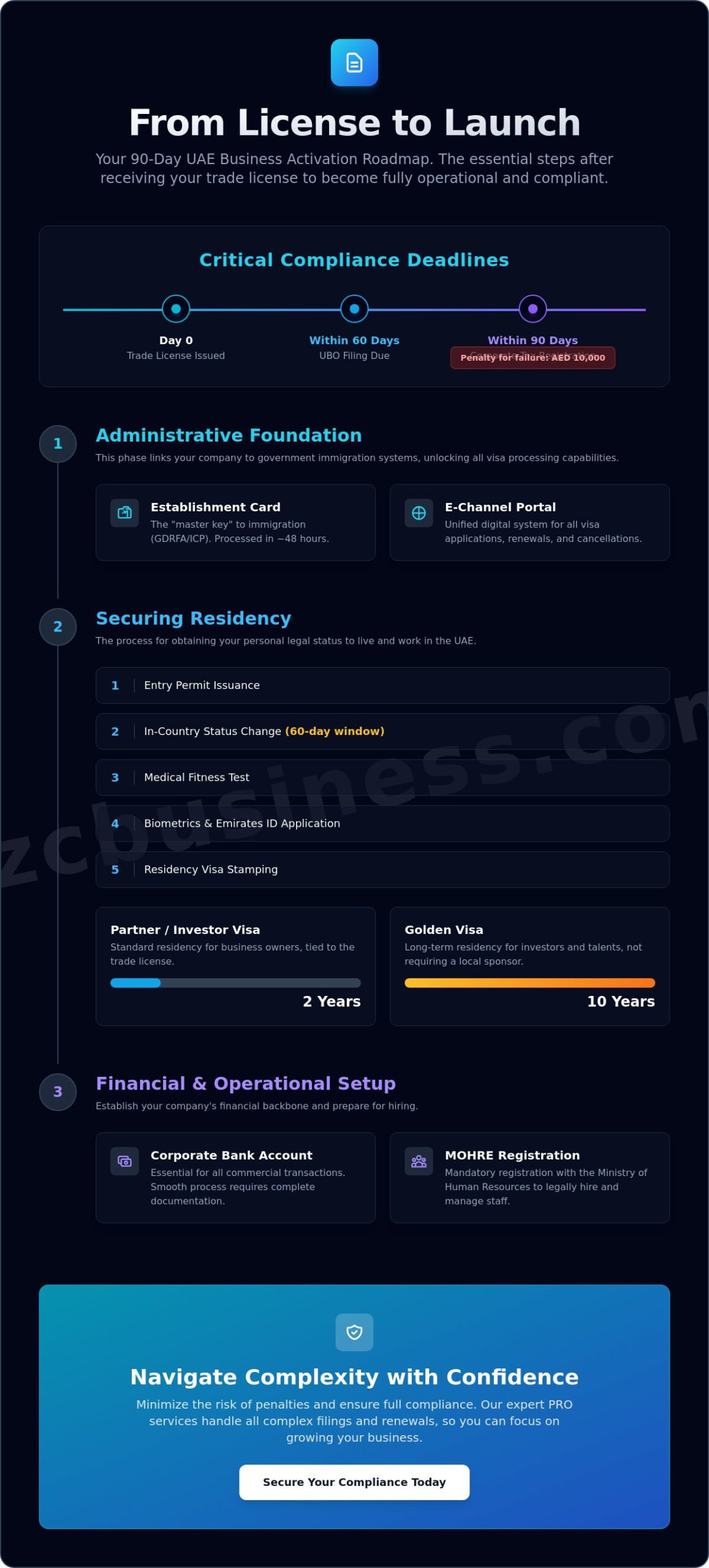
Your trade license is a commercial green light, but it doesn’t grant you the power to sponsor staff or bring partners into the country. This is the most common point of confusion for new founders. To move forward, you must build an administrative bridge to the UAE’s immigration systems. In 2026, the digital linkage between the Department of Economy and Tourism (DET) and immigration authorities is faster than ever, yet it requires manual activation of specific portals. If you’re wondering what to do after getting uae trade license, your first priority is the Establishment Card. Without it, your company effectively doesn’t exist in the eyes of the General Directorate of Residency and Foreigners Affairs (GDRFA) or the Federal Authority for Identity, Citizenship, Customs and Port Security (ICP).
While you focus on administrative setup, keep in mind that the UAE Corporate Tax regime now requires registration within 90 days of your license issuance. Missing this deadline results in a fixed AED 10,000 penalty, making early operational compliance a financial necessity. Digital transformation in 2026 means government systems now track these deadlines automatically. You don’t have the luxury of waiting until your first audit to get your paperwork in order.
To better understand the foundational role of your license, watch this helpful video:
Obtaining Your Establishment Card (Immigration Card)
The Establishment Card is the document that links your company to the immigration department. If your business is in Dubai, you’ll deal with the GDRFA; for other Emirates, it’s the ICP. You’ll need to submit your trade license, Memorandum of Association (MOA), and passport copies of all partners. In 2026, most of this process is handled through digital smart apps, often resulting in approval within 48 hours. This card is the “master key” for all future visa processing, so any errors here will halt your entire operation.
Activating the E-Channel Portal
Once your Establishment Card is ready, you must register for the E-Channel portal. This unified system streamlines all visa applications, renewals, and cancellations into one digital interface. Registration involves a mandatory deposit and setup fees, which vary depending on whether you’re a Mainland or Free Zone entity. Ensure your registered mobile number is linked correctly for OTP verifications, as this is the primary security layer for all transactions. Our team at Fast Zone Business provides expert guidance to ensure these portals are activated quickly, preventing costly delays in your residency timeline.
Securing Residency: The Visa and Emirates ID Process
Securing your residency is the most personal milestone in your business journey. While your company now exists on paper, your legal status as a resident is what allows you to sign contracts, rent a home, and access local services. If you’re already in the country on a tourist or cancelled visa, you have a strict 60-day window to complete your status adjustment once your entry permit is issued. Managing this timeline effectively is a critical part of what to do after getting uae trade license to avoid overstay fines that accrue daily. Knowing what to do after getting uae trade license regarding your visa hierarchy also ensures you don’t overpay for the wrong permit type.
The UAE offers a hierarchy of residency options tailored to your role. Most founders opt for an Investor or Partner visa, which typically grants a two-year residency period. However, for those seeking long term stability, the UAE Golden Visa provides a 10-year residency pathway without the need for a local sponsor. This option is increasingly popular for high-value investors and talented professionals who want to decouple their residency from their specific trade license. Understanding which path fits your five-year plan is essential before you begin the formal Visa and Emirates ID process.
The 5-Step Residency Sequence
The process begins with the Entry Permit, followed by a “Change of Status” if you are currently inside the UAE. Once this is processed, you must undergo a medical fitness test. In 2026, VIP medical services can provide results in as little as four hours, while standard services usually take 24 to 48 hours. Following the medical, you’ll attend a biometrics appointment at the Federal Authority for Identity and Citizenship (ICP). The final steps include the issuance of your digital residency and the delivery of your physical Emirates ID. In 2026, the fee for a new Emirates ID card valid for two years is AED 370. This card is your primary identification for everything from opening a utility account to registering a vehicle.
Sponsoring Dependents and Family Members
Once your own residency is finalized, you can begin sponsoring your family. This requires a registered tenancy contract, known as Ejari, and proof of a stable income. You must also provide mandatory health insurance for all dependents, a legal requirement in Dubai and Abu Dhabi. Because the documentation for family visas involves marriage and birth certificate attestations, many founders find that a professional PRO service is indispensable for avoiding administrative rejections. If you want to ensure your family’s transition is as smooth as your business setup, consider a free consultation to review your specific requirements.
Financial and Tax Compliance: Banking and FTA Registration
Once you’ve secured your residency, the next critical phase of what to do after getting uae trade license involves activating your financial engine. Without a corporate bank account and tax registration, your business can’t legally invoice clients or pay vendors. In 2026, the UAE’s financial landscape is highly regulated, making banking the most significant operational hurdle for new founders. You’re no longer just setting up; you’re entering a strict compliance environment where every transaction must be transparent.
The UAE government’s digital transformation means that the Federal Tax Authority (FTA) and banking systems are increasingly linked. This integration allows for real-time monitoring of business activity, which is why your financial foundation must be flawless from day one. Missing a registration deadline or failing a bank’s compliance check can stall your operations for months. Expert guidance at this stage isn’t just helpful; it’s a safeguard against the steep penalties that now apply to administrative oversight.
Corporate Bank Account Opening in 2026
Banks in the UAE have intensified their “Know Your Customer” (KYC) requirements. To secure an account, you must present a comprehensive file that includes your business plan, proof of residency, and clear evidence of your source of funds. Your choice of office impacts this process. While digital banks offer a smooth experience with onboarding typically completed in 5 to 10 business days, traditional Tier-1 banks often require a physical office lease and can take 4 to 8 weeks for approval. You’ll find a detailed breakdown of the documentation needed in our Corporate Bank Account UAE guide.
Registering with the Federal Tax Authority (FTA)
The most vital step in what to do after getting uae trade license today is registering for Corporate Tax. For any business incorporated from March 1, 2024, onward, the registration deadline is exactly 3 months from the date of incorporation. It’s a common mistake to wait until the end of the financial year. If you miss this window, you’ll face a fixed penalty of AED 10,000. This registration is mandatory even if your revenue is currently zero.
Value Added Tax (VAT) is another layer of compliance you must monitor. Registration becomes mandatory once your taxable supplies and imports exceed AED 375,000 per year. However, you can opt for voluntary registration at the AED 187,500 threshold, which allows you to reclaim VAT on setup expenses. In 2026, a standard corporate tax rate of 9% applies to taxable income over AED 375,000, though Small Business Relief remains available for companies with gross revenue below AED 3 million until December 31, 2026. Implementing a robust accounting system now ensures you’re ready for mandatory filings and potential FTA audits.
Operational Setup: MOHRE Registration and Office Requirements
Once your financial foundation is set, your focus must shift to the human and physical elements of your business. Having a bank account and tax registration is vital, but you can’t legally hire staff without registering with the Ministry of Human Resources and Emiratisation (MOHRE). This is a critical phase in the list of what to do after getting uae trade license. MOHRE acts as the regulator for the UAE’s private sector labor market, ensuring all employment follows the UAE Labour Law. Failing to maintain these records can lead to significant operational blocks, such as the inability to renew permits or hire new talent.
Your physical presence is equally important. For mainland companies, this means securing an Ejari, which is a registered tenancy contract. Free Zone entities require a valid lease agreement from their specific authority. If your business involves the movement of goods, you also need to register for a Customs Code with the local customs authority. These steps transform your company from a legal entity into a functional workplace. If the complexity of labor files and utility activations feels overwhelming, our expert PRO services can handle the entire administrative load for you.
Hiring Your First Employee
Opening your MOHRE file is the first step toward building your team. This file establishes your quota, which is the number of visas your company is permitted based on your office size. You must use the Wage Protection System (WPS) to pay salaries. This digital platform allows the government to monitor that employees are paid on time and in full. Additionally, all employees must now have Involuntary Loss of Employment (ILOE) insurance. Be mindful of deadlines. Failing to renew a labor card within 60 days of expiry results in a fine of AED 500, with further monthly penalties of AED 200. MOHRE work permit fees range from AED 250 to AED 3,450, depending on the skill level of the staff member.
Physical Workspace and Utilities
Your office is more than just a place to work; it’s a compliance requirement. Once your lease or Ejari is signed, you must activate your utility accounts, such as DEWA in Dubai. This activation is often a prerequisite for your final Establishment Card approval and bank account verification. If you’re fitting out a new office, you’ll need specific permits and Civil Defence approvals to ensure the space meets safety standards. While many start with a “Flexi-desk” in a Free Zone, growing your team often necessitates a transition to a permanent office. Understanding what to do after getting uae trade license regarding your workspace ensures you stay ahead of these logistical needs.
Maximizing Growth: Why Post-License PRO Services Matter
Focusing on growth while managing bureaucracy is a balancing act most founders fail. The first three months are often a “dead zone” where you pay rent but can’t trade if your paperwork stalls. Understanding what to do after getting uae trade license involves more than just a checklist; it requires a long-term compliance partner. At Fast Zone Business, we bridge the gap between receiving your license and reaching full operational capacity. Our expert guidance ensures you move through these hurdles without the friction that usually slows down new ventures.
The financial stakes in 2026 are exceptionally high. For instance, failing to register for corporate tax within your first 90 days results in a fixed AED 10,000 penalty. Additionally, missing the 60-day deadline for Ultimate Beneficial Ownership (UBO) filings can trigger fines starting at AED 50,000. These aren’t just theoretical threats; they’re automated penalties in the UAE’s digital-first government system. Expert PRO services ensure these dates never slip through the cracks, protecting your capital for actual business investment.
The Fast Zone Advantage
We act as your one-stop destination for both mainland and free zone support. Our team provides direct access to government portals, ensuring your labor ban removals, partner visa cancellations, and license renewals happen without delay. You don’t need to waste time learning the nuances of the 2026 corporate tax laws or the intricacies of MOHRE quotas. We customize our services to your specific business stage, allowing you to focus on your core business goals while we handle the complex government relations and banking requirements.
Your 90-Day Success Checklist
To become fully operational without setbacks, follow this specific timeline. In the first 30 days, secure your Establishment Card and initiate your corporate bank account opening. By day 60, ensure your UBO data is filed and your partner visas are issued. By day 90, you must complete your Corporate Tax registration with the Federal Tax Authority (FTA). This sequence is the definitive answer to what to do after getting uae trade license to avoid the common pitfalls of the initial setup phase.
Don’t let administrative hurdles slow your momentum. To ensure a smooth experience and total compliance with the latest 2026 regulations, Book a FREE Consultation with Fast Zone today and let our experts guide your operational roadmap.
Launch Your UAE Business with Confidence
Your trade license is the foundation, but your operational success depends on the speed and accuracy of your next steps. Moving from a legal entity to a functional business requires securing your Establishment Card, finalizing residency visas, and meeting strict 2026 tax deadlines. We’ve seen how missing the 90-day corporate tax registration window triggers an automatic AED 10,000 penalty. Staying compliant isn’t just about following rules; it’s about protecting your initial investment and ensuring your company is ready to trade without interruption.
Knowing exactly what to do after getting uae trade license ensures your first year is defined by growth rather than administrative delays. Fast Zone Business has already supported over 1,000 entrepreneurs in navigating this complex landscape. Our expert PRO team maintains direct links to government departments to provide you with a smooth, hassle-free experience for banking and tax setup. We handle the bureaucratic hurdles so you can focus on your core business goals. Take the final step toward full operational status and Book Your FREE Post-License Consultation with Fast Zone today. We’re ready to help you build your legacy in the UAE.
Frequently Asked Questions
How long does it take to get an Establishment Card after the trade license?
It typically takes 1 to 3 business days to receive your Establishment Card once the application is submitted. This card is essential because it registers your company with the immigration authorities, such as the GDRFA or ICP. Without it, you can’t proceed with visa applications or status adjustments for partners or employees.
Can I open a corporate bank account with just a virtual office?
Yes, you can open an account with a virtual office, but your options are usually limited to digital banks. Traditional Tier-1 banks in the UAE often require a physical office lease as part of their strict “Know Your Customer” (KYC) protocols. Digital banks typically complete onboarding in 5 to 10 business days for virtual office holders.
Is Corporate Tax registration mandatory for Free Zone companies in 2026?
Yes, Corporate Tax registration is mandatory for all companies, including those in Free Zones, regardless of their turnover. You must register within 3 months of your license issuance date to avoid a fixed AED 10,000 penalty. Even if you qualify for “Small Business Relief” or a 0% rate, the registration requirement remains a legal necessity.
What happens if I don’t apply for a visa within 60 days of getting my license?
If you’re already in the UAE, you must complete your status adjustment within 60 days to avoid daily overstay fines. Failing to manage this timeline is a common mistake when entrepreneurs aren’t sure what to do after getting uae trade license. Missing this window can lead to legal complications and additional government fees during the residency process.
Do I need a physical office to hire employees in Dubai?
Yes, a physical office is generally required to hire staff because your visa quota is linked to your workspace square footage. Most authorities allocate approximately one visa for every 9 to 10 square meters of office space. While some Free Zones offer “Flexi-desk” packages with limited visa allocations, a permanent office is necessary for larger teams.
What is the difference between VAT and Corporate Tax registration?
VAT is a 5% consumption tax on taxable supplies, while Corporate Tax is a 9% tax on business profits exceeding AED 375,000. You must register for VAT only if your turnover exceeds AED 375,000 per year. In contrast, Corporate Tax registration is a mandatory administrative step for every new business, regardless of income level.
Can I start trading immediately after receiving my trade license?
You can legally sign contracts and market your services, but full operations require a corporate bank account to process payments. Part of what to do after getting uae trade license involves setting up these financial channels properly. You should also ensure your tax registration is underway so your first invoices are compliant with UAE Federal Tax Authority standards.
How do I register for the Wage Protection System (WPS)?
You register for WPS by opening a corporate account with a UAE bank or a certified exchange house. Once your MOHRE file is active, you must transfer employee salaries through this system to ensure compliance with labor regulations. The government monitors these transfers to verify that staff are paid according to their registered employment contracts.
