

UK Entrepreneur Moving Business to Dubai: The 2026 Relocation Guide
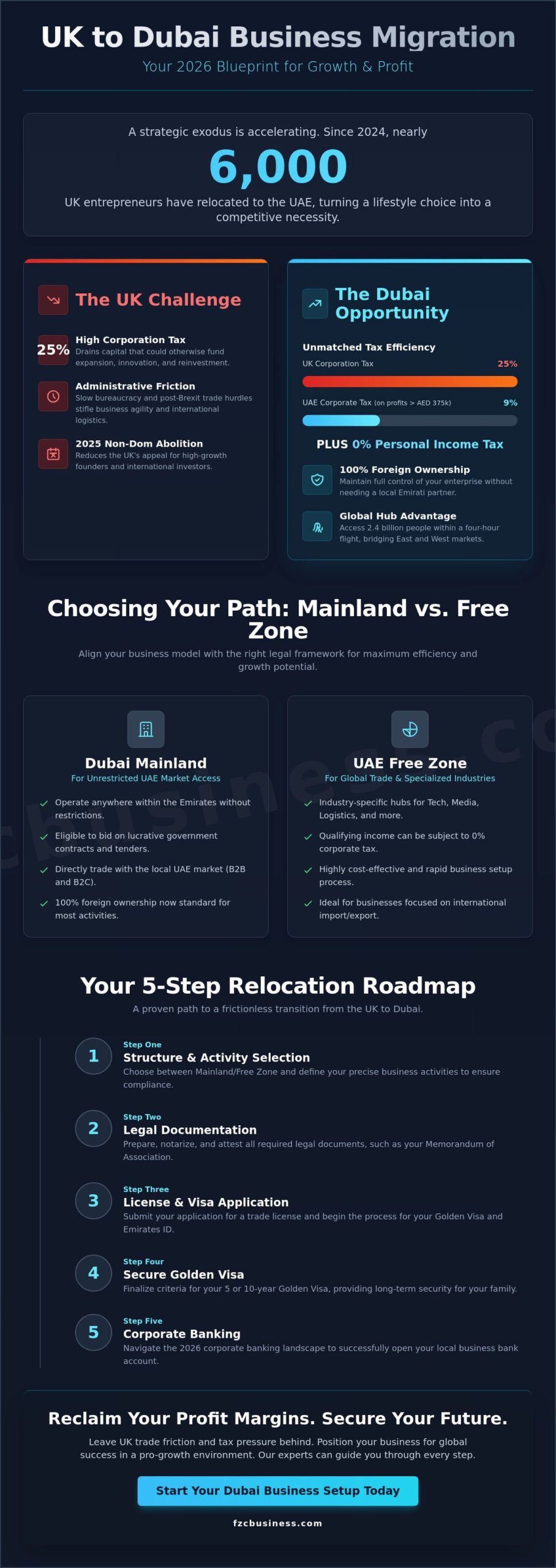
With nearly 6,000 UK entrepreneurs relocating to the UAE since 2024, the move to the Middle East has evolved from a tax-saving “hack” into a vital competitive necessity. You’ve likely felt the weight of the UK’s 25% corporation tax and the administrative friction that slows down your growth. For a uk entrepreneur moving business to dubai, these challenges are replaced by a pro-growth environment where 100% foreign ownership is the standard and personal income tax remains at 0%.
This 2026 relocation guide provides the clear, actionable blueprint you need to reclaim your profit margins and secure a 10-year Golden Visa for your family. We’ll explore the strategic choice between Mainland and Free Zone formations, how to optimize your position under the 9% UAE corporate tax rate, and the specific steps to ensure a frictionless transition. From opening corporate bank accounts to managing VAT and corporate tax assistance, you’ll discover how to position your business for global success while leaving UK trade friction and the 2025 non-dom changes behind.
Key Takeaways
- Contrast Mainland and Free Zone structures to identify the most efficient 100% foreign ownership model for your specific industry.
- Understand the 9% corporate tax threshold and VAT requirements to optimize your firm’s financial position within the UAE’s regulatory framework.
- Follow a proven five-step roadmap for a uk entrepreneur moving business to dubai, covering everything from activity selection to legal document attestation.
- Explore the criteria for long-term Golden Visas to provide permanent residency and security for your family and key business partners.
- Gain professional insights into navigating the 2026 corporate banking landscape to ensure your new firm establishes local financial operations without delay.
The UK to Dubai Business Migration: Why 2026 is the Pivot Year
The decision for a uk entrepreneur moving business to dubai has transitioned from a lifestyle choice to a calculated strategic necessity. By 2026, the “Great British Exodus” has reached a tipping point. Recent data shows that over 2,500 UK companies registered in Dubai in 2024 alone, marking a 14.2% increase from the previous year. This migration is fueled by a desire to escape the administrative friction of the post-Brexit UK and tap into the UAE’s aggressive D33 economic agenda, which seeks to double Dubai’s GDP by 2033.
To better understand the motivations behind this shift, watch this helpful overview:
The Push Factors: UK Tax and Regulatory Pressure
British business owners are currently operating in one of the most challenging fiscal environments in decades. The 25% Corporation Tax rate continues to drain capital that could otherwise fund expansion. Coupled with the April 2025 abolition of the non-domicile tax regime, the UK’s appeal for high-growth founders has diminished. Brexit-related trade friction remains a persistent hurdle, making international logistics slower and more expensive than ever before. For many, the UK has become a landscape of “friction” where slow administration and high costs stifle business agility.
The Pull Factors: Why Dubai is the Preferred Destination
Dubai offers an empowering alternative built on efficiency and global connectivity. It serves as a strategic bridge between East and West, allowing firms to reach 2.4 billion people within a four-hour flight. The UAE government’s commitment to a digital-first approach means you can manage Mainland Company Formation or explore various UAE Free Zones with unprecedented speed. The transition for a uk entrepreneur moving business to dubai is supported by a pro-business infrastructure that values growth over bureaucracy.
The incentives for relocation are tangible and immediate:
- Tax Efficiency: A 0% personal income tax rate and a competitive 9% corporate tax on profits exceeding AED 375,000.
- Long-term Security: Access to 5 or 10-year Golden Visas for investors and their families.
- Operational Clarity: 100% foreign ownership is now standard across most sectors, removing the need for local partners.
In this environment, founders focus on their core objectives rather than navigating bureaucratic hurdles. Dubai isn’t just a tax haven; it’s a high-performance hub for the next generation of global commerce.
Evaluating Your Structure: Mainland vs Free Zone for UK Firms
Selecting the right legal framework is the most critical decision for any uk entrepreneur moving business to dubai. This choice dictates your ability to trade locally, your tax obligations, and the efficiency of your financial operations. In the past, the distinction between jurisdictions was rigid, but recent reforms have created a more flexible environment for foreign founders. You must align your choice with your specific business model to avoid unnecessary administrative friction later.
Dubai Mainland: For Unrestricted UAE Market Access
A Mainland setup is ideal for businesses targeting the local UAE market or bidding for government contracts. Since June 2021, the requirement for a local Emirati sponsor has been abolished for most commercial and industrial activities. This means you maintain 100% control while operating anywhere in the Emirates. If your model involves physical retail or local B2B services, Business Setup in Dubai Mainland provides the necessary infrastructure for long-term growth without geographic restrictions.
UAE Free Zones: The UK Entrepreneur’s Favourites
Free Zones are dedicated jurisdictions tailored to specific industries like tech, media, and logistics. UK founders often gravitate toward hubs like the International Free Zone Authority (IFZA) or SHAMS for their cost-efficiency and rapid setup times. These zones offer 0% corporate tax on qualifying income and simplified customs procedures. When reviewing a guide to setting up a business in Dubai, you’ll find that Free Zones are often the fastest entry point for service-based consultants and digital nomads. For more detailed insights, explore Free Zone Company Setup in the UAE to compare specific zone benefits.
Strategic Considerations: Dual Licensing and Banking
For companies that require a Free Zone’s international benefits but also need to operate on the Mainland, “Dual Licensing” has become a popular solution. This allows a Free Zone entity to obtain a Mainland permit without establishing physical office space in both areas. It’s an efficient way to bridge the gap between global trade and local service delivery.
Your choice of jurisdiction directly impacts your financial setup. UAE banks maintain strict compliance standards; Free Zone companies often face more rigorous scrutiny during Corporate Bank Account Opening than their Mainland counterparts. Ensuring your business activity aligns perfectly with your license is the first step toward a seamless transition. If you’re unsure which path fits your 2026 goals, you can request a professional structure assessment to clarify your options before you begin the application process.
The 5-Step Roadmap to Relocating Your UK Enterprise
Transitioning for a uk entrepreneur moving business to dubai requires a methodical sequence to avoid operational downtime or legal delays. While the UAE offers a pro-growth environment, the administrative steps must be completed in a specific order to satisfy both local regulations and international compliance standards. Success depends on moving beyond the “idea” phase into a structured execution plan that covers everything from your trade name to your first local transaction.
Navigating Document Attestation in the UK
The most common bottleneck for British founders occurs before they even leave the UK. Any corporate or personal documents, such as degree certificates or Articles of Association, must undergo a multi-stage legalization process. This starts with certification by a UK solicitor, followed by an apostille from the Foreign, Commonwealth & Development Office (FCDO). The final step is attestation by the UAE Embassy in London. Skipping any part of this chain will stall your application once you arrive in Dubai. According to the UK Government guide to doing business in the UAE, legalizing these documents is a prerequisite for most residency and licensing activities.
Initial Approval and Trade Licence Issuance
Once your documents are in order, you’ll apply for initial approval from the relevant authority, whether it’s the Department of Economy and Tourism (DET) for Mainland or a specific Free Zone. During this stage, you’ll draft your Memorandum of Association (MOA), which defines your firm’s operational boundaries and ownership structure. For a detailed breakdown of this phase, consult our A Complete Step-by-Step Guide on how to start a business in Dubai. This stage typically takes between three to seven working days, depending on the complexity of your business activities.
The final steps of the roadmap involve moving from corporate setup to personal residency and financial integration:
- Visa Processing: After your license is issued, you’ll apply for an entry permit, followed by a medical fitness test and biometrics for your Emirates ID.
- Corporate Bank Account Opening: Banks in 2026 require a physical Emirates ID and a valid trade license before they begin the KYC (Know Your Customer) process.
- Ongoing PRO Services: Many entrepreneurs overlook the need for a government liaison. Professional PRO Services handle your labor contracts, visa renewals, and annual license updates so you can focus on scaling.
Establishing your firm is only the beginning. Maintaining compliance through expert VAT and Corporate Tax Assistance ensures that your UK-to-Dubai transition remains profitable and sustainable for the long term. By following this roadmap, you replace administrative guesswork with a clear, professional path to market entry.
Tax Efficiency and Compliance: Navigating the UK-UAE Corridor
The fiscal transition for a uk entrepreneur moving business to dubai represents a significant shift from the UK’s 25% corporation tax to a more competitive framework. While the UAE remains a low-tax jurisdiction, the 2026 landscape requires precise compliance with the Federal Tax Authority (FTA). Understanding the interplay between UAE regulations and HMRC’s exit requirements is essential to protect your global assets and avoid double taxation. Success in this area relies on moving beyond the “tax-free” myth and embracing a structured compliance strategy.
Corporate Tax and VAT Compliance
The UAE federal corporate tax is set at a standard rate of 9% on taxable profits exceeding AED 375,000. This threshold ensures that startups and smaller enterprises remain largely exempt, while larger firms benefit from a rate that is still less than half of the UK’s main rate. Additionally, small business relief may apply to companies with annual revenues below AED 3 million, potentially reducing the tax liability to zero.
VAT registration becomes mandatory once your taxable supplies and imports exceed AED 375,000 per annum. You must maintain rigorous accounting records to satisfy FTA audits. Many founders find that managing these obligations alone leads to administrative delays. Securing professional VAT and Corporate Tax Assistance ensures your filings are accurate and your business remains in good standing with local authorities.
Managing Your UK Tax Exit
Relocating your operations doesn’t automatically sever your ties with HMRC. You must demonstrate that the “mind and management” of your company has truly shifted to Dubai. This means board meetings, strategic decisions, and day-to-day operations should occur within the UAE to avoid the UK claiming your firm is still a tax resident.
On a personal level, you must navigate the Statutory Residence Test (SRT) to confirm your non-resident status. Under the UK Statutory Residence Test, you’re generally considered a tax resident if you spend 183 or more days in the country during a single tax year. Beyond this day count, factors like available accommodation and work ties in the UK can also impact your status. The 2016 UK-UAE Double Taxation Agreement serves as a vital safeguard, preventing you from being taxed on the same income in both countries. However, proactive planning is required to trigger these protections correctly.
If you’re ready to optimize your international tax position, you can consult our specialists for a compliance review to ensure your setup meets all 2026 regulatory standards.
Securing Your Future: Golden Visas and Corporate Banking
Establishing a trade license is the first step; securing your long-term residency and financial infrastructure is what ensures your business thrives. For a uk entrepreneur moving business to dubai, the transition often involves more than just a corporate entity. It requires a stable foundation for your family and a reliable banking partner that understands international trade. By 2026, the UAE has streamlined these processes, but they still require a strategic approach to avoid the common pitfalls of regional compliance.
The Golden Visa for Entrepreneurs
The UAE Golden Visa offers a 10-year renewable residency that provides unprecedented security for British investors. To qualify, you generally need a company with a minimum share capital of AED 500,000 and an endorsement from a recognized UAE authority. This visa allows you to live, work, and study in the UAE without the need for a local sponsor. It also provides the flexibility to remain outside the UAE for longer than the standard six-month limit without losing your residency status. Fast Zone Business simplifies this by managing your entire Golden Visa Application, ensuring all documentation meets the specific requirements of the immigration authorities.
Activating Your Corporate Bank Account
Opening a business account is often cited as the most challenging stage of relocation. UAE banks have rigorous Know Your Customer (KYC) protocols to maintain their standing in the global financial system. You’ll need your trade license, Emirates ID, and a clear business plan to approach top-tier institutions like Emirates NBD or Mashreq. Our Corporate Bank Account UAE Guide provides a detailed checklist of the documents required for UK-owned entities. We work directly with banking partners to help you overcome the “high-risk” hurdles often associated with new foreign-owned firms.
Relocating Your Team and Family
A significant gap in many relocation guides is the logistics of moving an existing UK team. If you’re bringing key employees from London to Dubai, you’ll need to manage their entry permits, medical tests, and labor contracts. This is where professional PRO Services become invaluable. We handle the administrative burden of sponsoring your staff, as well as your family and domestic help. This allows you to maintain your core team’s productivity while we navigate the government portals and labor regulations.
Your journey doesn’t end with a stamped visa. Ongoing compliance, from Company Renewal to managing labor ban removals, requires a dedicated partner on the ground. By integrating your banking, residency, and team relocation into a single strategy, you ensure a frictionless move that protects your interests and your people. If you’re ready to secure your 10-year residency and activate your local banking, contact our expert team today for a comprehensive consultation.
Launch Your Dubai Enterprise with Confidence
The transition from the UK’s restrictive fiscal environment to Dubai’s pro-growth landscape is a strategic move that defines your business’s future. You’ve seen how the 2026 economic shift makes this the ideal time to pivot. By selecting the correct Mainland or Free Zone structure and following a verified roadmap, you eliminate the administrative friction that often stalls international expansion. Navigating the 9% corporate tax threshold and securing a 10-year Golden Visa provides the long-term stability your family and firm deserve.
Expert guidance is the key to a frictionless relocation. As specialists in UK-to-UAE business migration, we provide the comprehensive PRO and Visa support necessary to handle government relations on your behalf. We also offer direct assistance with UAE bank account opening to ensure your financial operations are active from day one. Start your seamless UK to Dubai transition with a free expert consultation at Fast Zone Business and focus on your core objectives while we manage the regulatory complexity. Your journey as a uk entrepreneur moving business to dubai deserves a partner that prioritizes speed, clarity, and results. Your global future is within reach.
Frequently Asked Questions
Do I need to close my UK company to move to Dubai?
No, you aren’t required to close your UK entity. You can operate the Dubai firm as a subsidiary, a branch, or a completely separate entity. However, a uk entrepreneur moving business to dubai must ensure the “mind and management” of the Dubai firm is actually in the UAE to avoid UK tax residency issues. You should evaluate if keeping the UK firm open creates unnecessary liabilities under current HMRC rules.
Can I still trade with UK clients if my business is based in Dubai?
Yes, you can trade with UK clients without restriction. There are no barriers to exporting services or goods back to the UK from a UAE base. You must ensure your invoices reflect your UAE entity’s details and comply with any VAT regulations if you’re supplying services to UK-based consumers. The 2016 Double Taxation Agreement helps prevent being taxed twice on this international income.
How much does it cost to move a UK business to Dubai in 2026?
Total costs vary based on your chosen jurisdiction and visa requirements. You’ll need to account for trade license fees, mandatory health insurance, document attestation in London, and Emirates ID processing. While specific fees for Mainland and Free Zones differ, you should also budget for physical or virtual office space and the initial capital required for corporate banking. Professional fees for formation and PRO services are additional considerations for a seamless transition.
Will I lose my UK citizenship if I get a UAE residency visa?
No, obtaining a UAE residency visa or Golden Visa has no impact on your British citizenship. The UAE residency is a permit to live and work in the country; it is not a grant of nationality. You’ll remain a UK citizen and hold your British passport while enjoying the benefits of living in Dubai. Many British expats maintain their citizenship while living abroad for decades under various residency schemes.
What is the minimum investment required for a Golden Visa?
Entrepreneurs typically need a minimum company share capital of AED 500,000 to qualify for the 10-year Golden Visa. You also require an endorsement from an approved UAE free zone or business incubator. This long-term residency allows you to sponsor your family and domestic staff without a separate corporate sponsor. It provides a stable, renewable base for successful business owners looking for permanent security in the region.
How long does the entire business setup process take for a UK citizen?
The digital infrastructure in the UAE allows for rapid company formation, often resulting in a trade license being issued within a few working days. However, the full process, including document attestation in the UK and visa processing, usually takes between three to four weeks. Opening a corporate bank account is the final step and can take several additional weeks due to mandatory KYC and compliance checks required by local financial institutions.
Can I move my existing UK employees to my new Dubai office?
Yes, you can relocate your UK staff by sponsoring their employment visas through your new UAE entity. Each employee will need to undergo a medical fitness test and obtain an Emirates ID once they arrive. You’ll be responsible for their visa costs and mandatory health insurance as their employer. This is a common strategy for a uk entrepreneur moving business to dubai who wants to maintain operational continuity with a trusted team.
What are the main tax differences between the UK and UAE in 2026?
The primary difference is the corporate tax rate; the UK charges 25% while the UAE applies a 9% rate on profits exceeding AED 375,000. Additionally, the UAE offers 0% personal income tax and 0% capital gains tax. While the UK abolished the non-domicile regime in April 2025, the UAE continues to provide a low-tax environment for global earnings. You’ll still need to navigate the UK’s Statutory Residence Test to confirm your non-resident status.
