

UAE Labor Law for Small Business 2026: A Compliance Guide for Entrepreneurs
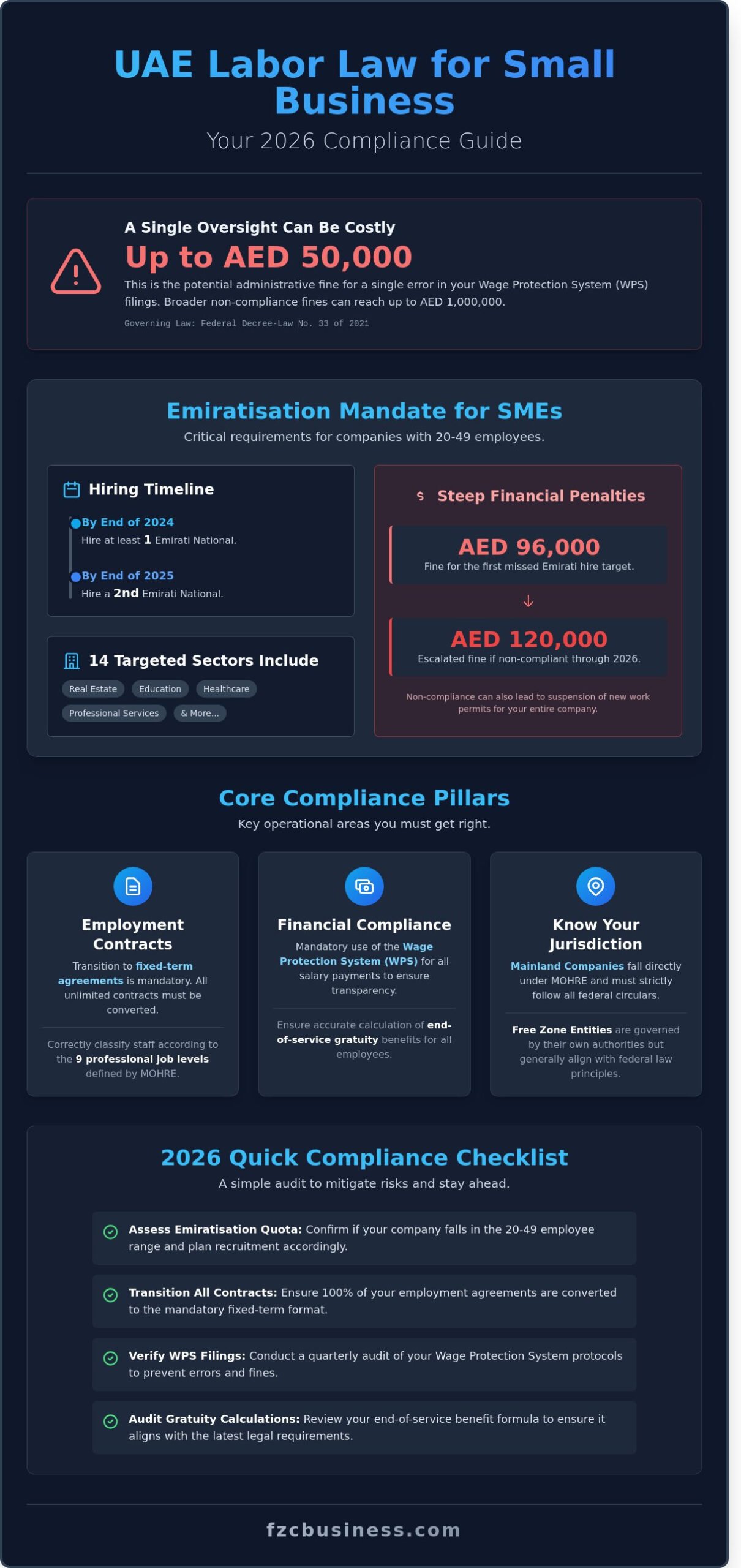
A single oversight in your Wage Protection System (WPS) filings could cost your small business up to AED 50,000 in administrative fines before you even realize the error. You likely launched your venture to innovate and scale, not to spend your nights decoding the latest Ministry of Human Resources and Emiratisation (MOHRE) updates. We understand that the pressure to meet 2026 Emiratisation targets while managing diverse contract types feels overwhelming for a lean team.
Our expert guidance simplifies the uae labor law for small business 2026 to ensure your operations remain smooth and penalty-free. By following this compliance guide, you’ll gain the clarity needed to protect your capital and focus on your core business goals. We’ll break down the 2026 minimum wage requirements, provide a step-by-step roadmap for legal hiring, and explain exactly how to calculate end-of-service benefits without the typical bureaucratic headache.
Key Takeaways
- Gain expert guidance on navigating Federal Decree-Law No. 33 of 2021 and MOHRE updates to ensure a smooth, compliant experience for your growing enterprise.
- Prepare for the 2026 Emiratisation expansion by understanding the specific “1-2 Emirati” hiring requirements for companies with 20 to 49 employees.
- Protect your operations by transitioning to fixed-term agreements and correctly classifying staff according to the nine professional job levels defined by the state.
- Ensure financial compliance by mastering mandatory Wage Protection System (WPS) protocols and accurate end-of-service gratuity calculations in AED.
- Discover how to use a quarterly audit checklist to mitigate risks and stay ahead of the uae labor law for small business 2026 requirements.
Understanding the UAE Labor Law Landscape in 2026
The UAE labor market has undergone a massive shift since the introduction of Federal Decree-Law No. 33 of 2021. By 2026, the grace periods for many transitional provisions have ended, making uae labor law for small business 2026 a critical topic for every founder. The Ministry of Human Resources and Emiratisation (MOHRE) now uses advanced digital systems to track compliance in real-time. You can’t afford to ignore these updates if you want a smooth experience operating in the region.
2026 is pivotal because the government has intensified its focus on private sector stability and digital integration. Small businesses often feel the weight of these regulations more than corporate giants because they lack dedicated HR departments. Understanding these rules ensures your venture stays operational and avoids heavy fines. For instance, administrative fines for non-compliance can range from AED 5,000 to AED 1,000,000 depending on the severity of the violation.
The Core Legal Framework
The unified labor law governs all private sector entities, creating a standardized environment for talent. It balances employer rights with strong employee protections, covering aspects like fixed-term contracts and diverse work models. In 2026, MOHRE circulars are the primary source for operational updates. These documents clarify everything from probation period rules to specific termination notice requirements. Staying updated with these circulars is the only way to maintain expert guidance within your own team and ensure a hassle-free workplace.
Small Business vs. Large Enterprise Rules
A small business in the UAE typically refers to an entity with fewer than 50 employees. While larger firms face strict Emiratisation quotas under the Nafis program, smaller teams have different reporting cycles and specific exemptions regarding certain welfare facilities. However, small businesses aren’t exempt from core mandates like the Wage Protection System (WPS). Early compliance is vital. It prevents future mainland company formation hurdles during license renewals or visa processing. We’ve seen that proactive entrepreneurs save an average of 20% in operational costs by avoiding late-filing penalties.
Understanding the distinction between jurisdictions is also essential for uae labor law for small business 2026 compliance:
- Mainland Companies: These fall directly under MOHRE jurisdiction and must follow every federal circular strictly.
- Free Zone Entities: These are governed by their respective authorities, such as DIFC or ADGM. While they have their own employment regulations, they generally align with the federal decree’s core principles.
Our in-depth knowledge of these regulations helps you focus on growth while we handle the bureaucratic complexities. Whether you’re managing a team of three or thirty, staying aligned with the 2026 updates is the foundation of a successful UAE enterprise.
Emiratisation for Small Businesses: The 20-49 Employee Rule
Small business owners often overlook Emiratisation, but the 2026 landscape changes everything. Under the updated uae labor law for small business 2026, companies with 20 to 49 employees face strict hiring mandates. This isn’t just for large corporations anymore. The Ministry of Human Resources and Emiratisation (MoHRE) requires these smaller firms to hire at least one Emirati in 2024 and a second by the end of 2025. By the start of the 2026 calendar year, your firm must maintain this headcount or face steep financial penalties. Failing to meet these targets results in a fine of AED 96,000 for the first missing position, which escalates to AED 120,000 if the vacancy remains unfilled through 2026.
The government’s expansion into smaller enterprises aims to integrate 12,000 Emiratis into the private sector annually. For a small business, this transition requires careful planning of recruitment cycles. You can’t wait until the final quarter of the year to begin your search. The 2026 deadline is firm, and the digital systems at MoHRE automatically flag non-compliant licenses, which can lead to a suspension of new work permits for your entire staff.
The 2026 Quota Targets
The expansion specifically targets 14 economic sectors. These include real estate, education, healthcare, and professional services. If your workforce falls within the 20 to 49 range, you’re legally obligated to integrate UAE nationals into your team. You can calculate your requirement by checking your total registered staff on the MoHRE portal. The Nafis program provides a vital bridge here. It offers salary subsidies and pension support, making it financially viable for small businesses to recruit local talent. Meeting these targets by the December 31, 2026, deadline is essential to avoid digital blocks on your company’s portal.
Minimum Wage for Emiratis in 2026
Compliance involves more than just hiring; it’s about meeting specific financial thresholds. The UAE government has established a minimum monthly wage of AED 6,000 for Emirati employees to qualify for Nafis benefits and count toward your quota. For any new work permits issued in 2026, you must ensure the contract reflects this threshold. Existing Emirati staff must also have their salaries adjusted to meet these standards if they’re currently below the mark. You’ll need to structure your payroll to clearly separate the basic salary from allowances to ensure full transparency during MoHRE audits. Managing these payroll adjustments requires expert guidance to ensure your business stays compliant with the uae labor law for small business 2026 without disrupting your operational cash flow.
Navigating Employment Contracts and Work Arrangements
Compliance with the uae labor law for small business 2026 requires a clear understanding of how contracts are structured. The UAE has fully transitioned away from unlimited contracts to fixed-term agreements. These contracts must specify a clear start and end date, though they can be renewed indefinitely upon mutual agreement. This shift provides entrepreneurs with better clarity regarding end-of-service gratuity and termination protocols.
Small business owners must also categorize staff into one of the nine professional levels defined by the Ministry of Human Resources and Emiratisation (MOHRE). Level 1 covers managers and executives, while Level 9 includes unskilled workers. Accurate classification is vital because it dictates minimum educational requirements for visa processing and influences Emiratisation quotas. When renewing or amending contracts, you must ensure all changes are registered through the MOHRE portal to remain legally binding. Any unilateral change to contract terms without employee consent can lead to significant fines, which often start at AED 5,000 per violation.
Modern Work Models in the UAE
Startups now have access to diverse employment structures that optimize operational costs. Full-time roles remain the standard, but part-time arrangements allow employees to work for multiple entities simultaneously. Flexible work models enable staff to vary their hours or work locations based on business needs. Job sharing is another innovative option where two employees split the responsibilities and pay of a single full-time position. These models provide the hassle-free scalability that modern entrepreneurs need to stay competitive in a fast-moving market.
The Probation Period Framework
The probation period serves as a critical evaluation window for any new hire. Under current regulations, the maximum duration is six months. If you decide to terminate an employee during this phase, you must provide at least 14 days’ written notice. If an employee resigns to join another employer in the UAE, they must give 30 days’ notice. In such cases, the new employer may be required to compensate you for recruitment costs. Understanding the costs associated with hiring employees in Dubai is essential for your budget planning. Fast Zone Business provides expert guidance to ensure your hiring process is efficient and fully compliant with the latest uae labor law for small business 2026 standards.
Financial Compliance: WPS, Gratuity, and Benefits
Financial compliance is the backbone of your operations. Under the uae labor law for small business 2026, you’re required to follow strict protocols for salary disbursements and employee benefits. Failing to meet these standards can lead to work permit suspensions or heavy financial penalties from the Ministry of Human Resources and Emiratisation (MOHRE). You need a clear system to track every dirham and ensure your staff receives their legal entitlements on time.
Mastering the Wage Protection System (WPS)
The WPS is an electronic salary transfer system that monitors wage payments across the private sector. You’ll need to link your payroll to your corporate bank accounts to ensure every payment is logged with the Central Bank. If you miss a payment deadline by more than 15 days, the MOHRE can impose fines of AED 5,000 per employee, reaching a maximum of AED 50,000. It’s vital to process salaries monthly to maintain your company’s legal standing and avoid recruitment blocks.
End-of-Service Gratuity Calculation
Calculating gratuity is a critical task for any entrepreneur. For employees who’ve completed at least one year of service, the 2026 regulations specify 21 days of basic salary for each year of the first five years. After five years, this increases to 30 days of basic salary for every additional year. This calculation is strictly based on the “basic salary” stated in the contract, excluding allowances. You can also opt for the Voluntary Savings Scheme, which allows you to pay monthly contributions into an investment fund instead of a lump sum. This is a proactive way to manage cash flow while staying compliant with the uae labor law for small business 2026.
Insurance and Leave Entitlements
Every employee must have Involuntary Loss of Employment (ILOE) insurance. While the employee typically pays the premium, you’re responsible for verifying their registration. Health insurance remains mandatory for all staff in Dubai and Abu Dhabi. Regarding leave, your team is entitled to 30 calendar days of annual leave after one year of service. Maternity leave has been updated to 60 days total: 45 days at full pay and 15 days at half pay. Sick leave allows for up to 90 days per year, with the first 15 days being fully paid by the employer.
Ensure your business stays compliant and avoids costly fines. Book a FREE consultation with Fast Zone Business to streamline your payroll and benefits management.
Reducing Risk: Compliance Checklist and PRO Support
Staying compliant requires a proactive strategy. Small business owners often feel overwhelmed by the administrative weight of the uae labor law for small business 2026. To mitigate legal risks, you should implement a quarterly audit routine. This ensures every employee file stays updated and every legal obligation is met before government inspections occur. A consistent checklist is your first line of defense against fines that can reach AED 50,000 or more per violation.
- WPS Verification: Confirm that 100% of salaries are paid through the Wage Protection System on time and match the registered contracts.
- Document Expiry: Track work permits and residency visas at least 90 days before they expire to avoid late renewal penalties.
- Insurance Compliance: Ensure health insurance coverage is active for every staff member as per mandatory local regulations in Dubai and Abu Dhabi.
- Record Keeping: Maintain signed copies of overtime logs, leave requests, and disciplinary notices to provide a clear paper trail.
Managing Labor Disputes
Labor disagreements can drain a small company’s resources quickly. The UAE has streamlined the resolution process to protect both parties. For claims valued at AED 50,000 or less, the Ministry of Human Resources and Emiratisation (MoHRE) now issues final, binding decisions. This avoids the lengthy Court of First Instance process for smaller disputes. It’s vital to remember the statute of limitations; employees must file claims within two years of the employment relationship ending. Preventative measures, such as clear HR policies and transparent documentation, remain the most effective way to avoid the courtroom.
The Fast Zone Advantage
Managing government relations doesn’t have to be a burden. Fast Zone Business offers PRO services that automate clearances and keep your business in good standing. We provide expert guidance to make visa and work permit management a smooth experience for small teams. Our team handles the specific uae labor law for small business 2026 transitions, allowing you to focus on your core business goals. We offer a hassle-free process that prioritizes efficiency and in-depth knowledge of the local market. By choosing a partner who understands the latest regulations, you ensure your enterprise is built on a foundation of total compliance and long-term security.
Secure Your Growth Under the 2026 UAE Labor Framework
Navigating the evolving regulatory landscape requires more than just awareness; it demands proactive operational changes. By 2026, small businesses must strictly adhere to the Emiratisation targets for firms with 20 to 49 employees and maintain 100% accuracy in Wage Protection System (WPS) filings to avoid heavy fines. Mastering the uae labor law for small business 2026 ensures your enterprise stays protected while attracting top-tier talent through compliant gratuity and benefit structures.
Fast Zone Business acts as your dedicated partner in this journey. As official PRO partners with in-depth knowledge of MOHRE regulations, we specialize in both Mainland and Free Zone compliance. Our team handles the complexities of visa and labor permit management so you can focus on scaling your operations. It’s our mission to provide a smooth experience that transforms bureaucratic hurdles into a competitive advantage. You’ll gain the confidence to lead without the weight of legal uncertainty.
Book a FREE Consultation with Fast Zone Business for Expert Compliance Support
Your business deserves a foundation built on certainty and professional excellence.
Frequently Asked Questions
What is the minimum wage for small businesses in the UAE for 2026?
The UAE Labor Law doesn’t set a specific universal minimum wage in a flat AED amount for all private sector employees. Instead, Article 27 of the law grants the UAE Cabinet the authority to determine minimum wages for specific categories or professional levels. You must ensure salaries are sufficient to meet basic needs and align with the professional levels defined by the Ministry of Human Resources and Emiratisation (MOHRE).
Do free zone companies have to follow the 2026 Emiratisation rules?
Most free zone companies aren’t currently required to follow the mainland Emiratisation targets unless they’re registered directly with MOHRE. However, businesses with 20 to 49 employees in 14 specific economic sectors must hire at least one UAE citizen. You should monitor your specific jurisdiction’s updates regarding the uae labor law for small business 2026 to ensure your setup remains fully compliant with evolving regional requirements.
What happens if a small business fails to meet its Emiratisation target?
Small businesses face a monthly fine of AED 6,000 for every UAE national not hired according to the government’s prescribed targets. This penalty increases by AED 1,000 each year, meaning the monthly fine rises to AED 8,000 by 2026. Failure to pay these contributions leads to the suspension of your company’s work permit services, which effectively stops you from hiring new staff or renewing existing visas.
Are fixed-term contracts mandatory for all employees in 2026?
Yes, fixed-term contracts are mandatory for all employees under the current legal framework. The UAE officially phased out unlimited contracts on February 1, 2023, to create a more transparent and flexible labor market. Your contracts must specify a clear start and end date, although they can be renewed or extended multiple times upon mutual agreement. This structure helps you manage workforce planning with greater precision and legal clarity.
How does the Wage Protection System (WPS) affect small business owners?
The Wage Protection System (WPS) requires you to pay employee salaries through authorized financial institutions like banks or exchange houses. This electronic system allows the government to monitor payments and ensure every worker receives their full salary on time. If you miss a payment deadline, the system triggers automatic alerts that can lead to administrative fines and a block on your company’s ability to process new visas.
Can a small business terminate an employee without notice in 2026?
You can only terminate an employee without notice under the 10 specific conditions listed in Article 44 of the UAE Labor Law. These include gross misconduct such as submitting forged documents, causing substantial financial loss to the company, or being under the influence of alcohol during work hours. In all other scenarios, you’re legally required to provide the contractually agreed notice period, which typically ranges from 30 to 90 days.
What is the ILOE insurance and is it mandatory for my staff?
The Involuntary Loss of Employment (ILOE) insurance is a mandatory requirement for all employees working in the UAE mainland and free zones. Workers must subscribe to this scheme to secure financial support in case of job loss. While the employee is responsible for the premium, you should ensure your team complies. Failure to subscribe results in an AED 400 fine for the individual, which can complicate their future visa renewals.
How long is the maximum probation period for new hires?
The maximum probation period for any new hire is six months according to the uae labor law for small business 2026. You cannot extend this period further, and you must provide at least 14 days’ written notice if you decide to terminate the employee during this timeframe. If the employee wishes to resign during probation to join another UAE employer, they’re required to provide you with a 30-day notice period instead.
