

UAE Corporate Bank Account Requirements: The 2026 Essential Guide
Opening a UAE bank account in 2026 is no longer a mere paperwork exercise; it’s a high-stakes credibility audit where your business substance carries more weight than your trade license. Success requires more than just a legal permit. You’ve likely heard the stories of twelve-week processing times and rejection letters that offer no explanation. It’s frustrating to feel like your business growth is on hold because of confusing uae corporate bank account requirements or sudden shifts in minimum balance demands.
This guide provides the expert clarity you need to master the compliance landscape and pass the most rigorous KYC checks on your first attempt. We’ve simplified the complex regulatory environment, including the updated AML/CFT frameworks and the April 2026 Central Bank guidance. You’ll gain a clear understanding of mandatory documentation, the reality of physical office mandates, and how to position your company as a low-risk, high-value client for the region’s leading financial institutions. We’ll help you find a banking partner that actually supports your specific industry goals.
Key Takeaways
- Understand how the latest Central Bank of the UAE regulatory shifts and the corporate tax framework influence banking transparency and reporting standards for 2026.
- Master the updated uae corporate bank account requirements, including the specific legal and personal documentation needed for shareholders and ultimate beneficial owners.
- Learn why physical business substance is now a non-negotiable factor for account approval and how to move beyond the limitations of virtual offices.
- Identify the top reasons for application rejection and discover how to navigate the “High-Risk” industry lists that often trigger extra bank scrutiny.
- Explore the benefits of pre-screening your profile to ensure a frictionless application process and a successful account opening on your first attempt.
The UAE Corporate Banking Landscape in 2026: What Has Changed?
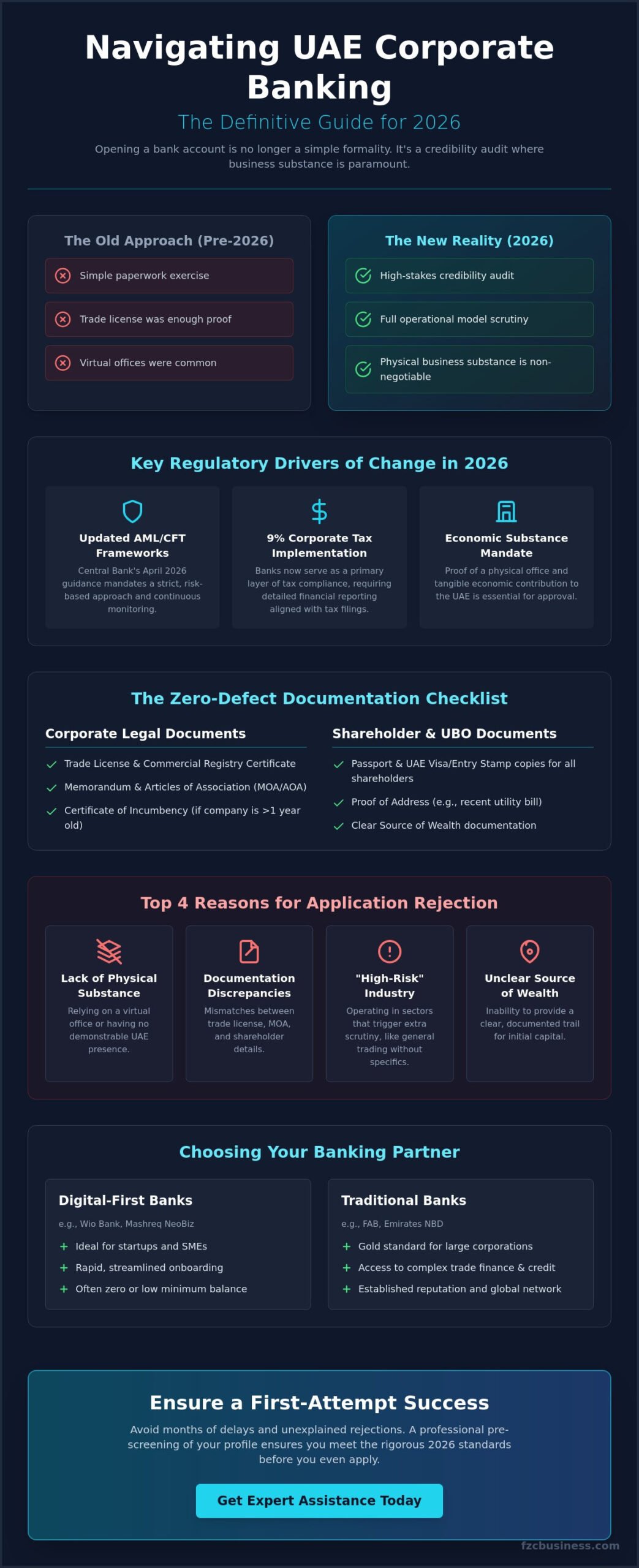
The financial sector in the Emirates has undergone a significant transformation. As of April 2026, the Central Bank of the UAE (CBUAE) issued updated guidance on AML/CFT and Counter-Proliferation Financing, marking a definitive shift toward a risk-based approach. For business owners, this means banks no longer just look at your license; they scrutinize your entire operational model. The implementation of the 9% corporate tax on income exceeding AED 375,000 has also forced a new level of transparency. Banks now act as a primary layer of tax compliance, requiring detailed financial reporting that aligns with your tax filings.
This evolution is deeply connected to the broader UAE’s economic landscape, which is diversifying rapidly away from oil. Banks are now prioritizing “high-value” sectors like AI, renewable energy, and advanced manufacturing over traditional general trading. If your business falls into a legacy category, expect more rigorous questioning. You must prove that your business is not just a shell but a contributing entity to the local economy. Meeting the uae corporate bank account requirements in 2026 requires demonstrating this tangible economic presence from day one.
To better understand the strategic decisions involved in setting up your financial foundation, watch this helpful video:
Choosing between digital-first and traditional brick-and-mortar banks is your next strategic hurdle. Digital-only platforms like Wio Bank or Mashreq NeoBiz offer rapid onboarding and zero minimum balance options, making them ideal for startups. However, traditional giants like First Abu Dhabi Bank (FAB) or Emirates NBD remain the gold standard for companies requiring complex trade finance or high-limit credit facilities. Your choice depends entirely on your transaction volume and long-term scaling needs.
Mainland vs. Free Zone: Choosing Your Banking Path
Jurisdiction is a major factor in the approval process. Mainland companies generally face fewer hurdles during KYC because they’re seen as having a deeper commitment to the local market. Certain Free Zones now have “pre-approved” status with major banks, which can cut processing times by weeks. However, if you choose a remote Free Zone without a physical office, your uae corporate bank account requirements will likely include a much higher minimum balance, sometimes exceeding AED 100,000, to offset the perceived risk.
The Role of AML and KYC Compliance
Compliance is no longer a one-time event. Under Federal Decree-Law No. 10 of 2025, which took effect in late 2025, banks have moved toward continuous monitoring. “Know Your Customer” (KYC) for a foreign shareholder now involves deep dives into the source of wealth and previous business history. If you can’t provide a clear trail of your initial capital, the application will stall. Banks aren’t just looking for a “yes” at the start; they’re looking for reasons to keep your account open as regulations tighten.
Essential UAE Corporate Bank Account Requirements & Documentation
Preparing your documentation package is the most critical phase of the application. Banks in 2026 operate on a zero-defect policy regarding file submissions. Any discrepancy between your license and your corporate structure leads to immediate delays. To meet the standard uae corporate bank account requirements, you must present a cohesive set of legal documents that prove your company is fully registered and legally compliant. This isn’t just about ticking boxes; it’s about building a narrative of legitimacy for the bank’s compliance department.
Corporate Legal Documents
Your submission must include a clear copy of your Trade License and the Commercial Registry Certificate. The Memorandum of Association (MOA) and Articles of Association (AOA) are essential to define ownership and signatory powers. If your company has been active for more than a year, banks now mandate a Certificate of Incumbency or a Certificate of Good Standing. These documents verify your current status and ensure no unauthorized changes have occurred in your corporate structure since inception.
Shareholder and UBO Documentation
Transparency regarding the Ultimate Beneficial Owner (UBO) is non-negotiable under the latest AML frameworks. Banks require high-resolution passport copies showing entry stamps or residency visa pages for every partner holding more than 5% equity. You must also provide proof of address, such as utility bills or lease agreements from your home country. A common pitfall is providing an outdated CV. In 2026, your professional profile must explicitly highlight industry experience that aligns with your UAE license activity to satisfy the bank’s risk assessment.
Business Plan and Financial Projections
A generic business plan no longer suffices for modern compliance checks. You need a detailed 2-year financial forecast that justifies your expected transaction volumes and monthly turnover. Banks expect a list of potential suppliers and clients, ideally supported by draft contracts or Letters of Intent (LOIs). You must also provide a transparent description of the source of your initial investment funds. If you’re feeling overwhelmed by these specifics, you can consult with an expert to pre-verify your document bundle before official submission.
A valid UAE Residency Visa and Emirates ID for the authorized signatory are essentially mandatory to secure an account with a traditional bank. While some digital platforms allow for non-resident signatories, the process is far more complex and often involves lower transaction limits. Be prepared to provide six months of personal bank statements from your home country to establish your financial footprint. These statements help the bank verify your wealth origin and personal financial stability before they commit to a corporate relationship.
Proving Business Substance: The Key to 2026 Approvals
Business substance is no longer a suggestion; it’s the primary filter banks use to separate legitimate enterprises from shell companies. In 2026, meeting the basic uae corporate bank account requirements includes proving that your company has a genuine economic reason to exist within the Emirates. Compliance officers are moving away from simple document checks toward “substance audits.” If your business model appears to be a “pass-through” entity with no real local roots, your application will likely face a swift rejection without a clear explanation.
The era of the “virtual office” as a viable banking solution has largely ended. While some competitors might suggest that a basic flexi-desk is enough, modern banking standards dictate otherwise. Banks now prioritize companies that show a clear commitment to the local economy through physical infrastructure. This shift is driven by the need for banks to verify tax residency and ensure compliance with the UAE’s evolving corporate tax framework. Without a tangible presence, you’ll struggle to convince a tier-1 bank that your operations are stable and low-risk.
The Physical Office Requirement
Your choice of office space directly impacts your approval odds. While “Co-working” spaces are acceptable for some digital-first banks, traditional institutions almost universally demand a physical lease. For Mainland companies, an Ejari certificate is the strongest evidence of local commitment you can provide. In Free Zones, a formal lease agreement for a dedicated office unit is now the standard. Business Substance is the physical and operational footprint required to justify a tax-resident status. Banks often verify these locations through site visits or by requesting photos of the company’s signage and internal workspace. If you’re still deciding on your setup, choosing a Mainland company formation with a physical office often streamlines the banking process.
Local Transactions and Relationships
Banks want to see that you actually need a UAE account to conduct business. Proving local operational presence through staff or local contracts is essential. Having at least one UAE-based supplier or client significantly strengthens your profile. It demonstrates that your business isn’t just using the UAE as a tax-neutral booking center. Secondary proof, such as local utility bills from DEWA or SEWA, acts as a powerful validator of your substance. These documents show the bank that your office is active and consuming resources, which justifies the necessity of a local corporate account for your daily operations. Showing a clear link between your UAE expenses and your business activity is the most effective way to satisfy the 2026 uae corporate bank account requirements.
Why UAE Corporate Bank Applications Get Rejected (and How to Avoid It)
Rejection letters from UAE banks are notoriously vague, often citing “internal policy” without further explanation. This lack of transparency is a major pain point for entrepreneurs. In 2026, the margin for error is non-existent. Most rejections stem from a failure to align the company’s stated activities with the bank’s current risk appetite. Understanding the specific triggers that lead to a “no” is the only way to safeguard your application and meet the uae corporate bank account requirements on your first attempt.
Immediate rejections typically occur due to one of these five factors:
- Activity Mismatch: Your business plan describes consulting, but your license includes “General Trading.”
- Opaque Ownership: Complex corporate layers that make it difficult to identify the Ultimate Beneficial Owner (UBO).
- Lack of Local Presence: Relying on a virtual address or having no UAE-resident signatory.
- Inadequate Source of Wealth: Failing to provide a clear, documented history of how initial capital was earned.
- Inconsistent Projections: Financial forecasts that don’t match the typical transaction patterns of your specific industry.
High-Risk Activities and Nationalities
Compliance departments apply strict filters for sectors like cryptocurrency, jewelry trading, and multi-level marketing (MLM). These industries face extra scrutiny because of their historical association with high-volume, high-risk transactions. If your business falls into these categories, a standard application will likely fail. Shareholders from sanctioned or high-risk jurisdictions also face a steeper climb. Success in these cases requires specialized compliance documentation and often the help of a consultant who can present your case to a specific bank’s high-risk committee. Secure your approval by using our professional Corporate Bank Account Opening services to pre-vet your application before submission.
The “Minimum Balance” Trap
Financial stability is a core pillar of uae corporate bank account requirements. Banks use the Average Monthly Balance (AMB) to gauge the viability of a client. For instance, First Abu Dhabi Bank (FAB) typically requires an AMB of AED 100,000, while Emirates NBD sets the bar at AED 50,000. Mashreq Bank offers a more accessible entry at AED 25,000. If your balance falls below these thresholds during the first six months, you risk high maintenance fees or even account closure. New entrepreneurs should consider “Lite” or “Starter” accounts, such as those offered by Wio Bank, which features a zero-minimum balance model to support early-stage growth without the pressure of high capital retention.
Your business plan must be a mirror image of your trade license. If your license says “Software Development,” but your plan mentions selling hardware, the bank will flag this as a compliance risk. Ensure every document in your bundle tells the same story. If you’ve recently changed your business model, update your license before approaching a bank. Consistency is the most effective way to instill confidence in a compliance officer and move your application from the “review” pile to “approved.”
Expert Assistance: Streamlining Your UAE Banking Journey
Attempting to manage the banking process independently often leads to avoidable delays or permanent rejections. International entrepreneurs frequently underestimate the rigidity of uae corporate bank account requirements in 2026. Without established local relationships, your application is just another file in a massive compliance queue. Banks often view DIY applications as higher risk because they lack the professional vetting that institutions expect. Pre-screening your profile before official submission is the most effective way to identify red flags that would otherwise trigger an immediate “no” from a compliance officer.
A rejection doesn’t just delay your start; it creates a record within the UAE banking system that can make future applications even more difficult. By the time you receive a rejection notice, the damage is often done. This is why a strategic, expert-led approach is necessary. You need a partner who understands the “why” behind every compliance request and can translate complex regulatory demands into actionable steps for your business. We ensure your documentation isn’t just complete, but also optimized for the specific bank’s internal risk appetite.
The Fast Zone Business Advantage
Fast Zone Business provides a comprehensive buffer between your company and the bank’s scrutiny. We conduct a rigorous document review and compliance “stress test” to ensure every piece of data aligns with current CBUAE standards. By leveraging our direct introductions to relationship managers at top UAE banks, we bypass the generic entry points that often cause 4 to 12-week wait times. Our team doesn’t just submit documents; we draft customized business plans that explicitly meet the specific criteria of your chosen financial institution, ensuring your uae corporate bank account requirements are met with precision.
Next Steps for Your UAE Business
Successful operations require a unified approach. Combining your company formation with specialized Corporate Bank Account UAE services ensures your financial foundation is as strong as your legal license. This integration prevents the common mismatch between trade license activities and banking profiles that leads to so many failures. Once your account is active, our PRO services manage the ongoing compliance documentation required to keep your status in good standing under the new 2025 and 2026 regulations.
Don’t leave your banking success to chance. We specialize in navigating the complex intersection of Mainland and Free Zone regulations to find the right banking partner for your specific industry. Our goal is to provide a frictionless process that allows you to focus on growth rather than administrative hurdles. Contact us today for a free consultation on your business setup and take the first step toward a secure and scalable financial future in the Emirates.
Secure Your Financial Foundation in the Emirates
Winning approval for your business bank account in 2026 demands a shift from passive application to active credibility building. You now understand that navigating uae corporate bank account requirements is less about the documents you have and more about the substance you prove. From securing a dedicated physical office to aligning your financial forecasts with your trade license, every detail must be precise. The regulatory landscape is stricter than ever, but it remains entirely accessible for those who approach it with expert preparation.
Fast Zone Business offers the specialized guidance needed to bypass the common pitfalls of DIY applications. We provide direct partnerships with major UAE banks and 100% transparent compliance pre-screening to ensure your profile is market-ready. Whether you operate in a Mainland or Free Zone jurisdiction, our team streamlines the entire journey from formation to final approval. Don’t leave your corporate future to chance. You’ve done the hard work of building your business; let us handle the administrative hurdles.
Start your UAE banking application with Fast Zone Business experts. Your success in the Emirates starts with a reliable financial partner.
Frequently Asked Questions
How long does it take to open a corporate bank account in the UAE in 2026?
Opening a corporate bank account typically takes between 4 and 12 weeks, depending on the complexity of your business structure and the bank’s internal due diligence. Digital-first banks like Wio or Mashreq NeoBiz can sometimes process applications in as little as 1 to 2 weeks for low-risk entities. However, traditional institutions with more rigorous compliance checks usually require at least a month to complete the full review and activation process.
Can I open a UAE business bank account without a residency visa?
It’s highly challenging to open an account without at least one authorized signatory who holds a valid UAE residency visa and Emirates ID. While some digital platforms offer non-resident options, these accounts often come with restrictive transaction limits and higher scrutiny. Having a resident partner or director significantly improves your chances of meeting the primary uae corporate bank account requirements and securing a successful approval on your first attempt.
What is the minimum balance required for a UAE corporate account?
Minimum balance requirements vary widely depending on the bank and the specific account tier you select. Digital platforms like Wio Bank offer zero-balance accounts, while traditional banks like Mashreq require AED 25,000. Larger institutions like Emirates NBD or First Abu Dhabi Bank (FAB) often mandate average monthly balances ranging from AED 50,000 to AED 100,000 to maintain the account without incurring monthly penalty fees.
Do I need a physical office to open a business bank account in Dubai?
Yes, most traditional banks in Dubai now require proof of a physical office, such as an Ejari certificate or a formal lease agreement. The decline of the “virtual office” for banking approvals is a direct result of increased regulatory focus on business substance. Having a dedicated workspace demonstrates your commitment to the local economy and helps you satisfy the modern uae corporate bank account requirements during risk-based compliance audits.
Why do UAE banks ask for personal bank statements from shareholders?
Banks request six months of personal bank statements to verify the “Source of Wealth” for all ultimate beneficial owners (UBOs). This is a standard part of modern Anti-Money Laundering (AML) protocols. They need to ensure that the initial capital used to fund the business was earned through legitimate means and matches the professional background described in your submitted CV and business plan.
Can a Free Zone company open a bank account in Dubai Mainland?
A Free Zone company can absolutely open a corporate bank account with a mainland institution in Dubai. Most major UAE banks serve both mainland and free zone entities, though free zone companies may face additional due diligence regarding their business activities. Ensuring your license activity is clearly defined and matches your operational reality helps bridge the gap between jurisdictions during the bank’s internal review process.
What are the fees associated with maintaining a corporate account in the UAE?
Monthly maintenance fees generally range from AED 99 to AED 500, depending on the bank and the service level. You may also encounter one-time account opening fees between AED 1,000 and AED 5,000. If your account balance falls below the required Average Monthly Balance (AMB), banks typically charge a shortfall fee, which can be several hundred dirhams per month until the balance is restored.
Is it possible to open a UAE corporate bank account online?
Yes, you can initiate and complete the application for a UAE corporate bank account online through digital-only banks and the digital divisions of traditional institutions. These platforms utilize AI-powered tools and digital KYC systems to expedite the onboarding process. While traditional banks allow you to start the application online, they often require a physical meeting with a relationship manager to verify original identity documents before final activation.
