

The Ultimate UAE Business Setup Checklist for 2026: A Step-by-Step Guide
In 2026, launching a company in the Emirates is no longer a simple matter of filing paperwork; it’s a strategic move to build a compliance-ready infrastructure from day one. This uae business setup checklist ensures you don’t just get a license, but stay ahead of the latest regulatory shifts that can impact your bottom line. We understand that the fear of hidden government fees and the complexity of choosing between mainland or free zone jurisdictions can be overwhelming for any entrepreneur.
You’re likely concerned about meeting the new Corporate Tax requirements or the strict 15% Domestic Minimum Top-up Tax for larger entities. It’s a valid worry, as the landscape now demands precise adherence to the latest Commercial Companies Law and VAT credit caps. This guide provides a clear, chronological roadmap to mastering these complexities. You’ll gain a comprehensive understanding of document requirements, residency visa protocols, and the essential steps for successful corporate bank account opening. By following this roadmap, you can focus on your core objectives while we handle the administrative hurdles.
Key Takeaways
- Learn to select the ideal jurisdiction and business activity to maximize ownership benefits under the latest 2026 regulations.
- Follow a comprehensive uae business setup checklist to prepare all necessary personal and corporate documentation for a frictionless application.
- Understand the step-by-step licensing process, from securing initial approvals with the DET to final trade name registration.
- Master post-license essentials, including residency visa processing, corporate tax compliance, and corporate bank account opening.
- Discover how expert PRO services simplify complex regulatory shifts, allowing you to focus on your core business growth.
Phase 1: Strategic Pre-Setup Decisions & Jurisdictions
Success in the Emirates starts with precision. Your uae business setup checklist begins with a fundamental choice: where will you operate? The Economy of the United Arab Emirates continues to diversify, offering unique opportunities in technology, trade, and services. You must align your professional goals with the specific regulatory frameworks provided by the Department of Economy and Tourism (DET) or various Free Zone authorities. It’s not just about getting a license; it’s about choosing the right foundation for future growth.
Choosing a legal structure is equally critical. Whether you opt for a Limited Liability Company (LLC), a Sole Establishment, or a Civil Company, each carries distinct implications for liability and capital requirements. Modern regulations allow for 100% foreign ownership in most sectors, but the operational requirements for a physical office versus a flexi-desk often depend on Economic Substance Regulations. You need to decide if your business requires a tangible presence to satisfy these compliance standards or if a virtual desk suffices for your initial launch.
To better understand this concept, watch this helpful video:
Mainland vs. Free Zone: The 2026 Decision Matrix
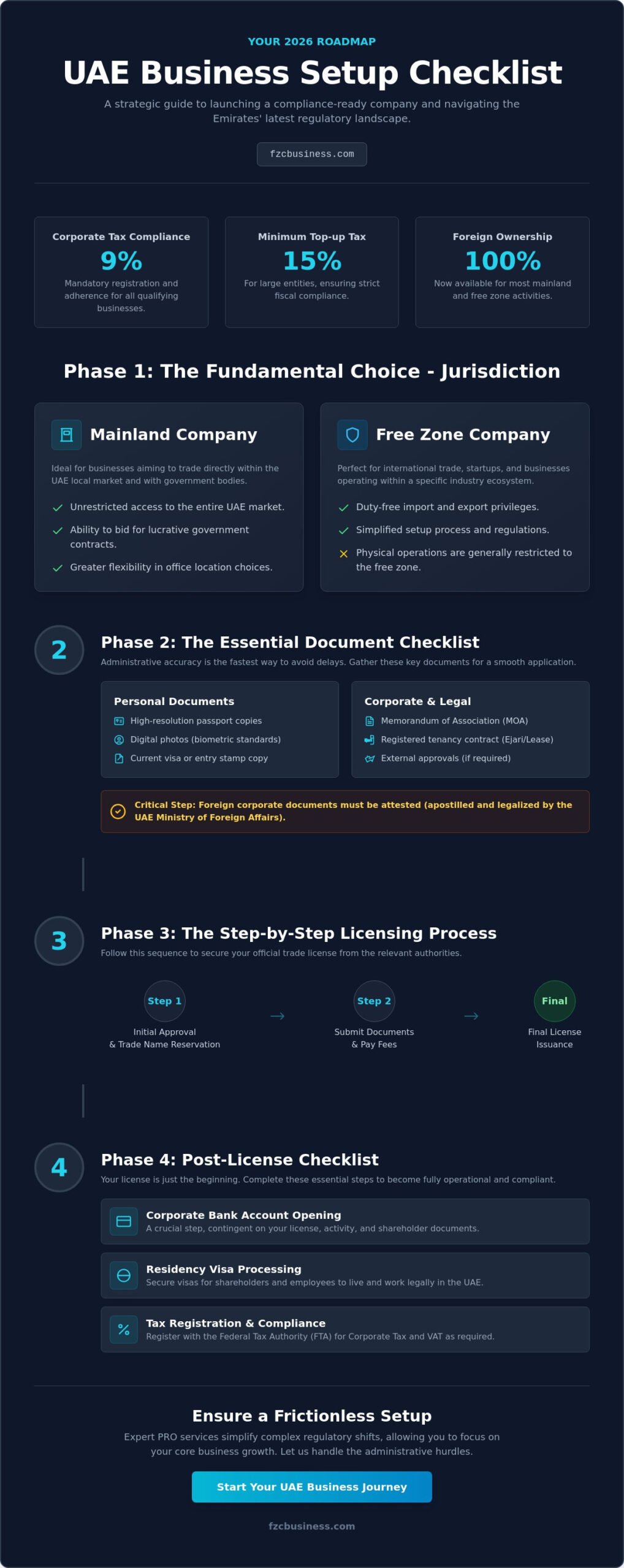
Mainland licenses permit you to trade directly within the local UAE market and compete for lucrative government contracts. This flexibility is ideal for retail or large-scale distribution. Conversely, Free Zones like SHAMS, RAKEZ, or IFZA offer duty-free imports and specialized ecosystems tailored to specific industries. While Free Zones provide a simplified setup process, they generally restrict your physical operations to that specific zone. Consider your long-term scalability. Moving from a Free Zone to Mainland later can be a complex and costly transition.
Activity Selection and Trade Name Reservation
Your business activity must be selected from the latest 2026 DED or Free Zone lists. This choice determines your license type and, crucially, your ability to open a corporate bank account. Banks are often sensitive to specific high-risk activities, so alignment is mandatory. Once selected, you’ll reserve a trade name through the Unified License (DUL) system. Ensure your name avoids religious references, political affiliations, or trademarked brands. At Fast Zone Business, we help you cross-reference your name and activities to ensure they meet all moral standards. This step is a vital part of your uae business setup checklist to avoid delays or rejection during the approval phase.
Phase 2: The Essential Document Checklist for UAE Formation
Once you’ve finalized your jurisdiction, the next stage of your uae business setup checklist involves gathering a precise set of documents. Administrative accuracy is the fastest way to avoid delays in a regulatory environment that values transparency. To align with the official process for establishing a company, you’ll need high-resolution passport copies and digital photos that meet current biometric standards. If you’re already in the country, you must provide a copy of your current visa or entry stamp. Don’t underestimate the importance of attestation; foreign corporate shareholders must provide documents that are apostilled in their home country and legalized locally by the UAE Ministry of Foreign Affairs.
Corporate documentation goes beyond personal IDs. You’ll need to draft a Memorandum of Association (MOA) and Articles of Association (AOA) that reflect your specific business structure and management hierarchy. For Mainland companies, a registered tenancy contract, known as an Ejari, is mandatory. Free Zone entities require a valid lease agreement from the zone authority. If your business involves regulated sectors like healthcare, transport, or education, you’ll also need external approvals from bodies such as the DHA, RTA, or KHDA. These approvals are non-negotiable and must be secured before the final license is issued.
Shareholder and Manager Documentation
Every partner and manager named on the license must undergo a strict Know Your Customer (KYC) check. This includes providing proof of residence, such as a recent utility bill or bank statement from within the last three months. For specialized professional licenses, authorities now frequently request a detailed CV or professional profile to verify that the management team possesses the relevant expertise for the chosen activity. Ensuring these documents are correctly formatted from the start prevents unnecessary back-and-forth with government departments.
The MOA and Side Agreements
The 2026 standard for executing corporate documents is digital. Most jurisdictions now utilize UAE Pass for secure, paperless signing of your MOA and AOA. Your MOA should clearly define the distribution of shares and management powers, especially to take full advantage of 100% foreign ownership laws. While professional licenses may still require a Local Service Agent (LSA), their role is strictly administrative and doesn’t involve equity. Drafting these agreements with precision protects your interests and ensures long-term compliance. If you find the legal jargon daunting, consulting with a PRO specialist can help you finalize these documents with total confidence.
Phase 3: The Step-by-Step UAE Company Formation Process
Moving from planning to execution requires a methodical approach to satisfy local authorities. Your uae business setup checklist now shifts toward the formal application phase. The first step is obtaining Initial Approval. This document confirms that the Department of Economy and Tourism (DET) or your chosen Free Zone authority has reviewed your business activity and found no regulatory objections. It essentially grants you the green light to proceed with the legal and physical requirements of your company.
Once you’ve secured initial approval, you’ll finalize your trade name reservation and pay the associated fees. This is followed by the drafting and notarization of your Memorandum of Association (MOA). While physical notarization at a Dubai Court or notary public is still possible, the 2026 standard is digital execution via UAE Pass. This paperless method is faster and carries the same legal weight. Simultaneously, you must secure your physical office location. For Mainland companies, this means registering your lease to obtain an Ejari. Free Zone entities will receive a lease agreement directly from the zone’s management.
The final step in the process is the issuance of the license. After the authority reviews your signed MOA and lease agreement, they’ll issue a payment voucher. Upon settlement of this voucher, your trade license is officially issued, and you’re legally permitted to conduct business. It’s a structured journey that rewards attention to detail.
Navigating External Approvals
Certain industries require more than just a standard license. If you’re entering the healthcare, education, or transport sectors, you’ll need clearances from specialized bodies like the DHA or RTA. Financial activities may require a nod from the Central Bank or the Ministry of Economy. These approvals often involve manual reviews and specific site inspections. Utilizing PRO services ensures these multi-agency clearances don’t stall your progress, as experts handle the back-and-forth communication with government departments on your behalf.
Timeline and Cost Expectations
Efficiency is a hallmark of the Emirates. The Doing Business in the UAE framework is designed for speed, yet timelines vary by jurisdiction. Mainland setups are remarkably fast, often taking only 3 to 5 working days. Free Zone formations typically require 1 to 2 weeks, depending on the specific zone’s internal protocols. When budgeting, account for government fees and license costs, but also remember administrative “hidden” costs. These include the knowledge and innovation fees, which are standard additions to government transactions in Dubai. Having a clear financial map ensures your uae business setup checklist remains on track without fiscal surprises.
Phase 4: Post-License Checklist: Banking, Visas, and Tax
Obtaining your trade license is a major milestone, but your uae business setup checklist isn’t complete until you finalize your operational status. The first post-license step is applying for your Establishment Card through the Federal Authority for Identity, Citizenship, Customs & Port Security (ICP). This document is essential as it allows your company to sponsor residency visas and interact with labor authorities. Once this card is issued, you can begin the residency visa process for yourself, your partners, and your employees. This sequence involves a medical fitness test, biometric scanning at a designated center, and the final issuance of your Emirates ID.
Compliance is the hallmark of the 2026 business environment. You must register your company for Corporate Tax with the Federal Tax Authority (FTA) within the mandatory deadlines. Failure to register on time results in a fixed penalty of AED 10,000. While the tax rate is 0% for taxable income up to AED 375,000, registration remains a legal requirement for all licensed entities. Additionally, monitor your turnover against VAT thresholds. Registration is mandatory if your taxable supplies and imports exceed AED 375,000, though you can register voluntarily once you cross the AED 187,500 mark. Maintaining precise financial records is vital to navigate these regulations without friction.
Residency Visas and the Golden Visa Advantage
The standard residency process provides a two or three-year partner/investor visa. However, many entrepreneurs now leverage the UAE Golden Visa for long-term stability. This 10-year residency option is available to business owners who meet specific investment criteria, such as a property investment of at least AED 2,000,000. Once your own residency is secured, you can sponsor your dependents, including your spouse and children. The 2026 regulations have streamlined family sponsorship, making it an efficient process for established business owners who want to relocate their families to the Emirates.
Mandatory 2026 Compliance: ILOE and Tax
All employees and business owners must enroll in the Involuntary Loss of Employment (ILOE) insurance scheme. It’s a mandatory requirement, and non-compliance leads to fines that can hinder your future license renewals. On the fiscal side, ensure your accounting systems are ready for the 9% Corporate Tax applied to income exceeding the AED 375,000 threshold. Proper record-keeping is a legal necessity that protects your company during potential audits. Finally, prioritize opening your corporate bank account. Banks require your full set of corporate documents, proof of address, and detailed KYC information. For a deeper dive into this process, consult our Corporate Bank Account guide to avoid common application pitfalls.
Managing these post-license requirements can be complex, but you don’t have to do it alone. Partner with our expert PRO team to ensure every step of your uae business setup checklist is completed with total precision.
How to Ensure a Frictionless Setup with Fast Zone Business
The 2026 regulatory shifts, including the updated Anti-Money Laundering (AML) laws and strict Corporate Tax penalties, make professional guidance a necessity rather than a luxury. Attempting to manage the uae business setup checklist alone often leads to administrative bottlenecks or costly delays that can stall your launch. Fast Zone Business acts as your local expert, bridging the gap between your entrepreneurial vision and the strict requirements of UAE authorities. We don’t just provide a service; we provide a clear path to market entry that minimizes risk and maximizes your resource optimization.
Our advantage lies in comprehensive, end-to-end management. We don’t just reserve your trade name; we manage the entire lifecycle of your formation. From drafting a compliant MOA to coordinating with the Federal Tax Authority for your tax ID, we ensure no detail is overlooked. By leveraging established relationships with the Department of Economy and Tourism (DET) and major regional banks, we significantly reduce setup times. This efficiency allows you to focus on your core business strategies while we navigate the bureaucratic intricacies of the 2026 landscape. We understand the local market’s rhythm and ensure your application moves through the system with priority and precision.
Comprehensive PRO and Government Services
Beyond the initial setup, our PRO services provide ongoing security for your operations. We handle complex issues such as labor ban removals and partner visa cancellations with speed and discretion. Our team manages document renewals and government clearances, often without requiring your physical presence in various government offices. This is particularly valuable for international investors who need to maintain compliance from abroad. For those focusing on the heart of the city, our Mainland Company Formation guide offers deeper insights into the specific benefits and requirements of a DET license in the current year.
Your Next Steps to UAE Success
Your journey toward a successful UAE enterprise starts with a single strategic decision. We offer a free initial consultation to help you finalize your jurisdiction selection and business activities. This ensures your foundation is compliant with the latest 2026 mandates from the very first day. Once we understand your unique professional journey, we provide a personalized quote covering all licensing and administrative costs. We also provide long-term support for license and visa renewals, ensuring your business remains in good standing year after year. Following a uae business setup checklist is easier when you have a dedicated partner handling the heavy lifting.
Start your UAE business journey today with Fast Zone Business and transform a complex process into a seamless success story.
Secure Your Business Future in the Emirates
Success in the UAE requires more than just an ambitious vision; it demands a meticulous approach to the 2026 regulatory landscape. By following this uae business setup checklist, you’ve already gained a strategic advantage. You now understand how to navigate jurisdiction selection, document attestation, and the essential post-license steps like tax registration and visa processing. These foundations are critical for long-term growth and compliance in a sophisticated global market.
At Fast Zone Business, we specialize in both Mainland and Free Zone jurisdictions to ensure your company is positioned for maximum benefit. Our expert PRO services handle all government approvals, allowing you to focus on your operations while we manage the bureaucracy. We also offer a proven track record in corporate bank account assistance, solving one of the most common challenges for new entrepreneurs. Don’t let administrative hurdles delay your ambitions.
Get Your Custom UAE Business Setup Quote
The Emirates offer unparalleled opportunities for those who arrive prepared. We’re ready to help you turn this roadmap into a reality with efficiency and expert care. Your professional journey starts here.
Frequently Asked Questions
What is the total cost of setting up a business in Dubai in 2026?
Total setup costs depend on your chosen jurisdiction, business activity, and the number of residency visas required. Fees vary between Mainland and various Free Zones, each with its own administrative structure. You must account for government registration, trade name reservation, and initial approval vouchers. It’s best to request a tailored quote to understand the full investment needed for your specific commercial goals.
Can I start a UAE business without a physical office?
Yes, many Free Zones offer flexi-desk or virtual office packages that allow you to obtain a license without a traditional physical space. However, you must ensure your chosen activity complies with Economic Substance Regulations. Some sectors or high-tier licenses may eventually require a permanent physical lease to satisfy banking and regulatory audit requirements in 2026.
Do I need a local Emirati partner for 100% ownership in 2026?
No, you don’t need a local Emirati partner for 100% ownership in the vast majority of commercial and industrial sectors. Amendments to the Commercial Companies Law now allow foreign investors full control over their Mainland entities. While certain professional licenses still utilize a Local Service Agent, these agents act as administrative liaisons and hold zero equity in your business.
How long does it take to get a corporate bank account in the UAE?
Opening a corporate bank account generally takes between two to four weeks, depending on the bank’s specific KYC protocols. This timeline is influenced by the complexity of your shareholder structure and the nature of your business activities. Following a detailed uae business setup checklist and providing verified documentation from the start is the most effective way to accelerate this process.
What are the Corporate Tax requirements for new UAE companies?
All new companies must register for Corporate Tax with the Federal Tax Authority regardless of their income level. A 0% tax rate applies to taxable income up to AED 375,000, while a 9% rate is applied to income exceeding that threshold. You must register within the government’s specified deadlines to avoid a fixed penalty of AED 10,000 for late registration.
Can I apply for a Golden Visa through my new business setup?
Yes, entrepreneurs and investors can qualify for a 10-year Golden Visa by meeting specific capital or property investment requirements. For instance, real estate investors with a property value of at least AED 2,000,000 are eligible for this long-term residency. The Golden Visa provides significant stability, allowing you to live and work in the UAE without the need for a traditional employer sponsor.
What is the difference between a Trade License and an Establishment Card?
A Trade License is the legal document that authorizes you to conduct business, while an Establishment Card allows your company to sponsor residency visas. You’ll receive your Trade License first from the Department of Economy and Tourism or a Free Zone authority. The Establishment Card is a post-license requirement issued by the immigration authorities to facilitate your hiring and labor needs.
Is VAT registration mandatory for all new businesses?
VAT registration is only mandatory if your taxable turnover exceeds AED 375,000 in a twelve-month period. You can choose to register voluntarily if your turnover is at least AED 187,500. Integrating these thresholds into your uae business setup checklist ensures you stay compliant with Federal Tax Authority regulations as your company grows and reaches new financial milestones.
