

Tax Implications of Moving Your Business to the UAE: The 2026 Strategic Guide
Did you know the UAE attracted $30.7 billion in foreign direct investment in 2026? This record-breaking figure proves that while the tax landscape has evolved, the Emirates remains a premier destination for global growth. You’re likely weighing the tax implications of moving business to uae, specifically how the 9% corporate tax rate affects your bottom line and whether you’ll be caught in a double taxation trap. It’s natural to feel concerned about the shift from a zero-tax environment to a regulated, two-tiered system.
We understand that navigating international compliance and “place of effective management” rules is daunting. This guide provides the clarity you need to master the 9% threshold, secure your tax residency, and legally optimize your global profits. We’ll examine the specific criteria for qualifying free zone persons, the 183-day residency rule, and the strategic steps to ensure your transition is both compliant and highly profitable.
Key Takeaways
- Understand the 9% corporate tax threshold and how to leverage the 0% rate on taxable income up to AED 375,000 for maximum profit retention.
- Identify the critical tax implications of moving business to uae, including how to establish a “Place of Effective Management” to shield your company from home-country tax claims.
- Distinguish between Mainland and Free Zone obligations to secure “Qualifying Free Zone Person” status and maintain a 0% tax rate on eligible income.
- Explore how the Golden Visa serves as a strategic pillar for long-term tax planning within the UAE’s 0% personal income tax environment.
- Gain a clear, step-by-step roadmap for Federal Tax Authority registration and VAT compliance to ensure a seamless operational transition.
The UAE Tax Landscape in 2026: From Tax Haven to Transparent Hub
The UAE has transitioned from a traditional tax-free zone into a sophisticated, transparent financial hub. Since the introduction of corporate tax on June 1, 2023, the Federal Tax Authority (FTA) has established a framework that aligns with international standards. Understanding the tax implications of moving business to uae is essential for any entrepreneur looking to optimize their global footprint while navigating the UAE’s evolving tax landscape.
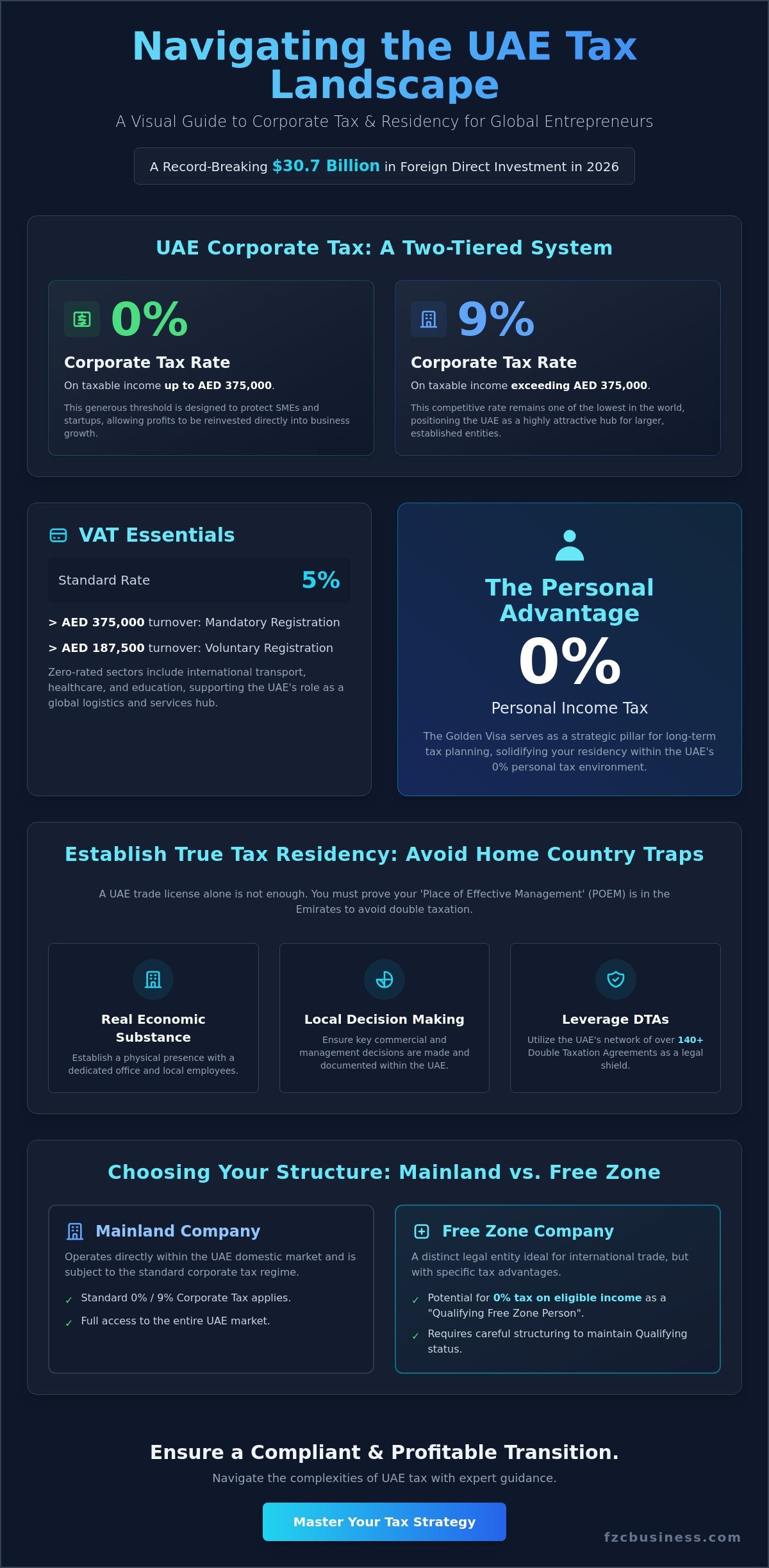
While the headline mentions a 9% corporate tax, the system is designed to protect small businesses and startups. You won’t pay a single dirham of corporate tax on taxable income up to AED 375,000. This generous threshold ensures that early-stage ventures can reinvest their profits directly into growth. For larger entities, the 9% rate remains one of the lowest in the world. Even with the introduction of the 15% Domestic Minimum Top-up Tax (DMTT) for massive multinationals in 2025, the UAE stays far more attractive than most Western jurisdictions.
To better understand how these changes might impact your specific situation, watch this helpful video:
Understanding Corporate Tax (CT) Basics
UAE corporate tax applies to “Taxable Persons,” which includes companies incorporated in the UAE and foreign entities with a permanent establishment here. It’s critical to register for Corporate Tax with the FTA regardless of your profit levels. Taxable income is generally your accounting net profit with specific adjustments, while certain dividends and capital gains remain exempt. Natural persons also fall under this scope if their business turnover exceeds AED 1 million annually. You must file your tax return within nine months of the end of your fiscal year. For those who find these requirements complex, VAT and Corporate Tax Assistance from a reliable partner can ensure you meet every deadline without stress.
VAT in the UAE: What Businesses Need to Know
Value Added Tax (VAT) remains stable at a 5% standard rate. Registration is mandatory if your taxable supplies and imports exceed AED 375,000 over a 12-month period. You can also choose to register voluntarily if your turnover exceeds AED 187,500. If you’re providing cross-border services, you’ll need to analyze the tax implications of moving business to uae carefully. International transport, healthcare, and education often qualify for zero-rated status. This structure supports Dubai’s role as a global logistics and services hub, allowing businesses to remain lean while accessing world-class infrastructure. Compliance is straightforward, but it requires diligent record-keeping to avoid administrative penalties.
Tax Residence and POEM: Avoiding Home Country Traps
Establishing a legal entity in Dubai is only the first step. One of the most critical tax implications of moving business to uae involves understanding the Place of Effective Management (POEM). Many entrepreneurs mistakenly believe that a trade license alone exempts them from their home country’s tax net. However, if the key commercial and management decisions are still being made in London, New York, or Berlin, your home tax authority may argue that the company is a resident there for tax purposes. This can lead to unexpected tax bills and legal complications.
To prevent this, you must demonstrate real economic substance. This means having a physical presence, local employees, and conducting board meetings within the Emirates. The UAE Federal Tax Authority provides clear guidelines on how businesses must operate to be recognized as local tax residents. Leveraging the UAE’s network of over 140 Double Taxation Agreements (DTAs) is vital. These treaties act as a legal shield, ensuring you aren’t taxed twice on the same income while providing a framework for international compliance.
The Risk of Permanent Establishment (PE)
A Permanent Establishment (PE) is triggered when a business has a fixed place of business or a dependent agent in another country. For a consulting firm, this might happen if a partner spends significant time working from a home office abroad. E-commerce brands face different risks, such as holding inventory in foreign warehouses. You must avoid “Ghost Management.” This happens when a UAE company appears to be managed locally on paper, but the actual decision-makers reside elsewhere. High-level strategic choices must happen on UAE soil to maintain your tax-exempt or low-tax status. If you need help structuring your operations, our VAT and Corporate Tax Assistance can ensure you stay on the right side of global regulations.
Managing the Exit: Tax Clearance in Your Home Country
Leaving your current tax jurisdiction requires more than a plane ticket. Many countries impose “Exit Taxes” on unrealized capital gains or require a formal tax clearance certificate before you can fully sever ties. You’ll generally need to satisfy the 183-day rule to establish UAE residency for treaty purposes. Understanding these nuances is why a professional business setup in Dubai Mainland requires a tax-first strategy. It isn’t just about the license; it’s about where you sit, how you sign contracts, and how you document your physical presence. Proper preparation now prevents costly audits later.
Mainland vs. Free Zone: Choosing the Right Tax Structure
Selecting your jurisdiction is the most critical decision when evaluating the tax implications of moving business to uae. Mainland companies operate under the standard 9% corporate tax on profits exceeding AED 375,000. In contrast, Free Zone entities can still enjoy a 0% rate, but only if they meet the strict criteria of a “Qualifying Free Zone Person” (QFZP). This distinction requires a strategic choice between unrestricted market access and maximum tax optimization.
Your choice should align with your primary revenue source. If your business focuses on international trade or providing services to other Free Zone entities, a Free Zone structure is likely the most efficient path. However, if your growth strategy relies on local government contracts or physical retail within the Emirates, a Mainland setup provides the necessary legal framework to operate without restrictions.
The 0% Free Zone Rate: Qualifying Income Explained
To benefit from the 0% rate, your Free Zone company must earn “Qualifying Income.” This generally includes revenue from transactions with other Free Zone entities or from specific “Qualifying Activities” such as manufacturing, shipping, and fund management. If you earn income from the UAE mainland, it’s often taxed at the standard 9% rate. The “De Minimis” rule provides a small safety net for these situations. If your non-qualifying revenue is less than 5% of your total revenue or AED 5 million (whichever is lower), you won’t lose your status as a QFZP.
Compliance is mandatory to maintain these benefits. You must maintain adequate substance in the UAE and prepare audited financial statements. Without a professional audit, the Federal Tax Authority will default your tax rate to 9% regardless of your income type. This makes diligent record-keeping a non-negotiable part of your operational strategy.
Mainland Benefits: Access to Local Markets
While the 9% tax applies to Mainland companies, this structure offers unrestricted access to the entire UAE economy. It’s the preferred choice for businesses bidding on government tenders or those in the construction and retail sectors. You can effectively manage your tax liability by deducting legitimate business expenses, including market-competitive salaries and operational costs, before calculating your taxable profit.
For many entrepreneurs, a Free Zone company setup in the UAE serves as a cost-effective stepping stone. It allows you to establish an international presence with lower overheads before expanding into a Mainland LLC as your local client base grows. Strategic hubs like SHAMS are excellent for creative ventures, while RAKEZ provides robust infrastructure for industrial firms. IFZA remains a top choice for professional consultants seeking a prestigious Dubai address with streamlined compliance. Choosing the right zone ensures your business structure aligns with both your operational needs and the latest tax regulations.
Personal Tax and the Golden Visa: The Residency Advantage
While corporate structures are vital, the personal tax implications of moving business to uae are equally transformative for your wealth. The UAE remains a premier jurisdiction for high-net-worth individuals because it does not levy personal income tax on salaries or personal investment income. This ensures that the dividends and director fees you draw from your company stay in your pocket. To fully capitalize on these benefits, you must align your physical presence with the Federal Tax Authority’s residency criteria.
Securing a Tax Residency Certificate (TRC) is the gold standard for proving your status to foreign tax offices. While you can establish domestic residency in as little as 90 days under specific conditions, the FTA generally requires 183 days of physical presence to issue a TRC for double taxation treaty benefits. This certificate is your primary defense against home-country tax claims. It proves you’re a legitimate resident of the UAE’s tax environment, allowing you to sponsor your family and dependents under your own business-owner visa with total confidence.
Golden Visa: More Than Just a Residency Permit
The Golden Visa provides 10 years of residency and unparalleled stability for business owners. To qualify through real estate, you need a minimum investment of AED 2 million. This long-term permit removes the need for a local sponsor and allows you to stay outside the UAE for extended periods without losing your residency status. Beyond lifestyle benefits, having this 10-year security significantly simplifies how to open a bank account in the UAE. Banks view Golden Visa holders as low-risk, long-term residents, which speeds up the compliance and onboarding process for both personal and corporate accounts.
Individual Tax Residency Rules
The UAE uses a tiered approach to determine individual tax residency. You’re considered a tax resident if you’re physically present in the country for 183 days or more in a consecutive 12-month period. Alternatively, you can qualify under the 90-day rule if you hold a valid residence permit and have a permanent place of residence or carry on a business in the UAE. Documenting your presence is essential. Keep records of your entry and exit stamps, utility bills, and lease agreements. These documents are vital when applying for a TRC to protect your global income from aggressive tax authorities in your home jurisdiction. If you want to streamline this entire process, our team can manage your Golden Visa Application from start to finish.
Implementation: Your Compliance Roadmap with Fast Zone
Executing a successful relocation requires a methodical approach that balances operational freedom with regulatory compliance. When you analyze the tax implications of moving business to uae, it’s clear that the sequence of your setup steps is just as important as the jurisdiction you choose. A flawed registration or a missed deadline can lead to administrative penalties that quickly erode your initial tax savings. Your roadmap begins with selecting the optimal license, a choice that dictates whether you’ll manage the standard 9% corporate tax or qualify for the 0% rate.
Once your trade license is issued, the focus shifts to Federal Tax Authority (FTA) registration. Every business must register for Corporate Tax, even if they expect to fall under the AED 375,000 profit threshold. If your turnover exceeds the mandatory limit, VAT registration must follow immediately to ensure your invoicing remains legal. Managing these steps concurrently allows you to focus on growth while we handle the technical filings. This proactive approach ensures your business is compliant from day one, avoiding the “ghost management” traps discussed in earlier sections.
Opening a Corporate Bank Account
Securing a corporate bank account is often the final hurdle for new entrepreneurs. Banks in the UAE operate under strict international compliance standards, requiring comprehensive documentation to prove economic substance. You’ll need to demonstrate that your business isn’t just a “shell” but a functional entity with a real presence. This includes providing proof of physical office space, detailed business plans, and evidence of management’s expertise. The tax implications of moving business to uae extend to how banks view your residency; having a Golden Visa can often streamline this process.
The process can be time-consuming without the right preparation. Check out our corporate bank account UAE guide for specific bank requirements and a checklist of necessary documents. Our team specializes in Corporate Bank Account Opening, ensuring your application meets the specific risk appetite of local and international banks.
The Fast Zone Advantage
The complexities of the 2026 regulatory environment shouldn’t distract you from your core objectives. Our PRO Services take the weight of government documentation off your shoulders, managing everything from visa renewals to company renewals with precision. We don’t just set up your company; we provide ongoing VAT and Corporate Tax Assistance to keep your business in good standing with the FTA. This allows you to navigate the tax landscape with total confidence.
We offer customized compliance packages designed to scale with your growth. Whether you need a Mainland Company Formation for local market access or a streamlined Free Zone Company Formation, we act as your dedicated partner. Ready to move? Contact Fast Zone Business for a tailored relocation strategy that maximizes your global profits while ensuring total compliance.
Secure Your Global Business Future in the UAE
The transition to a regulated tax environment in 2026 hasn’t diminished the UAE’s status as a premier global hub. By mastering the 9% corporate tax threshold and establishing a robust “Place of Effective Management,” you can protect your profits from aggressive foreign tax claims. Whether you choose the unrestricted reach of the Mainland or the optimized 0% qualifying income of a Free Zone, your success relies on precise compliance. Understanding the tax implications of moving business to uae ensures you benefit from the 0% personal income tax regime while securing your long-term residency through the Golden Visa program.
At Fast Zone, we provide the expert guidance needed to navigate these complexities without the administrative burden. We offer all-inclusive Mainland and Free Zone packages paired with expert FTA-registered tax assistance. Our team maintains a 100% success rate in Golden Visa applications, ensuring your transition is both seamless and permanent. Book a Free Tax & Setup Consultation with Fast Zone Business today and take the first step toward a compliant, high-growth future in the Emirates. We’re ready to help you thrive.
Frequently Asked Questions
Is the UAE still tax-free for businesses in 2026?
The UAE isn’t entirely tax-free for businesses in 2026, as a federal corporate tax system is now fully active. However, it remains one of the most attractive jurisdictions globally with a standard rate of only 9%. This transition reflects the country’s commitment to international transparency while keeping the tax burden significantly lower than in most Western economies.
How much is the corporate tax in the UAE for small businesses?
Small businesses pay 0% corporate tax on all taxable income up to AED 375,000. Any profit exceeding this specific threshold is taxed at the standard 9% rate. This tiered structure is specifically designed to support startups and SMEs, ensuring they have the capital needed to reinvest in their operations during their early growth stages.
Do I need to pay VAT if I move my international business to Dubai?
You’re required to register for VAT if your taxable turnover exceeds AED 375,000 over a 12-month period. The standard rate is 5%, but many international services qualify for zero-rating. Evaluating the tax implications of moving business to uae involves analyzing your specific revenue streams to determine your mandatory or voluntary registration requirements.
What is a Qualifying Free Zone Person for tax purposes?
A Qualifying Free Zone Person is an entity established in a Free Zone that maintains adequate substance and earns qualifying income. You must comply with transfer pricing rules and file audited financial statements to retain this status. Meeting these criteria allows your business to benefit from a 0% tax rate on eligible income even after the new laws.
Can I live in the UAE and still pay tax in my home country?
You might still owe tax in your home country if you don’t properly sever your tax residency ties. Home authorities often use the “Place of Effective Management” rule to claim tax rights over foreign companies managed from their soil. You must ensure your strategic decisions are made within the UAE and meet local physical presence requirements to avoid these traps.
How do I get a Tax Residency Certificate in the UAE?
You apply for a Tax Residency Certificate through the Federal Tax Authority’s portal by providing proof of your residency and physical presence. For treaty benefits, the FTA generally requires at least 183 days of physical presence in the UAE. You’ll need to submit documents like your lease agreement, residency visa, and a report of your entry and exit dates.
What are the penalties for not registering for UAE Corporate Tax?
The penalty for late registration for Corporate Tax is AED 10,000 as mandated by the Federal Tax Authority. Every taxable person, including Free Zone entities, must register within the deadlines set by the FTA based on their license issuance month. Missing these deadlines can lead to further administrative complications and financial costs that disrupt your business operations.
Does the UAE have a double taxation treaty with the UK and USA?
The UAE has a comprehensive double taxation agreement with the UK, which helps prevent taxpayers from being taxed twice on the same income. While the UAE has signed over 140 such treaties globally, it doesn’t currently have a full bilateral income tax treaty with the USA. American entrepreneurs should carefully review the tax implications of moving business to uae regarding their citizenship-based taxation rules.
