

Structuring a UAE Startup for Investment: The 2026 Founder’s Guide
What if the trade license you just paid for is the very thing that prevents a Venture Capitalist from signing your term sheet? Many founders rush into setup only to realize that choosing the right legal structure for a uae business is about much more than just getting a visa; it’s about building a foundation that supports international capital. You likely feel the pressure of deciding between a Mainland entity or a Free Zone, worrying that a mistake today will cost you tens of thousands of dirhams in restructuring fees tomorrow.
It’s a valid concern, especially with the 2026 regulatory shifts that have transformed the regional landscape. This guide simplifies the complexity, showing you how to select a jurisdiction that investors trust and a corporate framework that scales. We’ll explore how the latest Commercial Companies Law now allows for multiple share classes and drag-along rights. These changes provide a clear path for issuing Employee Stock Option Plans (ESOPs), ensuring your startup is investment-ready from day one.
Key Takeaways
- Distinguish between a lifestyle business and a scalable entity by aligning your jurisdiction with international Venture Capital expectations.
- Evaluate the trade-offs between Mainland and Free Zone setups to ensure you are choosing the right legal structure for a uae business from the outset.
- Protect your core assets by using a Special Purpose Vehicle (SPV) to isolate intellectual property from day-to-day operational risks.
- Leverage the 2026 Commercial Companies Law to draft a Memorandum of Association that supports multiple share classes and Employee Stock Option Plans.
- Streamline your path to market by partnering with experts who bridge the gap between basic licensing and an investment-ready corporate framework.
Why Your UAE Startup Structure Dictates Your Investment Success
Your company’s legal DNA determines its ultimate ceiling. A lifestyle business usually stays within its initial setup, but a scale-up requires a foundation built specifically for growth. Investment-ready structuring involves selecting a legal framework that supports equity dilution and multiple funding rounds. If your setup doesn’t allow for seamless transitions between seed and Series A stages, you aren’t truly ready for international capital.
Choosing the right legal structure for a uae business is the most significant decision you’ll make in your first year. It’s a strategic move within the evolving economic landscape of the UAE. You must avoid the trap of the “corporate flip.” Restructuring a poorly planned entity into a VC-compliant holding company in 2026 can easily cost six figures in AED legal fees and government charges. It’s far more efficient to build for the exit from the very start.
To better understand how legal frameworks impact your growth, watch this helpful video:
The Investor’s Mindset: Risk vs. Jurisdiction
Legal certainty is the top priority for international VC funds entering the region. They look for jurisdictions that offer clear exit paths and predictable governance. In certain zones, the transfer of shares is a manual, bureaucratic process that can stall a deal for weeks. Modern founders prioritize speed and clarity. Your early-stage due diligence will hinge on your Founders Agreement and your cap table management. If these aren’t hosted in a recognized, investor-friendly zone, you’ll face unnecessary friction during fundraising rounds. Experts at Fast Zone Business can help you identify which jurisdictions currently offer the fastest digital share registration.
Common Law vs. Civil Law: A Quick Comparison
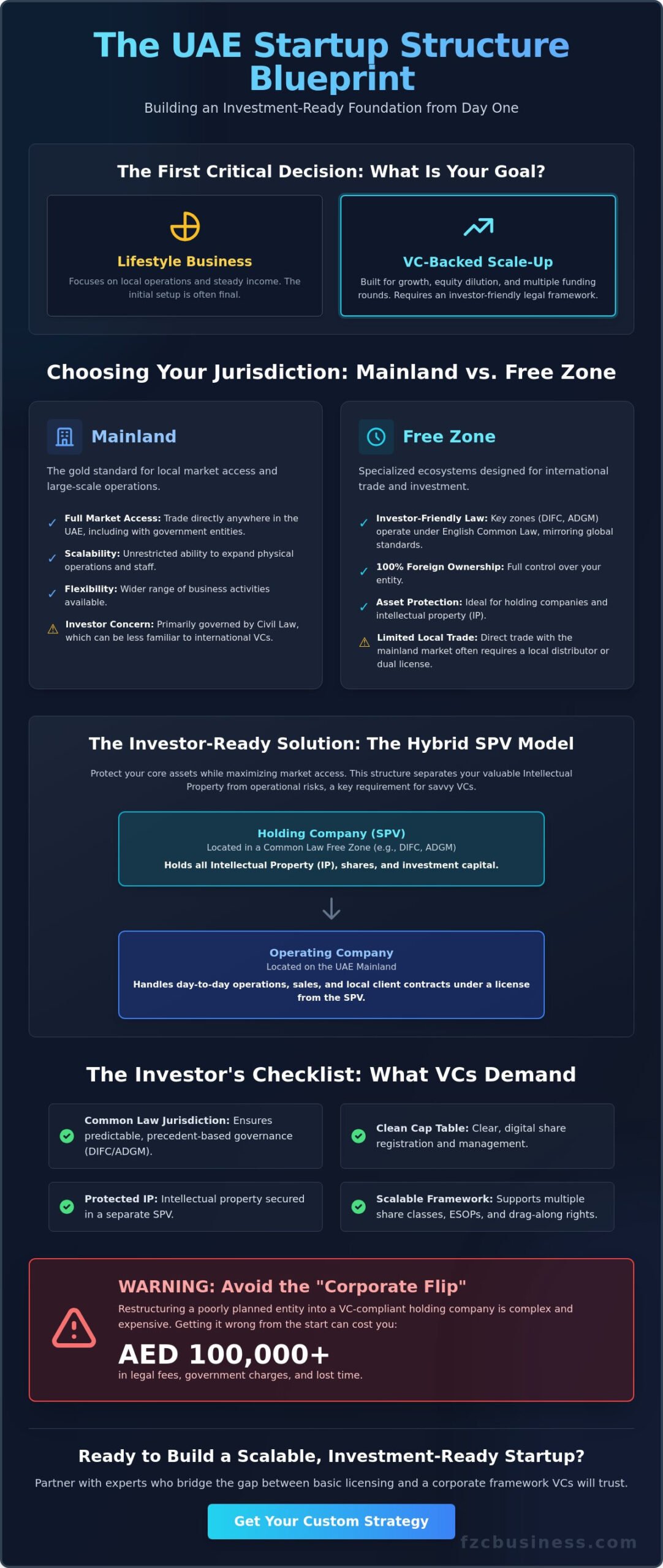
The UAE offers a unique “dual-track” legal system. When choosing the right legal structure for a uae business, the distinction between common and civil law is paramount. The DIFC and ADGM stand out as independent, English-language common law jurisdictions. These zones are designed to mirror the legal environments of global financial hubs like London or Singapore. They make it simple to implement standard investor protections like Drag-along and Tag-along clauses. Common law provides a predictable, precedent-based framework that mirrors international standards in London or Delaware. By using these structures, you’re speaking the same legal language as global investors, which significantly reduces their perceived risk.
Choosing the Right Jurisdiction: Mainland, Free Zone, or Hybrid?
Deciding where to plant your startup’s roots is the second hurdle after understanding investment readiness. When choosing the right legal structure for a uae business, you aren’t just picking an office location; you’re determining your tax liabilities, hiring capacity, and market reach. A strategic guide to UAE company formation highlights that the choice between mainland and free zones depends on whether your revenue is primarily local or international. For 2026, the decision is often between the high-growth potential of the mainland and the specialized ecosystems of free zones.
Many founders now opt for a dual licensing model. This involves operating on the mainland for local trade while holding your intellectual property in a secure, common-law-aligned Free Zone. This hybrid approach protects your core assets while allowing your operational team to work directly with clients in Dubai or Abu Dhabi. It’s an efficient way to balance regulatory compliance with aggressive market expansion. If you’re unsure which path fits your three-year roadmap, you can speak with an expert to map out a custom jurisdiction strategy.
Dubai Mainland for Scalability
A business setup in dubai mainland is the gold standard for startups targeting government contracts or large-scale physical operations. By 2026, mainland structures have evolved to allow 100% foreign ownership in most non-strategic sectors, removing the old requirement for a local partner. You gain the flexibility to lease office space anywhere in the city and can scale your physical presence across all seven Emirates without additional branch licenses. This is critical for tech-enabled logistics or service companies that need to be close to their customer base.
The Tech Founder’s Free Zone Shortlist
A free zone company setup in the uae remains the preferred route for remote teams and software-as-a-service (SaaS) platforms. Zones like SHAMS and RAKEZ offer cost-effective entry points, with zero-visa packages starting as low as AED 4,888. However, choosing the right legal structure for a uae business at the seed stage requires looking ahead. While a Meydan Free Zone license at AED 12,500 is excellent for initial operations, you should plan for a strategic transition to an ADGM SPV structure as you approach Series A. This ensures your cap table is ready for the high-level due diligence that institutional investors require.
The SPV Model: How to Separate IP from Operations
For founders aiming for a high-value exit or major funding, the Special Purpose Vehicle (SPV) is the gold standard. While many entrepreneurs start with a single trade license to save on initial costs, sophisticated investors expect a more robust architecture. This involves a “HoldCo” (Holding Company) and an “OpCo” (Operating Company) relationship. By choosing the right legal structure for a uae business that separates your assets from your daily activities, you shield your most valuable property from the risks of commercial life.
The HoldCo acts as the parent entity, owning the Intellectual Property (IP), brand rights, and software code. The OpCo, which is often a Mainland or Free Zone entity, handles the contracts, payroll, and physical operations. If the OpCo faces a legal dispute or operational debt, the parent company’s assets remain protected. This setup also simplifies the cap table. Investors enter at the holding level, which avoids the need to constantly update multiple operational licenses as your shareholder list grows. It provides a clean, professional entry point for Venture Capitalists who don’t want to get bogged down in the administrative details of an operational license.
The Holding Company Advantage
Isolating operational risks is essential for maintaining a clean valuation. Lawsuits or debts incurred by the operating unit don’t automatically bleed into your core valuation. When angel investors or VCs want to exit, they can transfer shares at the HoldCo level with minimal friction. Under the 2026 Corporate Tax regime, you must be aware that a 9% tax applies to taxable income exceeding AED 375,000. However, certain holding structures may benefit from specific exemptions if they are classified as Qualifying Free Zone Persons. This makes the SPV model not just a safety measure, but a strategic financial tool for long-term growth.
Equity and ESOPs: Planning for Your Team
Attracting top-tier talent in the UAE’s competitive market requires more than just a high salary. You need a clear path to equity. Common law frameworks, such as those found in the ADGM, allow you to structure Employee Stock Option Plans (ESOPs) that investors trust. These plans give employees a vested interest in the company’s success without complicating the operational license. By 2026, ADGM regulations allow for flexible share-based incentives that are legally enforceable and attractive to global talent. This level of legal sophistication is often the deciding factor when choosing the right legal structure for a uae business during the growth phase. If you need help setting up these complex frameworks, Fast Zone Business can guide you through the registration process efficiently.
Investment-Ready Checklist: 5 Steps to Setup
Successful fundraising starts months before you pitch to a Venture Capitalist. Choosing the right legal structure for a uae business requires a forward-looking strategy that anticipates the needs of institutional investors. If your foundation is built solely on the lowest initial cost, you’ll likely face a expensive restructuring phase when a lead investor demands a common-law holding company. Your setup must reflect your three-year funding roadmap, ensuring you have the right jurisdiction to support equity dilution and complex shareholder agreements.
To ensure your startup is ready for a term sheet in 2026, follow these five essential steps:
- Select your jurisdiction based on scalability: Don’t just pick the cheapest free zone. Ensure the zone allows for the specific activities and future visa quotas your growth plan requires.
- Draft a VC-compliant MoA: Under Federal Decree-Law No. 20 of 2025, which became effective on January 1, 2026, onshore LLCs can now issue multiple classes of shares. Ensure your Memorandum of Association is updated to reflect these rights.
- Open a corporate bank account in the uae early: You can’t accept investment without a fully operational account. Delays in banking can kill a deal’s momentum.
- Prioritize Tax and VAT registration: With the 9% corporate tax now standard for income over AED 375,000, investors will scrutinize your tax compliance during due diligence. Remember that late registration carries an AED 10,000 penalty.
- Leverage professional PRO services: Secure your founding team’s residency and government approvals through an expert who understands the 2026 regulatory landscape.
Banking and Financial Credibility
Investors won’t wire millions of dirhams to a personal account or an entity with “pending” status. Financial credibility is built on transparency and robust KYC (Know Your Customer) documentation. By 2026, UAE banks have tightened standards for high-growth startups, requiring clear proof of business activity and shareholder backgrounds. Managing multi-currency accounts is also vital. If you’re raising capital in USD but operating in AED, your banking structure must facilitate these international rounds without excessive fees or compliance blocks. You can start your investment-ready setup by ensuring your financial foundation is solid from day one.
The Role of PRO Services in Setup
Founders should spend their time refining product-market fit, not standing in queues for government approvals. Professional PRO services handle the administrative “red tape,” from labor ban removals to visa renewals. They also manage Golden Visa applications for the founding team, providing the long-term residency stability that gives investors confidence in your commitment to the region. Every approval, from the Department of Economy and Tourism (DET) to specific Free Zone authorities, must be documented and easily searchable. This level of organization is a silent signal to VCs that your startup is managed with professional rigor, making choosing the right legal structure for a uae business a seamless part of your success story.
Scaling with Fast Zone Business: Your Strategic Partner
Choosing the right legal structure for a uae business is not a one-time administrative task; it’s a continuous strategic process. Many founders mistake a trade license for a complete business foundation. At Fast Zone Business, we bridge the gap between basic registration and true investability. We ensure your corporate framework is built to withstand the scrutiny of institutional investors and global venture capital firms. Our team understands that for a tech startup in 2026, the difference between a Mainland entity and a Free Zone setup dictates your ability to scale and your eventual exit valuation.
Our specialized approach focuses on the unique needs of the tech ecosystem. We navigate the complexities of the 2026 regulatory environment, ensuring your startup remains compliant with the 9% Corporate Tax on income exceeding AED 375,000. We manage the entire administrative burden, from initial licensing in Dubai Mainland or strategic Free Zones to complex PRO requirements and labor ban removals. By handling the “red tape,” we allow you to focus on your core product and market expansion while we ensure your legal standing remains impeccable.
Beyond the License: Total Support
Our how to start a business in dubai guide is just the first step in a long-term partnership. We provide founders with access to a vetted network of corporate banking and legal partners, ensuring you have the right support for complex multi-currency accounts and international funding rounds. This personalized consulting is vital for startups navigating the high-stakes transition from Seed to Series A. We don’t just hand over a license; we provide the ongoing VAT and Corporate Tax assistance necessary to maintain clean books for future due diligence. If you’re managing a growing team, our PRO services streamline visa renewals and Golden Visa applications, securing long-term residency for your key hires and founding members.
Ready to Build Your UAE Success Story?
The UAE business landscape is evolving rapidly. With the implementation of the new Commercial Companies Law in early 2026 and mandatory e-invoicing rollout, professional guidance is no longer optional. Choosing the right legal structure for a uae business today requires an expert who understands the nuances of share classes, ESOPs, and SPV holding structures. Fast Zone Business provides the clarity and efficiency you need to move from a concept to a funded reality. Don’t let administrative hurdles slow your momentum or block your next investment round. Contact us for a confidential structuring consultation and take the first step toward a scalable, investment-ready future. Get started with Fast Zone Business today to ensure your startup is built for the global stage.
Secure Your Startup’s Future in the 2026 Market
Choosing the right legal structure for a uae business is the most critical decision a founder makes before their first funding round. By separating your intellectual property through an SPV and aligning with common-law frameworks, you provide the legal certainty that international venture capitalists demand. The 2026 regulatory landscape offers unprecedented flexibility for multiple share classes and ESOPs, but only if your foundation is built correctly from day one. Avoiding the high costs of future restructuring requires a strategic approach that balances local operational needs with global investor expectations.
Fast Zone Business provides the technical expertise needed to navigate ADGM and DIFC SPV setups while managing complete Golden Visa and PRO support for your founding team. We are trusted by international entrepreneurs to ensure 2026 compliance and long-term investability. Don’t let administrative complexity delay your growth or block your next capital injection. Book your expert startup structuring consultation with Fast Zone Business today. Your path to a scalable, investment-ready enterprise starts with a single, informed decision.
Frequently Asked Questions
What is the best legal structure for a tech startup in the UAE?
A hybrid model featuring an ADGM or DIFC holding company paired with a mainland or free zone operating entity is the most effective choice for tech startups. This setup allows you to hold intellectual property in a common law jurisdiction while maintaining local operations. It’s the most efficient way to manage equity dilution and prepare for future funding rounds.
Can I raise Venture Capital with a Dubai Mainland license?
Yes, you can raise capital with a mainland license because the 2026 Commercial Companies Law allows onshore LLCs to issue multiple share classes. While some international VCs still prefer common law frameworks for the holding of equity, a mainland license is perfectly viable for operational scale. Many founders use a mainland entity for local trade while keeping their cap table in a common law SPV.
Why do investors prefer DIFC or ADGM for UAE startups?
Investors prefer DIFC and ADGM because these zones operate under English language common law, which is predictable and mirrors international standards. This framework simplifies the enforcement of shareholder agreements, including tag-along and drag-along rights. Choosing the right legal structure for a uae business often involves these zones because they offer a recognized legal recourse that minimizes risk for global investment funds.
How much does it cost to set up an investment-ready company in Dubai?
Setup costs vary significantly based on your chosen jurisdiction and the number of visas your team requires. While a basic free zone license can start as low as AED 4,888, an investment-ready structure involves higher government fees for holding company registrations and legal drafting. You must budget for the license, establishment card, and the professional fees required to draft a VC-compliant Memorandum of Association.
What is an SPV and does my startup need one?
A Special Purpose Vehicle (SPV) is a passive legal entity designed to hold assets like intellectual property or shares in other companies. If you plan to raise institutional capital, you likely need an SPV to separate your core assets from operational liabilities. This structure allows investors to enter at the holding level without disrupting the daily commercial activities of your operating license.
Can I offer equity to my employees in the UAE?
Yes, you can offer equity through Employee Stock Option Plans (ESOPs) using common law frameworks in zones like the ADGM. These jurisdictions provide the legal certainty necessary to issue and manage share-based incentives for both resident and non-resident team members. It is an essential tool for attracting global talent while maintaining an enforceable and transparent cap table.
How long does it take to get a corporate bank account for a new startup?
Opening a corporate bank account typically takes between two to four weeks, depending on your shareholder complexity and the bank’s KYC requirements. Since 2026, UAE banks have improved digital onboarding for startups, but you must have your incorporation documents and proof of business activity ready. Choosing the right legal structure for a uae business can actually speed up this process if you select a jurisdiction the bank recognizes as low-risk.
Does a UAE startup need a Golden Visa for its founders?
A Golden Visa isn’t a legal requirement, but it provides 10 years of residency stability that instills confidence in potential investors. It removes the administrative burden of frequent renewals and allows founders to focus entirely on scaling their business. This long-term security is often viewed favorably during investor due diligence as it signals a permanent commitment to the region.
