

Starting a Business in Dubai as an Indian Citizen: The 2026 Ultimate Guide
Did you know that Dubai attracted over 6,700 new millionaires in 2024 alone? For Indian entrepreneurs, this city is no longer just a luxury destination; it’s a strategic near-shore hub optimized by the CEPA treaty and 100% ownership laws. You’re likely ready to scale your operations but feel hesitant about the technical complexities of starting a business in dubai as an indian citizen. It’s common to feel concerned about navigating FEMA regulations or choosing between a Mainland and Free Zone structure while protecting your hard-earned capital.
This expert guide removes the guesswork, providing a clear roadmap to master UAE company formation in 2026. You’ll learn how to secure 100% business ownership, qualify for a UAE Residency or Golden Visa, and establish tax-efficient profit repatriation to India. We preview the essential steps for regulatory compliance, from understanding the 9% corporate tax threshold to the practical requirements for opening a corporate bank account, ensuring your transition to the Dubai market is efficient, compliant, and positioned for long-term growth.
Key Takeaways
- Identify the ideal jurisdiction for your goals by comparing the local market access of Dubai Mainland against the specialized industry clusters of various Free Zones.
- Follow a streamlined 6-step roadmap for starting a business in dubai as an indian citizen, from selecting your business activity to final license issuance.
- Explore the criteria for the 10-year Golden Visa to secure long-term residency and stability for your family and investment partners.
- Master the essential requirements for corporate bank account opening and maintain local compliance with the 2026 VAT and corporate tax regulations.
- Understand how to navigate Indian FEMA guidelines and utilize Tax Residency Certificates for efficient, tax-compliant profit repatriation.
Why Indian Entrepreneurs are Choosing Dubai in 2026
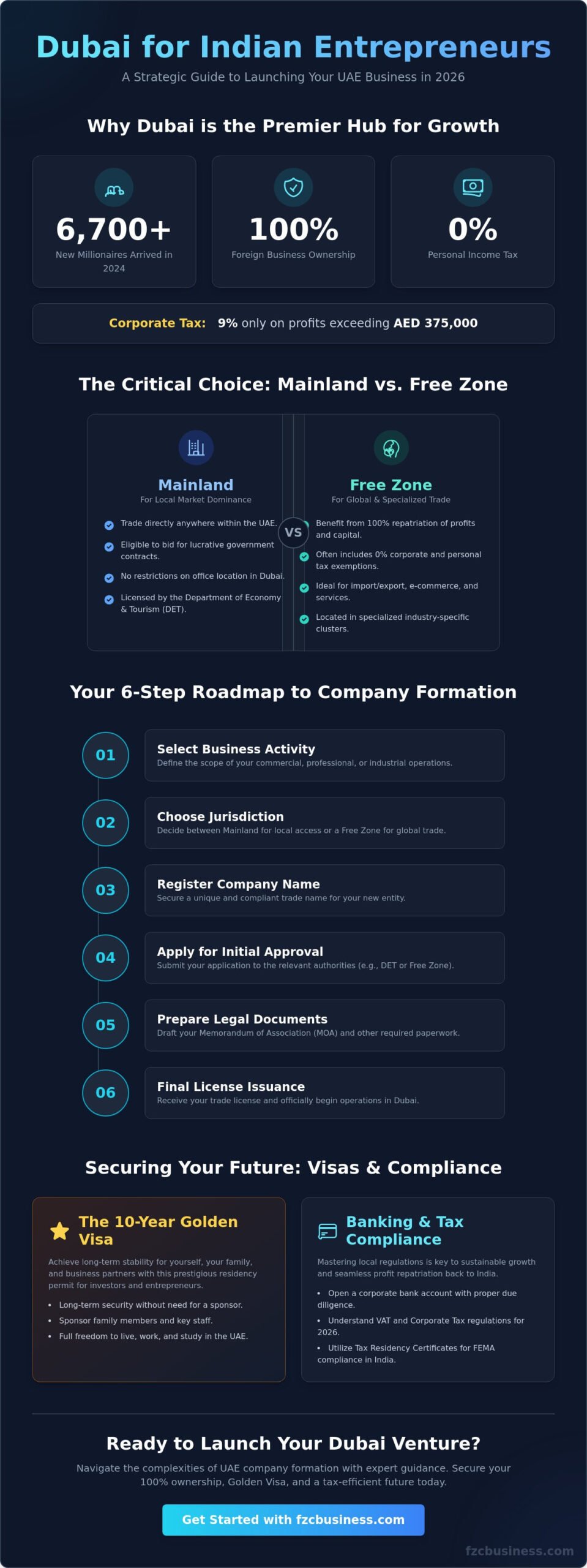
Dubai’s transformation into a primary business hub for Indian citizens is driven by more than just tax incentives. The geographic advantage of a three-hour flight from Mumbai or Delhi allows entrepreneurs to manage operations in both countries with ease. By 2026, the synergy between the two nations has reached an all-time high, supported by 100% ownership laws that empower international investors. This makes starting a business in dubai as an indian citizen a strategic necessity for those seeking global expansion without losing touch with their home base. With over 6,700 new millionaires moving to the city in 2024, the networking potential alone justifies the transition.
The Economy of the United Arab Emirates provides a stable, low-tax environment that is increasingly attractive to the subcontinent’s elite. While the corporate tax rate is 9% for income above AED 375,000, personal income remains taxed at 0%. This structure offers a significant competitive edge over the domestic Indian tax landscape, particularly for high-growth startups and established exporters who need to maximize their reinvestment capital. You can scale your operations globally while your personal wealth grows unhindered by income tax.
To better understand the logistical advantages and the setup process, watch this helpful video:
The CEPA Advantage for Indian Traders
The UAE-India Comprehensive Economic Partnership Agreement (CEPA) has matured significantly by 2026. It has successfully eliminated tariffs on over 90% of traded goods, creating a massive opening for Indian manufacturers. Traders in the jewelry, textile, and engineering sectors now enjoy frictionless access to the Middle East. This treaty ensures that starting a business in dubai as an indian citizen remains a highly profitable venture, allowing your company to leverage Dubai as a springboard into European markets while utilizing world-class port facilities.
Lifestyle and Residency Benefits
Dubai offers an unmatched cultural ecosystem that minimizes the stress of relocation for your family. With a massive Indian diaspora, entrepreneurs find a familiar environment that includes top-tier Indian-curriculum schools and premium healthcare facilities. This familiarity is paired with high-tech infrastructure that supports both business and family life. Long-term stability is now accessible through a Golden Visa Application, granting ten years of residency to eligible investors. This ensures your family’s future is as secure as your business interests. It’s a seamless transition that allows you to focus on growth rather than administrative hurdles.
Mainland vs. Free Zone: Selecting the Right Jurisdiction
The most critical decision you’ll face when starting a business in dubai as an indian citizen is choosing between a Mainland and a Free Zone jurisdiction. This choice dictates where you can trade, who your clients can be, and your long-term scalability. While Free Zones were traditionally the only way to ensure 100% ownership, recent regulatory shifts have revolutionized the Mainland landscape. You must evaluate your business model against the specific geographical and operational restrictions of each zone to ensure maximum resource optimization.
Mainland companies are registered with the Department of Economy and Tourism (DET). They allow you to trade anywhere within the UAE and bid for lucrative government contracts without restrictions. Conversely, Free Zones are specialized economic hubs that offer 100% tax exemptions and 100% repatriation of profits. However, they generally restrict your physical operations to the zone’s boundaries or international markets. This makes Free Zones an excellent choice for import-export businesses or service providers who don’t require a physical retail presence on the streets of Dubai.
The 100% ownership reality has changed for Indian entrepreneurs. You no longer require a local Emirati partner to hold a 51% stake in most commercial and industrial activities. This landmark shift allows you full operational and financial control of your Mainland entity from day one. If you’re unsure which path fits your unique professional journey, exploring Mainland Company Formation services can provide the clarity needed to proceed with confidence. This ensures you don’t face administrative hurdles later during your expansion.
When to Choose Dubai Mainland
Choose the Mainland if your business model relies on the local UAE population. It’s the standard for retail outlets, construction firms, and professional service providers who need to open multiple branches across different Emirates. This jurisdiction is a natural fit for those seeking business setup in dubai mainland to serve the domestic market directly. It also provides the flexibility to rent office space anywhere in the city, allowing you to choose a location that minimizes your operational costs while maximizing visibility.
Top Free Zones for Indian Tech and Media Startups
If your business is remote or focused on international trade, specific Free Zones offer efficient entry points. For instance, the Meydan Free Zone is a favorite for e-commerce and creative startups due to its digital-first approach. IFZA and RAKEZ are equally popular for IT consultancies and tech entrepreneurs starting a business in dubai as an indian citizen because of their flexible office space requirements and quick visa processing times. These zones offer tailored clusters that connect you with like-minded innovators, helping you focus on your core objectives rather than complex licensing logistics.
The 6-Step Setup Process for Indian Citizens
Executing the vision of starting a business in dubai as an indian citizen requires a methodical approach to satisfy both local and international regulatory standards. The process is designed to be logical, but each step demands precision to avoid unnecessary delays. By following this 6-step framework, you can transition from a concept to a fully licensed entity with minimal friction.
- Step 1: Determine your business activity and legal structure. Your choice here dictates whether you need a commercial, industrial, or professional license. It also determines if you’ll form a Limited Liability Company (LLC) or a Sole Establishment.
- Step 2: Register your trade name. You must ensure compliance with UAE guidelines. This means avoiding any religious references, offensive language, or existing brand names. The name must be followed by the legal acronym of your structure, such as “LLC.”
- Step 3: Apply for Initial Approval. This is a “no objection” from the Department of Economy and Tourism (DET) or the relevant Free Zone Authority. It signals that the UAE government has no issue with you starting your business.
- Step 4: Draft the Memorandum of Association (MOA). For Mainland companies, this legal document outlines the ownership and operational rules. If you’re using a Local Service Agent (LSA) for professional activities, you’ll sign an LSA agreement instead.
- Step 5: Secure a physical office or virtual desk. A physical address is a mandatory requirement for most licenses. Many Indian entrepreneurs opt for a “Flexi-desk” in a Free Zone to keep initial costs low while meeting regulatory standards.
- Step 6: Collect your Trade License. Once you’ve submitted all documents and paid the relevant fees, you’ll receive your license. This allows you to begin the visa process for yourself, your family, and your employees.
Documentation Checklist for Indians
Precision in documentation is the fastest way to clear administrative hurdles. You’ll need clear passport copies and photographs that meet specific UAE specifications. If you’re currently employed in the UAE, a No Objection Certificate (NOC) from your current sponsor is essential. Most importantly, ensure your educational certificates are attested by the Ministry of External Affairs (MEA) in India and the UAE Embassy, followed by final attestation by the Ministry of Foreign Affairs (MoFA) in Dubai.
Timeline and Expectations
In 2026, the timeline for starting a business in dubai as an indian citizen has become significantly more efficient. Free Zone licenses are often issued within 48 to 72 hours through digital portals. Mainland licenses typically take 5 to 7 working days, depending on the need for external department approvals. Common bottlenecks usually occur during the certificate attestation phase or bank account opening. Engaging business setup consultants in dubai can help you bypass these hurdles by ensuring your paperwork is perfect before submission.
Visas, Banking, and the 2026 Golden Visa Opportunity
After the successful issuance of your trade license, your focus shifts to establishing a permanent presence through residency and banking. Starting a business in dubai as an indian citizen provides a clear pathway to several visa categories, each offering different levels of flexibility. The standard Investor Visa is the foundation for most, but the 2026 regulatory environment has made the Golden Visa more accessible for those with proven revenue or significant capital. These residency options don’t just benefit the business owner; they extend to your spouse, children, and parents, ensuring a holistic transition for your family.
The 10-year Golden Visa has emerged as the most sought-after residency option for Indian business owners. Data indicates that Indian citizens are among the primary applicants for this category, driven by the desire for long-term stability and the ability to stay outside the UAE for extended periods without risking visa cancellation. To qualify as an entrepreneur, your startup must have an annual revenue of at least AED 1 million or be an innovative project approved by an official incubator. Alternatively, a minimum investment of AED 2 million in real estate or a public fund grants you the Investor Golden Visa, providing a secure anchor in the region’s economy.
Securing a Corporate Bank Account
Opening a corporate account remains one of the most rigorous steps due to strict KYC and AML regulations. Banks require your passport, Emirates ID, and proof of address, along with a comprehensive business plan. Traditional institutions like Emirates NBD and Mashreq offer robust services, while digital-first options like Wio have gained popularity for their faster onboarding processes. Refer to our corporate bank account uae guide for detailed steps on preparing your application to minimize the risk of rejection.
Golden Visa Requirements for 2026
The requirements for the Golden Visa are designed to attract high-value talent and capital. Property owners can qualify with an investment of AED 2 million, even if the property is mortgaged, provided the equity meets the threshold. One of the primary benefits is the removal of the need for a local sponsor, granting you full autonomy over your residency status. You can initiate your golden visa application through Fast Zone to ensure every document is verified against current immigration standards.
Corporate banking is the final pillar of your operational setup. While it’s often cited as a challenge, preparation is the key to success. UAE banks seek transparency in your business model and proof of your professional background. By presenting a clean file and choosing the right banking partner, you’ll overcome the initial hurdles of due diligence and focus on your market entry strategy. If you’re ready to secure your long-term residency, contact us for expert Golden Visa Application assistance today.
Strategic Support: Managing Compliance and Indian Regulatory Links
Establishing your entity is only the first phase of long-term success. Ensuring your business adheres to both the Federal Tax Authority (FTA) guidelines in the UAE and the Reserve Bank of India (RBI) regulations is the key to wealth preservation. Compliance is non-negotiable. When starting a business in dubai as an indian citizen, you must navigate the Foreign Exchange Management Act (FEMA) to ensure your overseas direct investment is reported correctly. This avoids potential penalties from Indian authorities and ensures your global expansion remains legally sound.
UAE tax regulations have evolved to align with international standards. While you enjoy 0% personal income tax, your business must register for Corporate Tax if taxable income exceeds AED 375,000, at which point a 9% rate applies. Additionally, if your taxable supplies and imports exceed AED 375,000 annually, VAT registration at the standard 5% rate is mandatory. Maintaining precise records and filing timely returns ensures your entity remains in good standing, allowing you to focus on growth rather than administrative fines. Professional guidance is essential to manage these local requirements while staying aligned with your Indian tax obligations.
Repatriation of Profits to India
Legally transferring dividends and profits back to India requires a clear understanding of the Double Taxation Avoidance Agreement (DTAA). Unlike the vague advice found on social media forums, you shouldn’t just “send money back” without a strategy. You must obtain a Tax Residency Certificate (TRC) from the UAE Ministry of Finance to claim benefits under the DTAA, which prevents you from being taxed on the same income in both countries. Maintaining clean audit trails is vital for Indian tax authorities to verify the source and nature of these funds. This transparency protects your personal assets and simplifies future reinvestments into your Indian operations.
The Fast Zone Advantage
Success in the Dubai market requires a partner who understands the intricacies of the local regulatory landscape. We handle the heavy lifting of government approvals and documentation, allowing you to prioritize your core business objectives. From managing your pro services to assisting with starting a business in dubai as an indian citizen, our team provides tailored support for SMEs and individual consultants. We ensure your license renewals, visa requirements, and corporate compliance are managed with professional efficiency. Contact Fast Zone Business today for a free consultation and secure your strategic position in the UAE market.
Secure Your Strategic Position in the Dubai Market
Transitioning your operations to the UAE is a definitive step toward global scalability. By now, you understand that starting a business in dubai as an indian citizen involves more than just obtaining a license; it requires a deep understanding of jurisdiction selection, tax residency, and cross-border compliance. Whether you choose the local market access of a Mainland entity or the specialized clusters of a Free Zone, the opportunities for growth in 2026 are unprecedented.
Fast Zone Business is your dedicated partner in this journey. We provide specialized expertise in the India-UAE trade corridor, ensuring your setup respects all FEMA and FTA regulations. Our dedicated PRO team handles the complexity of government approvals so you can focus on your core objectives. We prioritize clarity through transparent pricing with no hidden costs, giving you the confidence to invest and expand. Start your Dubai business journey with Fast Zone Business today. Your vision for a global enterprise is within reach, and we’re here to ensure your transition is seamless and successful.
Frequently Asked Questions
Can an Indian citizen own 100% of a business in Dubai?
Yes, Indian citizens can own 100% of their business in both Dubai Mainland and various Free Zones for most commercial and industrial activities. Recent regulatory changes have removed the mandatory requirement for a local Emirati partner to hold a 51% stake in Mainland companies. Some strategic sectors still have specific ownership requirements, so it’s vital to verify your specific business activity during the planning phase.
How much does it cost to start a business in Dubai for an Indian?
The total cost depends on your chosen jurisdiction, the type of license, and the number of visas required. You’ll need to budget for government registration fees, trade name reservation, and mandatory office space or a flexi-desk lease. While entry-level packages are available for startups, expenses scale based on your operational needs and whether you’re establishing a Mainland or Free Zone entity.
Is an Indian passport holder eligible for a UAE Golden Visa?
Yes, Indian passport holders are among the most frequent applicants for the UAE Golden Visa. You qualify by meeting specific investment thresholds, such as owning a property worth AED 2 million or managing a startup with annual revenue of at least AED 1 million. This 10-year residency permit offers long-term stability and allows you to sponsor your family members and domestic staff without a local sponsor.
Do I need to live in Dubai to run my business there?
No, you aren’t required to reside in Dubai to maintain your business operations. Many entrepreneurs manage their companies remotely while visiting the UAE periodically to satisfy banking or administrative requirements. However, holding a residency visa is beneficial for opening a corporate bank account and managing local contracts. If you’re starting a business in dubai as an indian citizen, you can choose a setup that fits your lifestyle.
What is the minimum investment required for a Dubai trade license?
There is no specific “minimum investment” mandated by law for a standard trade license, other than the costs of the license itself and the required office space. However, if you’re aiming for residency through investment, you must meet the specific capital requirements set by immigration authorities. This makes Dubai an accessible market for both lean startups and large-scale industrial projects.
Can I open a bank account in Dubai if I am an Indian resident?
Yes, you can open a corporate bank account once your UAE business license is active and you’ve secured your Emirates ID. Banks in Dubai perform rigorous due diligence and will require your business plan, proof of professional background, and residency status. While the process is thorough, it’s a standard step that provides you with the financial infrastructure needed to operate globally.
What are the tax implications in India for a Dubai-based business?
Your business will be subject to a 9% UAE corporate tax on taxable income exceeding AED 375,000. Regarding Indian taxes, you must adhere to FEMA regulations and consider the Double Taxation Avoidance Agreement (DTAA) between India and the UAE. Proper tax planning ensures that you can repatriate profits efficiently without being taxed twice on the same income. It’s a critical part of starting a business in dubai as an indian citizen.
How long does the business setup process take for Indians?
The timeline varies between jurisdictions but is generally very efficient in 2026. Free Zone licenses can often be issued within 48 to 72 hours if all documentation is digitally submitted. Mainland licenses typically take between 5 to 7 working days, depending on whether your activity requires additional approvals from specific government departments. Having your Indian documents pre-attested significantly speeds up these timelines.
