

Required Documents for UAE Company Formation: The 2026 Master List
In 2026, securing a business license is no longer the finish line; it’s the first step in building a “Banking-Ready” corporate file that satisfies both regulators and financial institutions. Many entrepreneurs face unexpected delays because they overlook the nuances of Federal Decree-Law No. 20 of 2025 or fail to secure the correct attestations from their home countries. Understanding the exact required documents for uae company formation is the difference between a seamless launch and a costly rejection.
You likely feel the pressure of shifting regulations, especially with the mandatory requirement to obtain a Tax Registration Number within three months of incorporation to avoid penalties. It’s frustrating to manage conflicting advice regarding Mainland versus Free Zone requirements while trying to focus on your core business strategy. We promise to eliminate this confusion by providing a clear, actionable roadmap that ensures your documentation is flawless from day one.
This master list details every essential paper, from initial trade name approvals to the specific Ejari or lease agreements needed for your physical office. You’ll learn exactly how to navigate the attestation process and prepare a submission that meets the highest standards of modern UAE compliance.
Key Takeaways
- Master the distinction between DED and Free Zone mandates to ensure your application aligns with the latest 2026 AML compliance standards.
- Identify the specific required documents for uae company formation, including precise passport specifications and entry stamp protocols for foreign investors.
- Learn how to structure your Memorandum of Association (MOA) and Trade Name Reservation to prevent common administrative rejections.
- Understand the nuances of Local Service Agent (LSA) agreements and the mandatory MOFA attestation process for international documents.
- Discover the legal Arabic translation requirements that transform your foreign paperwork into a valid, submission-ready corporate file.
Understanding the UAE’s Regulatory Documentation Framework in 2026
The UAE business environment remains one of the most dynamic in the world, yet its regulatory framework has become increasingly sophisticated. As of 2026, the process relies on a two-tier system of jurisdictions. You must first decide between a Mainland setup or a Free Zone entity. This choice dictates the specific legal structure and the governing body that will oversee your application. Understanding the nuances of UAE corporate law is essential because it defines the legal forms available to foreign investors and the specific obligations they carry.
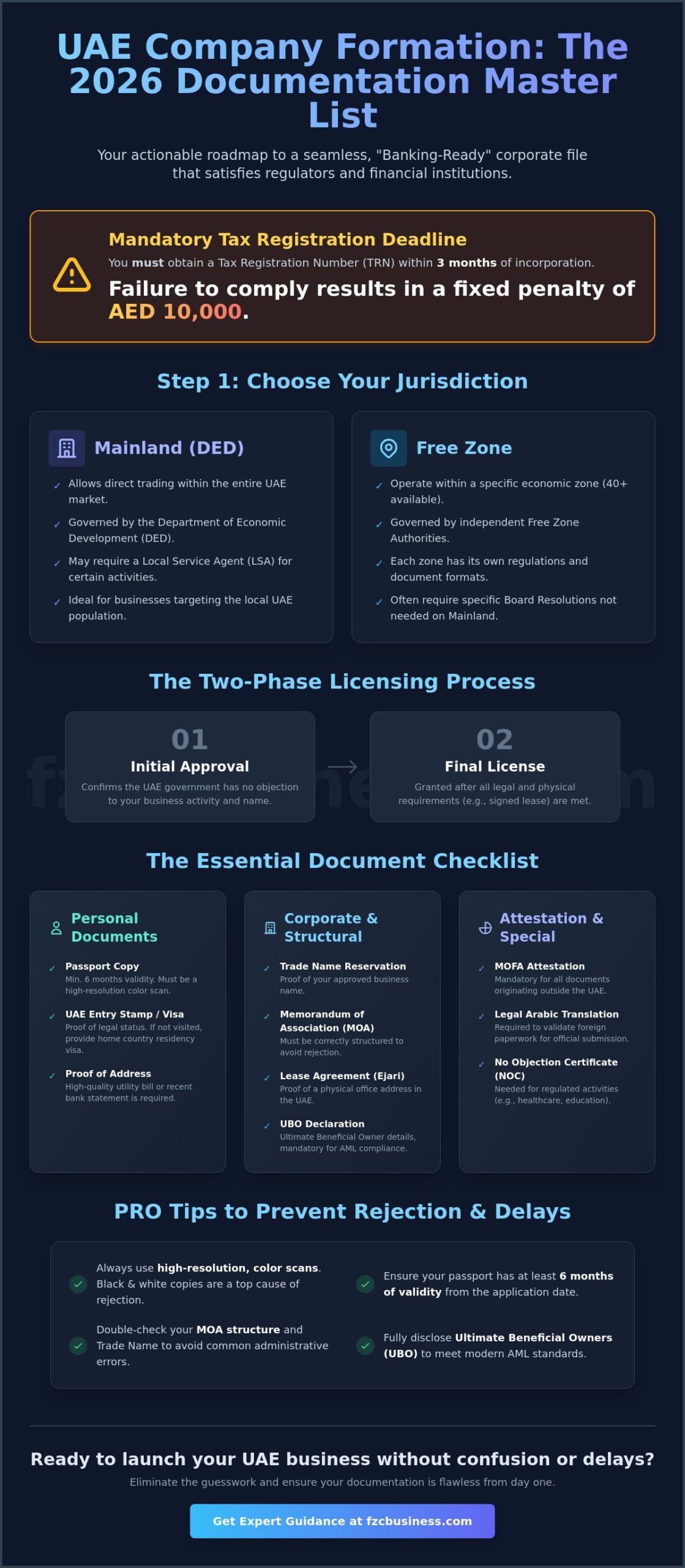
Organizing the required documents for uae company formation involves more than just a passport copy. You need to distinguish between documents for “Initial Approval” and those for the “Final License.” Initial approval confirms the UAE government has no objection to you starting a business, while the final license is granted only after legal and physical requirements, such as a signed lease agreement, are satisfied.
To better understand this concept, watch this helpful video:
Your chosen business activity dictates the complexity of your file. A simple consultancy might only need personal documents, while a manufacturing plant requires environmental permits and industrial clearances. This hierarchy of approvals ensures every business operates within the safety and economic standards of the Emirates. Missing a single secondary approval can stall your application for weeks.
The Role of the DED and Free Zone Authorities
The Department of Economic Development (DED) manages Mainland licenses. These allow you to trade directly within the UAE market without restrictions. In contrast, Free Zone authorities operate as independent registrars. Each of the 40+ free zones has its own internal regulations and document formats. When gathering the required documents for uae company formation, remember that Free Zones often require specific board resolutions that Mainland entities do not. If your activity is regulated, you’ll need a No Objection Certificate (NOC) from the relevant ministry, such as the Ministry of Health for medical firms.
The Impact of 2026 Compliance Standards
Regulatory compliance is the foundation of a sustainable business. Recent updates to Anti-Money Laundering (AML) laws have made Ultimate Beneficial Owner (UBO) declarations a mandatory part of your file. Authorities require full transparency regarding who ultimately controls the company. Additionally, proof of address has become significantly more stringent. You’ll need high-quality utility bills or bank statements to satisfy both the licensing authority and future requirements for Corporate Bank Account Opening. Document accuracy is also linked to your Tax Registration Number (TRN). Failure to register for corporate tax within three months of incorporation leads to a fixed penalty of AED 10,000.
Essential Personal Documents for Shareholders and Managers
While the legal framework sets the stage, the identity documents of your shareholders and managers move the application forward. Licensing authorities in 2026 demand high-precision documentation to verify the background of every individual involved in the company. When gathering the required documents for uae company formation, ensure every scan is in color and high resolution. Grainy or black-and-white copies are the leading cause of initial rejection.
Your passport must be valid for at least six months from the date of application. This isn’t just a guideline; it’s a hard requirement for both DED and Free Zone authorities. For foreign investors, the entry stamp in your passport serves as critical proof of your legal status within the country. If you’ve never visited the UAE, you’ll need to provide a copy of your current residency visa from your home country instead. Strategic insights in this Forbes guide to UAE company formation emphasize that getting these basics right saves weeks of administrative back-and-forth.
Passport and Visa Requirements for Expats
Beyond the bio-data page, you must scan the last page of your passport if it contains family details or your residential address. If you’re currently in the UAE on a tourist visa, the entry stamp is mandatory. This stamp contains your Unified ID (UID) number, which is a unique nine-digit code that links your personal profile across all government databases. If you’re unsure where to locate this number or how to verify your status, our PRO Services team can quickly identify it to prevent filing errors.
Residency Documentation for UAE-Based Partners
For those already residing in the Emirates, the Emirates ID is the most powerful tool in your file. It’s now used for digital e-signatures on the Memorandum of Association (MOA) through the UAE PASS system. You’ll also need to provide proof of residential address. A recent utility bill or an Ejari certificate in your name is the gold standard. If you’re currently employed and starting a side venture, a No Objection Certificate (NOC) from your current sponsor might be required. While many free zones have abolished the NOC requirement, mainland setups often still demand it to ensure there’s no conflict of interest.
Verify that your proof of residence is no more than three months old. This ensures that the required documents for uae company formation reflect your current status and satisfy the rigorous “Know Your Customer” (KYC) checks performed by licensing bodies. Digital clarity is essential, so avoid taking photos of documents with your phone; use a flatbed scanner for all submissions.
Corporate and Structural Documentation: From MOA to Ejari
Once you’ve verified your personal identity documents, you must establish the legal architecture of your business. This phase focuses on the structural papers that define your company’s purpose and operational boundaries. The first critical milestone is the Trade Name Reservation certificate. Choosing a name involves more than just branding; it requires strict adherence to UAE naming conventions. Your trade name must not contain restricted religious or political terms, and it must accurately reflect your licensed activity. Licensing authorities will reject names that are too similar to existing brands, so preparing three distinct options is a standard best practice.
After securing your name, you’ll receive an Initial Approval Certificate. This document acts as the government’s “green light,” confirming that the UAE has no objection to your residency or business presence. While this isn’t a license to trade yet, it’s one of the most vital required documents for uae company formation because it allows you to proceed with secondary approvals and lease negotiations. Without this certificate, you cannot legally sign a commercial tenancy contract.
Drafting the MOA and AOA in 2026
The Memorandum of Association (MOA) and Articles of Association (AOA) are the constitutional documents of your company. They outline share distribution, management powers, and profit-sharing ratios. In 2026, the process has shifted significantly toward digital efficiency. Most jurisdictions now utilize the UAE Pass for digital MOA signing, removing the need for physical notarization at a court. This digital transformation speeds up the setup significantly. For a detailed look at where this fits in your journey, refer to our guide on how to start a business in Dubai. Ensure your MOA includes specific clauses regarding the Ultimate Beneficial Owner (UBO) to satisfy modern banking KYC requirements.
Physical Office and Ejari Requirements
A physical address is a non-negotiable requirement for Mainland licenses. You must secure a commercial space and register the lease through the Ejari system in Dubai or Tawtheeq in Abu Dhabi. This lease serves as proof of your business’s economic substance. For Free Zone entities, authorities often provide more flexible “Flexi-Desk” or “Virtual Office” documents. These are sufficient for licensing but might face closer scrutiny during the Corporate Bank Account Opening process.
Crucially, as of 2026, your Ejari must be issued in the company’s legal name to comply with Federal Tax Authority (FTA) rules. This documentation is essential for your Corporate Tax registration. If the lease remains in a personal name, you’ll likely fail the “Permanent Establishment” test, which can lead to complications with your tax residency status. Organizing these required documents for uae company formation correctly ensures you’re ready for both the license and the subsequent tax compliance hurdles.
Jurisdiction-Specific Requirements: Mainland vs. Free Zones
Choosing between Mainland and Free Zone jurisdictions significantly alters the volume and type of paperwork you’ll submit. While core identity documents remain constant, the structural agreements differ based on where you choose to trade. Mainland companies generally focus on local agency agreements, while Free Zones prioritize corporate governance documents like board resolutions.
Offshore jurisdictions, such as JAFZA or RAK ICC, often present the highest documentation burden despite not requiring a physical office. You’ll need original bank reference letters and comprehensive CVs for all directors. This rigorous KYC process is designed to maintain the UAE’s reputation as a transparent financial hub. If you’re overwhelmed by these varying requirements, we can simplify the process. Contact us for expert Mainland Company Formation assistance today.
Mainland Document Nuances
Mainland setups now frequently allow 100% foreign ownership for many commercial and industrial activities. However, you still need specific agreements depending on the legal form. For a Civil Works company, you’ll require a Local Service Agent (LSA) agreement. This document outlines the relationship between the expat owner and the UAE national who acts as a representative for administrative tasks. In contrast, an LLC might require a Corporate Agent agreement if you’re using a corporate structure to hold shares. For a deeper dive into these specifics, read our business setup in Dubai Mainland guide.
Free Zone Documentation Specifics
Free zones like IFZA, RAKEZ, and Ajman Free Zone offer streamlined processes, but they have unique board resolution requirements. If your company is owned by another corporate entity, you’ll need a Board Resolution from the parent company authorizing the new setup. Specialised zones like SHAMS or Dubai Media City often require professional portfolios or work samples as part of the required documents for uae company formation to verify your expertise in the creative sector.
As of 2026, many northern emirate free zones have introduced a mandatory “Business Plan” document for specific license categories. This isn’t just a formality; it must detail your projected revenue and AML compliance strategy. To explore these variations, check out our comprehensive resource on Free Zone company setup UAE. Ensuring these required documents for uae company formation are tailored to your specific zone is the only way to avoid the “pending” status that stalls so many startups.
Expert PRO Tips to Prevent Document Rejection and Delays
Rejection isn’t just a minor delay; it’s a drain on your startup capital and momentum. Most applications fail not because the business model is flawed, but because the paperwork lacks technical precision. As you finalize the required documents for uae company formation, you must audit every page for absolute consistency. A single discrepancy in a middle name across your passport and a utility bill can trigger an AML red flag, stalling your progress for weeks.
When a parent company acts as a shareholder, the document trail becomes significantly more complex. You’ll need the Certificate of Incorporation, the parent company’s MOA, and a Board Resolution authorizing the new UAE entity. These documents must clearly trace the ownership back to the individual Ultimate Beneficial Owners (UBO). Authorities in 2026 are particularly vigilant about these “paper trails” to ensure full compliance with international transparency standards.
Navigating Foreign Document Attestation
For documents issued outside the Emirates, the attestation process is a non-negotiable three-step journey. You cannot simply present a foreign document to a UAE registrar and expect it to be accepted. Follow this sequence to ensure your papers are legally recognized:
- Step 1: Secure notarization and attestation from the Ministry of Foreign Affairs in your home country.
- Step 2: Obtain a stamp from the UAE Embassy or Consulate located in that same country.
- Step 3: Complete the process with a final Ministry of Foreign Affairs (MOFA) attestation once the documents arrive in the UAE.
Don’t forget the translation rules. The DED and most Free Zones require documents in Legal Arabic. These must be handled by a translator certified by the UAE Ministry of Justice. Using a standard translation service will result in an immediate rejection of your file.
The “Banking-Ready” Document Audit
A “Banking-Ready” audit is your final safeguard. While a licensing authority might not always demand your professional CV or six months of personal bank statements, these are essential for the next phase. Organizing these alongside your required documents for uae company formation ensures a frictionless transition when you begin the corporate bank account UAE opening process. Banks will scrutinize your professional history to verify you have the expertise to run the business you’ve licensed.
Finally, check for common technical pitfalls. Ensure your passport and IDs have at least six months of validity remaining. Use a flatbed scanner for all submissions; smartphone photos often have glare or distorted edges that fail digital verification. If you’ve encountered naming conflicts during the reservation stage, don’t try to force the name through. Pivot to an alternative that matches the UAE’s strict naming conventions to keep your application moving forward.
Launch Your UAE Business with Precision in 2026
Establishing a business in the Emirates is a strategic move that demands technical accuracy and foresight. We’ve explored the transition toward digital MOAs and the strict 2026 compliance standards that now define the licensing landscape. Success depends on more than just gathering the required documents for uae company formation; it requires building a corporate file that is audit-ready for both regulators and financial institutions. One small error in attestation or translation can stall your progress for months.
With over 3,000 companies formed, our expert PRO team in Dubai Mainland understands the nuances of local licensing better than anyone. Our certified VAT and corporate tax consultants ensure your company structure remains compliant with Federal Tax Authority mandates from day one. Don’t let administrative hurdles delay your vision or lead to unnecessary penalties. Get a Free Document Audit from Fast Zone Business Experts to ensure your application is flawless and ready for submission.
Your entrepreneurial journey in the UAE starts with clarity. We’re here to turn your documentation into a foundation for long-term growth and success in the region.
Frequently Asked Questions
What are the basic documents required for a Dubai Mainland license?
The primary required documents for uae company formation on the mainland include color passport copies with six months’ validity, a copy of your UAE entry stamp or residency visa, and the Trade Name Reservation certificate. You’ll also need the Initial Approval certificate and a signed Memorandum of Association. Since 2026 compliance standards are stricter, you must also provide a clear Ultimate Beneficial Owner (UBO) declaration to satisfy Anti-Money Laundering regulations.
Do I need to be physically present in the UAE to submit these documents?
You don’t always need to be physically present in the UAE to start the process. Many jurisdictions allow for remote submission through digital platforms like UAE Pass or through a licensed PRO service provider. However, you’ll eventually need to be present for medical fitness tests and biometrics to finalize your residency visa. For the document submission phase, high-resolution scans are usually sufficient to begin the registration.
What is a Memorandum of Association (MOA) and why is it required?
A Memorandum of Association (MOA) is a legal document that outlines the company’s structure, including share distribution, management powers, and profit-sharing ratios. It’s required because it serves as the formal contract between shareholders and the government. In 2026, most MOAs are signed digitally. This document is essential for opening a corporate bank account, as it proves the legal standing and internal governance of your new entity.
How long is the trade name reservation certificate valid for?
A trade name reservation certificate is typically valid for six months from the date of issuance in Dubai. You must finalize your license within this period or the name will become available for others to use. If your application takes longer, you can usually apply for a renewal by paying an additional fee. It’s best to reserve your name only when you’re ready to submit the full set of required documents for uae company formation.
Do I need to translate my documents into Arabic?
Yes, legal Arabic translation is mandatory for all documents submitted to the Department of Economic Development (DED) for mainland licenses. These translations must be performed by an agency certified by the UAE Ministry of Justice. While many Free Zone authorities accept documents in English, any paper intended for a federal ministry or a local court must be translated. This ensures your corporate files are legally recognized across all local government bodies.
What documents are needed for a UAE Golden Visa through investment?
To apply for a 10-year Golden Visa through real estate, you’ll need a title deed showing a minimum investment of AED 2,000,000. For angel investors, a certificate from a UAE-licensed startup incubator is required for investments over AED 500,000. You must also provide a medical fitness certificate, health insurance coverage from a UAE provider, and a high-resolution passport copy. These documents verify your financial commitment and eligibility for long-term residency.
Is a business plan mandatory for all company formations in 2026?
A business plan isn’t mandatory for every license, but it’s increasingly required for specialized Free Zones and regulated activities. Jurisdictions like SHAMS or Dubai Media City often request a detailed plan to verify your professional background. Additionally, banks will almost certainly require a business plan during the account opening process. It should outline your revenue projections and AML compliance strategy to prove the legitimacy of your commercial operations.
What happens if my passport expires during the application process?
If your passport expires or has less than six months of validity, the licensing authority will pause or reject your application. You must renew your passport before starting the process to avoid delays. If it expires mid-process, you’ll need to submit the new passport copy and potentially pay a fee to update the government records. Always ensure your documents are current to maintain a frictionless path toward your business license.
