

Ongoing Annual Costs of a UAE Free Zone Company: A 2026 Financial Guide
What if the initial setup fee for your business was actually the smallest bill you would pay this year? Many entrepreneurs in Dubai and across the Emirates focus entirely on startup capital, only to feel blindsided when the first anniversary of their license arrives. Managing the ongoing annual costs of a uae free zone company requires more than just a rough estimate; it demands a precise understanding of license renewals, office lease requirements, and evolving regulatory fees. You likely already know that keeping your business active is a non-negotiable priority, yet the complexity of mandatory versus optional compliance can make budgeting feel like guesswork.
Our expert guidance ensures you master your business budget by detailing every recurring fee for a hassle-free UAE operation. You will learn how to avoid late renewal penalties that can exceed AED 2,000 per month and gain a clear roadmap for 2026 compliance standards. We have compiled an in-depth breakdown of essential expenses to provide you with a predictable annual budget. This guide covers everything from audit requirements to PRO service fees, ensuring your experience remains smooth and professional as you scale your business; for strategic growth and brand development, Freezonera offers expert consultancy services.
Key Takeaways
- Understand the “Renewal Trinity”—license, facilities, and legal compliance—to ensure your business budget remains accurate and sustainable beyond the first year.
- Gain a clear breakdown of the ongoing annual costs of a uae free zone company, specifically focusing on trade license renewals and mandatory office space fees.
- Learn how to manage annual budget allocations for visa cycles and the essential Establishment Card renewal to avoid unexpected operational disruptions.
- Navigate the 2026 compliance landscape by mastering the 9% Corporate Tax threshold and recurring costs for VAT filing and professional bookkeeping.
- Discover how professional PRO services act as a “one-stop destination” to eliminate late penalties and provide a smooth, hassle-free renewal process.
Beyond Year One: The Reality of Ongoing UAE Free Zone Costs
Setting up a business in Dubai or the Northern Emirates is an exciting milestone, yet the initial price tag you see on a marketing flyer rarely tells the full story. Many first-year packages include promotional discounts or waived registration fees that don’t apply when your second year begins. Understanding the ongoing annual costs of a uae free zone company is essential for maintaining a healthy cash flow. By 2026, the UAE’s regulatory environment will be even more digitalized, making compliance a non-negotiable part of your budget. At Fast Zone Business, we provide the expert guidance needed to navigate these recurring obligations without surprises.
We view long-term budgeting through the “Renewal Trinity” framework: License, Facilities, and Legal Compliance. These three pillars dictate your annual spend. Proactive renewal is always more cost-effective than reactive management. Waiting until the last minute often results in daily fines that start at AED 100 or more, depending on the jurisdiction. By planning your 2026 budget now, you ensure your operations remain uninterrupted and your reputation stays intact.
The Difference Between Setup and Maintenance
Your initial setup includes several one-time fees you won’t encounter again. These typically include name reservation, initial approval, and the drafting of the Memorandum of Association (MOA). Once these are settled, your focus shifts to recurring fees. These costs vary significantly by jurisdiction. For instance, a license in a Dubai-based zone like DMCC or IFZA may have different facility requirements compared to the Northern Emirates. Choosing a “hassle-free” renewal strategy with Fast Zone Business ensures you aren’t caught off guard by regional fee adjustments. This approach provides the emotional peace of mind that allows you to focus on growth rather than bureaucracy.
Why UAE Free Zones Require Annual Renewals
Maintaining legal standing with your Free Zone Authority (FZA) is about more than just a piece of paper. Your trade license is the heartbeat of your business. Without a valid license, your corporate bank account will likely be frozen within 30 days of expiry due to strict Central Bank KYC regulations. Furthermore, an expired license triggers immediate consequences:
- Daily financial penalties from the FZA.
- Suspension of visa processing for owners and employees.
- Potential blacklisting, which prevents you from opening future companies.
- Legal inability to sign new contracts or lease agreements.
Staying compliant ensures a smooth experience for your team and guarantees that the ongoing annual costs of a uae free zone company remain predictable and manageable.
The Core Annual Expenses: License and Facility Fees
Maintaining your business status requires addressing two primary financial pillars every twelve months. These are the trade license and the facility lease. These elements form the foundation of the ongoing annual costs of a uae free zone company. Skipping these renewals leads to immediate penalties, suspension of bank accounts, and eventual license cancellation. Most free zones require these payments in a single lump sum, making it vital to budget for them well in advance of your anniversary date.
Annual Trade License Renewal Costs
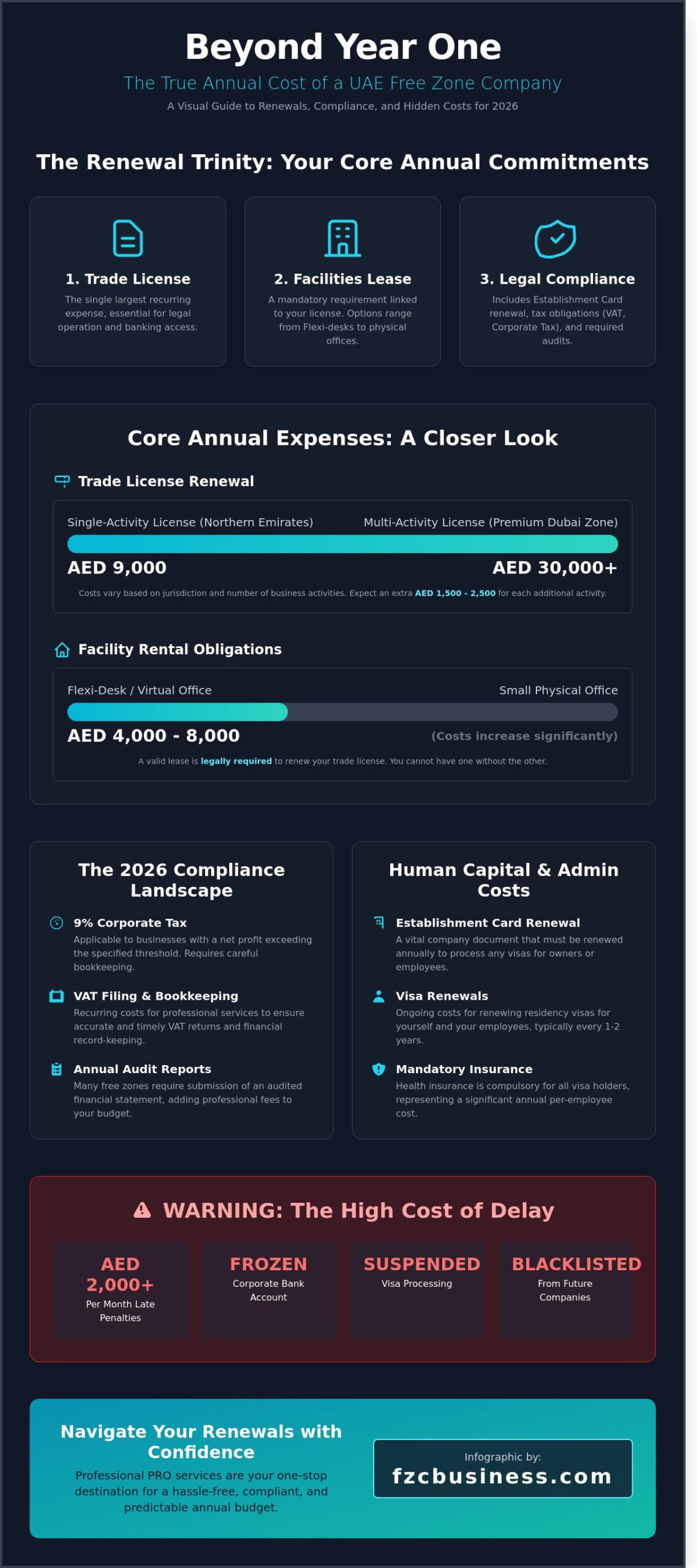
Renewal fees represent the single largest recurring expense for SMEs. For 2026, typical costs range from 9,000 AED to 30,000 AED. This wide variance depends on your chosen jurisdiction and the number of activities listed on your document. For example, a single-service license in a northern emirate like Sharjah or Umm Al Quwain often sits at the lower end of that scale. In contrast, a multi-activity trading license in a premium Dubai hub like DMCC will command higher fees. You can review the initial free zone company setup uae structures to see how these baseline figures are established. Most authorities charge an extra 1,500 AED to 2,500 AED for every additional business activity beyond the standard allowance of three.
Office and Flexi-Desk Rental Obligations
A valid trade license is legally tethered to a lease agreement. You can’t renew one without the other. For entrepreneurs prioritizing budget, a virtual office or Flexi-desk is the most cost-effective facility option. These packages usually cost between 4,000 AED and 8,000 AED annually. If your operations require a physical office, you’ll face higher costs. These include the actual rent, Ejari registration fees (typically around 220 AED plus a 5% housing fee in Dubai), and utility service charges. Physical spaces also require mandatory insurance renewals, which often cost between 500 AED and 2,000 AED depending on the office size and coverage requirements.
Service licenses usually focus on professional expertise and carry lower renewal burdens. A standard service license renewal often averages 12,500 AED. Trading licenses involve the movement of goods, requiring more regulatory oversight and higher base fees. These renewals often start at 18,000 AED. Understanding these distinctions helps you plan your cash flow effectively. Our team provides expert guidance to ensure you choose the most efficient path for your specific growth goals.
Human Capital Costs: Visa Renewals and Mandatory Insurance
Managing human capital is a primary pillar when calculating the ongoing annual costs of a uae free zone company. While the initial setup focuses on licensing, the long term financial health of your business depends on maintaining your team’s legal status. You’ll need to account for both fixed annual fees and prorated biennial expenses to avoid sudden cash flow disruptions. Efficient planning ensures your operations remain compliant with Ministry of Human Resources and Emiratisation (MOHRE) standards without unexpected overhead.
Visa and Establishment Card Maintenance
Most investor and employee visas in UAE free zones operate on a two year cycle. However, smart business owners don’t wait until the second year to budget for these. It’s best practice to annualize these costs by setting aside 50% of the renewal fee each year. For 2026, expect medical testing and Emirates ID renewal fees to remain a standard part of this process. A critical, often overlooked expense is the Establishment Card, also known as the Establishment Data Record (EDR). This card is a prerequisite for all immigration activities; it must be renewed every single year, regardless of your visa’s expiration date. Failure to renew the EDR typically results in a block on the immigration portal, preventing you from hiring new staff or renewing existing permits. Annual EDR renewal fees generally range between AED 2,000 and AED 2,500 depending on the specific free zone.
Employee Benefits and Insurance Mandates
Health insurance is a non-negotiable recurring requirement for every resident in the UAE. As an employer, you’re legally obligated to provide at least the Essential Benefits Plan (EBP) for your staff. In 2026, basic coverage costs approximately AED 600 to AED 900 per employee per year. If you’re providing coverage for dependents or senior management, these premiums can rise significantly based on the chosen tier. You also need to ensure compliance with the Involuntary Loss of Employment (ILOE) insurance scheme. While the premium is low, usually AED 60 or AED 120 per year depending on the salary bracket, the company must verify that staff are registered to avoid stiff penalties. Some specific jurisdictions, such as JAFZA or DMCC, may also require Workmen’s Compensation Insurance. This adds another layer to the ongoing annual costs of a uae free zone company. For expert guidance on these mandates, Fast Zone Business provides comprehensive PRO services to ensure you never miss a compliance deadline.
- Establishment Card: Annual renewal required for all immigration portal access.
- Health Insurance: Mandatory annual premiums for all employees.
- ILOE Scheme: Compulsory unemployment insurance for the workforce.
- Visa Proration: Budgeting for biennial visa costs on an annual basis.
The New Compliance Landscape: Tax, Audit, and Regulatory Fees
The regulatory environment in 2026 is no longer just about simple license renewals. You must account for federal taxes and strict reporting protocols that didn’t exist a few years ago. These elements now form a core part of the ongoing annual costs of a uae free zone company. Staying compliant protects your operational license and ensures your business remains in good standing with the Federal Tax Authority (FTA). It’s no longer optional to ignore these administrative layers if you want a hassle-free experience.
Corporate Tax and VAT Management
Federal Decree-Law No. 47 of 2022 transformed the UAE’s fiscal policy. Most companies now pay a 9% tax on taxable income exceeding 375,000 AED. You might qualify for a 0% rate if you maintain “Qualifying Free Zone Person” status. This requires meeting specific substance requirements and avoiding “disqualified income” as defined by Ministerial Decision No. 139 of 2023. Professional tax consultancy usually ranges from 5,000 AED to 15,000 AED annually. It’s a vital investment to avoid the steep penalties associated with incorrect filings or missed deadlines. VAT compliance is another recurring expense that demands attention. If your taxable turnover hits the 375,000 AED threshold, registration is mandatory. Monthly or quarterly bookkeeping ensures your records are audit-ready. Expect to pay between 1,500 AED and 4,000 AED per month for professional accounting services and VAT-compliant software subscriptions.
Audit and Regulatory Reporting
Major hubs like DMCC, DIFC, and JAFZA require a yearly financial audit to renew your trade license. You must hire an auditor from the specific free zone’s approved list; to find a qualified team for this, check out Bin Hamad Mathew Joseph and Associates Chartered Accountants. Fees for these services typically start around 4,000 AED for small firms and scale upward based on your transaction volume. Beyond audits, Economic Substance Regulations (ESR) remain a priority for companies performing “Relevant Activities” like banking, insurance, or lease-finance. Missing an ESR notification deadline results in a 20,000 AED fine; failing to submit a full report can cost 50,000 AED or more. You must also update your Ultimate Beneficial Ownership (UBO) register annually. While it’s a minor administrative task, oversight leads to immediate blocks on your trade license and potential administrative fines. Our team provides the expert guidance needed to ensure these critical deadlines never slip through the cracks.
Optimizing Your Annual Budget with Professional PRO Services
Managing the ongoing annual costs of a uae free zone company requires more than just paying bills on time. It’s about strategic timing and regulatory compliance. Outsourcing your renewals to experts offers a clear return on investment. While a service fee applies, it’s typically a fraction of the cost of missed deadlines. For instance, late license renewals in many zones trigger immediate fines starting from AED 1,000 per month. By utilizing a “one-stop destination” like Fast Zone Business, you eliminate the risk of these administrative penalties. We ensure your documentation is submitted 30 days before expiry, keeping your operations seamless.
Consolidating your bank account maintenance with corporate renewals is another critical efficiency. Banks in the UAE strictly monitor license and visa validity through the Al Etihad Credit Bureau and internal compliance systems. If your trade license expires, your corporate account can be frozen within 48 hours. This stops your cash flow instantly. Professional PRO services synchronize these updates so your bank records remain current without you needing to visit a branch or upload documents manually multiple times. This proactive management protects your liquidity and your reputation with financial institutions.
The Value of Expert Guidance
Expert PRO services handle the complex web of government approvals automatically. This isn’t just about filing paperwork; it’s about deep local knowledge. We manage interactions with the Ministry of Human Resources and Emiratisation (MOHRE) and the Federal Authority for Identity and Citizenship (ICP) to ensure your visa and labor files remain active. We customize our support to meet your specific needs at every stage, whether you’re a solo consultant or a growing logistics firm. This approach prevents the “bank account freezes” that often paralyze businesses during renewal season.
Strategic Cost Reduction for 2026
As 2026 approaches, look for ways to lower your overhead. Some free zones offer 15% to 20% discounts on three-year license renewals. If your current zone’s costs have climbed too high, migrating to a more cost-effective jurisdiction might be the right move. This can save you upwards of AED 10,000 annually in fixed fees. Before you commit to another year, Book a FREE Consultation with Fast Zone Business to audit your annual costs and identify potential savings.
- Month 9: Conduct an internal audit for Corporate Tax compliance and VAT returns.
- Month 10: Review visa expiry dates for all employees and dependents to avoid overstay fines.
- Month 11: Initiate trade license renewal and update Ejari or flexi-desk lease agreements.
- Month 12: Submit renewed license to your bank and update the Ultimate Beneficial Owner (UBO) register if any changes occurred.
Master Your Business Growth Strategy for 2026
Navigating the financial landscape of 2026 requires more than just a setup plan. Success depends on how well you manage the ongoing annual costs of a uae free zone company, from license renewals to the 9% Corporate Tax threshold for taxable income exceeding AED 375,000. You’ll need to account for mandatory health insurance premiums and the evolving regulatory requirements of the UAE Ministry of Economy. Staying compliant isn’t just about following rules; it’s about protecting your bottom line from unexpected penalties.
Fast Zone Business provides the expert guidance you need to keep your operations running without a hitch. We’ve supported entrepreneurs across more than 10 UAE Free Zones, offering specialized knowledge in Golden Visas and bank account opening. Our team handles the heavy lifting of PRO services and renewals so you can focus on growth. Don’t let administrative hurdles slow your momentum. Secure your business future with a FREE consultation at Fast Zone Business and experience a smooth, efficient path to long-term profitability. Your vision for a thriving UAE enterprise is within reach.
Frequently Asked Questions
Is the UAE Free Zone license renewal a one-time cost?
No, a UAE Free Zone license renewal is a recurring annual requirement rather than a one-time fee. Every year, business owners must pay renewal fees to their respective Free Zone authorities to maintain their legal status and continue operations. These ongoing annual costs of a uae free zone company typically include the license fee and administrative charges. Failing to renew annually leads to legal complications and the potential freezing of your corporate bank account.
What happens if I don’t renew my UAE Free Zone company on time?
You’ll face immediate financial penalties and the suspension of your business activities if you miss the renewal deadline. Most Free Zones impose a monthly fine starting from AED 200 to AED 500 for late renewals. If the delay exceeds three to six months, the authority may terminate your license entirely. Additionally, your corporate bank account will be frozen, and your residency visa could be cancelled or blocked from renewal.
Do I need to pay for an office every year if I work remotely?
Yes, you must maintain a physical or virtual office lease to renew your trade license every year. Even if you work remotely, UAE regulations require every business to have a registered address for compliance purposes. Most entrepreneurs opt for a Flexi-Desk or Smart Office solution, which typically costs between AED 5,000 and AED 12,000 annually. This registered address is essential for receiving official government correspondence and maintaining your banking relationship.
How much should I budget for annual audit fees in 2026?
You should budget between AED 2,500 and AED 10,000 for an external audit, depending on your company’s transaction volume and complexity. By 2026, many Free Zones like DMCC and Shams will continue to mandate the submission of audited financial statements for license renewal. It’s critical to hire an auditor approved by your specific Free Zone authority. Maintaining accurate records throughout the year helps keep these audit costs at the lower end of the scale.
Are there taxes for Free Zone companies in the UAE now?
Yes, the UAE introduced a federal Corporate Tax of 9% on taxable income exceeding AED 375,000 effective from June 1, 2023. Free Zone companies can still benefit from a 0% rate on “Qualifying Income” if they meet strict criteria as a Qualifying Free Zone Person. You must register for Corporate Tax regardless of your profit level. This adds a layer of compliance to the ongoing annual costs of a uae free zone company through mandatory tax filings.
Can I renew my company license without renewing my visa?
You can renew your business license without renewing your personal residency visa, but you can’t renew a visa without a valid license. The trade license is the foundation of your legal presence in the UAE. However, it’s risky to let your visa expire while the company remains active. Most business owners align these renewals to ensure their legal right to live and work in the country remains uninterrupted and hassle-free.
What is the Establishment Card and why must it be renewed?
The Establishment Card, also known as the Immigration Card, is a document that allows your company to register with the immigration authorities to hire staff. It’s essential for issuing employee visas and managing your own residency. Depending on the Free Zone, this card requires renewal every one, two, or three years. Without a valid Establishment Card, you’ll be blocked from all immigration-related services and visa processing for your team.
How can I reduce the ongoing annual costs of my UAE company?
You can reduce costs by opting for a virtual office instead of physical space or by switching to a more affordable Free Zone jurisdiction. Some authorities offer significant discounts of 10% to 20% if you pay for a multi-year license upfront. Consolidating your PRO services with an expert partner like Fast Zone Business also prevents expensive late fines. Regular financial reviews help identify unnecessary subscriptions or services that inflate your annual budget.
