

Key Legal Requirements for Business Setup in Dubai: 2026 Compliance Guide
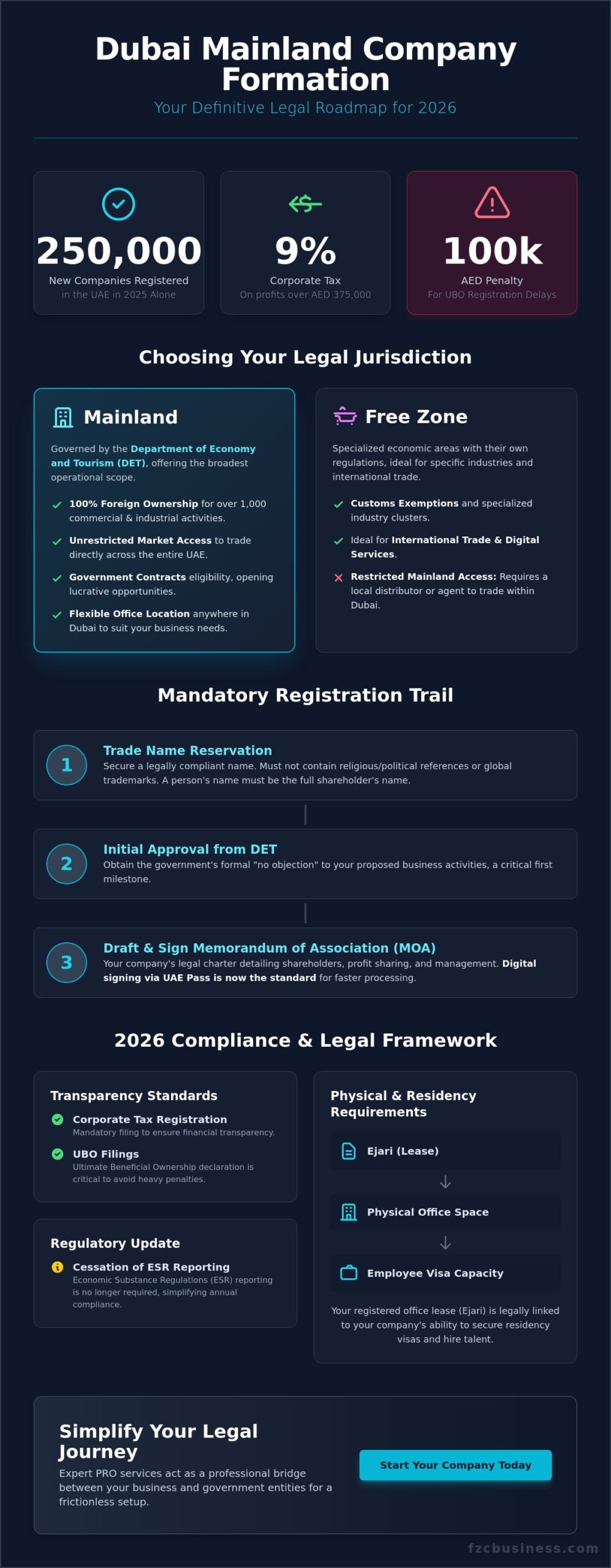
With approximately 250,000 new companies registered in the UAE in 2025 alone, the momentum for entering this market is undeniable. It’s completely natural to feel a sense of urgency mixed with caution as you evaluate the latest dubai mainland company formation requirements for 2026. You’ve likely felt the pressure of balancing the 9% Corporate Tax on profits over AED 375,000 with the strict AED 100,000 penalties for UBO registration delays. The fear of non-compliance is real, but it doesn’t have to stall your progress.
This article provides the definitive legal roadmap you need to master the essential framework and documentation for a successful launch. You’ll gain the confidence to structure your ownership correctly while securing seamless government approvals. We’ll preview the most critical 2026 regulatory updates, including the cessation of ESR reporting and current trade license fee expectations. By the end of this guide, you’ll have a clear, actionable strategy to navigate the local landscape and focus on your core business objectives without administrative friction.
Key Takeaways
- Distinguish between the Department of Economy and Tourism (DET) and Free Zone authorities to leverage 100% foreign ownership laws effectively.
- Navigate the essential dubai mainland company formation requirements by securing mandatory initial approvals and reserving a legally compliant trade name.
- Ensure long-term compliance by mastering the 2026 transparency standards for Corporate Tax registration and Ultimate Beneficial Ownership (UBO) filings.
- Understand the legal link between your physical office space (Ejari) and your company’s capacity for securing residency visas and hiring talent.
- Discover how expert PRO services facilitate a frictionless setup process by acting as a professional bridge between your business and government entities.
Choosing the Right Legal Jurisdiction: Mainland vs. Free Zone
Selecting between a Mainland and Free Zone setup is the most consequential decision in your entrepreneurial journey. This choice dictates your tax obligations, ownership rights, and where you can legally conduct business within Dubai’s diversified economy. While Free Zones offer specialized environments, the Department of Economy and Tourism (DET) governs Mainland entities, providing the broadest operational scope available in the UAE. Understanding these legal distinctions is the first step in mastering the current dubai mainland company formation requirements.
In 2026, the 100% foreign ownership laws remain a primary driver for international investors. Previously, most Mainland commercial activities required a local partner holding 51% of the shares. Today, you can retain 100% ownership of your Mainland company for over 1,000 commercial and industrial activities. This shift has fundamentally simplified the regulatory landscape, allowing you to maintain full control over your operations and profits while benefiting from the UAE’s robust legal framework.
To better understand the nuances of setting up your business, watch this helpful video:
Dubai Mainland Legal Framework
A Mainland license grants you direct access to the local UAE market and the ability to bid for lucrative government contracts without geographic restrictions. You have the freedom to establish your office anywhere in Dubai, which is essential for retail or service businesses targeting specific neighborhoods. You must distinguish between Professional and Commercial licenses. Professional licenses are tailored for service-based activities, while Commercial licenses cover trading. Both structures now offer streamlined paths to full ownership, ensuring your legal setup matches your commercial goals.
Free Zone Legal Framework
Free Zones like IFZA or SHAMS provide customs exemptions and specialized industry clusters that foster rapid growth. These jurisdictions are ideal for companies focused primarily on international trade or digital services. However, legal limitations exist. A Free Zone entity cannot trade directly with the Dubai Mainland market unless it works through a local distributor or a Mainland-registered agent. If your business model relies on physical sales within the city, a Mainland license is typically the more efficient legal route. At Fast Zone Business, we help you weigh these factors to ensure your jurisdiction supports long-term scalability.
The Mandatory Documentation Trail for Dubai Business Registration
Establishing a firm legal foundation requires more than just filling out forms. It involves a precise sequence of approvals that transform a business concept into a recognized legal entity. The first milestone in meeting dubai mainland company formation requirements is obtaining Initial Approval from the Department of Economy and Tourism (DET). This document serves as the government’s formal “no objection” to your proposed activity. Before this, you must secure a Trade Name. Dubai’s naming regulations are strict. Names cannot contain religious references, political affiliations, or trademarked global brands. If you use a person’s name, it must be the full name of the shareholder, not just a surname. The efficiency of these administrative steps is a key reason why the UAE ranks highly in the World Bank’s Doing Business report regarding the ease of starting a company.
Drafting the Memorandum of Association (MOA)
The MOA is your company’s primary legal charter. It explicitly details shareholder percentages, profit-sharing ratios, and management authority. By 2026, the shift toward mandatory digital MOA signing has become the standard for all new registrations. While traditional notarization at Dubai Courts remains an option, most entrepreneurs now utilize the UAE Pass and e-notary systems for faster processing. This digital transition ensures that your legal documents are securely recorded and easily accessible for future renewals or corporate bank account openings. Ensure your management powers are clearly defined within this document to prevent future operational disputes.
Sector-Specific Legal Approvals
Not all business activities are approved by the DET alone. Specialized sectors require external approvals from relevant government ministries before a license can be issued. For instance, healthcare providers must obtain clearance from the Dubai Health Authority (DHA). Educational institutions require the Knowledge and Human Development Authority (KHDA). Engineering and construction firms must satisfy the technical requirements of the Dubai Municipality. These clearances are mandatory precursors to final license issuance and can significantly impact your setup timeline. Managing these multi-agency document flows is complex, which is why many investors rely on professional PRO services to navigate the bureaucratic landscape efficiently. These experts ensure every certificate and permit is in place, preventing costly delays in your operational timeline.
Regulatory Compliance in 2026: Tax, UBO, and ESR
Compliance is no longer a secondary concern for business owners in the UAE. It’s the foundation of your operational longevity. In 2026, the regulatory framework has matured, requiring every entrepreneur to look beyond the initial license. Understanding these specific dubai mainland company formation requirements ensures your business stays on the right side of the law while avoiding massive financial penalties. Proactive management of your corporate obligations is the only way to sustain a frictionless presence in the market.
The UAE Corporate Tax Landscape
Registration for UAE Corporate Tax is mandatory for all entities. Even if your annual taxable profit falls below the AED 375,000 threshold for the 0% rate, you must still register with the Federal Tax Authority (FTA). This isn’t just about paying tax; it’s about transparency. You are legally required to maintain comprehensive financial records for at least seven years. This documentation must clearly demonstrate how your taxable income was calculated, even if no tax is ultimately due. Failure to register within the government-mandated deadlines can lead to administrative fines that disrupt your cash flow. This registration is now a core component of the dubai mainland company formation requirements for any serious investor.
UBO and ESR Compliance
The Ministry of Economy enforces strict Ultimate Beneficial Ownership (UBO) rules to maintain global transparency standards. You must identify any individual who ultimately owns or controls 25% or more of your company. This data must be registered within 60 days of receiving your trade license. If your ownership structure changes, you have only 15 days to update the registry. Non-compliance is expensive. The penalty for failing to maintain an accurate UBO register is AED 100,000.
Regarding Economic Substance Regulations (ESR), a significant update occurred via Cabinet Decision No. 98 of 2024. Reporting is no longer required for financial years ending after December 31, 2022. However, you must keep all ESR-related records from the 2019 to 2022 period for at least six years. This ensures you can satisfy potential retrospective audits by the authorities. Maintaining these archives is a legal necessity for all companies that were previously subject to ESR.
Designated Non-Financial Businesses and Professions (DNFBPs), such as real estate brokers and dealers in precious metals, face additional Anti-Money Laundering (AML) requirements. These entities must register on the goAML portal and implement robust “Know Your Customer” (KYC) protocols. At Fast Zone Business, we provide specialized support to help you navigate these complex reporting cycles without administrative stress. By staying ahead of these filings, you protect your company’s reputation and ensure your trade license remains valid for years to come.
Physical and Residency Legalities: Ejari and Visas
Securing a physical location is more than a logistical hurdle; it’s a legal cornerstone for any business operating within the city. Your office space serves as the official point of contact for government inspections and bank verifications. Understanding the link between your commercial lease and your ability to hire staff is a critical component of dubai mainland company formation requirements. Without a registered address, your company cannot finalize its labor file or issue residency permits to its employees.
Ejari and Office Space Requirements
Your Ejari certificate is the primary proof of a valid commercial address. This system, managed by the Dubai Land Department, records your lease and ensures it complies with local zoning laws. While some jurisdictions allow virtual offices, Dubai Mainland typically requires a physical presence. However, the 2026 Instant License provides a strategic exception; it allows you to operate without a physical office for the first year of registration. This grace period is designed to reduce initial overhead, but you must secure an Ejari before your first license renewal to maintain legal standing.
For startups, co-working spaces and “desk-only” leases have become popular solutions. These arrangements still generate a unique Ejari code, satisfying the legal mandate while keeping costs manageable. The size of your office directly impacts your visa quota. The Ministry of Human Resources and Emiratisation (MOHRE) generally allocates one visa for every 80 to 100 square feet of office space. If you plan to scale your team quickly, ensure your physical footprint supports your hiring goals. You can consult our experts to calculate the exact space needed for your specific visa requirements.
Residency and the Golden Visa
Holding a Mainland license grants you the legal right to apply for an Investor or Partner Visa. This residency permit is typically valid for two years and requires a minimum share value of approximately AED 72,000. For those seeking long-term stability, the 10-year Golden Visa remains the gold standard. This status allows you to live, work, and study in the UAE without a local sponsor. It also provides the legal framework to sponsor your family and domestic staff with ease. Learn more about the UAE Golden Visa: Requirements & Application Steps to see if your investment qualifies for this premium residency tier.
Compliance doesn’t end with the visa stamp. Every Mainland entity must register with the MOHRE and utilize standard employment contracts. These contracts protect both the employer and the employee, outlining salary, benefits, and termination clauses in accordance with UAE Labor Law. Maintaining these records is essential for avoiding labor disputes and ensuring your company remains in good standing for future visa renewals.
Simplifying Your Legal Journey with Fast Zone Business
The 2026 regulatory environment demands more than just administrative filing; it requires a strategic partnership with experts who understand the evolving legal landscape. Fast Zone Business acts as your primary legal bridge to the Department of Economy and Tourism (DET) and various municipal authorities. While some attempt a DIY approach, the risk of legal errors during the document submission phase can lead to costly delays or license rejections. We eliminate this friction by managing every aspect of the dubai mainland company formation requirements, ensuring your setup is compliant from day one.
Our support extends far beyond the initial license issuance. We provide a comprehensive suite of corporate services designed to sustain your business throughout its lifecycle. This includes managing trade name reservations, drafting precise Memorandums of Association (MOA), and facilitating corporate bank account openings. By entrusting these technical hurdles to our team, you can direct your energy toward market entry and growth. We take responsibility for the complex document flows, providing you with the clarity and confidence needed to succeed in a competitive economy.
The Fast Zone Advantage
Our expertise isn’t limited to a single jurisdiction. We maintain deep operational knowledge across both Dubai Mainland and major Free Zones, including SHAMS, IFZA, and RAKEZ. This dual-market proficiency allows us to offer unbiased advice on which legal structure best serves your specific commercial activities. Whether you need a professional license for consulting or a commercial license for regional trade, we handle the nuances of each authority’s specific mandates. For a detailed breakdown of the setup process, read our How to Start a Business in Dubai: A Complete Step-by-Step Guide.
Long-term compliance is the hallmark of a healthy enterprise. We simplify this through proactive company and visa renewal management. Our PRO services ensure you never miss a deadline for Ejari updates, labor file renewals, or UBO filings. This methodical approach protects your business from the “Compliance Red List” and the heavy fines discussed in previous sections. We act as your dedicated administrative department, providing the infrastructure you need to scale without the overhead of an in-house legal team.
Your Next Steps to Success
Your journey begins with a targeted consultation. We map your intended business activities to the most advantageous legal structure, ensuring you meet all dubai mainland company formation requirements without unnecessary expenses. Once the strategy is set, we take over the document collection and submission process. From securing initial approvals to finalizing your residency permits, we provide a seamless, end-to-end experience. Contact us at fzcbusiness.com for a tailored compliance roadmap today. Let’s transform your entrepreneurial vision into a fully operational and legally secure reality.
Secure Your Future in Dubai’s Thriving Market
Launching a business in 2026 requires a precise alignment with the UAE’s evolving legal standards. You’ve learned that mastering dubai mainland company formation requirements involves more than just licensing; it’s about establishing a robust compliance framework. From leveraging 100% foreign ownership laws to ensuring your Ejari supports your long-term visa quotas, every decision impacts your operational scalability. Staying ahead of Corporate Tax registrations and UBO filings is no longer optional; it is the definitive path to avoiding penalties and sustaining a reputable presence.
Fast Zone Business provides the expert guidance you need to navigate these complexities without administrative friction. Our team specializes in 100% foreign ownership structures and offers comprehensive Corporate Tax and VAT assistance to keep your finances in order. We provide expert PRO services for all government approvals, acting as your reliable partner in a sophisticated regulatory landscape. Start Your Compliant Business Setup with Fast Zone Today and focus on your core growth objectives while we handle the legal hurdles. Your successful journey in the UAE starts with a firm, compliant foundation.
Frequently Asked Questions
What is the most important legal requirement for a new business in Dubai?
The most critical legal requirement is obtaining a valid trade license from the Department of Economy and Tourism (DET). This document officially authorizes your activity and serves as the basis for all other dubai mainland company formation requirements, including opening bank accounts and hiring staff. Without this permit, your business has no legal standing in the UAE and cannot enter into commercial contracts.
Can I legally own 100% of my business in Dubai Mainland in 2026?
You can legally own 100% of your Mainland business for the vast majority of commercial and industrial activities. Since the landmark reforms in 2021, the requirement for a local Emirati partner holding 51% of shares has been removed for over 1,000 activities. This allows international investors to retain full control over their operations, capital, and profit distribution without a local intermediary.
Is a physical office legally required for all business licenses?
A physical office space registered via the Ejari system is legally required for Mainland licenses, though some exceptions apply for the first year. The Instant License allows you to operate without a lease for 12 months to reduce initial startup costs. After this period, you must secure a physical location to maintain your license’s validity and fulfill your company’s visa quota obligations.
What are the legal consequences of not registering for Corporate Tax?
Failing to register for Corporate Tax leads to significant administrative fines and potential restrictions on your trade license renewals. Registration is a mandatory legal step for all entities, even if your annual taxable profits are below the AED 375,000 threshold for the 0% rate. Compliance ensures you avoid the Federal Tax Authority’s “Red List” and maintains your standing as a transparent business.
How does the Memorandum of Association (MOA) affect my legal rights?
The Memorandum of Association (MOA) is the legally binding charter that dictates your company’s internal governance and shareholder rights. It explicitly outlines management powers, profit-sharing ratios, and the process for resolving corporate disputes. In 2026, the shift toward digital MOA signing ensures these rights are securely recorded in the government’s central registry for easy access during audits or renewals.
Do I need a local sponsor for a professional license in 2026?
You don’t need a local sponsor or a Local Service Agent (LSA) for a professional license in 2026. Current regulations allow 100% foreign ownership for service-oriented businesses like consulting or design. This provides professional firms with a streamlined setup process and full autonomy over their business decisions, allowing you to focus on client delivery rather than local partnership management.
What is the legal difference between a Trade License and a Commercial License?
A Trade License is the broad category of permit issued to any business, while a Commercial License is a specific type used for trading physical goods. Commercial licenses allow you to import, export, and distribute products within the UAE local market. In contrast, Professional licenses are reserved for service providers and consultants, focusing on the delivery of specialized skills rather than products.
How long does it legally take to set up a company in Dubai?
The legal timeline for setup ranges from a few minutes to several weeks depending on your activity. An Instant License provides immediate approval for many standard activities. However, if your dubai mainland company formation requirements involve external approvals from bodies like the DHA for healthcare or KHDA for education, the process typically takes between 7 and 15 working days to complete.
