

Is It Hard to Start a Business in Dubai? A Realistic 2026 Guide
What if the biggest barrier to your Dubai expansion isn’t government red tape, but the volume of conflicting advice you’ve found online? You’ve likely heard that the Emirates offer a world-class environment for growth, yet you’re probably still asking: is it hard to start a business in dubai when you consider the 2026 tax landscape and strict banking compliance? It’s common to feel hesitant about hidden fees or the complex choice between Mainland and Free Zone structures.
This guide provides a realistic look at the setup process in 2026, offering the clarity you need to move from hesitation to action. We’ll show you how to navigate the 9% Corporate Tax threshold, secure 100% foreign ownership, and streamline your path to a functional corporate bank account. You’ll gain a clear roadmap of the administrative effort required, ensuring your focus remains on your core business objectives rather than regulatory hurdles. From licensing costs to visa renewals, we’ll detail exactly what it takes to succeed in this thriving market.
Key Takeaways
- Learn how the D33 Agenda has digitized the licensing process, reducing administrative friction for entrepreneurs entering the market in 2026.
- Determine whether a Mainland or Free Zone jurisdiction best serves your goals based on your need for local market access or 100% ownership benefits.
- Evaluate the honest reality of is it hard to start a business in dubai by identifying the specific friction points in corporate banking and visa processing.
- Understand your 2026 tax obligations, including the 9% Corporate Tax rate and the AED 375,000 exemption threshold for small businesses.
- Follow a strategic roadmap to define your business activity and secure initial approvals without the risk of costly licensing errors.
The Reality of Doing Business in Dubai in 2026
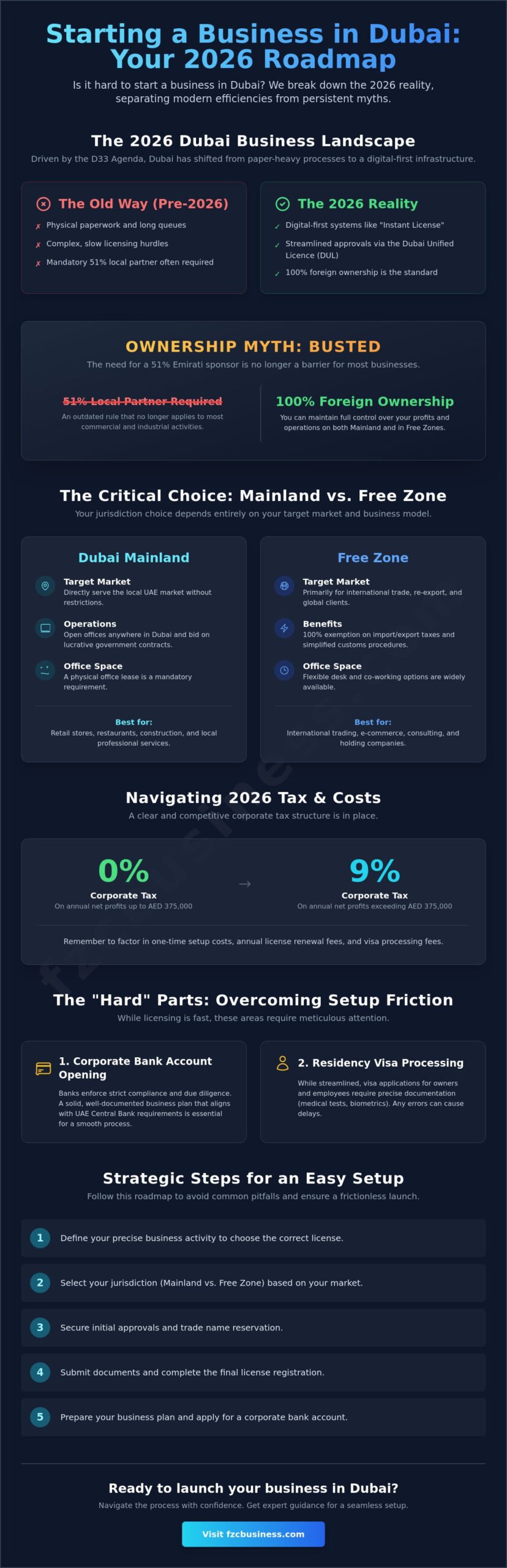
By 2026, the D33 Agenda has fundamentally altered how entrepreneurs perceive entry into the Emirates. While many still ask, is it hard to start a business in dubai, the answer depends on your understanding of the shift from physical paperwork to digital-first infrastructure. Dubai’s strategic focus on doubling its economy over the next decade has simplified many licensing hurdles. Understanding Dubai’s economic landscape helps you see that the city now prioritizes speed and transparency to attract global talent. The Dubai Unified Licence (DUL) serves as the primary 2026 standard for business identification, providing a single digital identity for all registered entities across the city.
To better understand this concept, watch this helpful video:
Is the Process Tedious or Streamlined?
The “paper-heavy” era is largely a thing of the past. Current digital systems, such as the “Instant License,” allow many entrepreneurs to receive their legal documents in under five minutes. However, setup speed isn’t universal. Your specific activity type, chosen jurisdiction, and document readiness determine the timeline. While the initial license is fast, many founders find the “last mile” of setup challenging. Opening a corporate bank account and securing residency visas still require meticulous attention to detail and strict regulatory compliance. You can achieve a frictionless start by ensuring your business plan aligns with current Central Bank requirements before you apply.
The Myth of the Mandatory Local Partner
A common misconception that persists is the need for a local Emirati sponsor to own 51% of your company. The 2021 Commercial Companies Law changes have matured by 2026, making 100% foreign ownership the standard for most commercial and industrial activities on the Mainland. This revolution allows you to maintain full control over your operations and profits without a local partner. Local participation is now only required in a very few strategic sectors, such as oil and gas or defense. Whether you choose Mainland or Free Zone company formation, you can likely enjoy full ownership rights. This policy shift has removed one of the most significant historical barriers, proving that when people ask if is it hard to start a business in dubai, they’re often worrying about rules that no longer apply.
Choosing Your Jurisdiction: Mainland vs. Free Zone
The most critical decision you’ll face isn’t about the cost of your license, but where you intend to sell your goods or services. This choice defines your operational boundaries and determines your long term growth potential. The recent World Bank partnership with UAE highlights the nation’s focus on strengthening its investment climate, making the choice between jurisdictions even more strategic for global investors. While many beginners ask is it hard to start a business in dubai, the difficulty often stems from selecting a jurisdiction that doesn’t align with their target market.
Mainland companies, regulated by the Department of Economy and Tourism (DET), offer unlimited trade within the UAE and the ability to bid on lucrative government contracts. In contrast, Free Zones are specialized hubs designed for international trade. These zones offer 100% import and export tax exemptions and simplified customs procedures, but they generally require a distributor or a separate permit to sell directly into the local UAE market. Your choice should depend on three primary criteria:
- Target Market: Are your clients based locally in Dubai or across the globe?
- Physical Office Requirements: Mainland licenses require a physical office lease, while many Free Zones allow for flexible desk arrangements.
- Employee Count: Your jurisdiction and office size directly impact the number of residency visas you can apply for.
When to Choose Dubai Mainland
Mainland setup is the ideal choice for retail businesses, construction firms, and professional services targeting the local population. It provides the flexibility to open an office anywhere within the Emirate, allowing you to position your brand in high traffic areas. Since 2021, you can maintain 100% ownership of your mainland entity for most commercial activities. For a deeper dive into the specifics of this jurisdiction, read our guide on Business Setup in Dubai Mainland.
When a Free Zone is the Smarter Move
A Free Zone is often the smarter move for tech startups, media agencies, and international consultancies that don’t need local distribution. In 2026, zones like IFZA, Meydan, and Shams continue to be popular for their efficient digital portals and rapid processing times. These hubs provide a supportive ecosystem for specific industries, often including networking events and shared resources. Explore the various options available in our detailed article on Free Zone Company Setup in the UAE. To ensure you select the most cost effective path for your specific activity, consider seeking expert jurisdiction advice before finalizing your application.
The “Hard” Parts: Overcoming Setup Friction
While the digital licensing revolution has simplified the front end of company formation, many investors still wonder is it hard to start a business in dubai when they encounter the administrative middle of the process. The reality is that the license is often the easiest part. True friction usually occurs during corporate bank account opening, residency visa processing, and the meticulous requirement for document attestation. These stages require a precise understanding of UAE regulatory standards to avoid the “rejection loop” that stalls many international founders.
Professional PRO services act as your primary defense against these delays. By managing your interactions with government departments, these experts ensure that your paperwork meets every specific criterion before it reaches a desk for approval. One often overlooked step is the attestation of foreign documents. If your home country certificates aren’t verified by the Ministry of Foreign Affairs (MOFA), your entire application will halt. Anticipating these requirements is the difference between a two week setup and a three month struggle.
Navigating Corporate Bank Account Opening
Banking is the most significant bottleneck for new entrepreneurs. In 2026, UAE banks have intensified their “Know Your Customer” (KYC) protocols to comply with global financial standards. To secure an account, you must provide a detailed business plan, proof of residence, and clear evidence of your professional background. Banks aren’t just looking for your capital; they’re assessing your operational legitimacy. You can significantly increase your approval chances by following our comprehensive guide on How to Open a Bank Account in the UAE. Preparation is your only shortcut here.
Visa and Residency Logistics
Securing your residency is a multi stage chain that begins with an entry permit and concludes with your medical fitness test and Emirates ID biometrics. For many high net worth investors, the 2026 Golden Visa provides a 10 year residency option that removes the need for frequent renewals. If you’re hiring a team, you must also manage employee quotas and labor contracts through the Ministry of Human Resources and Emiratisation (MOHRE). Efficiently managing family sponsorship is another layer of the process. When people ask is it hard to start a business in dubai, they’re usually reacting to this logistical complexity. However, with a methodical approach to each permit, these steps become manageable milestones rather than insurmountable barriers.
Costs and Tax Compliance in 2026
Understanding the financial commitment is essential when you’re evaluating the Emirates for your next venture. Many prospective owners ask is it hard to start a business in dubai because they’re concerned about the transition from a zero tax environment to the current structured fiscal landscape. While the UAE remains one of the most competitive markets globally, 2026 requires a more sophisticated approach to budgeting and compliance than in previous years. You must account for both the visible licensing fees and the regulatory obligations that ensure your company remains in good standing with the Federal Tax Authority (FTA).
The 9% Corporate Tax is a primary consideration for any new entity. This rate applies only to taxable income exceeding AED 375,000, which effectively protects small businesses and early stage startups from a heavy tax burden. However, registration is mandatory for all businesses, including those in Free Zones, and failing to register within the specified deadlines results in an immediate AED 10,000 penalty. Additionally, the 5% Value Added Tax (VAT) remains a factor. Registration becomes mandatory once your taxable supplies and imports exceed AED 375,000, though you can choose to register voluntarily at the AED 187,500 threshold to recover input tax. “Tax-Free” in Dubai now refers to Personal Income, not all Corporate profits.
Annual Renewal and Maintenance
Operational costs don’t end once you receive your trade license. You must budget for annual license renewals and the mandatory update of your office lease agreement, known as Ejari for mainland companies. Under 2026 FTA regulations, maintaining accurate accounting records is no longer optional; it’s a critical requirement for tax audits. Utilizing professional PRO services is the most efficient way to manage these recurring tasks. These experts track your document expiry dates and handle filings, preventing expensive fines related to late renewals or administrative oversights. Staying ahead of these deadlines ensures your operations remain frictionless.
Setup Cost Breakdown (Categories)
It’s helpful to distinguish between one time setup fees and recurring operational costs to avoid cash flow surprises. Your initial budget will be heavily influenced by whether you choose a “Virtual Office” or a “Physical Office.” While virtual options in Free Zones offer a lower entry point, a physical mainland office is mandatory for certain activities and often provides a smoother path for corporate bank account approvals. Be cautious of “cheap” license packages that seem attractive at first. These often lack the necessary quotas or documentation required for visa processing and banking, leading to much higher costs later. To ensure your budget is optimized for your specific goals, contact us for professional VAT and Corporate Tax Assistance to keep your business compliant and profitable.
Strategic Steps to Make Setup Easy
So, is it hard to start a business in dubai? Only if you attempt to navigate the shifting 2026 regulations without a methodical strategy. When you break the process down into logical, manageable phases, the perceived “hardness” disappears. Success in the UAE market is a matter of precision and timing. By following a structured roadmap, you can bypass the common friction points that delay other founders. Fast Zone Business removes the complexity of 2026 regulations by acting as your dedicated administrative partner, ensuring every document meets the current standards of the DET and Free Zone authorities.
- Step 1: Define your activity precisely. Selecting the wrong license code can lead to tax complications or bank account rejection. Precision is mandatory.
- Step 2: Secure your trade name and initial approval. This formalizes your intent with the DED or Free Zone and reserves your corporate identity.
- Step 3: Leverage PRO services. Let experts handle the tedious government liaison work, document attestation, and labor department registrations.
- Step 4: Finalize your workspace. Whether you choose a physical office or a virtual desk, securing your lease or Ejari triggers the final license issuance.
The Value of Professional Guidance
DIY setup often leads to rejected bank applications or incorrect license codes that are difficult to change later. Expert consultants understand the specific nuances of different jurisdictions, such as the unique benefits of Ajman, SHAMS, or IFZA zones. For instance, some zones are better suited for e-commerce, while others prioritize industrial growth. Choosing the wrong hub can limit your future expansion or visa quotas. For a detailed breakdown of the entire journey, consult our guide on How to Start a Business in Dubai. Expert advice ensures your structure is built for long-term growth from day one.
Final Checklist for 2026 Founders
Before you fly to Dubai, ensure you have these five essential documents ready to expedite your application: your passport copy, a high-resolution passport photo, a brief business plan summary, an updated professional CV, and your UAE entry stamp or current visa copy. While an “Instant License” can be issued in as little as 48 hours, you should realistically budget four weeks for your corporate bank account opening. Managing these expectations prevents operational downtime. If you’re ready to transition from planning to execution, book a free consultation with Fast Zone Business to simplify your journey and secure your place in Dubai’s thriving economy.
Securing Your Future in the Dubai Market
Success in Dubai’s 2026 landscape requires more than just an entrepreneurial spirit; it demands a precise alignment with the city’s evolving regulatory framework. As we’ve explored, the fundamental choice between Mainland and Free Zone jurisdictions dictates your market access, while the 9% Corporate Tax threshold makes financial compliance a primary focus. While you might still wonder is it hard to start a business in dubai, the reality is that the process is only as difficult as your lack of preparation. By matching your business activity to the correct license and preparing for the rigorous KYC standards of local banks, you can transform administrative friction into a competitive advantage.
You don’t have to navigate these complexities alone. Our specialists in Mainland and Free Zone formation provide 2026-ready tax and compliance support to keep your operations secure. With expert PRO services for all government approvals, we handle the technical hurdles so you can focus on growth. Start your stress-free Dubai business journey with Fast Zone Business today. Your vision for a successful international enterprise is within reach, and the right guidance makes all the difference.
Frequently Asked Questions
Is it possible for a foreigner to start a business in Dubai without a local partner in 2026?
Yes, foreigners can maintain 100% ownership of their companies in both Mainland and Free Zone jurisdictions for almost all commercial and industrial activities. The requirement for a local Emirati partner to hold a 51% stake was largely abolished for the Mainland in 2021. Only a small number of strategic sectors, such as defense and certain utilities, still require local participation. This makes the entry process significantly more attractive for international investors.
How much does it actually cost to start a small business in Dubai?
Total costs depend on your specific business activity, the number of visas required, and whether you choose a Mainland or Free Zone setup. You’ll need to budget for license fees, initial approvals, and mandatory residency costs. Additional expenses often include office rentals or flexi-desk fees. Because each business has unique requirements, it’s best to request a customized quote to avoid underestimating your initial capital needs for 2026.
Can I start a business in Dubai while living in another country?
You can initiate most of the business setup process remotely through digital portals and the Dubai Unified Licence system. Many Free Zones allow for 100% remote registration and document submission. However, you must eventually travel to the UAE to complete your medical fitness test and biometrics for your residency visa. Opening a corporate bank account also typically requires a physical meeting with a bank representative to finalize KYC procedures.
How long does the business setup process take in 2026?
Obtaining a trade license can take as little as 48 hours for certain activities using “Instant License” systems. However, the complete journey, including visa processing and corporate bank account opening, usually takes four to six weeks. While the legal formation of the company is rapid, the administrative steps required to become fully operational involve multiple government departments and strict compliance checks that require a realistic and patient timeline.
Do I need a physical office to get a trade license in Dubai?
A physical office lease is mandatory for all Mainland businesses and must be registered through the Ejari system. In contrast, many Free Zones offer flexible “flexi-desk” or “virtual office” packages that satisfy licensing requirements without the need for a dedicated physical space. If you plan to hire employees, your office size will directly determine your visa quota, making space selection a strategic operational decision for your growth.
What is the hardest part about starting a business in Dubai?
Most entrepreneurs find that is it hard to start a business in dubai primarily because of the strict corporate banking and KYC requirements. While the licensing process is highly digitized and efficient, UAE banks enforce rigorous standards to ensure global financial compliance. Successfully opening an account requires a comprehensive business plan and verifiable proof of residence. Navigating these specific banking expectations is often the most time-consuming phase of the entire setup journey.
Is Dubai still tax-free for businesses in 2026?
Dubai is no longer entirely tax-free for corporate entities. A standard Corporate Tax rate of 9% applies to taxable profits exceeding AED 375,000. Profits below this threshold remain subject to a 0% rate to support small businesses and startups. Additionally, a 5% VAT applies to most goods and services. However, personal income tax remains at 0%, allowing individuals and business owners to retain their full salaries and dividends without personal deductions.
What is the difference between a Mainland and a Free Zone license?
A Mainland license allows you to trade freely anywhere within the UAE and bid for government contracts, but it requires a physical office. A Free Zone license is ideal for international trade and consultancies, offering 100% import and export tax exemptions within a specialized hub. While Free Zones provide streamlined processes, they often require a distributor or a separate permit to sell directly to the local UAE market outside the specific zone’s boundaries.
