

Expanding from UAE Free Zone to Mainland: The 2026 Strategy Guide
The era of choosing between the tax efficiency of a free zone and the total market reach of the mainland is officially over. For years, entrepreneurs have struggled with geographical restrictions that blocked them from lucrative government tenders and local trading. If you’ve found yourself caught in the complexity of managing multiple licenses just to scale, you’re not alone. The landscape has shifted, and expanding from uae free zone to mainland is now a streamlined reality rather than a regulatory hurdle.
This guide provides the definitive strategy to master your transition using the framework established by Dubai Executive Council Resolution No. (11) of 2025. You’ll discover how to unlock full access to the local market while maintaining your qualifying tax benefits under the latest 2026 standards. We’ll preview the digital application process through the Invest in Dubai platform, explore hybrid operational models, and outline the steps you must take before the March 21, 2026 compliance deadline to ensure a frictionless expansion for your professional journey.
Key Takeaways
- Understand how Resolution No. (11) of 2025 dismantles operational barriers, allowing free zone entities to access the wider UAE economy.
- Learn how expanding from uae free zone to mainland provides direct access to local markets and eligibility for high-value government contracts.
- Identify the most efficient pathway for your business, whether through a mainland branch or a dedicated DET license.
- Master the critical compliance steps, including obtaining a No Objection Certificate (NOC) and securing activity approvals from the DET.
- Discover how professional PRO services can manage complex government documentation to ensure a seamless and compliant expansion.
The Evolution of Business: Why Expand to Mainland in 2026?
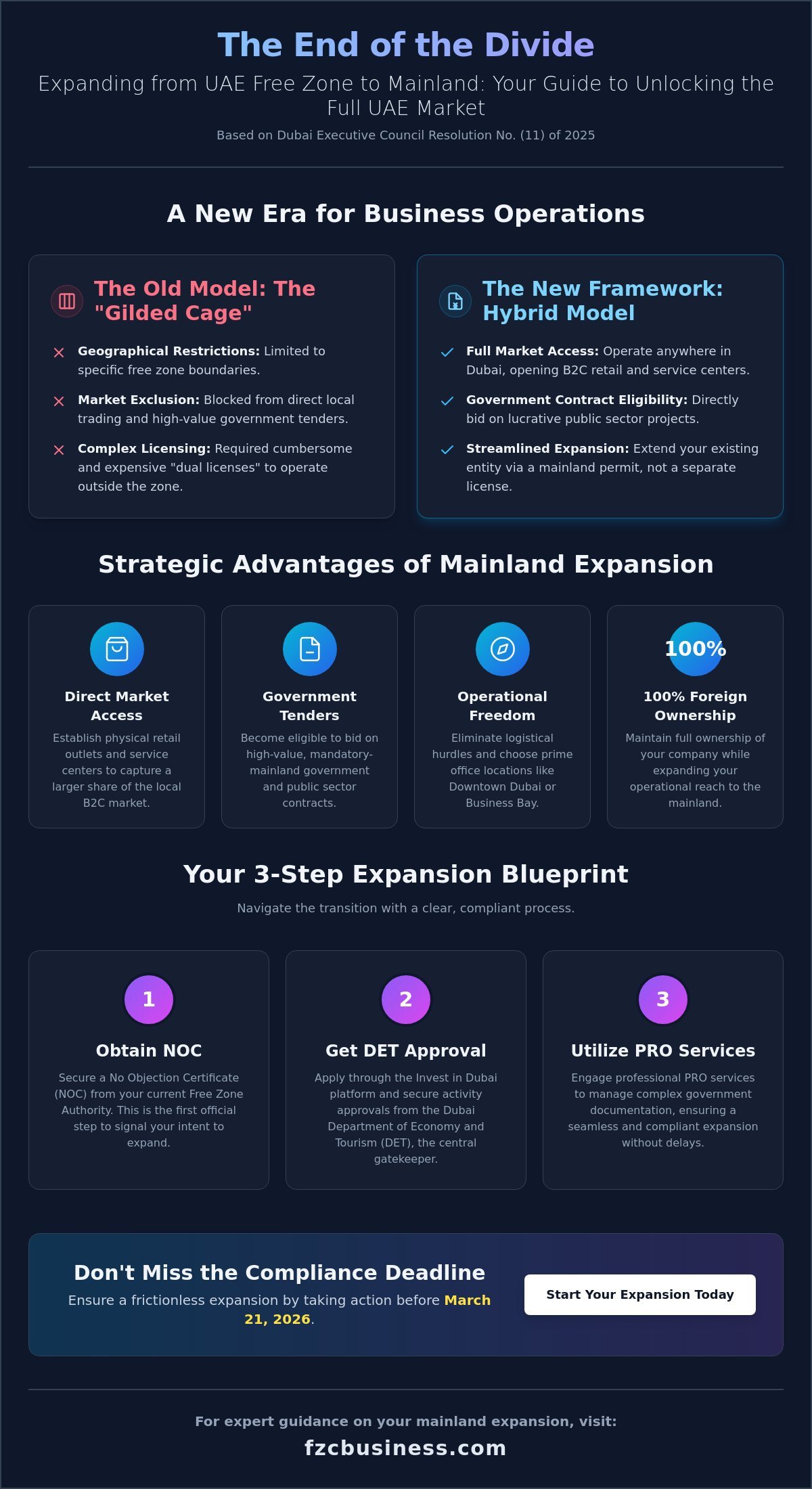
The business environment in the Emirates is undergoing its most significant transformation in decades. Historically, UAE free trade zones offered a sanctuary for international trade but often acted as a gilded cage, restricting operations to specific geographical boundaries. Expanding from uae free zone to mainland is the strategic move that breaks these walls, allowing companies to trade directly with the local market and government entities without middle-men or restricted permits.
This evolution is driven by the Dubai Economic Agenda (D33), which aims to double the size of the economy by 2033. The old “Dual Licensing” model, while functional, was often cumbersome and expensive. With the integrated Resolution 11 framework introduced in 2025, the process has become a streamlined expansion rather than a fragmented setup. It’s about creating a hybrid operational model that leverages the best of both worlds while aligning with the emirate’s long-term growth vision.
To better understand the core differences and why this shift matters for your growth, watch this helpful breakdown:
Tapping into Local and Government Contracts
Mainland status is no longer just a “nice to have” feature; it’s a prerequisite for serious growth. If you’re looking to bid on high-value government tenders, a mainland license is usually mandatory. Pure free zone entities are often ineligible for these lucrative contracts. Beyond the public sector, expanding from uae free zone to mainland opens massive B2C opportunities. You can establish physical retail outlets or service centers anywhere in Dubai, reaching customers where they live and work rather than waiting for them to find you in a remote zone. This direct access is the key to capturing a larger share of the local market.
The Limitations of the Traditional Free Zone Model
The “onshore vs offshore” dilemma has long frustrated ambitious entrepreneurs. Traditional free zone models come with strict geographical boundaries that limit where you can have a physical office. If your team is growing and you need a central location in Downtown Dubai or Business Bay, a free zone license won’t suffice. Logistics companies also face hurdles with local distribution when restricted to a zone. These barriers often lead to increased costs and slower delivery times. Transitioning to the mainland eliminates these friction points, providing the operational flexibility needed for resource optimization. For businesses ready to scale, Fast Zone Business provides the expert guidance needed to navigate these regulatory shifts.
Understanding Executive Council Resolution No. (11) of 2025
The regulatory landscape in Dubai reached a pivotal milestone on March 17, 2025. On this date, H.H. Sheikh Hamdan bin Mohammed bin Rashid Al Maktoum issued Executive Council Resolution No. (11) of 2025. This landmark ruling changed the trajectory for thousands of companies by effectively dismantling the operational wall that once separated free zones from the mainland. Before this resolution, expanding from uae free zone to mainland was a fragmented process involving entirely separate legal identities. Now, it’s a strategic extension of your existing business.
The Dubai Department of Economy and Tourism (DET) acts as the central gatekeeper in this new framework. While your original Free Zone Authority remains your primary regulator, the DET provides the necessary permits to operate onshore. This collaborative approach ensures that businesses entering the local market meet the rigorous standards of the Dubai economy. Most Dubai-based free zone jurisdictions are participating in this integrated model, focusing initially on non-regulated sectors like consultancy, technology, and professional services. If you’re looking to streamline this transition, our team at Fast Zone Business can help you verify your eligibility and manage the DET interface.
Key Provisions for Free Zone Establishments
One of the most reassuring aspects of the 2025 resolution is the protection of your ownership structure. You can maintain 100% foreign ownership while expanding from uae free zone to mainland. This removes the historic anxiety regarding local partnership requirements for branch setups. However, this flexibility comes with specific requirements. You must obtain a DET-issued permit or license for any onshore activities, and you’re required to maintain separate financial records for your mainland operations. It’s also important to recognize specific exclusions. Financial institutions operating within the DIFC, for instance, follow a separate regulatory path under the DFSA and don’t fall under this specific resolution’s scope.
Compliance and Annual Renewal Requirements
Expanding your reach doesn’t mean you can ignore your roots. Maintaining your original Free Zone license in good standing is a non-negotiable requirement for onshore operations. If your primary license expires or faces a labor ban, your mainland permit will likely be suspended. The renewal cycle for these expansion permits is typically annual, aligning with standard UAE licensing practices. For businesses already operating outside their designated zones, the countdown has begun. You must fully comply with the new resolution by the March 21, 2026, deadline to avoid penalties. Resolution 11 serves as the vital regulatory bridge for Free Zone growth in 2026.
Pathways for Expanding from Free Zone to Mainland
Selecting the correct structural pathway is the most critical decision for any entrepreneur expanding from uae free zone to mainland. The right choice balances operational freedom with administrative efficiency. Currently, three primary routes exist for businesses looking to cross the jurisdictional line. You can establish a formal mainland branch, secure a separate license from the Department of Economy and Tourism (DET), or utilize the new integrated permit system introduced by Resolution 11 of 2025. Each option carries distinct implications for your corporate liability, setup speed, and long-term compliance costs.
A separate DET license is often preferred by businesses that want to keep their mainland and free zone operations entirely distinct, perhaps for different service lines or partnership structures. However, for most established firms, the integrated permit system represents the most modern and efficient approach. This strategy for expanding from uae free zone to mainland aligns with the digital-first focus of the Invest in Dubai platform, significantly reducing the time spent on government documentation and physical inspections.
The Mainland Branch Model
A mainland branch acts as a direct legal extension of your parent company. Unlike a subsidiary, it doesn’t possess a separate legal identity, which means the parent entity remains liable for all branch obligations. This structure is highly efficient for resource optimization. Choosing this route allows you to use your existing workforce across both jurisdictions without complex secondment agreements. Managing a branch also simplifies your financial architecture. You can often link the branch’s operations to your existing corporate bank account, provided you maintain the required separate financial records for mainland revenue to comply with the 9% corporate tax threshold for onshore profits.
The New Integrated DET Permit
The integrated permit is the cornerstone of the 2025/2026 regulatory shift. It’s designed for free zone entities that need to conduct specific activities onshore without the overhead of a full second license. The key to success here is activity matching. Your existing activities must align with the official DET classifications to qualify for the permit. This system is particularly beneficial for consultancy, design, and professional service firms. Obtaining this permit doesn’t alter your Free Zone company setup or its “Qualifying Free Zone Person” status for tax purposes, provided you meet the relevant economic substance requirements. It simply provides the legal authorization to serve clients directly on the mainland.
Step-by-Step Guide to the Expansion Process
Executing a successful transition requires more than just a strategic plan; it demands a precise sequence of government approvals. Expanding from uae free zone to mainland is a multi-stage journey that begins with your current regulator. You’ll first need to obtain a No Objection Certificate (NOC) from your Free Zone Authority. This document serves as official clearance, confirming your company is in good standing and authorized to extend its reach. Once you have this, the focus shifts to the Department of Economy and Tourism (DET). You’ll reserve your trade name and seek activity approval, ensuring your services align with mainland classifications.
The digital transformation of UAE government services has simplified these initial hurdles. Most of these steps are now managed through the Invest in Dubai (IID) platform, which acts as a centralized hub for your application. If you want to avoid the administrative burden of these filings, you can leverage our PRO services to manage the entire documentation cycle from start to finish.
The Role of Ejari and Physical Office Space
One of the most significant changes when expanding from uae free zone to mainland is the office requirement. While many free zones allow virtual offices or flexi-desks, the DET requires a physical presence for mainland licenses. You’ll need to secure a commercial lease and register it through the Ejari system. This certificate is a mandatory prerequisite for final license issuance. In 2026, regulations allow for more flexible shared office models for certain professional activities, but many trading and industrial licenses still require a dedicated, independent office space to pass physical inspections.
Visa Migration and Labor File Opening
Managing your workforce during an expansion is often the most complex phase. You’ll need to open a new labor file with the Ministry of Human Resources and Emiratisation (MOHRE) to sponsor mainland-based staff. A common point of confusion is what happens to your existing team. Under the 2025 resolution, you don’t necessarily need to cancel and re-issue every visa, but you must register your intention to use your free zone workforce for mainland operations. For new hires specifically for the mainland branch, you’ll follow a separate quota system. It’s vital to keep these two labor files synchronized to stay compliant with the latest UAE labour law. This dual-file management ensures your employees are legally protected while working across different jurisdictions.
How Fast Zone Business Simplifies Your Mainland Expansion
Transitioning your operations requires more than just paperwork; it demands a strategic partner who understands the friction points between different jurisdictions. Expanding from uae free zone to mainland involves managing the delicate relationship between your current Free Zone Authority and the Department of Economy and Tourism. We provide the expert guidance needed to navigate these entities, ensuring your application moves through the Invest in Dubai platform without technical delays. Our role is to act as your single window for growth, allowing you to focus on market capture while we handle the regulatory heavy lifting.
Choosing the right path is essential for resource optimization. Whether you need a full branch license or a temporary six-month permit, we analyze your specific activities to recommend the most cost-effective solution. For ambitious founders, this expansion is often the perfect catalyst for a Golden Visa application. We assist expanded business owners in securing long-term residency, anchoring your professional journey in the UAE’s thriving economy. Our team ensures that your corporate structure supports your personal residency goals as much as your commercial ones.
Comprehensive PRO and Visa Support
Administrative hurdles with the Ministry of Labour and Immigration can stall even the best expansion plans. Our PRO services eliminate these bottlenecks by leveraging established government connections to fast-track your approvals. We don’t just set up your license; we manage the ongoing lifecycle of your business. This includes coordinating company and visa renewals to ensure your operations remain uninterrupted. By handling the labor file openings and employee registrations discussed in previous sections, we provide a frictionless experience for your entire team. We understand the urgency of business, so we prioritize speed and accuracy in every government interaction.
Financial and Tax Compliance Integration
Expanding your footprint changes your fiscal responsibilities. Under the 2026 regulatory framework, mainland operations are subject to a 9% corporate tax on profits exceeding AED 375,000. We ensure your corporate structure is optimized for this regime while helping you maintain separate financial records to protect your qualifying free zone tax benefits. Our team also manages the necessary updates to your VAT registration to reflect your new mainland status. This holistic approach prevents costly compliance errors that can arise when expanding from uae free zone to mainland. Ready to grow? Contact Fast Zone Business today for a tailored expansion roadmap that turns regulatory complexity into a competitive advantage.
Secure Your Competitive Edge in the UAE Market
The regulatory shift introduced by Resolution 11 of 2025 provides a unique window for sustainable growth. By expanding from uae free zone to mainland, you’re no longer restricted by geographical boundaries or limited to international trade. You now have the roadmap to tap into lucrative local government contracts and establish a physical presence across Dubai while retaining your essential free zone tax benefits. With the March 21, 2026, compliance deadline approaching, taking proactive steps ensures your business remains operational and ahead of the competition.
Fast Zone Business acts as your dedicated partner in this transition, specializing in the seamless integration of mainland and free zone frameworks. We provide expert PRO services to navigate complex DET and MOHRE approvals, alongside a proven track record in Golden Visa facilitation and corporate bank account opening. Don’t let administrative hurdles or regulatory changes slow your momentum. Start your Mainland Expansion with Fast Zone Business and unlock the full potential of the UAE’s thriving local economy. Your journey toward a truly borderless and scalable business model starts today.
Frequently Asked Questions
Can a Free Zone company trade directly with mainland Dubai in 2026?
Yes, free zone companies can trade directly with the local market provided they obtain the necessary mainland permit or branch license. Under the current regulatory framework, businesses are no longer restricted to their designated zones or required to use local distributors. This shift allows for direct B2B and B2C engagement across the entire emirate while maintaining your primary headquarters in the free zone.
What is Resolution 11 of 2025 regarding Free Zone expansion?
Executive Council Resolution No. (11) of 2025 is the landmark legislation issued on March 17, 2025, that enables free zone entities to operate on the mainland. It creates a legal bridge for expanding from uae free zone to mainland by establishing a clear permit system managed by the Department of Economy and Tourism (DET). The law requires all businesses currently operating outside their zones to become fully compliant by the March 21, 2026, deadline.
Do I lose my 100% ownership if I expand to the mainland?
No, you do not lose your 100% foreign ownership when expanding to the mainland. The 2025 resolution and current UAE companies law allow international entrepreneurs to maintain full equity in their mainland branches or licensed entities. This ensures you retain total control over your operations and corporate structure while accessing the wider UAE economy without the need for a local partner.
How much does it cost to expand from a Free Zone to the mainland?
The cost of expansion depends on your chosen pathway, such as a temporary six-month permit or a permanent annual branch license. Total fees are determined by the Department of Economy and Tourism (DET) based on your specific business activities and the number of visas required. You’ll also need to budget for the mandatory physical office lease and Ejari registration, which are prerequisites for mainland licensing.
Is a physical office required on the mainland for Free Zone companies?
Yes, securing a physical office space on the mainland is a mandatory requirement for any free zone company looking to operate onshore. While your free zone license might allow for a virtual office, the DET requires a registered commercial lease and an Ejari certificate for mainland expansion. This physical presence ensures compliance with local labor regulations and facilitates government inspections.
Can I use my existing Free Zone bank account for mainland operations?
You can typically use your existing corporate bank account for mainland activities, but you must maintain separate financial records for onshore revenue. This distinction is vital for tax compliance, as profits generated from mainland operations exceeding AED 375,000 are subject to a 9% corporate tax. It’s important to notify your bank about your expanded license to ensure your account remains compliant with UAE central bank regulations.
How long does the expansion process typically take?
The process for expanding from uae free zone to mainland generally takes between 5 to 10 working days once all documentation is finalized. The timeline is influenced by how quickly your Free Zone Authority issues a No Objection Certificate (NOC) and the time required for DET activity approvals. Utilizing digital platforms like Invest in Dubai has significantly streamlined these steps compared to traditional manual filings.
Do I need a local sponsor for a mainland branch in 2026?
No, you don’t need a local sponsor or a National Service Agent for a mainland branch in 2026. The UAE has modernized its licensing requirements to allow foreign investors full ownership across most commercial and professional sectors. This removal of the local sponsorship requirement reduces your administrative overhead and provides a more direct, transparent path for scaling your business into the local market.
