

Employee Visa Process UAE: The Complete 2026 Guide for Employers & Expats
What if a single clerical error on a work permit application cost your company 50,000 AED in avoidable labor fines this year? You probably feel that the employee visa process uae is a moving target, especially with the frequent regulatory updates from MOHRE and GDRFA. It’s stressful to manage tight deadlines while trying to avoid administrative hurdles that delay your team’s productivity. You want a reliable path that removes the guesswork and protects your bottom line.
This 2026 guide promises to give you total clarity on every stage of the residency journey, from the initial offer letter to the final residency stamping. We’ll provide expert guidance on the latest compliance mandates and the specific costs associated with onboarding new talent. You’re about to discover a linear, step-by-step roadmap that ensures a smooth experience for both your HR department and your new expatriate hires. We will cover everything from medical fitness standards to the nuances of free zone versus mainland requirements, providing the in-depth knowledge needed for a hassle-free setup.
Key Takeaways
- Identify the critical differences between Standard and Green Visas to choose the most efficient residency path for your 2026 hires.
- Navigate the end-to-end employee visa process uae with a clear, phase-by-phase roadmap from initial offer to final residency stamping.
- Break down complex government fees and company tiers to accurately forecast and manage your recruitment budget with expert guidance.
- Ensure total regulatory compliance by mastering mandatory health insurance requirements and MOHRE contract standards for Dubai and Abu Dhabi.
- Learn how professional PRO services provide a hassle-free experience through real-time tracking and expert document management.
Understanding UAE Employment Visa Types in 2026
The UAE labor market entered 2026 with a highly streamlined regulatory framework designed to attract global talent. Understanding the employee visa process uae requires recognizing the distinction between traditional sponsorship and the newer self-sponsored categories. For a foundational perspective on how these permits function within the national legal framework, reviewing a UAE visa policy overview helps clarify how these permits integrate with broader entry requirements. Fast Zone Business provides expert guidance to ensure a smooth experience for both employers and candidates during this initial selection phase.
To better understand the practical steps involved in securing these permits, watch this helpful video:
The 2026 residency landscape is split between the Standard Work Visa and the Green Visa. Standard visas remain the cornerstone of the private sector, requiring a local employer to act as the legal sponsor. In contrast, the Green Visa has gained significant traction among skilled professionals who prefer independence from a single employer. Jurisdictional differences also play a role. Mainland companies operate under the direct regulations of federal ministries, while Free Zone entities follow the specific rules of their respective authorities, often resulting in varying employee visa process uae timelines and costs.
Standard Work Visa vs. Green Visa: Which is Right?
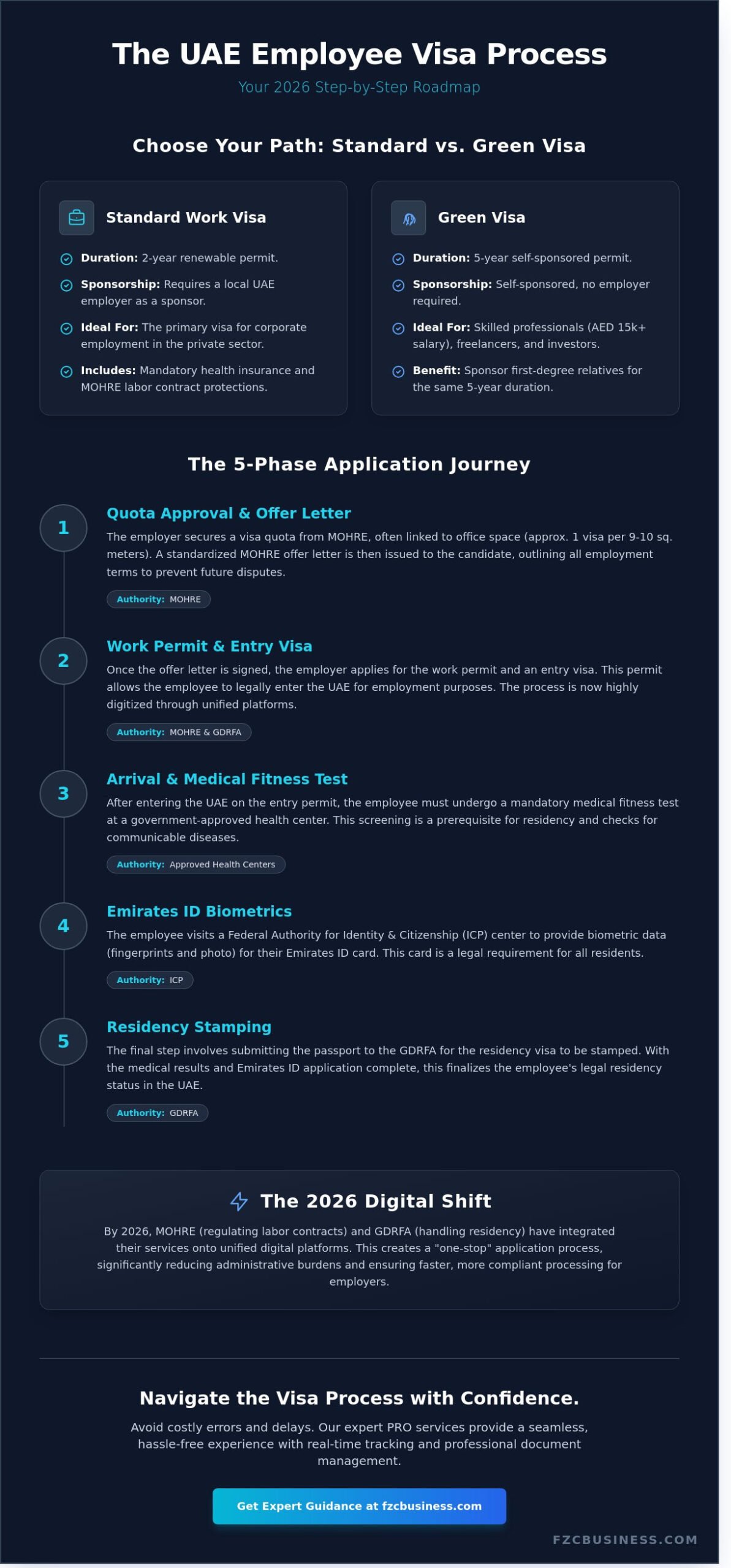
Eligibility for the Standard Work Visa depends on a valid job offer from a UAE-registered company. This visa provides a 2-year renewable permit and includes mandatory health insurance and labor contract protections. The Standard Work Visa is the primary vehicle for corporate employment in 2026. For high-tier talent, the 5-year Green Visa offers a self-sponsored alternative. It targets freelancers, skilled employees with a minimum monthly salary of AED 15,000, and investors. The Green Visa allows holders to sponsor their first-degree relatives for the same duration, providing a more stable long-term residency option without the need for a corporate sponsor.
The Role of MOHRE and GDRFA in 2026
The Ministry of Human Resources and Emiratisation (MOHRE) manages the issuance of work permits and the regulation of labor contracts across the mainland. Their digital systems ensure that all employment agreements comply with the latest UAE labor laws. In Dubai, the General Directorate of Residency and Foreigners Affairs (GDRFA) handles the actual residency stamping and entry permit approvals. By 2026, unified digital platforms have merged these once-separate processes. This integration allows for a “one-stop” digital application where labor permits and residency visas are processed simultaneously, reducing the administrative burden on businesses. Fast Zone Business utilizes in-depth knowledge of these systems to provide a hassle-free setup at https://fzcbusiness.com/, ensuring all regulatory filings are accurate and timely.
The Step-by-Step Employee Visa Application Process
The employee visa process uae consists of five distinct phases that bridge the gap between a job offer and legal residency. This journey is designed to protect both the employer and the expat by ensuring all labor rights are documented and health standards are met. In 2026, the system is more digitized than ever, reducing the need for physical paperwork and long wait times at government centers.
From Quota Approval to Entry Permit
The process starts with the company securing a visa quota through the Ministry of Human Resources and Emiratisation (MOHRE). Authorities link quota availability directly to the physical office space listed on your trade license. Typically, the government grants one visa for every 9 to 10 square meters of office area. Once the quota is secured, the employer must issue a MOHRE-standardized offer letter. This document is vital. It prevents labor disputes by clearly outlining salary, benefits, and job responsibilities in a format the government recognizes.
According to the Official UAE Government Visa Portal, this step ensures all contracts align with federal labor laws before the expat even arrives. After the signed offer is submitted and the initial fee is paid, the Entry Permit, often called the “Pink Visa,” is issued. In 2026, the timeline for Entry Permit issuance is efficient, usually taking just 3 to 5 working days. This permit allows the employee to enter the country or, if they’re already inside, triggers the status change process.
Medical Fitness and Biometrics: The Physical Steps
Once the entry permit is processed and the status is changed, the candidate undergoes a mandatory medical fitness test at an authorized government health center. This screening checks for communicable diseases such as HIV and Tuberculosis. If a result is “unfit,” the applicant is generally required to leave the country. However, 2026 regulations allow for specific appeals and re-tests in cases where old, inactive TB scars are present, provided the individual is not a threat to public health.
Following a successful medical test, the employee attends a biometrics appointment. This step captures fingerprints and a retina scan for the next-generation Emirates ID. These advanced IDs now serve as the primary proof of residency, replacing the traditional physical passport stickers for most visa categories. The final stage involves the issuance of the Labour Card and the digital residency stamping. The entire employee visa process uae is now largely paperless, with all records stored in the ICP smart system. If you’re managing a growing team, getting expert guidance on PRO services can help you avoid administrative bottlenecks during these critical final steps.
- Phase 1: Securing the Quota and Offer Letter Approval via MOHRE.
- Phase 2: Issuance of the Entry Permit for legal entry.
- Phase 3: Status Change to update the applicant’s legal file.
- Phase 4: Medical Fitness Test and Emirates ID Biometrics.
- Phase 5: Residency Stamping and final Labour Card issuance.
Completing these steps accurately ensures that the business remains compliant with the latest 2026 labor reforms. It also provides the employee with the security needed to begin their professional life in the UAE without legal hurdles.
Once these legal hurdles are cleared, many expatriates look forward to exploring their new home and the wider region; Crescent Travel Solutions provides curated adventure trips and global tour packages to help new residents make the most of their international relocation.
Essential Costs and Documentation for UAE Employers
Managing the employee visa process uae requires a clear understanding of the Ministry of Human Resources and Emiratisation (MOHRE) fee structures. In 2026, the UAE continues to use a tiered system for company classification that directly impacts your overhead. Tier 1 companies, which demonstrate high levels of Emiratisation and compliance, enjoy significantly lower work permit fees. Tier 2 remains the standard category for most compliant businesses, while Tier 3 applies to firms with legal violations or a lack of workforce diversity. Each application involves fixed government levies like the AED 10 Knowledge Dirham and the AED 10 Innovation Fee. These are non-negotiable components of every transaction.
Security deposits have evolved into a more flexible system. While the traditional AED 3,000 bank guarantee is still an option, most employers now opt for the Workers’ Protection Insurance Scheme. This insurance costs approximately AED 60 per year per employee. It provides a more cash-flow-friendly alternative for startups and established firms alike. You must also account for mandatory medical fitness tests and Emirates ID processing fees, which vary based on the speed of service and the duration of the residency.
Mandatory Document Checklist for 2026
Precision in documentation prevents costly delays. For skilled positions, you must provide educational certificates that have undergone the full attestation cycle, including the Ministry of Foreign Affairs (MOFA) in the UAE. Your company must present a valid Trade License and an active Establishment Card. Employee requirements include a passport copy with at least six months of validity and digital photographs. These photos must have a white background and meet specific biometric standards set by the ICP to ensure acceptance in the employee visa process uae.
Budgeting for Visa Costs: A Strategic View
Total costs per employee generally include the work permit fee, entry permit, status adjustment, medical screening, and Emirates ID. For a standard mainland company in Tier 2, these government fees typically range between AED 3,000 and AED 7,000 excluding any private PRO service charges. Using Fast Zone Business helps startups navigate these costs with transparent pricing structures that eliminate hidden surprises. It’s vital to remember that visa costs are an investment in legal stability, not just an administrative expense. This financial commitment ensures your workforce remains compliant and protected under UAE labor laws. Our team provides expert guidance to ensure your budget aligns with the latest 2026 regulatory updates.
Post-Visa Compliance: Labour Contracts and Insurance
The employee visa process uae doesn’t end when the residency permit is approved. Compliance begins the moment the employee enters the country under your sponsorship. You have a strict 90-day window to complete all medical tests, biometric appointments, and final contract signings. Missing this deadline results in daily financial penalties and potential blocks on your company’s ability to hire new staff in the future.
MOHRE Contracts and Labour Law Compliance
The Ministry of Human Resources and Emiratisation (MOHRE) governs the legal relationship between you and your staff. By 2026, all private sector employees must be on fixed-term contracts that align with the standards set by Federal Decree-Law No. 33 of 2021. You’ll need to ensure the contract clearly states the basic salary, as this specific figure determines the end-of-service gratuity calculations later. It’s vital to include clear clauses regarding notice periods, which are capped at 90 days, and non-compete agreements that protect your business interests. For a deeper understanding of your obligations as a business owner, consult our UAE Labour Law Guide to ensure your templates meet current standards.
Mandatory Insurance and ILOE Requirements
Insurance is a legal prerequisite for final visa stamping and residency status. In Dubai, the Dubai Health Authority (DHA) mandates that every employer provides a health insurance plan with a minimum annual coverage of AED 150,000. In Abu Dhabi, the Department of Health (DOH) requirements are often broader, requiring employers to cover dependents in specific cases. You’re legally responsible for paying these insurance premiums. You cannot deduct these costs from the employee’s monthly salary under any circumstances.
Beyond health cover, the Involuntary Loss of Employment (ILOE) scheme is a critical compliance pillar you must manage. Since its 2023 rollout, every employee in the UAE must be registered in this social security pool. While the employee usually pays the small monthly premium, the employer must verify that the staff is registered to avoid corporate penalties. Failure to subscribe leads to a fine of AED 400 per employee. These fines stay on the company’s file and can prevent future visa renewals.
Finally, you must register your company with the Wages Protection System (WPS). This system is monitored by the Central Bank of the UAE. It tracks salary payments to ensure they’re paid on time and in full. If you fail to pay at least 80% of your total workforce through WPS by the 15th of the following month, MOHRE will suspend your work permit issuance. Using a professional partner ensures these systems are set up correctly from day one.
Simplifying the Process with Fast Zone PRO Services
Managing the employee visa process uae requires more than just filling out digital forms. It involves navigating the evolving regulations of the Ministry of Human Resources and Emiratisation (MoHRE) and the Federal Authority for Identity, Citizenship, Customs & Port Security (ICP). For most Dubai businesses, outsourcing these tasks to a dedicated Public Relations Officer (PRO) is the standard operating procedure. This approach ensures 100% compliance while allowing leadership to focus on revenue-generating activities.
Fast Zone Business provides a distinct advantage through real-time tracking and automated document management. We handle the heavy lifting, especially when business owners face complex legal scenarios. If you’re dealing with visa cancellations, labor ban removals, or status corrections for employees already in the country, our team intervenes directly with government departments. We resolve issues that would otherwise stall your operations for weeks, ensuring your 2026 hiring targets remain on track.
The Role of a Public Relations Officer (PRO)
A PRO acts as the essential bridge between your business and various government entities. Utilizing professional PRO Services can reduce total setup time by as much as 40%. This efficiency comes from eliminating the trial-and-error phase that many new entrepreneurs face. We prevent common application errors, such as incorrect job titles or mismatched educational attestations, which remain the primary causes of costly delays and rejected permits in the UAE.
- Expert Document Clearing: We ensure every stamp and attestation meets current 2026 standards.
- Regulatory Updates: Our team monitors daily changes in labor laws so you don’t have to.
- Cost Management: Avoid fines related to late renewals or improper cancellations.
Scaling Your Team in the UAE
Your administrative needs change as your company grows. Whether you’re hiring your first manager or managing a fleet of 50 technicians, our systems scale with your requirements. We don’t just stop at the employee visa process uae. We integrate our workforce solutions with other essential milestones, such as Corporate Bank Account Opening. This ensures your new hires can receive their salaries via the Wage Protection System (WPS) without technical delays.
Efficiency in the current market demands a proactive approach to immigration and labor laws. Don’t let paperwork slow down your expansion or impact your talent acquisition strategy. Book your free consultation with Fast Zone Business today to build a streamlined, hassle-free hiring plan for the year ahead.
Master Your UAE Talent Acquisition in 2026
Success in the Emirates depends on a firm grasp of the evolving employee visa process uae. As the Ministry of Human Resources and Emiratisation (MOHRE) updates its 2026 regulatory framework, employers must prioritize accurate labour contracts and mandatory health insurance compliance. Handling these administrative layers correctly from day one prevents costly delays and ensures your staff can begin work without legal friction. It’s about more than just paperwork; it’s about building a foundation for your company’s growth.
Fast Zone Business acts as your one-stop destination for company formation and residency. Our expert PRO team utilizes deep government connections to accelerate approvals and provide a smooth experience. We offer transparent pricing with no hidden fees, ensuring you’re never surprised by unexpected costs. Our in-depth knowledge turns a complex bureaucratic journey into a straightforward path to success.
Start your hassle-free employee visa process with Fast Zone Business today. We’re ready to help you turn your business goals into a reality in one of the world’s most dynamic markets.
Frequently Asked Questions
How long does the employee visa process take in the UAE in 2026?
The employee visa process uae typically takes 10 to 15 business days to complete from the initial application to the final residency stamping. This timeline includes three days for the entry permit issuance and approximately 48 hours for medical results. Our team provides expert guidance to ensure documents are submitted correctly, preventing the delays that often occur during peak processing periods.
Can an employee work while their UAE visa is being processed?
Employees cannot legally start their duties until the Ministry of Human Resources and Emiratisation (MOHRE) issues a formal work permit. Federal Decree-Law No. 33 of 2021 states that working without a valid permit can result in employer fines of 50,000 AED. We manage the transition smoothly so that your staff can begin their roles the moment the legal requirements are satisfied.
What is the cost of an employment visa in Dubai for 2026?
Government fees for a Dubai employment visa generally range between 3,000 AED and 7,000 AED depending on the company’s classification and the applicant’s current location. These costs cover the MOHRE application, medical fitness tests, and the Emirates ID card. You’ll also need to account for mandatory health insurance premiums, which vary based on the chosen coverage level and provider.
Is a medical test mandatory for all UAE employment visas?
Every expatriate over 18 years old must pass a medical fitness test to secure a residency visa in the UAE. The screening includes a blood test for infectious diseases like HIV and a chest X-ray to check for tuberculosis. These tests are conducted at authorized government centers, and a “fit” certificate is required before the visa can be stamped in the passport.
What happens if a UAE employment visa is rejected?
If a visa is rejected, the authorities provide a specific reason code, which often relates to security clearance issues or incomplete documentation. We analyze these rejection notices to determine if an appeal is possible or if a new application is the better path. Most issues are resolved by providing additional clarity or correcting errors in the initial filing during a second attempt.
Can I sponsor my family on an employment visa?
You can sponsor your spouse and children if you earn a minimum monthly salary of 4,000 AED or 3,000 AED plus company-provided housing. The employee visa process uae for dependents must be initiated within 60 days of your own residency being finalized. Our PRO services make this a hassle-free experience by handling the birth certificates, marriage licenses, and attestation requirements for your family.
What is the difference between a work permit and a residency visa?
A work permit is an authorization from MOHRE that allows a person to be legally employed by a specific UAE company. A residency visa is the permit issued by the ICP or GDRFA that allows the individual to live in the country for two or three years. You must have a valid work permit to qualify for an employment-based residency visa in any emirate.
Do I need to cancel my old visa before applying for a new one in the UAE?
You must officially cancel your previous residency visa before a new employer can start your application process. The UAE immigration system doesn’t allow an individual to hold two active residency permits at the same time. Once the cancellation is processed via the government portal, the system clears, allowing for a smooth and efficient transition to your new sponsorship.
