

Dubai Mainland vs Free Zone Comparison: The 2026 Entrepreneur’s Guide
Choosing the most affordable license today could cost your business 25% more in hidden operational restrictions by 2026. You’ve likely spent hours researching the 2021 Decree Law that granted 100% foreign ownership on the mainland; yet, you still feel the weight of geographic limitations and the anxiety of complex banking requirements. It’s common to feel overwhelmed by the technicalities of a dubai mainland vs free zone comparison when your primary goal is simply to start trading. We understand that you need a smooth experience that prioritizes your growth over bureaucratic hurdles.
This guide delivers the expert guidance required to navigate these jurisdictions with total confidence. You’ll gain a clear roadmap for setup costs and a definitive answer on which path secures your 100% ownership while ensuring your corporate bank account opens without delay. We’ll examine the specific trade-offs between local market access and tax-efficient hubs to provide a hassle-free transition into the UAE market. This clarity allows you to focus on your core business goals while we handle the intricate details of compliance and long-term growth.
Key Takeaways
- Identify the critical differences in trade scope and geographic reach to determine if local market access or international trading is your priority.
- Review a comprehensive dubai mainland vs free zone comparison to evaluate which jurisdiction offers the most strategic path for your 2026 business goals.
- Navigate the complexities of the 9% corporate tax threshold and understand how “Qualifying Free Zone Person” status impacts your bottom line.
- Determine the most cost-effective office solution for your sector, from mainland physical spaces to flexible desk options in designated zones.
- Learn how expert PRO services can simplify the banking and licensing process, ensuring a smooth and compliant setup for your new venture.
Understanding Dubai Mainland and Free Zone Jurisdictions
Dubai Mainland refers to an onshore business entity registered under the Department of Economy and Tourism (DET). This jurisdiction allows you to trade freely throughout the UAE market and bid for lucrative government contracts without geographic restrictions. In contrast, Free Zones are designated geographic areas that operate under their own regulatory authorities, offering specialized environments for specific industries. Deciding between these two is the most critical factor in your how to start a business in Dubai journey because it dictates where you can trade and how you manage your taxes.
The 2026 business landscape has leveled the playing field for international investors. Both jurisdictions now offer 100% foreign ownership for the vast majority of commercial activities. This means the dubai mainland vs free zone comparison no longer centers on who owns the shares, but rather on your business model and target audience. Understanding these nuances ensures you build a compliant and scalable foundation from day one.
To better understand this concept, watch this helpful video:
The Evolution of Mainland Ownership
The landscape of mainland business changed significantly following the June 2021 amendment to the Commercial Companies Law. This decree enabled 100% foreign ownership for more than 1,000 commercial and industrial activities, removing the previous requirement for a local Emirati partner to hold 51% of shares. You’ll generally choose between a Commercial or Industrial license for trading and manufacturing, or a Professional license for service-based work. In 2026, a Local Service Agent (LSA) serves as a legal representative to manage government administrative tasks but holds zero equity or operational control in your professional company.
The Specialized Nature of Free Zones
There are currently more than 40 UAE Free Zones, each designed to support specific sectors. For instance, the Dubai Multi Commodities Centre (DMCC) is the hub for global commodities trade, while Sharjah Media City (SHAMS) provides a digital-first environment for media and creative professionals. Each Free Zone Authority functions as a one-stop-shop, handling everything from company registration to residency visas. For many entrepreneurs, a Free Zone company setup UAE represents the fastest route to market entry, especially when your primary focus is international trade or digital services. This specialized focus helps you connect with a community of like-minded professionals in your specific niche.
Mainland vs Free Zone: The 2026 Comparison Matrix
Deciding between these two jurisdictions requires a clear understanding of your 2026 growth targets. While both options offer distinct advantages, the choice dictates your operational ceiling and your ability to scale within the local economy. This Dubai Mainland vs Free Zone Comparison highlights how ownership structures and regulatory environments have evolved, making the choice more nuanced than ever before.
Mainland companies are regulated by the Department of Economy and Tourism (DET), formerly known as the DED. Free Zones, however, operate under their own individual Free Zone Authorities (FZA), such as DMCC, Shams, or IFZA. These authorities set their own rules, which means a dubai mainland vs free zone comparison often comes down to who you want to answer to and where your customers live.
Trading Scope and Geographic Restrictions
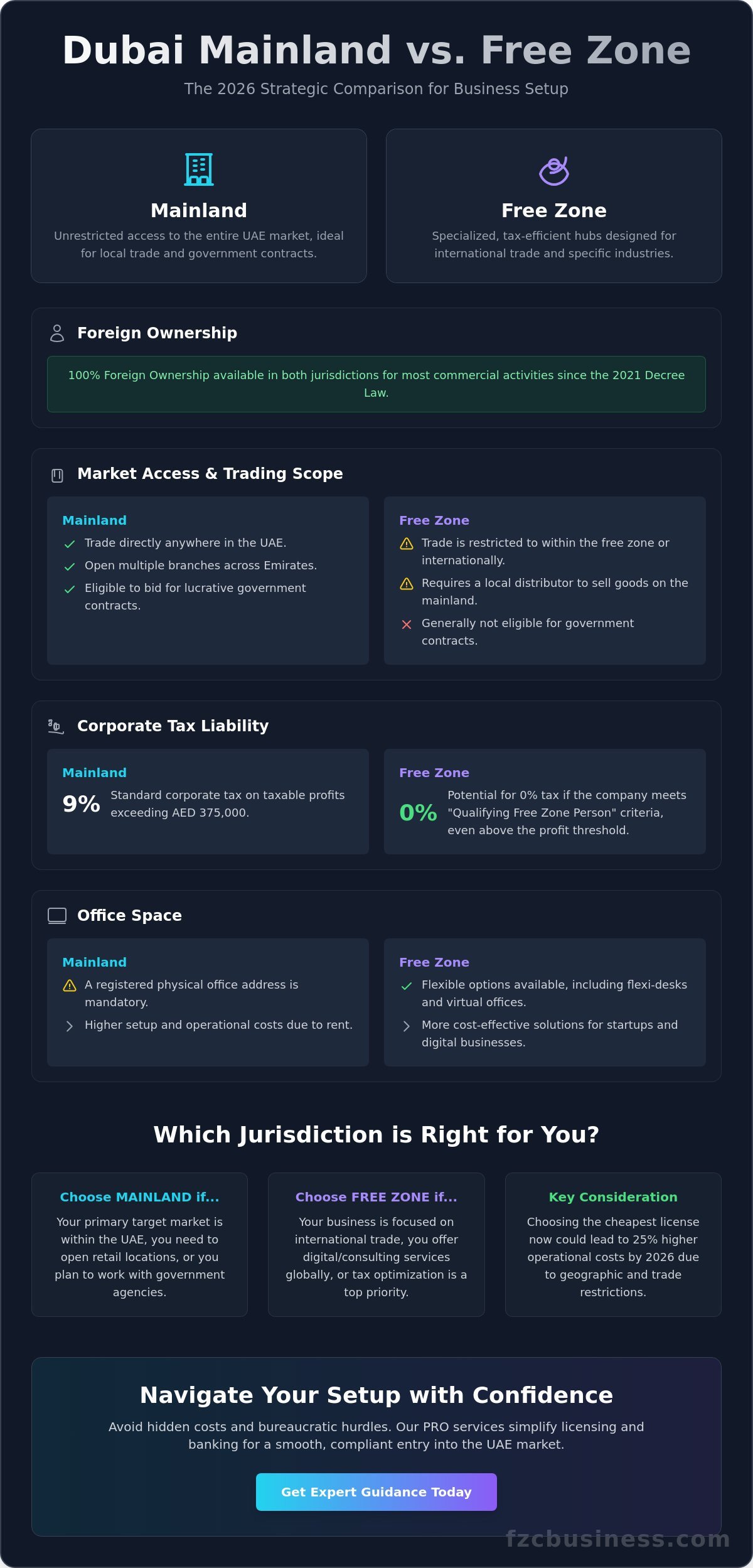
Mainland entities enjoy total geographic freedom. You can bid for government contracts, open multiple branches across the Emirates, and trade directly with consumers in any neighborhood. This is a massive advantage for B2C models like retail or local services. Free Zone companies are technically restricted to trading within their specific zone or internationally. To sell goods on the mainland, a Free Zone company must typically engage a local distributor or establish a mainland branch. For B2B service providers targeting global clients, the Free Zone’s geographic limit is rarely an issue, but for those eyeing the 2026 local UAE market, mainland remains the gold standard.
Visa and Workforce Planning
Your hiring capacity is directly linked to your physical footprint. Free Zones are popular for solo entrepreneurs because they offer “flexi-desk” or “virtual office” packages that include 1 to 3 visas without needing a large office. However, if you plan to build a large team, business setup in dubai mainland provides more long-term flexibility.
- Mainland: Visa allocation is usually based on office size, typically 1 visa per 80 or 100 square feet.
- Free Zone: Visas are often bundled into packages; exceeding these limits requires upgrading to physical office space within the zone.
- Employment Laws: Mainland companies follow Ministry of Human Resources and Emiratisation (MoHRE) regulations, while Free Zones have their own internal labor departments.
Mainland setups allow you to hire staff and station them anywhere in the UAE, which is essential for construction, logistics, or field sales teams. Most Free Zones use an “e-channel” system to streamline visa applications, making the process fast and digital. If you need a customized roadmap for your team expansion, you can book a free consultation with our specialists to compare specific visa costs for 2026.
Strategic Decision Factors: Tax, Banking, and Costs
Choosing your jurisdiction is a high-stakes financial decision that dictates your tax liability and banking success for years. A thorough dubai mainland vs free zone comparison reveals that while both offer advantages, the 2026 regulatory framework demands a more nuanced approach than in previous years. Your choice impacts everything from your bottom line to how quickly you can process your first client payment.
Navigating the UAE Corporate Tax Landscape
The UAE corporate tax regime is now fully active. Every business, whether Mainland or Free Zone, must register with the Federal Tax Authority (FTA). A 9% tax rate applies to taxable income exceeding 375,000 AED. Free Zone entities can still access a 0% tax rate on “Qualifying Income,” but this isn’t automatic. To maintain “Qualifying Free Zone Person” status in 2026, you must demonstrate “Substance.” This means having adequate assets, a physical office, and qualified employees within the zone. If you fail these tests, your Free Zone company will be taxed at the standard 9% rate, just like a Mainland entity.
Opening a Corporate Bank Account
Securing a corporate bank account UAE remains the biggest hurdle for new entrepreneurs. Banks have intensified their Know Your Customer (KYC) and Anti-Money Laundering (AML) protocols. Mainland companies often find the process more straightforward because they’re seen as having a deeper footprint in the local economy. In contrast, entities in certain “high-risk” Free Zones may face 3 to 6 months of scrutiny. You can accelerate this process by working with PRO services that have established relationships with Tier 1 banks. They ensure your bank account application is “pre-vetted” to meet 2026 compliance standards.
Operational Costs and Auditing
Understanding the total cost of ownership is vital. While a dubai mainland vs free zone comparison often highlights lower initial license fees in Free Zones, you must weigh these against long-term operational overhead. Mainland setups require a physical office lease, which can be more expensive than a Free Zone flexi-desk. However, Mainland companies don’t face the “cross-border” transaction fees sometimes applied to Free Zone entities dealing with the local market.
Auditing requirements also differ significantly across jurisdictions:
- Mainland Companies: Generally required to maintain proper financial records, though small businesses may have simplified reporting.
- DIFC and ADGM: These financial hubs mandate annual audited financial statements submitted by approved auditors.
- DMCC and JAFZA: These major Free Zones require annual audit reports to renew your business license.
- Northern Emirate Free Zones: Often offer more relaxed auditing rules, which can reduce annual administrative costs.
It’s best to plan for an annual audit regardless of your choice. Transparent financial records are now essential for maintaining your tax status and keeping your bank account active in the 2026 business environment.
Which Jurisdiction is Right for Your Business Sector?
Selecting the correct legal home for your enterprise depends on your specific operational requirements. A detailed dubai mainland vs free zone comparison shows that your business activity dictates your structure more than your initial budget. While both jurisdictions offer 100% foreign ownership for most activities in 2026, their geographic and regulatory boundaries create distinct advantages for different industries.
- E-commerce: Mainland is the superior choice for brands focusing on local delivery. It allows you to manage “last-mile” logistics across all seven Emirates without hiring a third-party distributor.
- Consultancy and Services: Free Zones are often the most cost-effective starting point. They offer “flexi-desk” solutions that provide a legal business address and visa eligibility with minimal overhead.
- Trading and Re-export: Free Zone warehouses are designed for international trade. Companies in these zones benefit from 0% customs duties on goods stored or re-exported to global markets.
- Retail and F&B: Mainland is the only viable option for physical storefronts. If you plan to open a restaurant or a boutique in a high-traffic area like Downtown Dubai or a major mall, a Mainland license is mandatory.
Case Study: The Digital Nomad and Freelancer
Individual professionals often choose between a freelance visa Dubai and a single-owner Free Zone company. Freelance permits are highly affordable for solo operators who don’t require employee visas immediately. Creative professionals find their niche in Dubai Design District (d3), while tech developers and software engineers gain better networking opportunities in Dubai Internet City. To save costs, startups should look for zones offering “all-inclusive” packages that bundle the license, visa, and a virtual office into one annual fee.
Case Study: The Global Trading Hub
Heavy industry and large-scale logistics firms gravitate toward JAFZA or KIZAD due to their proximity to world-class ports. These zones provide the infrastructure needed for massive storage and manufacturing. Many of these entities eventually establish a Mainland branch to sell directly to the UAE public. This is often simplified through Dual Licensing, which is a regulatory arrangement allowing a Free Zone company to obtain a Mainland permit from the Department of Economy and Tourism without leasing a second physical office. This hybrid approach offers the best of both worlds in a dubai mainland vs free zone comparison for 2026.
Selecting the wrong jurisdiction can lead to expensive restructuring later. Get expert guidance today to ensure your setup is right from day one.
Hassle-Free Setup with Fast Zone Business
Choosing between jurisdictions involves more than just comparing license fees. We streamline the dubai mainland vs free zone comparison by evaluating your specific business activities against the latest 2026 UAE regulations. Our team identifies which path offers the best tax efficiency and market access for your unique goals. It’s about finding the right fit for your operational needs, not just the cheapest entry point.
Our “One-Stop-Shop” model eliminates the fragmented approach that often stalls new ventures. By managing the entire lifecycle of a setup, we’ve helped entrepreneurs reduce their administrative wait times by up to 60%. Our PRO services handle the heavy lifting, from securing initial government approvals to finalizing Ejari contracts for office spaces. We also provide dedicated support for Golden Visa applications, ensuring business owners and their families secure long-term residency through the correct investment channels without the typical bureaucratic stress.
Expert Guidance from Start to Finish
Fast Zone Business maintains a strong physical presence in the heart of the city. You’ll find our consultants at our office in API Tower, conveniently located right by the World Trade Metro station. This central hub allows us to maintain direct relationships with key government departments, which translates to faster processing times for our clients. We don’t just provide advice; we provide a local partnership that’s physically accessible when you need it most.
We go beyond the basic license. Our experts provide a customized approach to VAT and Corporate Tax registration, ensuring your company remains compliant with the 9% corporate tax regulations introduced in 2023. We also leverage the “Fast Zone Advantage” to navigate the complexities of UAE banking. While many struggle with long wait times and high rejection rates, our established partnerships help speed up the process for securing corporate bank account approvals.
Take the Next Step in Your UAE Journey
Your choice of jurisdiction shouldn’t just be about the immediate setup cost. It’s a strategic decision that dictates your growth over the next five years. Whether you need the global flexibility of a Free Zone or the local market reach of the Mainland, the right foundation is essential. We’re here to turn your vision into a functional, compliant entity. Don’t let bureaucracy slow down your entry into the Dubai market. Start your journey today with a partner who understands the local landscape inside and out.
Book Your FREE Consultation with Fast Zone Business
Secure Your Competitive Edge in the Dubai Market
Choosing the right jurisdiction is the most critical step for any business entering the UAE. This dubai mainland vs free zone comparison highlights that while mainland licenses offer total geographic flexibility for local trade, Free Zones provide cost-effective hubs for international operations. By 2026, regulatory landscapes will continue to evolve, making it essential to align your structure with current corporate tax laws and banking standards. You don’t have to navigate these complexities alone.
Fast Zone Business provides the expert guidance you need from our strategic office located in the Dubai World Trade Center. Our team consists of specialists in Golden Visa applications and corporate banking solutions, ensuring your transition is both compliant and efficient. We’ve already helped over 1,000 entrepreneurs launch successful ventures through our hassle-free setup model. We prioritize your time by managing every legal detail, allowing you to concentrate on your 2026 revenue goals. It’s time to turn your vision into a registered reality with a partner who understands the local landscape.
Book Your FREE Consultation for Expert UAE Business Setup
Your journey toward a successful Dubai enterprise starts with a single, informed decision today.
Frequently Asked Questions
Can a Free Zone company trade in the Dubai Mainland?
Free Zone companies can’t trade directly with the Dubai Mainland without appointing a local distributor or establishing a mainland branch. Under Federal Decree-Law No. 32 of 2021, these entities are restricted to operating within their specific geographic boundaries or international markets. To sell goods locally, you must utilize a service agent or pay a 5% customs duty on products moved into the mainland market.
Do I need a local sponsor for a Dubai Mainland company in 2026?
You don’t need a local sponsor for over 1,000 commercial and industrial activities following the 2021 amendment to the Commercial Companies Law. Foreign entrepreneurs now enjoy 100% ownership in the Dubai Mainland for most business categories. Only a small list of strategic activities, like oil and gas or defense, still require a UAE national partner holding a 51% stake in the company.
Which is cheaper: Mainland or Free Zone business setup?
Free Zone setups generally require a lower initial investment because they offer virtual office packages and exempt you from certain municipal fees. A dubai mainland vs free zone comparison shows that mainland licenses often involve higher costs due to mandatory physical office leases and a 2.5% to 5% market fee on the annual rent. However, mainland companies avoid the 5% customs duty when trading locally.
How many visas can I get with a Free Zone license?
The number of visas depends on the size of your physical office, typically calculated at one visa per 9 square meters of space. Most Free Zones offer “Flexi-desk” packages that limit you to between 1 and 3 visas. If your business grows, you’ll need to upgrade to a physical warehouse or office suite to increase your visa quota beyond these initial limits provided in your package.
Can I switch from a Free Zone to a Mainland license later?
You can’t technically convert a Free Zone license into a mainland one; you must instead register a new mainland entity and liquidate the old one. This process involves a fresh application with the Dubai Department of Economy and Tourism. Our team provides expert guidance to ensure a smooth experience during this transition, helping you transfer assets and staff visas without disrupting your daily operations or client contracts.
What are the corporate tax implications for Free Zone companies in 2026?
Free Zone companies pay a 0% corporate tax rate on “Qualifying Income” as defined by Federal Decree-Law No. 47 of 2022. For all other taxable income exceeding AED 375,000, a standard 9% rate applies. Maintaining “Substance” in the Free Zone is mandatory to qualify for the 0% rate, which includes having adequate staff and physical premises within the zone to manage your core operations.
Is a physical office mandatory for a Dubai Mainland company?
A physical office or “Sustainability Contract” is mandatory for all Dubai Mainland companies to obtain a license. Unlike Free Zones that offer virtual desks, the Department of Economy and Tourism requires a verified Ejari tenancy contract for a workspace of at least 200 square feet. This ensures your business has a legitimate presence and facilitates routine inspections by local authorities to ensure compliance with safety standards.
How long does it take to open a bank account for a Mainland vs Free Zone company?
Opening a corporate bank account typically takes between 4 and 12 weeks for both jurisdictions due to strict Central Bank KYC protocols. Mainland companies often experience a slightly faster process because banks view them as lower risk for local operations. Providing a detailed dubai mainland vs free zone comparison of your business model to the bank helps speed up the approval of your application and ensures a hassle-free setup.
