

Dubai Mainland License: The Definitive 2026 Guide to Business Setup
Did you know that over 80% of international entrepreneurs now prioritize a mainland setup to tap into the UAE’s 1.8 trillion AED economy? You’ve likely heard that the 2021 ownership laws changed the game, but the reality of securing a dubai mainland license still involves complex paperwork and the constant threat of hidden government fees. It’s frustrating when bureaucratic hurdles or bank account rejections stall your momentum before you even begin.
We understand these pressures and are here to provide the expert guidance needed for a smooth experience. This definitive 2026 guide promises to clear the fog around 100% ownership eligibility, the latest 9% corporate tax regulations, and how to secure your Golden Visa without the typical stress. You’ll gain a methodical roadmap for full legal compliance and unrestricted market access. We’re covering everything from initial trade name reservation to finalizing your corporate banking setup with the UAE’s top financial institutions.
Key Takeaways
- Navigate the 2026 ownership landscape to leverage 100% foreign equity rules when securing your dubai mainland license.
- Identify high-growth business activities for 2026, such as AI and sustainable manufacturing, to ensure your legal structure meets future banking and audit requirements.
- Master the step-by-step application process, from navigating strict trade name conventions to the Department of Economy and Tourism’s latest unified activity list.
- Decode the complete investment structure in AED, distinguishing between one-time setup fees and recurring government charges like innovation and market fees.
- Streamline your first 90 days of operations by understanding essential compliance steps, including FTA registration and the latest corporate tax mandates.
Decoding the Dubai Mainland License in 2026
A dubai mainland license represents the gold standard for entrepreneurs aiming for scale. It’s a trade permit issued by the Dubai Department of Economy and Tourism (DET) that allows a company to operate across the entire UAE. This jurisdiction is central to Dubai’s economic landscape, which has transitioned from oil dependency to a global hub for trade and services. In 2026, the mainland remains the most versatile legal structure for businesses wanting direct access to the local market.
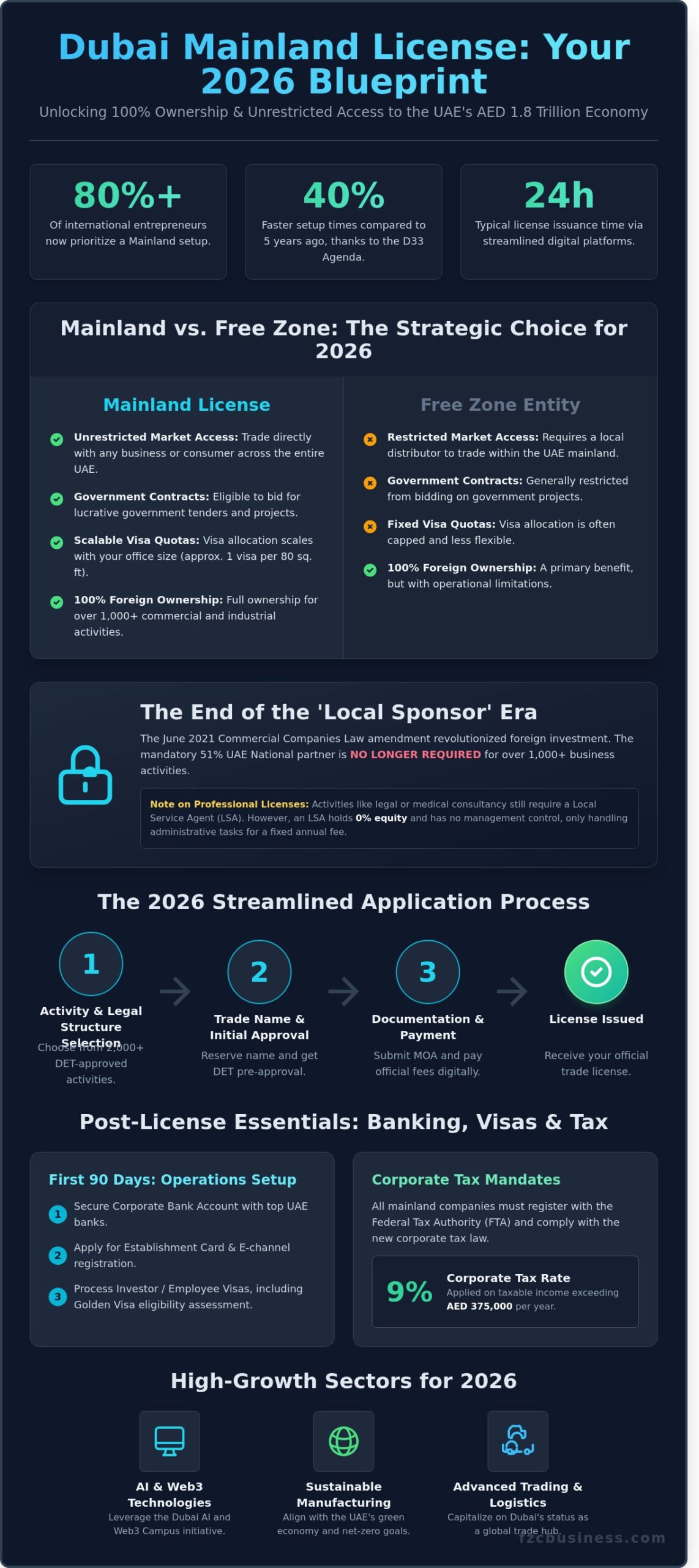
The Dubai Economic Agenda (D33) has redefined the setup experience for foreign investors. This initiative aims to double the size of the city’s economy by 2033, and the results in 2026 are evident. Setup times have dropped by 40% compared to five years ago, with most licenses issued through digital platforms within 24 hours. The DET has removed unnecessary bureaucratic layers, making it easier for startups and multinationals to establish a presence without physical paperwork.
To better understand this concept, watch this helpful video:
Mainland companies enjoy three distinct advantages that Free Zone entities lack. First, you can trade directly with the local public and other companies without a distributor. Second, you can bid for lucrative government tenders, a privilege that remains restricted for many offshore structures. Third, your visa quota isn’t capped by an arbitrary limit; it scales proportionally with your physical office size. This flexibility is vital for businesses planning rapid workforce expansion.
Mainland vs. Free Zone: Making the Strategic Choice
Choosing a mainland structure provides total geographical freedom. You don’t need a branch office to trade in Abu Dhabi or Sharjah. Regarding visas, the rule remains consistent in 2026: your office square footage determines your headcount. Typically, the authorities grant one visa for every 80 square feet of leased space. For tax, mainland entities pay 9% corporate tax on taxable income exceeding AED 375,000. While Free Zones offer “Qualifying Income” exemptions, the mainland provides a simpler, more transparent tax path for local trading.
The End of the ‘Local Sponsor’ Era
The June 2021 amendment to the Commercial Companies Law changed the game for investors. Foreigners now enjoy 100% ownership of a dubai mainland license for over 1,000 commercial and industrial activities. You no longer need a UAE National to hold 51% of your shares. However, professional licenses for services like legal consultancy or medicine still require a Local Service Agent (LSA). This agent manages administrative tasks but holds 0% equity in your firm. Fast Zone Business ensures your legal structure is optimized for full control and maximum profit retention.
- Unrestricted Trade: Sell goods and services anywhere in the UAE and internationally.
- Government Contracts: Directly participate in projects funded by Dubai’s AED 32 trillion D33 agenda.
- Scalable Visas: Increase your staff capacity by simply expanding your office footprint.
- 100% Ownership: Maintain full legal and financial control over your business assets.
Choosing the Right License Category and Legal Structure
Selecting the correct activity code is the most critical step in securing your dubai mainland license. This choice dictates your operational boundaries and determines which banks will accept your corporate account application. Since the UAE updated its Commercial Companies Law in June 2021, the Department of Economy and Tourism (DET) offers over 2,000 activity codes. If your license doesn’t precisely match your business model, you’ll face significant hurdles during annual audits or when seeking 100% foreign ownership approvals. Getting expert advice on Dubai business setup ensures you select a code that allows for future expansion without requiring a total license restructure.
Looking ahead to 2026, specific sectors show explosive growth potential. The Dubai AI and Web3 Campus plans to attract 500+ high-tech companies by 2028, making AI technology a top-tier activity choice. Sustainable manufacturing is also rising as the “Make it in the Emirates” initiative gains momentum, offering incentives for eco-friendly production. Meanwhile, the UAE e-commerce market is projected to reach 33.7 billion AED by 2026. Aligning your license with these high-growth sectors positions your brand for long-term scalability and investor interest.
Commercial vs. Professional vs. Industrial Licenses
Commercial licenses are designed for entities engaged in trading or retail. Whether you’re importing electronics or running a local boutique, this license covers the movement of goods. Professional licenses cater to service-based experts, such as IT consultants, marketing agencies, and artisans. This category often allows for 100% ownership while requiring a local service agent. Industrial licenses are mandatory for any business involving manufacturing or processing. These require a physical warehouse or factory space and specific approvals from the Ministry of Industry and Advanced Technology to ensure compliance with safety standards.
The Limited Liability Company (LLC) Structure
The LLC remains the gold standard for international investors. It’s the most flexible legal form, allowing for a minimum of two and a maximum of 50 shareholders. While Dubai regulations state there’s “no minimum” capital for many activities, a benchmark of 300,000 AED is often recommended to establish credibility with landlords and financial institutions. The structure protects your personal assets, as your liability is limited to your shares in the company’s capital. It’s a robust shield that allows entrepreneurs to take calculated risks without endangering their personal wealth.
Your Memorandum of Association (MOA) acts as the constitution of your business. It’s vital to structure this document with precision to define profit-sharing ratios and dispute resolution protocols. A well-drafted MOA ensures that your rights are protected even if the management structure changes. If you’re feeling overwhelmed by the legal jargon, seeking professional business setup support can streamline the entire documentation process.
Choosing the wrong legal structure can limit your ability to sponsor employees or open branch offices later. A Sole Establishment, for instance, provides no distinction between personal and business assets, which is a major risk for high-turnover ventures. An LLC, by contrast, provides a clear path for adding new partners or selling the business. Making the right choice today ensures a smooth experience as you scale your operations across the UAE mainland.
The 2026 Step-by-Step Application Process
Securing a dubai mainland license in 2026 involves a structured sequence designed by the Dubai Department of Economy and Tourism (DET). The first step requires you to identify your specific business activity from a unified list of over 2,000 options. This selection is critical because it determines your legal form and the types of visas you can apply for later. Fast Zone Business provides in-depth knowledge during this phase to ensure your chosen activities match your operational goals and minimize future amendment costs. Once the activity is set, you’ll move into the trade name reservation and documentation phase.
Trade Name Reservation and Initial Approval
Your trade name is your brand’s identity in the UAE, but it must adhere to strict naming conventions. You can’t use names that reference religion, political groups, or existing global brands. Names shouldn’t start with “Global” or “International” unless the company has a substantial presence. After the name is approved, you’ll apply for Initial Approval. This document serves as the government’s “no objection” certificate, allowing you to move forward with legal contracts. Fast Zone Business accelerates this specific phase, often securing approvals within 24 to 48 hours so you don’t lose momentum. It’s a vital step that confirms you’re eligible to conduct business in the emirate.
Physical Office Requirements and Ejari
While some jurisdictions allow for flexible desks, most mainland businesses still require a physical footprint. The standard Dubai business license requirements for 2026 generally mandate a minimum office space of 200 square feet. You’ll need a valid tenancy contract and an Ejari certificate, which is the official registration of your lease with the Dubai Land Department. For industrial or manufacturing licenses, you must secure a warehouse that meets Dubai Municipality safety standards. We assist in linking your Ejari directly to your DET application, ensuring a smooth experience without the typical bureaucratic hurdles of mismatched documentation.
Between the office setup and the final license issuance, you must draft and notarize your legal documents. This involves a Memorandum of Association (MOA) for companies with multiple shareholders or a Local Service Agent (LSA) agreement for professional setups. These documents outline the profit-sharing ratios and management powers within the company. Since 2021, many activities allow for 100% foreign ownership, but the MOA remains the legal backbone that protects your investment under UAE law.
External Approvals for Regulated Industries
If your business falls under a regulated sector, you’ll need additional clearances from specific government bodies. For instance, educational ventures require KHDA (Knowledge and Human Development Authority) approval, while healthcare entities must clear DHA (Dubai Health Authority) standards. Real estate brokers must pass RERA exams and obtain certification before their license is finalized. Managing these third-party clearances can be time-consuming, which is why our PRO services are essential for coordinating between different departments efficiently. For eligible service and commercial activities in 2026, the ‘Instant License’ option allows for immediate issuance without an initial office lease for the first year of operations.
The final step is the payment of the license fees and the issuance of the actual license. Once the DET issues your dubai mainland license, you’re legally authorized to trade, hire employees, and open corporate bank accounts. The entire process, when managed by experts, typically takes between 5 to 10 working days, depending on the complexity of external approvals. This efficient timeline ensures you spend less time on paperwork and more time on your core business strategy.
Cost Breakdown: Investing in a Dubai Mainland License
Starting a business requires a clear financial roadmap. You’ll face two distinct types of expenses: one-time setup fees and recurring annual obligations. Initial costs for a dubai mainland license typically start around AED 15,000 to AED 25,000, but these figures fluctuate based on your specific business activity and office requirements. It’s vital to distinguish between the license fee itself and the operational costs that follow immediately after approval. Understanding this distinction prevents cash flow issues during your first year of operation.
Government Fees and Trade License Charges
The Department of Economy and Tourism (DET) issues a payment voucher that summarizes your primary costs. This isn’t a single fee; it’s a bundle of specific charges. For instance, you’ll see Knowledge and Innovation fees, which are fixed at AED 10 each for most government transactions. A significant variable is the 5% Market Fee. This is calculated directly from your annual office lease value. If your annual rent is AED 50,000, you’ll pay AED 2,500 to the DET as part of your license issuance or renewal. Additionally, registration with the Dubai Chamber of Commerce is mandatory. Fees here range from AED 1,200 for general trading to higher amounts for specific industrial activities. These costs are recurring, meaning you’ll need to budget for them every 12 months to keep your business compliant.
Budgeting for Visas and PRO Services
Your financial planning must extend beyond the license itself. You’ll need to register for an Establishment Card with the Ministry of Human Resources and Emiratisation (MOHRE), which costs approximately AED 2,000. For immigration services, the e-Channel registration involves a one-time fee of roughly AED 2,100. Employee visa costs are another critical factor. Expect to pay between AED 3,000 and AED 5,000 per person. This covers medical fitness tests (AED 320), Emirates ID (AED 370), and mandatory health insurance, which starts around AED 600 for basic coverage. Fast Zone Business provides transparent pricing to ensure you avoid “fee creep,” where small, unquoted costs inflate your final bill. Their expert guidance helps you forecast these expenses accurately from day one, ensuring a smooth experience without financial surprises.
Don’t overlook administrative expenses that often hide in the fine print. Legal translation of your Memorandum of Association (MoA) into Arabic usually costs between AED 300 and AED 800. Notarization fees at the Dubai Courts or through a private notary add another AED 500 to AED 1,500 to the total. Choosing a prime location like Business Bay will result in higher rent, which directly increases your 5% Market Fee. Opting for a smaller office in Deira or utilizing a shared workspace can significantly reduce your initial investment while still securing your dubai mainland license. Accurate budgeting for these variables is the difference between a successful launch and early financial strain. Professional PRO services can often bundle these costs into a single package, saving you the hassle of managing multiple individual payments.
Post-License Essentials: Banking, Visas, and Compliance
Securing your dubai mainland license is a major milestone, but the first 90 days of operation determine your long-term success. This period involves activating your corporate identity through banking, staffing, and tax registration. You’ll move from administrative setup to active market participation. Transitioning from a licensed entity to an operational powerhouse requires a structured approach to local regulations. Our team at Fast Zone Business ensures you don’t miss critical deadlines that could result in avoidable fines during this phase.
Opening Your Corporate Bank Account
Opening a corporate bank account is often the most challenging step for new entrepreneurs. UAE banks maintain strict Know Your Customer (KYC) protocols to comply with international anti-money laundering standards. Your “Investor Profile” must clearly demonstrate your business experience and source of funds. Statistics show that 60% of delays in account opening stem from mismatched activity descriptions between the trade license and the business plan. Fast Zone partners with leading institutions like Emirates NBD and Wio Bank to streamline this process, helping you present a profile that aligns with current banking appetites.
Residency Visas and the Golden Visa Program
Your dubai mainland license serves as the foundation for your residency. Standard investor and employee visas typically grant a 2-year residency permit. However, the landscape has evolved significantly. Business owners who maintain a property or business investment of at least AED 2,000,000 can qualify for the prestigious 10-year Golden Visa. This long-term residency offers unparalleled stability for your family and key executives. Once your visa is stamped, you can sponsor dependents, including spouses, children, and domestic staff, ensuring your personal life is as settled as your professional one.
Ongoing Compliance: VAT and Corporate Tax
The UAE tax environment reached a new level of maturity with the introduction of Federal Corporate Tax on June 1, 2023. All mainland entities must now register with the Federal Tax Authority (FTA). While a 9% tax rate applies to taxable income exceeding AED 375,000, many startups benefit from specific exemptions. Small Business Relief is available to resident taxable persons with gross revenue of AED 3,000,000 or less in the relevant tax period. Additionally, Value Added Tax (VAT) registration remains mandatory once your taxable supplies and imports exceed the AED 375,000 threshold over a 12-month period. Maintaining accurate, digital accounting records is no longer optional; it’s a legal requirement for 2026 compliance.
Managing these moving parts requires professional oversight. PRO services act as the backbone of your compliance strategy, handling everything from labor card renewals to legal translations. At Fast Zone Business, we provide expert guidance to navigate these bureaucratic layers. Our goal is to create a smooth experience so you can focus on scaling your revenue. Don’t let paperwork slow your momentum. Book a consultation today to ensure your mainland entity remains fully compliant and ready for growth.
Launch Your Future in the Heart of Dubai 2026
Establishing a presence in the UAE’s most dynamic trade hub requires a strategic approach to the 2026 regulatory landscape. You’ve seen how 100% foreign ownership now empowers entrepreneurs across most commercial sectors; you also know that a methodical application process is the key to avoiding costly delays. Navigating the initial investment and post-license requirements like corporate tax compliance and visa processing ensures your entity remains resilient and ready for rapid growth.
Securing your dubai mainland license is a critical milestone that shouldn’t be left to chance. Fast Zone Business acts as your expert partner; we’re an authorized DET service provider with deep expertise in 100% foreign ownership structures. Our team provides dedicated banking support for new entities, ensuring you clear every financial hurdle with confidence. We’ve streamlined the setup journey into a smooth, efficient experience that prioritizes your time and resources.
Don’t let administrative complexity hold your vision back. Book a FREE Consultation with Fast Zone Business to start your Dubai journey and join the thousands of successful founders thriving in the mainland. It’s time to build your legacy in the world’s leading business destination.
Frequently Asked Questions
Can I own 100% of my Dubai mainland company in 2026?
Yes, you can own 100% of your Dubai mainland license in 2026 for over 1,000 commercial and industrial activities. This regulation follows the landmark June 2021 amendment to the Commercial Companies Law which removed the requirement for a local Emirati partner to hold 51% of shares. Foreign investors now maintain full control over their business operations and profits across most sectors without needing a local sponsor for ownership.
How much does a Dubai mainland license cost on average?
A standard dubai mainland license typically costs between AED 15,000 and AED 35,000 for the initial setup. This range covers the Department of Economy and Tourism (DET) registration fees, trade name reservation, and initial approvals. Your final investment depends on specific factors like your chosen business activity, the size of your office rent, and the number of visa allocations required for your staff members.
What is the difference between a Mainland and a Free Zone license?
The primary difference is that a mainland license allows you to trade directly with the local UAE market and bid for government contracts without restrictions. Free Zone companies are generally restricted to trading within their specific zone or internationally. While mainland firms offer more geographic flexibility for office locations, Free Zones often provide specific customs exemptions and simplified setup processes within their designated boundaries.
Do I need a physical office to get a mainland license in Dubai?
You generally need a physical office space with a valid Ejari certificate to secure a mainland license in Dubai. The Department of Economy and Tourism requires a minimum of 200 square feet for most business types to ensure operational legitimacy. However, the “Instant License” initiative allows entrepreneurs to operate without a physical lease for the first 12 months to help reduce initial startup costs for new founders.
How long does it take to get a business license in Dubai?
You can obtain your business license in 3 to 10 working days if all documentation is accurate and submitted correctly. The process involves initial approval, trade name reservation, and final payment to the DET. Our team at Fast Zone Business streamlines these steps to ensure a smooth experience, though specific approvals from external regulators like the Dubai Health Authority can occasionally extend this timeline by several days.
Can I open a corporate bank account with a mainland license?
Yes, you can open a corporate bank account with a mainland license at any major UAE bank like Emirates NBD, ADCB, or Mashreq. Having a mainland setup often makes the banking process more straightforward because banks view these entities as having a stronger local presence. You’ll need to present your valid trade license, Memorandum of Association, and proof of address to complete the mandatory KYC requirements for your account.
Is corporate tax mandatory for all mainland companies in 2026?
Corporate tax is mandatory for mainland companies in 2026, with a standard rate of 9% on taxable profits exceeding AED 375,000. This law, implemented on June 1, 2023, applies to all businesses operating within the UAE mainland. Small businesses with a gross turnover below AED 3 million may still qualify for Small Business Relief until December 31, 2026, which helps startups manage their early financial growth.
What are PRO services and why are they necessary for mainland companies?
PRO services involve professional consultants managing your government documentation, visa processing, and labor contracts. These experts are necessary because they navigate the complex legal requirements of the Ministry of Human Resources and Emiratisation. Utilizing our PRO services ensures your dubai mainland license remains compliant with all local laws while saving you approximately 40 hours of administrative work monthly, allowing you to focus on your core business goals.
