

Corporate Tax Compliance for UAE SMEs: The 2026 Practical Guide
In 2026, your SME’s bookkeeping is no longer just a back-office chore; it’s the only thing standing between a 0% tax rate and a 14% annual late payment penalty. Achieving total corporate tax compliance for uae smes has moved beyond simple registration to a strategic exercise in record-keeping. You likely feel the pressure of the September 30, 2026 filing deadline or worry that a minor error in your AED 3 million Small Business Relief claim could trigger an audit. It’s a common concern for entrepreneurs who want to focus on growth rather than bureaucratic hurdles.
We’ve designed this guide to provide the expert guidance you need to master the essentials of UAE corporate tax. You’ll learn exactly how to qualify for the 0% rate on income up to AED 375,000 and maintain the seven-year record-keeping standards required by the FTA. We’ll walk you through a practical checklist for audit-ready books, clarify the Small Business Relief election process, and help you avoid the AED 10,000 penalty for non-registration. This guide provides a clear roadmap to keep your business hassle-free and fully compliant as you scale.
Key Takeaways
- Identify if your business qualifies for the 0% tax rate on income up to AED 375,000 or the standard 9% rate.
- Master the AED 3 million revenue threshold for Small Business Relief and the critical steps required to formally elect for this benefit.
- Transition your accounting to IFRS standards and digital formats to meet the FTA’s mandatory seven-year record-keeping requirement.
- Follow a practical roadmap for securing your Tax Registration Number (TRN) and ensuring ongoing corporate tax compliance for uae smes.
- Learn how expert guidance can simplify your filing process, providing a hassle-free experience that avoids costly late-payment penalties.
The 2026 UAE Corporate Tax Landscape for SMEs
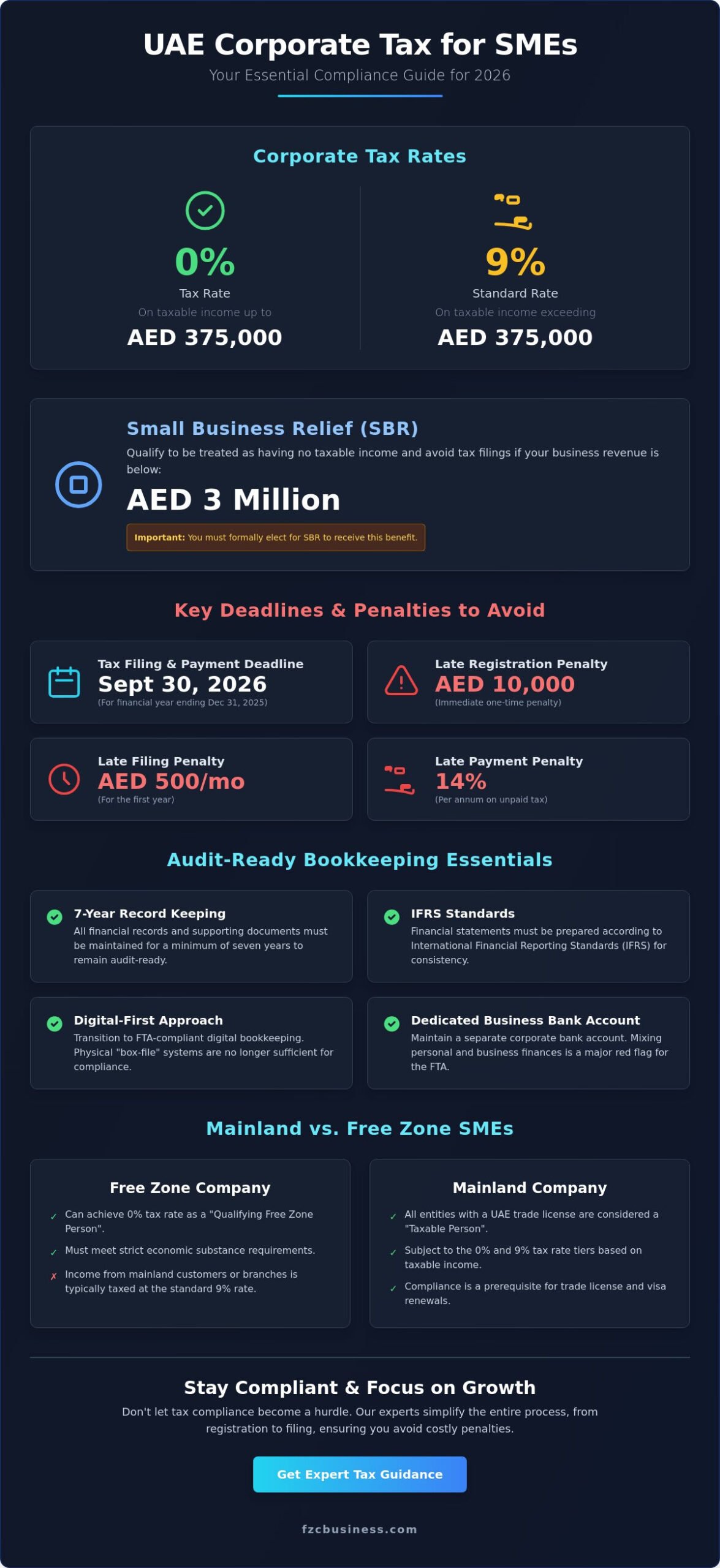
The 2026 tax environment is a mature system where the Federal Tax Authority (FTA) focuses on enforcement and audit readiness. For most businesses, the standard 9% tax rate applies to taxable income exceeding AED 375,000. If your annual profit remains below this threshold, your rate is effectively 0%. However, this doesn’t exempt you from registration or filing requirements. Every entity with a UAE trade license is considered a “Taxable Person.” This includes mainland companies and those operating within Free Zones. For a broader historical context on how these laws developed, the UAE Taxation Overview provides a solid foundation for understanding the system’s evolution.
To better understand how these rates and reliefs impact your bottom line, watch this helpful video:
In 2026, the UAE has integrated tax records with the licensing system. You’ll find that corporate tax compliance for uae smes is now a prerequisite for renewing trade licenses and employee visas. The FTA and Department of Economy and Tourism (DET) share data to ensure that only compliant businesses continue to operate. Failing to show a valid Tax Registration Number (TRN) or proof of filing can stall your company renewal process, leading to operational downtime. Our expert guidance ensures you avoid these bottlenecks by maintaining a clean compliance record from day one.
Mainland vs. Free Zone SME Requirements
Free Zone SMEs often assume they’re exempt, but the reality is more nuanced. To maintain a 0% rate as a “Qualifying Free Zone Person,” you must meet strict substance requirements and deal only with specific qualifying income. If your Free Zone company opens a mainland branch or conducts business with mainland customers, that income is typically taxed at the standard 9% rate. Understanding your specific jurisdiction is vital for accurate corporate tax compliance for uae smes. For a detailed breakdown of these jurisdictions, see our guide on Free Zone Company Setup in the UAE.
Key Tax Deadlines for the 2026 Financial Year
Deadlines are firm and missing them is expensive. For a financial year ending December 31, 2025, your return and payment are due by September 30, 2026. Registration timelines depend on the month your license was issued; failing to register results in an immediate AED 10,000 penalty.
- Late Registration Penalty: AED 10,000.
- Late Filing Penalty: AED 500 per month for the first year.
- Late Payment Penalty: 14% per annum (1.5% monthly) on unpaid amounts.
Most SMEs follow a January-December tax cycle, but you can apply for a customized cycle if it suits your business model. Regardless of your cycle, you must maintain financial records for seven years to remain audit-ready.
Essential Bookkeeping and Accounting Standards
The days of managing business expenses through a “box-file” system are over. In 2026, the Federal Tax Authority (FTA) expects a digital-first approach to financial management. Transitioning to FTA-compliant digital bookkeeping isn’t just about modernizing your office; it’s a mandatory step for ensuring corporate tax compliance for uae smes. Digital records allow for real-time tracking and provide the transparency required during a potential audit. If your records are disorganized, you risk hefty penalties and the loss of Small Business Relief eligibility.
A clean audit trail begins with a dedicated business account. Mixing personal and business finances is one of the quickest ways to trigger FTA scrutiny. Your corporate bank account serves as the primary source of truth, documenting every dirham that enters or leaves your business. This transparency simplifies the reconciliation process and ensures your financial statements reflect reality. If you’re still operating without a separate entity account, we can facilitate a smooth corporate bank account opening to get your records on the right track.
The FTA mandates that financial statements be prepared in accordance with International Financial Reporting Standards (IFRS). This global benchmark ensures consistency and reliability in financial reporting across the Emirates. You can find detailed requirements on the Official UAE Corporate Tax Guidelines, which outline how these standards apply to different business sizes. Adhering to IFRS means your balance sheets and income statements are ready for professional review at any time.
IFRS for SMEs: What You Need to Implement
Most small businesses can utilize the “IFRS for SMEs” standard, which is a simplified version of the full framework. It reduces the complexity of disclosures while maintaining high reporting quality. The FTA generally prefers the accrual basis of accounting, where revenue is recorded when earned rather than when cash is received. This is especially vital for service-based SMEs that may bill clients months before payment arrives. Trading SMEs must also apply specific revenue recognition principles to account for inventory and cost of goods sold accurately.
The 7-Year Record-Keeping Rule
You must maintain all financial records and supporting documents for a minimum of seven years. This isn’t a suggestion; it’s a legal requirement. The FTA can request these documents during an audit to verify your tax filings. Required documents include:
- Sales and purchase invoices.
- Credit and debit notes.
- Bank statements and payment receipts.
- Payroll records and employee benefit statements.
- VAT records and previous tax returns.
While digital storage is acceptable, files must be easily accessible and legible. Many entrepreneurs find that utilizing professional PRO services simplifies this burden. Expert document management ensures your records are indexed correctly, keeping your business audit-ready without distracting you from your core growth goals. This proactive approach is the most efficient way to maintain corporate tax compliance for uae smes in the long term.
Small Business Relief (SBR) vs. Standard Corporate Tax
Small Business Relief (SBR) is a powerful tool for startups, but it isn’t a “get out of jail free” card. Under this provision, eligible businesses with gross revenue of AED 3 million or less can elect to be treated as having no taxable income. This relief is currently available for tax periods ending on or before December 31, 2026. However, achieving corporate tax compliance for uae smes under this scheme requires an active “election” during your tax filing. If you don’t formally claim the relief, the Federal Tax Authority (FTA) will default your status to the standard 9% rate for profits exceeding AED 375,000. For a comprehensive look at these provisions, the analysis on UAE corporate tax relief for small businesses offers vital legal context.
Choosing SBR involves significant strategic trade-offs. While you save on the tax payment itself, you lose the ability to carry forward tax losses from that period to offset future profits. You also cannot deduct interest expenses that would be allowed under the standard regime. The FTA is also vigilant about “business splitting.” If an owner divides one operation into three separate licenses just to stay under the AED 3 million cap, the FTA can consolidate these entities and apply the 9% rate retroactively. Our team provides the expert guidance needed to ensure your structure remains compliant and audit-ready.
Eligibility Criteria for SBR in 2026
To qualify, the entity must be a resident person. This includes most mainland and Free Zone companies. However, certain “Excluded Persons” cannot apply. This group includes financial institutions and members of large multinational enterprise (MNE) groups with consolidated global revenues exceeding AED 3.15 billion. You must also evaluate your “Associated Persons.” If you have multiple businesses with shared ownership, their relationship could impact how the FTA calculates your revenue threshold. We can help you navigate these definitions to ensure a smooth experience during your first filing cycle.
SBR vs. Standard Filing: A Strategic Comparison
The decision to elect for SBR should be based on your financial projections. SBR is ideal for stable businesses that value simplified accounting and immediate cash flow. Standard filing, however, might be more beneficial for high-growth SMEs. If your business is currently operating at a loss or has high debt-servicing costs, standard filing allows you to carry those losses forward indefinitely. This can significantly reduce your tax burden in later years when your profits soar. We offer specialized VAT and Corporate Tax Assistance to help you model these scenarios and choose the path that best supports your long-term growth.
Step-by-Step Compliance Roadmap for UAE SMEs
Achieving corporate tax compliance for uae smes is a structured journey that begins long before your filing deadline. It’s a four-phase process designed to integrate tax obligations into your daily operations without disrupting your business flow. By following this roadmap, you ensure that your entity remains in good standing with the Federal Tax Authority (FTA) while maximizing available reliefs and avoiding the AED 10,000 non-registration penalty.
Phase 1: Tax Assessment. Before you register, you must determine your residency status and taxable income projections. This involves reviewing your jurisdiction and identifying if you qualify as a “Taxable Person” or a “Qualifying Free Zone Person.” If you’re just starting out, our guide on how to start a business in Dubai provides the foundational steps for choosing the right legal structure for tax efficiency.
Phase 2: FTA Registration. Once your assessment is complete, you must obtain a Tax Registration Number (TRN) through the EmaraTax portal. This is mandatory even if your profits are below the AED 375,000 threshold. Phase 3: Ongoing Maintenance. This phase focuses on the monthly bookkeeping and VAT reconciliation discussed in previous sections to ensure your data is audit-ready. Phase 4: Annual Filing. You have a nine-month window after the end of your financial year to submit your Corporate Tax Return and pay any due tax.
Registering on the EmaraTax Portal
The EmaraTax portal is your primary interface for all tax-related activities in the UAE. To register, you’ll need your current trade license, the passport and Emirates ID of the authorized signatory, and proof of authorization. It’s vital to link your VAT and Corporate Tax profiles within the portal to ensure unified reporting and data consistency. Many SMEs face application rejection due to mismatched license details or expired documents. Our team provides the expert guidance needed to avoid these common registration errors, ensuring a smooth experience from the start.
Calculating Taxable Income: Deductions and Exemptions
Your accounting profit isn’t always your taxable profit. You must adjust your financial statements to account for non-deductible expenses. For instance, the FTA imposes a 50% limit on entertainment expenses, such as meals or events for clients and suppliers. Director salaries and shareholder drawings must also be conducted at “arm’s length,” meaning they should reflect market rates. If a salary is deemed excessive, the FTA may disallow the deduction. For personalized support in navigating these calculations, you can book a free consultation for tax assistance today to ensure your deductions are fully compliant.
How Fast Zone Business Simplifies Your Tax Journey
Fast Zone Business serves as your one-stop destination for navigating the complexities of the 2026 tax landscape. We understand that managing a growing company is demanding. Our mission is to provide a hassle-free experience that allows you to focus on your core goals while we handle the bureaucratic hurdles. Achieving corporate tax compliance for uae smes requires absolute precision. A single error in your AED 3 million Small Business Relief claim or a missed registration deadline can lead to an immediate AED 10,000 penalty. We mitigate these risks through expert guidance and in-depth knowledge of FTA protocols.
Our team manages all communication with the Federal Tax Authority on your behalf. This proactive approach ensures your registration, annual filing, and VAT reconciliations are handled efficiently. We offer customized tax assistance packages tailored specifically to the unique needs of both Mainland and Free Zone SMEs. Whether you’re navigating the 9% standard rate or claiming exemptions, our solutions are designed to ensure you remain 100% compliant. We prioritize your peace of mind by delivering tangible results and cost-effective solutions.
We also provide specialized support for Golden Visa applications. In 2026, business ownership and tax residency are more closely linked than ever before. Holding a Golden Visa can influence your tax status and long-term residency benefits. We ensure that your visa status aligns perfectly with your corporate tax obligations, providing a smooth experience for you and your family. This holistic approach is why entrepreneurs trust us as their reliable partner in the UAE.
Comprehensive PRO and Tax Support
Our PRO services act as the vital bridge between your business and government entities. We manage all necessary approvals and trade license renewals, which are now contingent upon valid tax registration. To maintain clean financial records, we also assist with corporate bank account opening. Having a separate, professional account is the first step toward audit readiness. For entrepreneurs looking to expand their footprint, our guide on Business Setup in Dubai Mainland offers a detailed look at jurisdiction-specific requirements for the 2026 period.
Book Your Free Tax Consultation Today
The 2026 tax year brings stricter enforcement and higher penalties for minor filing errors. Don’t leave your business’s future to chance. Expert guidance is the most effective way to avoid common FTA audit triggers and ensure your records meet IFRS standards. Our action-oriented approach has helped thousands of entrepreneurs establish and grow their presence in the UAE market. We invite you to Book a FREE Consultation today. Let us streamline your corporate tax compliance for uae smes so you can focus on building your legacy.
Master Your Tax Obligations for a Profitable 2026
The 2026 tax landscape requires more than just awareness; it demands active management of your financial records. Success hinges on your ability to meet the September 30 filing deadline and maintain IFRS-compliant books for the mandatory seven-year period. Whether you’re electing for Small Business Relief under the AED 3 million revenue cap or managing the standard 9% rate, precision is your best defense against FTA penalties. Maintaining corporate tax compliance for uae smes ensures your trade license renewals and visa processes remain uninterrupted and professional.
Fast Zone Business provides the expert guidance needed to navigate these regulations without the stress of bureaucratic hurdles. We offer FTA-aligned tax assistance and expert PRO services for seamless documentation, ensuring your company formation and renewal processes are always hassle-free. You can focus on scaling your operations while we handle the complexities of the EmaraTax portal and bank reconciliation. Our team is committed to providing the smooth experience your business deserves.
Ready to protect your company’s future? Secure Your Business Growth with Expert Tax Compliance Assistance. Your entrepreneurial journey in the UAE is built on solid foundations, and with the right partner, tax season becomes an opportunity for clarity rather than a source of concern.
Frequently Asked Questions
Is Corporate Tax applicable to Free Zone SMEs in 2026?
Yes, all Free Zone entities must register and file a return regardless of their income level. While “Qualifying Free Zone Persons” can benefit from a 0% rate on specific income, any revenue from mainland UAE customers is typically taxed at 9%. You must maintain 100% corporate tax compliance for uae smes even if your effective tax rate is zero.
What is the minimum revenue threshold for UAE Corporate Tax?
There are two key thresholds to remember for your 2026 planning. Taxable income up to AED 375,000 is taxed at 0%, while profit above this amount is taxed at 9%. Additionally, the Small Business Relief (SBR) allows businesses with gross revenue under AED 3 million to elect for a 0% rate on all income until December 31, 2026.
Can I file my own Corporate Tax return or do I need a tax agent?
You can legally file your own return through the EmaraTax portal. However, the FTA requires financial statements to follow IFRS standards. Most SMEs find that professional assistance prevents costly errors during the complex reconciliation process. Our expert guidance ensures your filing is accurate and submitted within the nine-month deadline following your financial year-end.
What happens if my SME revenue exceeds AED 3 million mid-year?
If your total revenue for the tax period exceeds the AED 3 million limit, you lose eligibility for Small Business Relief for that year. Your profit will then be subject to the standard 9% rate for any amount exceeding AED 375,000. It’s vital to monitor your books monthly to prepare for this shift in tax liability and avoid missing payment deadlines.
How does VAT compliance interact with Corporate Tax filing?
Your VAT returns and corporate tax filings must reconcile perfectly. The FTA uses VAT data to verify the total revenue reported on your corporate tax return. Any discrepancy between your 5% VAT filings and your 9% corporate tax declarations can trigger an audit. Consistent digital bookkeeping is the only way to manage these two systems effectively and maintain a clean record.
Are SME salaries and bonuses tax-deductible for the company?
Salaries and bonuses are generally deductible if they are “arm’s length” transactions. This means the compensation must reflect the market value for the role. If the FTA determines that a director’s salary is artificially high to reduce taxable profit, they may disallow the deduction. Proper documentation of payroll and employment contracts is essential for corporate tax compliance for uae smes.
What are the penalties for non-compliance with the UAE Tax Law?
Penalties are strictly enforced to ensure market transparency. Failure to register for corporate tax results in a flat AED 10,000 fine. Late filing carries a penalty of AED 500 per month for the first 12 months, while late payments accrue interest at 14% per annum. Avoiding these costs requires a proactive approach to your annual filing obligations and registration timelines.
Do I need to keep physical copies of all my business receipts?
No, the FTA accepts digital records as long as they are legible and easily accessible. You must store all invoices, bank statements, and receipts for a minimum of seven years. Using a digital bookkeeping system makes this process hassle-free and ensures you’re audit-ready at a moment’s notice. This digital approach is now the standard for modern business operations in the UAE.
