

Annual Audit Requirements for UAE Companies: The 2026 Compliance Guide
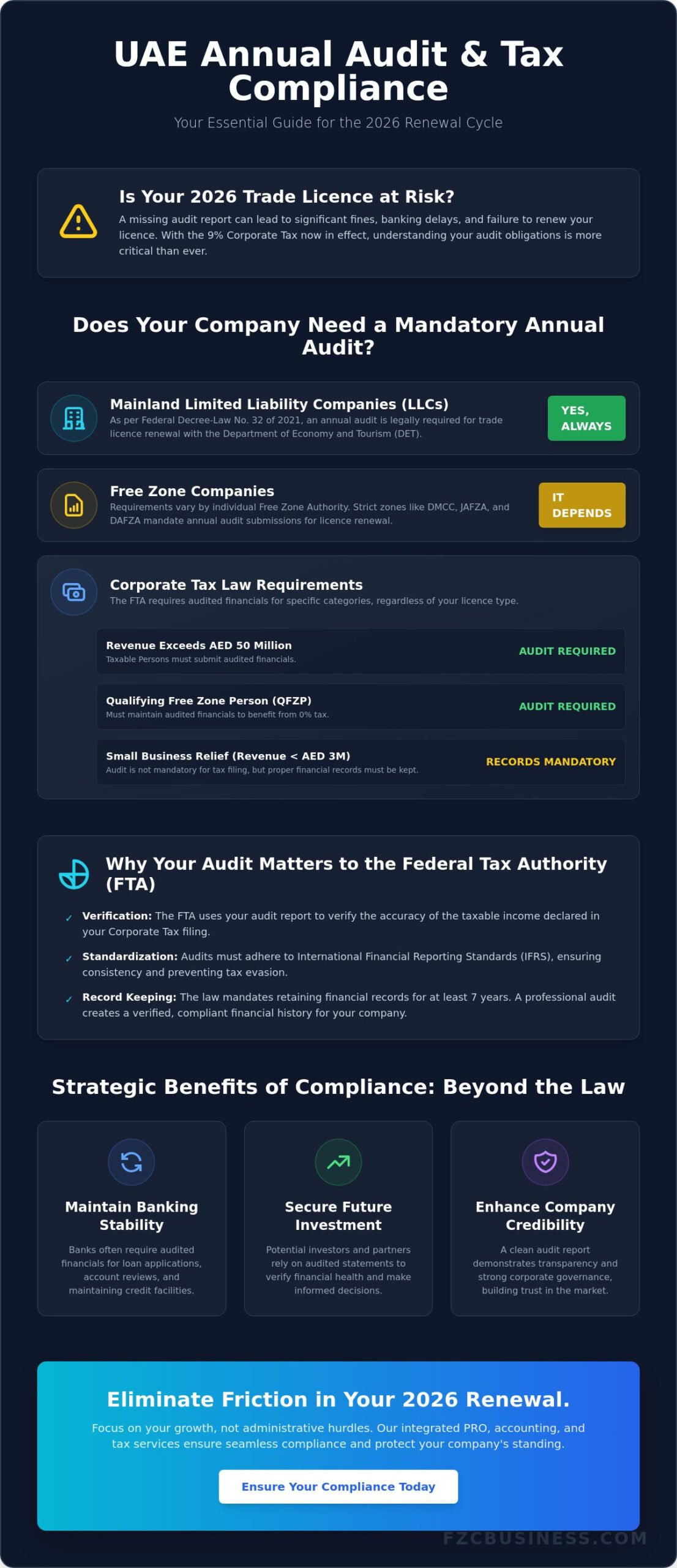
Is your 2026 trade licence renewal already at risk because of a missing audit report? For many business owners, the transition to a stricter regulatory environment feels like moving targets, especially with the 9% Corporate Tax now firmly in effect. You likely feel the pressure of managing annual compliance for uae companies while trying to decipher whether your specific Free Zone or Mainland licence requires a formal audit this year. It’s a complex puzzle where one missing document can lead to significant fines or banking delays.
We understand that you want to focus on growth, not administrative hurdles. This guide provides the clarity you need to master legal and tax mandates for the 2026 cycle. You’ll learn exactly which entities must submit audited financials to the Federal Tax Authority and how to prepare your records to ensure a seamless renewal process. We provide a clear Yes/No framework for your licence type and a practical checklist of documents to get you ready for your auditor today. By understanding the direct link between your audit and tax obligations, you can protect your company’s standing in the UAE market.
Key Takeaways
- Identify the specific legal mandates under UAE Federal Decree-Law No. 32/2021 that require Mainland LLCs to conduct annual audits.
- Learn how audit requirements differ between Mainland Dubai and various Free Zones to ensure your trade licence renewal remains on track.
- Streamline your annual compliance for uae companies by following a structured preparation checklist for your FTA-approved external auditor.
- Discover how audited financial statements act as a strategic asset for maintaining banking stability and securing future investment.
- Understand how integrated PRO and tax services can eliminate administrative friction during your 2026 company renewal cycle.
Understanding the Legal Framework for UAE Annual Audits
A statutory audit is a formal examination of your company’s financial records performed by an external, FTA-approved firm. It’s not just a routine check; it’s a legal requirement designed to ensure transparency and accuracy in the financial reporting of your business. Under the UAE Corporate Law Framework, specifically Federal Decree-Law No. 32 of 2021, all mainland limited liability companies (LLCs) must have their accounts audited annually. This mandate ensures that your business remains in good standing with the Department of Economy and Tourism (DET) and other regulatory bodies.
Ministerial Decision No. 82 of 2023 has further refined these requirements. It specifies the categories of taxable persons required to maintain audited financial statements for corporate tax purposes. It’s vital to remember that these obligations follow your company’s financial year, which might not align with the calendar year. For example, if your financial year ends on June 30, your audit and tax filing deadlines will be calculated from that date. Managing the annual compliance for uae companies requires a precise understanding of these overlapping legal timelines.
To better understand this concept, watch this helpful video:
The Role of the Federal Tax Authority (FTA)
The FTA uses audited reports to verify that the taxable income you report in your Corporate Tax filing is accurate. Auditors must follow International Financial Reporting Standards (IFRS) to ensure consistency across the UAE market. This standardization helps the FTA identify discrepancies and prevents tax evasion. Additionally, the FTA mandates that you retain all financial records for at least 7 years. Having a professional audit simplifies this record-keeping process by creating a verified trail of your financial history.
Who is Legally Obligated in 2026?
In 2026, several types of entities must prioritize their audit preparation. This includes all mainland LLCs, Public Joint Stock Companies (PJSCs), and branches of foreign companies. Beyond the licensing requirement, the UAE Corporate Tax Law mandates audited financial statements for any taxable person with revenue exceeding AED 50 million during a tax period.
Even if you fall below this threshold, you aren’t necessarily exempt. Qualifying Free Zone Persons must maintain audited financial statements to benefit from the 0% corporate tax rate on qualifying income, regardless of their revenue levels. Companies claiming Small Business Relief (those with revenue under AED 3 million) must still register for tax and maintain records, even if a full audit isn’t strictly mandatory for the tax filing itself. Staying ahead of these rules is a core part of successful annual compliance for uae companies.
Mainland vs. Free Zone: Varying Audit Requirements
The regulatory landscape for annual compliance for uae companies isn’t uniform. It shifts significantly depending on whether your business operates on the Mainland or within a specific Free Zone. For Mainland Dubai companies, particularly Limited Liability Companies (LLCs), submitting an annual audit report is a non-negotiable step for trade licence renewal. Without this verified financial document, the Department of Economy and Tourism (DET) will not process your renewal application. This creates a critical timeline where your 2026 licence validity directly hinges on the accuracy and submission of your 2025 financial report.
Free Zones operate under their own independent authorities, leading to a diverse range of requirements. While some zones demand annual submissions, others only require you to maintain records on a request-basis. It’s essential to distinguish between internal audits, which you might conduct for management purposes, and external audits performed by approved third-party firms. Only the latter satisfies the statutory requirements of strict Free Zone authorities and the Federal Tax Authority (FTA).
Mandatory Audit Free Zones (DMCC, JAFZA, DAFZA)
Zones like the Dubai Multi Commodities Centre (DMCC) maintain some of the strictest standards in the region. DMCC companies must submit their audited financial statements via the online portal within 90 days of the end of their financial year. If you miss this window, you face immediate fines and potential portal blocks. In Jebel Ali Free Zone (JAFZA), late submission can lead to the suspension of your trade licence, effectively halting your operations. These authorities use audit reports as a primary tool to monitor Economic Substance Regulations (ESR) compliance, ensuring that companies have a genuine operational presence in the UAE.
Flexible Audit Free Zones (SHAMS, IFZA, RAKEZ)
Authorities such as Sharjah Media City (SHAMS), IFZA, and RAKEZ are often perceived as more flexible because they don’t always require an audit report for the annual licence renewal. However, this doesn’t mean you should skip the process. As discussed in our Free Zone Company Setup in the UAE guide, maintaining high standards of financial reporting is vital for long-term stability. Even in these zones, the FTA can demand your financial records at any time to verify Corporate Tax obligations. An audit provides the necessary verification to avoid penalties during these request-basis inspections. If you find these varying rules confusing, you can consult with our experts to determine the exact requirements for your specific jurisdiction. This proactive approach ensures your annual compliance for uae companies remains flawless across all your business activities.
The Audit Process: Preparation and Documentation
Achieving annual compliance for uae companies requires more than just keeping receipts in a folder. It’s a structured process that demands coordination between your internal finance team and your external auditor. The journey begins with the formal appointment of an auditor who is registered and approved by the Federal Tax Authority. This firm must remain independent, meaning they cannot be the same individuals who manage your monthly bookkeeping.
Once appointed, you must provide a complete Trial Balance. This document serves as the foundation for the Financial Statements. The auditor then performs substantive testing, which involves verifying your assets and liabilities through bank reconciliations and third-party confirmations. The final stage is the issuance of the Audit Opinion. This report, accompanied by a Management Letter detailing any internal control gaps, is what you’ll submit to the relevant authorities for your 2026 renewals.
Essential Document Checklist for 2026
To expedite the process, gather these documents before the auditor arrives:
- Corporate documents: Your current Trade Licence, Memorandum of Association (MoA), and Share Certificates.
- Financial records: The general ledger, all VAT returns filed during the year, and monthly bank statements.
- Operational data: Wage Protection System (WPS) records to prove payroll compliance and copies of major service contracts.
Timeline and Deadlines to Remember
A standard audit typically lasts between 2 to 4 weeks. This duration depends on the volume of transactions and the complexity of your business structure. Most jurisdictions require you to submit the final report within 3 to 6 months after your financial year ends. For those involved in Business Setup in Dubai Mainland, early preparation is critical. The DET renewal window is narrow, and a delay in your audit can lead to late fees or the suspension of your commercial activities. Starting your preparation at least two months before your year-end ensures a frictionless transition into the new licensing year. Proactive documentation is the most reliable way to guarantee seamless annual compliance for uae companies in a tightening regulatory market.
Strategic Benefits of Compliance: Beyond the Law
Viewing an annual audit solely as a regulatory burden is a missed opportunity for growth. In the UAE’s maturing economy, an audit serves as a financial passport. Beyond fulfilling the basic requirements for annual compliance for uae companies, it builds a foundation of trust with external stakeholders. It’s a proactive way to demonstrate that your business is transparent, solvent, and managed with professional integrity.
Investor confidence relies heavily on these verified figures. Whether you’re looking to secure private equity, take out a business loan, or facilitate a future company sale, audited financials provide the necessary proof of value. They also act as a vital internal safeguard. A thorough audit identifies operational inefficiencies and potential internal fraud before they escalate, allowing you to optimize your resources and protect your capital. For many entrepreneurs, there’s also a residency benefit. Maintaining clean, audited accounts demonstrates your company’s stability, which directly supports long-term residency applications like the Golden Visa.
Audit as a Tool for Corporate Tax Optimization
Audits provide a powerful shield during official FTA inspections. By verifying your figures before you file, you prevent costly disputes over taxable income. Auditors help you identify all legitimate deductible expenses, which can effectively lower your overall corporate tax liability in 2026. This is especially critical if your business engages in related-party transactions. Your auditor ensures you’re following Transfer Pricing regulations, preventing the FTA from re-characterizing your transactions and imposing heavy penalties for non-compliance.
Maintaining Your Corporate Bank Account
In 2026, UAE banks have intensified their scrutiny of business activities. During your annual Know Your Customer (KYC) refresh, the bank will almost certainly request your latest audited financials to verify the legitimacy of your turnover. If you’re currently setting up or need to understand these banking expectations, review our guide on How to Open a Bank Account in the UAE. You must be aware that a “qualified” audit opinion, where an auditor flags significant discrepancies, can lead to immediate account closure. Banks view these as high-risk indicators for financial instability or money laundering.
Proactive auditing transforms a mandatory task into a strategic asset for your business. If you need to align your financial records with these high standards to ensure your account stays active, contact our compliance experts to secure your company’s standing today.
Simplifying UAE Compliance with Fast Zone Business
Fast Zone Business acts as your strategic partner in navigating the intricate web of UAE regulations. We understand that as a business owner, your time is best spent on scaling operations rather than deciphering the latest ministerial decisions. Our team provides a comprehensive suite of services that bridges the gap between your annual audit requirements and your day-to-day business activities. By integrating PRO and tax services, we ensure that every piece of your financial and legal documentation aligns perfectly with the standards expected by the DET and the FTA. This integrated approach is the most efficient way to manage the annual compliance for uae companies.
Our experts don’t just point out problems; we provide the solution. We connect you with a vetted network of approved auditors and tax specialists, creating a frictionless environment for your business to thrive. This proactive management allows you to avoid the panic of last-minute filings and the risk of heavy fines. Trust our team to maintain your company’s good standing while you focus on your core objectives.
Our PRO and Corporate Tax Solutions
Managing the annual compliance for uae companies involves constant coordination with various government bodies to maintain your licence and visas. We take the lead in these interactions, ensuring your trade licence renewal is processed without delays or administrative friction. Our services include:
- Coordinating with government bodies for seamless trade licence renewals.
- Assisting with VAT and Corporate Tax registration and quarterly filings.
- Ensuring all Golden Visa requirements are met through consistent compliance.
- Handling partner and family visa renewals to keep your team and family secure.
Why Entrepreneurs Choose Fast Zone Business
Our reputation is built on deep local expertise and a refusal to let administrative hurdles slow down our clients. Whether you are operating in Dubai Mainland or one of the many specialized Free Zones, we provide tailored guidance that reflects your specific jurisdiction’s rules. If you’re currently researching how to start a business in dubai, you’ll find that our support begins from the very first day. We offer transparent communication and efficient turnaround times, giving you the peace of mind that your renewals are in safe hands. Our action-oriented approach ensures that complex regulatory hurdles are cleared quickly, allowing your business to maintain its momentum in the competitive UAE market.
Secure Your Company’s Standing for 2026 and Beyond
Navigating the evolving financial landscape in the Emirates requires a proactive approach to documentation and legal mandates. As we have explored, an annual audit is no longer just a checkbox for large corporations; it’s a vital tool for trade licence renewals, Corporate Tax accuracy, and maintaining essential banking relationships. Whether you operate in a strict Free Zone like DMCC or on the Dubai Mainland, the 2026 cycle demands precision and early preparation to avoid costly penalties or operational delays.
Maintaining annual compliance for uae companies doesn’t have to be a source of administrative stress. By partnering with experts who understand the nuances of both regional licensing and federal tax laws, you can focus on your core business growth while we handle the regulatory hurdles. Our team provides specialized VAT and Corporate Tax assistance alongside expert PRO services for all jurisdictions. We are also a trusted partner for those seeking to secure their future through Golden Visa and residency applications.
Get Expert Guidance on Your UAE Audit and Tax Compliance Today. Take control of your corporate journey and ensure your business remains a symbol of stability and success in the UAE market.
Frequently Asked Questions
Is an annual audit mandatory for all Dubai Mainland companies in 2026?
Yes, all Mainland Limited Liability Companies (LLCs) and Public Joint Stock Companies (PJSCs) are legally required to have their financial accounts audited annually. This mandate is driven by the UAE Commercial Companies Law, specifically Federal Decree-Law No. 32 of 2021. Failing to provide these audited statements can prevent your trade licence renewal and lead to administrative penalties from the Department of Economy and Tourism. It is a non-negotiable requirement for staying in good standing.
What are the penalties for not submitting an audit report in the UAE?
Non-compliance leads to several severe consequences, including financial penalties that vary by jurisdiction. In major Free Zones like DMCC, late submission can result in immediate fines and the suspension of your company portal access. For Mainland entities, the inability to renew a trade licence due to a missing audit can halt operations and trigger bank account restrictions. These hurdles disrupt your annual compliance for uae companies and damage your corporate reputation with investors.
Can I use an internal accountant to perform my annual statutory audit?
No, you cannot use an internal employee for this process. A statutory audit must be conducted by an external, independent auditing firm that is registered and approved by the relevant UAE authorities. While your internal accountant prepares the trial balance and supporting documents, the auditor provides an unbiased opinion on the accuracy of your financial statements. This independence is a core legal requirement for valid financial reporting and is strictly enforced by the FTA.
Do Free Zone companies need to submit audits to the Federal Tax Authority?
Free Zone companies must maintain audited financial statements if they wish to qualify as a “Qualifying Free Zone Person” to benefit from the 0% corporate tax rate. Even if you don’t meet that specific criteria, the Federal Tax Authority requires audited reports if your annual revenue exceeds AED 50 million. Maintaining these records is a critical component of annual compliance for uae companies to ensure you don’t lose tax benefits or face unexpected inspections.
How much does a typical annual audit cost for an SME in Dubai?
The cost of an annual audit is not fixed and depends on several factors specific to your business operations. Auditors typically base their fees on your total revenue, the volume of monthly transactions, and the complexity of your company structure. While we don’t provide specific pricing for third-party auditing services, SMEs with organized records generally face lower fees than those with complex multi-currency accounts. It is best to request a tailored quote based on your ledger.
What is the AED 50 million threshold for UAE Corporate Tax audits?
The AED 50 million threshold is a specific requirement under the UAE Corporate Tax Law. Any taxable person, whether Mainland or Free Zone, whose revenue exceeds this amount during a relevant tax period is legally obligated to have audited financial statements. This ensures that the figures reported to the FTA are verified by an independent party. If your revenue is below this but you are a Qualifying Free Zone Person, the audit remains mandatory regardless of income.
How long must a UAE company keep its audited financial records?
UAE regulations require businesses to retain their financial records for significant periods to satisfy potential inspections. For VAT purposes, you must keep records for at least 5 years. However, the Corporate Tax Law requires you to maintain financial records and audited statements for a minimum of 7 years from the end of the tax period. Keeping these records digitally and in hard copy ensures you remain compliant during any future FTA inspections or bank KYC refreshes.
Is an audit required for trade licence renewal in 2026?
Yes, for all Mainland LLCs and specific Free Zone entities like those in DMCC or JAFZA, an audit is a prerequisite for licence renewal. Other authorities, like RAKEZ or IFZA, may not require it for every renewal but reserve the right to demand audited financials at any time. Regardless of the immediate renewal trigger, having an audit ready is essential for maintaining your corporate bank account and ensuring smooth operations throughout your 2026 business cycle.
