
UAE Business Setup Process for a Holding Company: The 2026 Expert Guide
In 2025, the UAE attracted over $45 billion in Foreign Direct Investment, a 50% increase that cements its position as a leading global financial hub. If you’re looking to shield your wealth, the uae business setup process for a holding company offers a robust framework to centralize management and optimize your tax profile. You likely recognize that while the opportunities are vast, the 2026 implementation of Federal Decree-Law No. 20 of 2025 and the 9% corporate tax rate have made structural precision more important than ever.
We understand that navigating the choice between Mainland and Free Zones, where setups can start as low as AED 10,900, often leads to more questions than answers. This guide provides the expert guidance you need to master the step-by-step journey of establishing a UAE holding company that qualifies for participation exemptions on dividends and capital gains. You’ll learn how to select the ideal jurisdiction, clear banking hurdles, and build a compliant, hassle-free foundation for your global assets.
Key Takeaways
- Identify the critical differences between Mainland and Free Zone jurisdictions to ensure your legal structure aligns with your specific asset locations.
- Simplify the uae business setup process for a holding company with a clear 2026 roadmap covering name reservation and scope definition.
- Protect your global wealth by understanding how holding entities qualify for the “Participation Exemption” to optimize your tax profile.
- Ensure your entity meets modern Economic Substance Regulations (ESR) to maintain a compliant and secure investment vehicle in the UAE.
- Leverage expert PRO services to manage bureaucratic hurdles, providing a smooth and efficient experience from registration to bank account opening.
Understanding the UAE Holding Company Structure in 2026
A Holding company is a specific legal entity that doesn’t produce goods or provide services itself. Instead, its sole purpose is to own assets or shares in other corporations. In the UAE, these entities are strictly “passive,” meaning they don’t engage in active trade but serve as the ultimate parent for a group of companies. Understanding this distinction is the first step in the uae business setup process for a holding company because it dictates your licensing requirements and compliance obligations.
To better understand how these structures operate in the local market, watch this helpful video:
2026 marks a turning point for the region. The UAE is now a top-tier global hub, especially for family offices seeking stability. This shift follows a record-breaking 2025 where the country captured more than half of all investment flows into the Middle East. Whether you’re managing global real estate or international tech startups, the holding structure provides a “whitelisted” environment that satisfies international transparency standards while keeping your assets secure. You can choose between an Investment Holding, which purely manages private wealth, or an Operational Holding, which oversees active trading subsidiaries. Both structures act as a powerful “Asset Shield,” ring-fencing your global assets from the operational risks associated with individual business units.
Key Functions of a UAE Holding Entity
A holding company provides a centralized command center for your entire portfolio. It allows you to:
- Manage multiple business units under a single umbrella, simplifying corporate governance and reporting.
- Facilitate the smooth transfer of dividends and profits from subsidiaries to the parent entity.
- Mitigate financial risks by ensuring that the liabilities of one subsidiary don’t impact the assets held by the parent or other group members.
Why 2026 is the Strategic Year for Setup
The 9% corporate tax rate is now a reality, but it’s not a deterrent for savvy investors. Holding companies are specifically positioned to benefit from participation exemptions. This means dividends and capital gains from qualifying shareholdings can remain tax-free if you meet the right criteria. Additionally, the UAE’s commitment to digital transformation means that opening corporate bank accounts for holding structures is faster than ever. As the expert guidance at Fast Zone Business shows, setting up now ensures your structure is fully compliant with the latest Economic Substance Regulations while benefiting from the UAE’s high-growth environment.
Choosing the Right Jurisdiction: Mainland, Free Zone, or ADGM?
Selecting a home for your assets is the most consequential step in the uae business setup process for a holding company. Your choice dictates everything from your tax exposure to your ability to own local property. While many entrepreneurs gravitate toward Free Zones for their perceived simplicity, the reality of 2026 requires a more nuanced approach. You must align your jurisdiction with the geographic location of your subsidiaries and the specific legal protections your investors demand.
Mainland Holding Advantages
A Mainland structure, governed by the Department of Economy and Tourism (DET), is the premier choice if your primary goal is to hold UAE-based real estate or local subsidiaries. Unlike other options, a Mainland holding company offers unrestricted ownership of property across all seven Emirates. Recent updates from the UAE Ministry of Economy confirm that 100% foreign ownership is now standard for most commercial activities, removing the traditional need for a local sponsor. If you plan to manage a portfolio of local operational businesses, this path provides the most direct control. For a deeper dive into these specific requirements, see our Mainland License Guide.
Free Zone vs. Financial Centres
Free Zones like IFZA, Meydan, and RAKEZ are highly cost-effective for international asset holding. With packages at IFZA starting from AED 10,900, these zones are ideal for digital entrepreneurs or those holding global intellectual property. They offer a faster setup and lower initial capital requirements than financial hubs. You can explore these efficient options further in our Free Zone Setup Guide.
In contrast, the Abu Dhabi Global Market (ADGM) and Dubai International Financial Centre (DIFC) represent the gold standard for sophisticated investors. These financial centres operate under English Common Law, providing a familiar legal framework for succession planning and complex trust structures. While the costs are higher, ADGM recently revised its registration fee to a more competitive USD 5,500 effective January 1, 2025. DIFC remains a premium choice with first-year costs typically ranging between AED 180,000 and AED 250,000. These jurisdictions are perfect for those who prioritize a robust judicial system over initial setup costs.
Deciding between these paths requires a clear understanding of your long-term goals. If you aren’t sure which jurisdiction fits your subsidiary geography, it’s wise to book a free consultation with our team to ensure your structure is built for growth from day one.
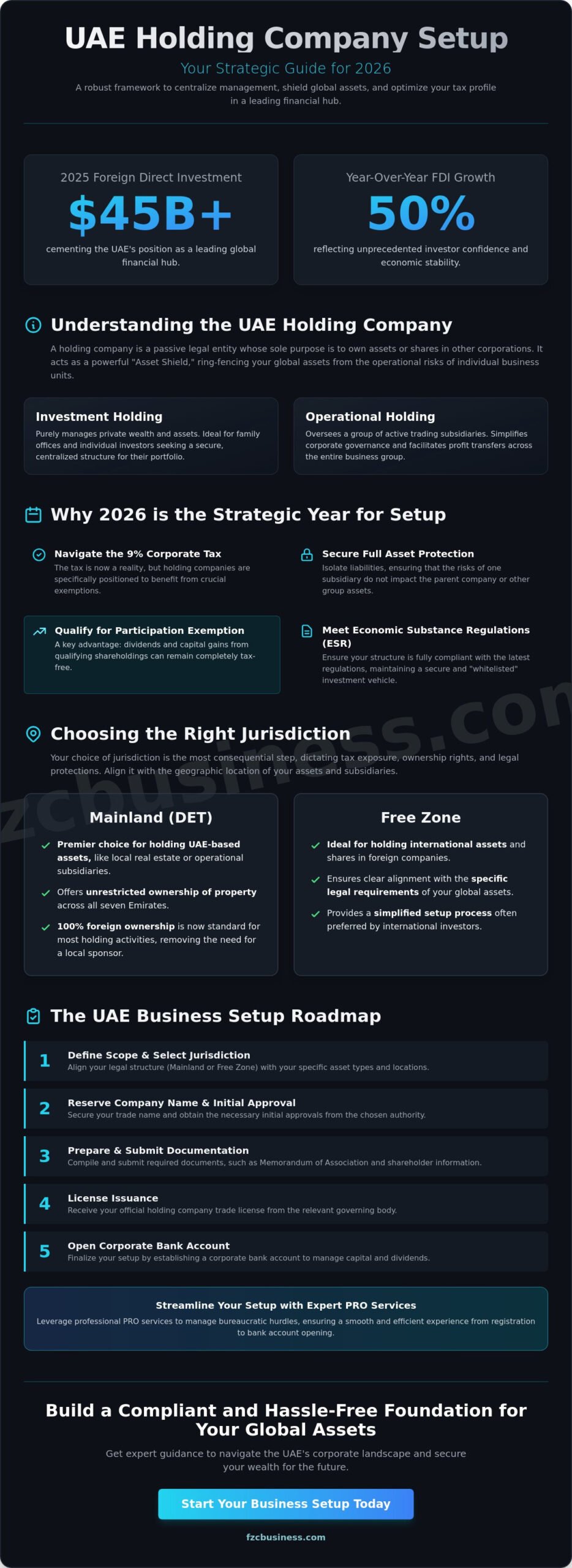
The Step-by-Step UAE Business Setup Process for Holding Companies
The uae business setup process for a holding company is a methodical journey that requires strict adherence to regulatory timelines. While the UAE has streamlined digital registrations, holding entities face unique scrutiny regarding asset types and ownership structures. Following a structured path ensures your entity is active and compliant within days rather than weeks.
Step 1: Define the scope. You must decide if the holding company will own UAE-based assets, global subsidiaries, or a combination of both. This decision dictates whether you need a Mainland or Free Zone license. Step 2: Name reservation. Regulatory bodies require that the trade name reflects the company’s nature. Your chosen name must include “Holding” or “Holdings” to comply with Federal Decree-Law No. 20 of 2025.
Step 3 involves obtaining initial approval and drafting legal documentation. You’ll need a Memorandum of Association (MOA) and Articles of Association that clearly outline the parent company’s powers over its subsidiaries. Step 4: Office space requirements. Holding companies often have lower physical space needs. Most Free Zones allow for virtual offices or “flexi-desks,” but Mainland entities usually require a physical lease agreement (Ejari) to satisfy registration requirements. Step 5: Final license issuance and FTA registration. Once the license is issued, you must register with the Federal Tax Authority to manage your 9% corporate tax obligations and ensure you’re eligible for participation exemptions.
Document Checklist for 2026
Preparation is the key to a smooth experience. In 2026, authorities require high-resolution passport copies of all shareholders and a detailed Ultimate Beneficial Owner (UBO) declaration to meet global transparency standards. If your parent company is based overseas, you must provide documents attested by the UAE Embassy in the country of origin. Additionally, having professional reference letters and evidence of address ready will expedite your bank account pre-approval, which is often the longest part of the setup journey.
The Role of PRO Services in Expediting Setup
Managing government portals and document attestation can be a bureaucratic hurdle for international investors. Our PRO services provide a bridge between your business goals and government requirements. We manage the entire “Initial Approval” stage to avoid common delays caused by incorrect activity coding or naming conflicts. By utilizing expert guidance, you ensure a hassle-free process that allows you to focus on your investment strategy while we handle the administrative heavy lifting with the relevant authorities. This professional oversight is particularly vital given the 32% increase in new company registrations seen in hubs like DIFC during 2025, which has led to stricter document verification queues.
Compliance, Corporate Tax, and Asset Protection Strategies
Mastering the uae business setup process for a holding company involves more than just filing paperwork; it requires a proactive approach to the 2026 fiscal environment. While the standard 9% corporate tax applies to taxable income exceeding AED 375,000, holding entities are uniquely positioned to optimize their tax profile. By meeting specific criteria, you can access the “Participation Exemption,” which allows dividends and capital gains from qualifying shareholdings to remain tax-free. This level of security and tax efficiency is a primary driver in the uae business setup process for a holding company for international investors.
Compliance in 2026 also hinges on Economic Substance Regulations (ESR). Holding companies are classified as a “Relevant Activity,” meaning you must prove that your entity has sufficient “substance” within the UAE. Even though holding companies often face a “reduced substance” test, you must still file annual notifications and ensure that strategic decisions are made by a local board. Additionally, all holding structures must complete GoAML registration. This platform is mandatory for Anti-Money Laundering compliance, ensuring your business meets the transparency standards that helped the UAE attract over $45 billion in FDI during 2025.
Asset protection remains a cornerstone of the UAE’s appeal. A properly structured holding company acts as a legal firewall, shielding your global assets from liabilities or litigation faced by individual subsidiaries. If a business unit in another country encounters financial distress, the assets held by your UAE parent company remain protected under the nation’s robust commercial laws.
Managing Corporate Tax in 2026
To secure a 0% tax rate on dividends, your holding company must hold a minimum 5% ownership stake in the subsidiary for at least 12 months. Maintaining substance is equally critical. You must ensure that your entity has adequate personnel and premises in the UAE, even if these are managed through a virtual office in a Free Zone. A key part of this compliance is having a functional financial footprint. You can learn more about securing the necessary infrastructure in our Corporate Bank Account Guide.
Succession Planning and the Golden Visa
A significant advantage often overlooked is how a holding company facilitates long-term residency. By establishing a structure with a total investment value of at least AED 2 million, shareholders typically qualify for the 10-year Golden Visa. This provides a stable environment for legacy planning, allowing you to sponsor family members and key executives without the need for a local employer. For more sophisticated needs, you can integrate your holding company with an ADGM or DIFC Foundation. This combination offers an unparalleled level of control over succession, ensuring your wealth is transferred according to your specific wishes across generations.
If you need specialized VAT and Corporate Tax Assistance to ensure your structure remains compliant, our team provides the expert guidance required to navigate these regulations with ease.
Scaling Your Portfolio with Fast Zone Business Support
Establishing your structure is only the first phase of your investment journey. The long-term success of your wealth management vehicle depends on continuous compliance and strategic scaling. Fast Zone Business serves as your one-stop destination for the entire uae business setup process for a holding company, ensuring that your entity remains a robust asset shield year after year. We don’t just sell licenses; we build customized structures that align with the specific geographic footprint of your subsidiaries. Whether you’re managing real estate in Dubai Mainland or tech startups in a Free Zone, our in-depth knowledge ensures your group structure is optimized for the 2026 tax landscape.
Our “Hassle-Free” promise means we handle the administrative heavy lifting while you focus on your core investment goals. From the initial name reservation to final VAT and Corporate Tax assistance, we navigate the bureaucratic hurdles on your behalf. This is especially vital as the UAE continues to see massive growth, with FDI hitting $45 billion in 2025. As regulations like Economic Substance Regulations (ESR) and GoAML registration evolve, having a reliable partner ensures your portfolio remains compliant without distracting you from your primary business objectives.
Why Entrepreneurs Choose Fast Zone
Entrepreneurs choose our team because we provide a smooth experience backed by expert guidance. We maintain trusted partnerships with leading UAE banks, which is critical for holding entities that often face stricter due diligence during account opening. Our team manages every detail of the Dubai Business Setup Checklist, from document attestation to UBO declarations. We also bridge the gap that many competitors ignore: the integration of your business structure with your residency status. A holding company with qualifying assets is a powerful tool for securing a 10-year Golden Visa, and we manage that entire application process for you and your family.
Book Your Free 2026 Strategy Consultation
The uae business setup process for a holding company is a journey that requires a personalized roadmap. We invite you to speak with one of our setup experts to determine the most efficient jurisdiction and legal structure for your specific needs. Whether you’re interested in ADGM’s common law protections or the cost-efficiency of a Free Zone, we provide the clarity you need to move forward with confidence. Our team is ready to customize our services to meet the specific needs at every stage of your business journey, from initial formation to annual license and visa renewals. Book your FREE consultation with Fast Zone Business today and take the first step toward a secure, tax-optimized future in the UAE.
Build a Secure Legacy with a UAE Holding Structure
Establishing a holding entity in the UAE is a strategic move that demands precision. You’ve now seen how the right jurisdiction, whether Mainland or a specialized Free Zone, creates a robust shield for your global assets. Mastering the uae business setup process for a holding company ensures you remain compliant with the 2026 tax updates while securing long-term residency for your family. Success in this landscape requires more than just a license; it requires a structure designed for growth and transparency.
Fast Zone Business acts as your professional partner and one-stop destination for all corporate needs. Our team brings specialized knowledge in both Mainland and Free Zone regulations to provide you with a smooth, hassle-free experience. We have a proven track record in managing Golden Visa applications and complex Corporate Tax compliance for international investors. You can focus on your core investment goals while we handle the technical bureaucracy and government relations.
Start Your UAE Holding Company Journey with Fast Zone Business today. We’re ready to help you build a secure foundation for your global portfolio.
Frequently Asked Questions
Can a UAE holding company own assets outside the UAE?
Yes, a UAE holding company can own assets and shares in subsidiaries located anywhere in the world. This structure is specifically designed to centralize the management of international portfolios. Since the UAE is recognized as a whitelisted jurisdiction in 2026, these entities are widely accepted by international banks and regulatory bodies for cross-border asset management and profit repatriation.
Do I need a physical office for a holding company setup in Dubai?
Office requirements depend entirely on your chosen jurisdiction. Mainland entities must have a physical lease agreement, known as an Ejari, to comply with Department of Economy and Tourism rules. However, many Free Zones like IFZA offer flexi-desk packages starting from AED 10,900, which satisfy the uae business setup process for a holding company without the need for a large physical space.
Is 100% foreign ownership allowed for holding companies in the UAE Mainland?
Yes, 100% foreign ownership is standard for holding companies on the UAE Mainland. Federal Decree-Law No. 20 of 2025, which became effective on January 1, 2026, reinforces this right by allowing international investors to maintain full control without a local sponsor. This allows you to manage local real estate and subsidiaries with total autonomy and legal security.
How long does it take to get a holding company license in 2026?
Obtaining a license typically takes between 3 and 10 working days once all documents are submitted. The timeline varies based on the specific Free Zone or Mainland authority you choose. While digital platforms have streamlined the uae business setup process for a holding company, the 32% increase in new registrations seen in early 2025 means that having complete, attested paperwork is essential to avoid queues.
What are the minimum capital requirements for a holding company?
Most UAE Free Zones do not require you to deposit a minimum paid-up capital to issue a holding license. In contrast, financial hubs like ADGM or DIFC may have specific capital adequacy rules depending on the complexity of the assets you intend to hold. It’s vital to check the current regulations for your specific jurisdiction, as requirements for financial services can differ from general investment holdings.
Does a holding company need to register for VAT?
Registration for VAT is only mandatory if your taxable turnover exceeds the AED 375,000 threshold. Many holding companies only receive passive income, such as dividends, which are often outside the scope of VAT. However, you can choose to register voluntarily if your turnover is between AED 187,500 and AED 375,000 to recover input tax on your setup and operational costs.
Can I get a Golden Visa through a holding company setup?
Yes, you can qualify for a 10-year Golden Visa if the assets held by your company have a total value of at least AED 2 million. This requires providing an official audit report or a government-approved valuation to prove the investment level. This residency pathway is a primary benefit for high-net-worth individuals who want to secure a long-term future for their family in the UAE.
What is the difference between a holding company and a family office in the UAE?
A holding company is a legal entity used to own assets, whereas a family office is a management structure that oversees the broader affairs of a wealthy family. A family office often uses multiple holding companies to organize different asset classes like real estate or private equity. In 2026, the UAE offers specialized licenses for both, allowing families to separate asset ownership from legacy planning functions.