
UAE VAT Registration for New Company: A Step-by-Step 2026 Guide
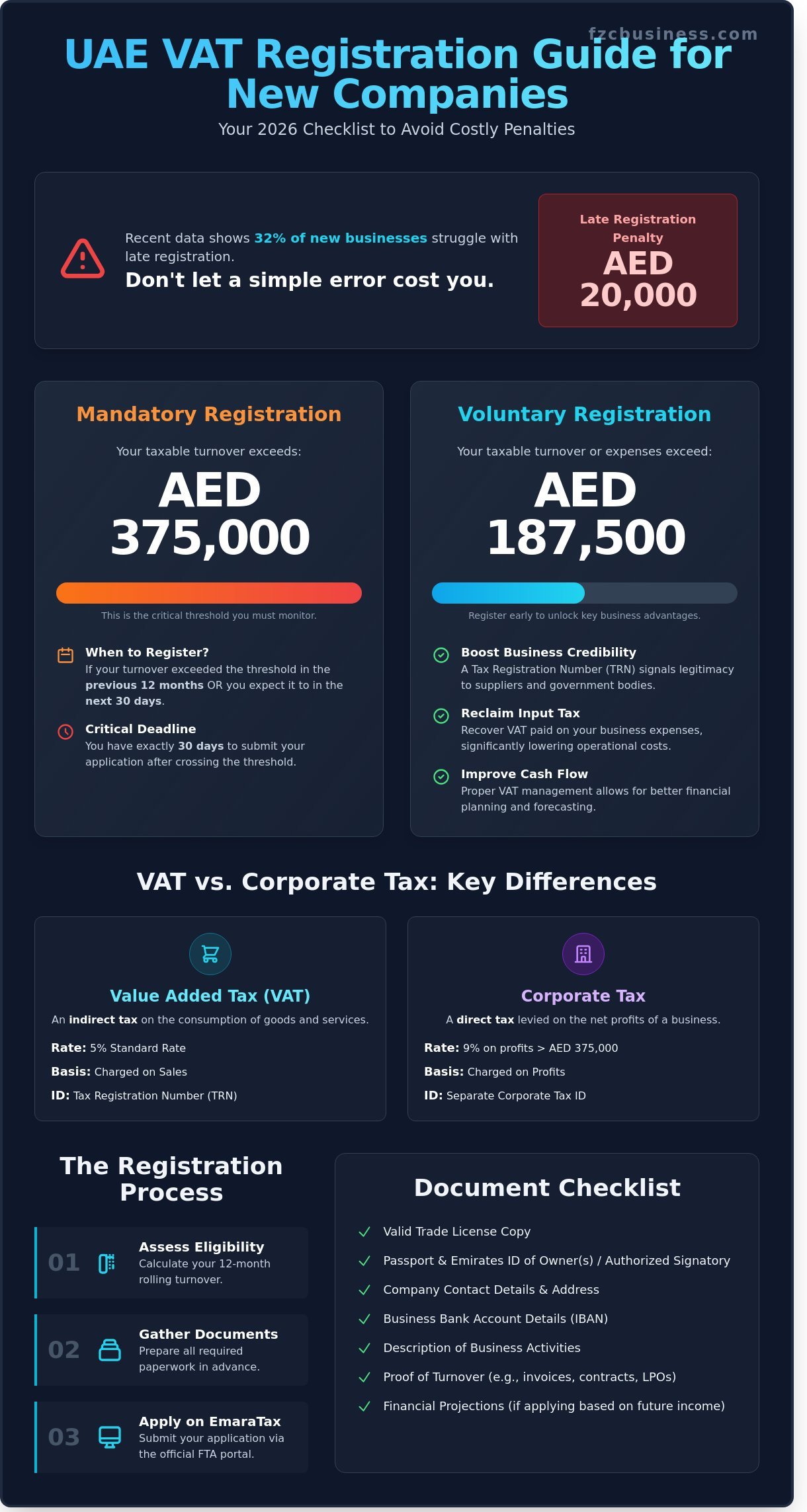
What if a single missed deadline cost your startup AED 20,000 before you even made your first sale? Data from recent FTA filings shows that 32% of new businesses struggle with late registration penalties due to simple administrative errors. You know that uae vat registration for new company is a critical step, yet the line between the AED 187,500 voluntary threshold and the AED 375,000 mandatory requirement remains confusing for many owners in 2026.
It’s natural to feel frustrated by the technical hurdles of the EmaraTax portal or the specific documentation required by UAE authorities. We’re here to provide the expert guidance necessary to ensure a smooth experience, allowing you to focus on your growth. This comprehensive guide promises to simplify the path to your Tax Registration Number (TRN) with a clear, action-oriented checklist. You’ll learn exactly how to handle eligibility, gather your documents, and complete your registration with total confidence.
Key Takeaways
- Determine whether your business meets the AED 375,000 mandatory threshold or qualifies for voluntary registration at AED 187,500.
- Follow our expert guidance to complete your uae vat registration for new company through the EmaraTax portal for a smooth, efficient experience.
- Prepare a comprehensive document checklist, including authorized signatory identification, to avoid common delays in your FTA application.
- Discover the essential requirements for issuing VAT-compliant invoices and managing your Tax Registration Number (TRN) with confidence.
- Gain professional insights into the 2026 regulatory landscape and the Federal Tax Authority’s role in overseeing your corporate tax obligations.
Understanding UAE VAT Registration for Your New Company in 2026
Launching a business in 2026 requires a firm grasp of the local tax environment to ensure long-term success. Value Added Tax (VAT) is a 5% consumption tax charged at each step of the supply chain. In the UAE, the Federal Tax Authority (FTA) acts as the primary regulator, managing the collection and enforcement of these taxes. For any entrepreneur, uae vat registration for new company entities is a vital step that builds immediate credibility with suppliers and government bodies. It signals that your business is a legitimate, transparent participant in the national economy.
The standard VAT rate of 5% applies to most goods and services, but the system also includes zero-rated sectors. These typically include international transportation, healthcare, and education services. Understanding the nuances of Taxation in the United Arab Emirates is essential for accurate financial planning. By registering, you gain the ability to reclaim “input tax” paid on business expenses, which can significantly lower your operational costs. Our team provides expert guidance to ensure this process is a smooth experience for your leadership team.
To better understand the practical steps involved, watch this helpful video:
The Legal Framework for Tax in the UAE
The UAE tax system is built on Federal Decree-Law No. 8 of 2017. By 2026, new amendments have further refined how digital services and cross-border trades are handled. You can’t separate your tax obligations from your trade license; the two are legally linked. If you haven’t secured your license yet, refer to our guide on starting a business in Dubai to begin. Once your license is active, the FTA requires registration if your taxable supplies and imports exceed the mandatory threshold of AED 375,000.
VAT vs. Corporate Tax: What New Owners Must Know
New owners must distinguish between indirect and direct taxes. VAT is an indirect tax you collect from customers on behalf of the government. In contrast, Corporate Tax is a direct 9% levy on business profits exceeding AED 375,000. When you complete your uae vat registration for new company, you’ll receive a Tax Registration Number (TRN). This is entirely different from your Corporate Tax registration number. Your accounting software must be configured to track both tax types from day one. This proactive approach ensures a hassle-free audit process and maintains your compliance with FTA standards. Fast Zone Business offers in-depth knowledge to help you manage these dual requirements efficiently.
Mandatory vs. Voluntary VAT Registration: When Must You Apply?
Understanding the specific financial thresholds is the first step in managing uae vat registration for new company requirements. The Federal Tax Authority (FTA) defines two distinct categories for registration based on your business turnover. You must register for VAT if your taxable supplies and imports exceeded AED 375,000 over the previous 12 months. This is known as the mandatory registration threshold. If you anticipate your taxable supplies will exceed this AED 375,000 limit in the next 30 days, you are also legally required to apply.
The 30-day rule is a critical deadline for every entrepreneur. Once you cross the mandatory threshold, the clock starts ticking immediately. You have exactly 30 days to submit your application through the Federal Tax Authority VAT Registration portal. Delaying this process is a costly mistake. The FTA imposes a fixed administrative penalty of AED 20,000 for late registration. This fine applies regardless of whether the delay was intentional or a simple oversight. If you are unsure about your current turnover status, our team can help you evaluate your tax obligations through a professional assessment.
Calculating Your Taxable Supplies
Determining your registration status requires two distinct calculations. The “Backward Look” involves reviewing your total turnover from the last 12 months on a rolling basis. The “Forward Look” requires you to project revenue for the next 30 days based on signed contracts or confirmed purchase orders. Taxable supplies include all goods and services sold within the UAE that are subject to either the 5% standard rate or the 0% rate. It also includes imported goods and services. However, exempt supplies, such as certain financial services or residential local transport, do not count toward these thresholds.
Why Register Voluntarily as a New Startup?
Many entrepreneurs choose uae vat registration for new company long before they hit the mandatory limit. You can apply voluntarily once your taxable supplies or taxable expenses exceed AED 187,500. This strategy offers significant financial advantages. It allows you to recover Input Tax paid on startup costs, office equipment, and professional fees. Without a Tax Registration Number (TRN), these costs simply become a sunk expense for your business.
Registering early also builds professional credibility. Many large corporate clients and government entities in Dubai prefer or strictly require vendors to have a valid TRN. It signals that your business is a legitimate, compliant entity. For startups with high initial capital expenditure in 2026, voluntary registration ensures you can claim back 5% on every dirham spent during your setup phase, directly improving your initial cash flow.
Document Checklist: Preparing Your Application for the FTA
Precision is the key to a smooth experience with the Federal Tax Authority (FTA). Missing a single document or uploading an expired license can delay your uae vat registration for new company by several weeks. You need to gather high-quality digital copies of your official records before starting the online portal application to ensure a hassle-free process.
Core Corporate Documentation
- Valid Trade License: This must be current and issued by the relevant licensing authority, such as the DET for mainland firms or specific Free Zone authorities.
- Certificate of Incorporation/MOA: The Memorandum of Association (MOA) must clearly outline the shareholding structure and business activities.
- Identification: Clear color scans of the Passport and Emirates ID for all owners, partners, and managers.
For Free Zone entities, the FTA often requests a specific “Certificate of Incumbency” or a similar document if the ownership structure involves offshore holding companies. Mainland businesses generally find the process more straightforward if their Ejari is already linked to their trade license in the government database.
Financial and Banking Information
New companies often lack a 12-month financial history. In this case, the FTA requires projected revenue statements for the next 30 days or signed purchase orders and contracts that prove you’ll hit the threshold. If your expected taxable supplies exceed the voluntary threshold of AED 187,500, you’re eligible to register immediately. You must provide an official IBAN letter from your bank. If you haven’t secured a local account yet, consult our corporate bank account opening guide to expedite this step. Providing a recent bank statement, even if it only shows the initial capital deposit, adds significant credibility to your application.
Contact and Communication Details
The FTA requires a verified physical presence in the UAE. You’ll need to upload your Ejari certificate for mainland offices or a valid lease agreement for free zone premises. While virtual offices are common, a physical desk or office space is often preferred for a faster approval. The Authorized Signatory is the person legally responsible for the tax account. If this person isn’t a shareholder listed on the license, you must provide a notarized Power of Attorney (POA). Additionally, if your uae vat registration for new company involves importing or exporting goods, include your Customs Code to link your VAT and customs profiles for seamless tax recovery on imports.
Managing these requirements requires in-depth knowledge of current 2026 regulations. Our team provides expert guidance to ensure every document meets FTA standards the first time, allowing you to focus on your core business goals while we handle the bureaucratic hurdles.
Step-by-Step Guide to the UAE VAT Registration Process
Completing your uae vat registration for new company requires precision and a clear understanding of the Federal Tax Authority (FTA) requirements. The process moved entirely to the EmaraTax platform, which streamlined how businesses interact with tax regulations. Following a methodical approach ensures you avoid common pitfalls that lead to application delays or rejections.
Initial Setup on EmaraTax
The first step involves creating a digital profile on the EmaraTax portal. Using UAE PASS is the most efficient way to handle authentication. It’s a secure national digital identity that allows for seamless login without the need for multiple passwords. During setup, you must link a permanent mobile number and an active business email to the FTA profile. This ensures you receive critical notifications regarding your tax status. You’ll also need to select the correct entity type. Most new setups choose “Legal Person” for LLCs or “Natural Person” for sole establishments. Making the right choice here is vital; an error in entity selection requires a complete restart of the application.
Completing the VAT Registration Form
Accuracy in the digital form prevents 90% of common registration delays. You must enter business activity codes that match your trade license exactly. If your license lists “General Trading,” don’t select a specific niche code that contradicts your legal documents. Document management is also a technical hurdle. The FTA limits uploads to PDF or JPEG formats, typically capped at 5MB per file. You’ll need to provide clear scans of your trade license, passport copies of owners, and the Emirates ID of the authorized signatory.
You must also declare your financial projections. For 2026, the FTA requires specific data on your expected turnover for the next 30 days or the previous 12 months. If your business engages in international trade, be prepared to list the countries you deal with. This helps the FTA determine if your services are eligible for zero-rating or if they fall under standard 5% VAT rules.
Post-Submission: Timelines and TRN Issuance
After you submit the application, the FTA begins a formal review. As of 2026, the average processing time for a uae vat registration for new company is 14 to 20 business days. During this period, a tax officer might issue a “Request for More Information” (RFI). You usually have 5 business days to provide the requested clarity or additional documents. Prompt responses are essential to keep your application active. Once the officer is satisfied, your Tax Registration Number (TRN) is issued. You can immediately download your VAT Registration Certificate from the dashboard to begin issuing tax-compliant invoices.
Ready to secure your TRN without the stress of paperwork? Book a FREE consultation with our tax experts for a smooth experience.
Post-Registration Compliance: Managing Your TRN
Receiving your Tax Registration Number (TRN) marks a significant milestone, but it also triggers specific legal duties under Federal Decree-Law No. 8 of 2017. Maintaining uae vat registration for new company status requires rigorous attention to the Federal Tax Authority (FTA) calendar. Most new entities file returns quarterly, though the FTA may mandate monthly filings for companies with annual turnover exceeding AED 150 million. It’s vital to remember that even if your business generated zero sales during a specific period, you must file a “nil” return to avoid an initial AED 1,000 penalty. Consistency is the foundation of a clean compliance record.
Setting Up Your VAT-Compliant Invoicing
Your invoicing structure must meet strict legal criteria to ensure your clients can recover their input tax. Use a full “Tax Invoice” for supplies exceeding AED 10,000. For smaller retail transactions or supplies to non-registered persons, a “Simplified Tax Invoice” is usually acceptable. Every document must clearly display your TRN, the applicable tax rate, and the gross amount in AED. If you bill international clients in foreign currencies, you must convert the values using the specific historical exchange rates published by the UAE Central Bank for that transaction date. For ongoing administrative support and template creation, Fast Zone PRO Services can help automate these essential workflows.
Common Pitfalls to Avoid
Errors often lead to unnecessary audits or heavy administrative fines. Don’t mix personal expenses with business taxable supplies; the FTA strictly monitors input tax recovery to prevent fraud. Another frequent mistake is neglecting to update the FTA portal within 20 business days of changing your trade license details, legal name, or business address. Failure to notify the authority of these changes results in a fine of AED 5,000. Additionally, the law requires you to store all financial records, including purchase receipts and credit notes, for at least 5 years. This retention period extends to 15 years for any records related to real estate assets.
The Fast Zone Advantage
We provide more than just a trade license. We offer hassle-free VAT registration as a core component of our comprehensive Business Setup packages. Our consultants provide expert guidance on tax planning to ensure you don’t overpay while staying fully compliant with the latest 2026 regulations. Fast Zone Business is your one-stop destination for visas, corporate banking assistance, and long-term tax compliance. We handle the complex bureaucracy so you can focus on scaling your operations. Our team ensures that your uae vat registration for new company process is smooth, efficient, and perfectly aligned with your specific commercial goals.
Secure Your Tax Compliance and Accelerate Growth
Navigating FTA requirements doesn’t have to be a bottleneck for your growth. Remember that mandatory registration kicks in once your taxable turnover hits AED 375,000, while the voluntary option at AED 187,500 offers early market credibility. Managing your EmaraTax profile and maintaining accurate records are vital steps to avoid administrative penalties. Fast Zone Business simplifies uae vat registration for new company by handling the technical documentation and portal submissions for you. We’ve acted as a trusted partner for 1,000+ Dubai business setups, providing the expert guidance needed to ensure 100% compliance with 2026 tax laws. You don’t need to struggle with complex tax codes when you have dedicated UAE tax consultants by your side. Our team ensures a smooth experience so you can focus on scaling your operations in the mainland or free zones. We’ll handle the paperwork while you build your empire.
Book a FREE Consultation for Your UAE VAT Registration
Your business journey in Dubai is just beginning, and we’re here to ensure every step is a success.
Frequently Asked Questions
How long does it take to get a VAT TRN in the UAE for a new company?
It typically takes 20 business days for the Federal Tax Authority (FTA) to process your application and issue a Tax Registration Number (TRN). This timeline depends on the accuracy of your documentation and whether the FTA requires additional clarifications. Our team provides expert guidance to ensure your submission is complete, which helps you avoid common delays during the review process.
Can I register for VAT without a physical office in the UAE?
You cannot register for VAT without a physical place of establishment or a legal representative located in the UAE. The FTA requires a valid Ejari or a physical office lease agreement as part of the mandatory documentation for both mainland and Free Zone entities. If you’re using a virtual office, you must demonstrate that your senior management conducts daily business activities and makes core decisions within the country.
What are the penalties for late VAT registration for a new business?
The administrative penalty for failing to submit a registration application within the 30-day legal timeframe is AED 10,000. This fine is triggered the moment your taxable turnover exceeds the mandatory threshold of AED 375,000 and you fail to notify the FTA. We help you monitor your monthly revenue to ensure a hassle-free compliance experience and protect your startup from these initial financial setbacks.
Is VAT registration mandatory for Free Zone companies in 2026?
VAT registration is mandatory for all Free Zone companies if their taxable supplies and imports exceed the AED 375,000 annual limit. While certain Designated Zones have specific rules for the movement of goods, the legal entity itself isn’t exempt from the tax system. In 2026, the FTA continues to require all companies to track their local and international transactions to determine their registration obligations accurately.
Do I need to register for VAT if my company only exports services?
You must register for VAT even if you only export services, provided your total turnover exceeds the AED 375,000 mandatory threshold. Under UAE law, exports are considered “zero-rated” taxable supplies, meaning they count toward your registration limit even though you charge 0% tax to your clients. Completing your uae vat registration for new company allows you to recover VAT paid on local expenses like office rent and equipment.
What is the cost of VAT registration in the UAE?
There’s no government fee for submitting a VAT registration application through the EmaraTax portal. Most entrepreneurs choose to invest between AED 1,200 and AED 2,500 in professional PRO services to manage the process and ensure document accuracy. Our affordable pricing plans offer a smooth experience by handling all the technical filings, which prevents the much higher costs associated with application rejections or late fines.
Can I claim VAT back on expenses incurred before my company was registered?
You can claim VAT back on business expenses and capital assets purchased before your registration date, provided they’re used for making taxable supplies. Goods must still be in your possession at the time of registration, and services must have been acquired within 6 months prior to your effective date. You’ll need to maintain clear records and original tax invoices that show the 5% VAT paid to recover these costs in your first return.
What happens if my new company’s revenue falls below the threshold later?
You can apply for voluntary de-registration if your taxable turnover falls below the AED 187,500 voluntary threshold and you don’t expect to exceed it soon. If your revenue stays between AED 187,500 and AED 375,000, you have the option to keep your TRN or cancel it. We provide the in-depth knowledge needed to assess your trailing 12-month revenue, helping you decide which path is most efficient for your company’s long-term growth.