
UAE Corporate Tax for Free Zone Companies: The 2026 Compliance Guide
Is your business truly protected by the 0% rate, or are you risking a surprise AED 10,000 penalty for a simple registration oversight? Understanding uae corporate tax for free zone companies is no longer optional; it’s a critical survival skill for the 2026 fiscal year. You’ve likely spent years building your brand under the promise of tax-free growth, only to find the new FTA landscape filled with complex definitions of Qualifying Income and Economic Substance. It’s natural to feel concerned about how these regulations impact your bottom line as the 9% threshold begins to apply to more entities.
We’re here to provide the expert guidance you need to secure your 0% tax eligibility and ensure a smooth experience with the authorities. This guide delivers a clear, hassle-free strategy to master the complexities of the tax law and meet every 2026 compliance milestone. You’ll learn the exact steps to register before your specific deadline, the truth about Exempt Income, and the three core pillars of maintaining the substance required to stay compliant. We’ll help you move past the bureaucratic hurdles so you can focus on your core business goals.
Key Takeaways
- Navigate the dual-rate system to understand why your entity may qualify for the 0% incentive or be subject to the standard 9% tax under 2026 regulations.
- Identify the five mandatory criteria required to maintain Qualifying Free Zone Person (QFZP) status and protect your tax-exempt position.
- Differentiate between Qualifying and Excluded activities to ensure your revenue streams are correctly categorized for uae corporate tax for free zone companies.
- Master the essential compliance roadmap, including mandatory registration steps and critical 2026 filing deadlines to avoid administrative penalties.
- Leverage expert guidance to achieve a smooth, hassle-free tax position, ensuring your business remains fully aligned with Federal Tax Authority standards.
Understanding the UAE Corporate Tax Landscape for Free Zones in 2026
The UAE business environment reached a historic milestone with the implementation of Federal Decree-Law No. 47 of 2022. By 2026, the initial transition phase has concluded, and every business owner must recognize that the tax regime is now a permanent fixture of the economy. Understanding uae corporate tax for free zone companies is no longer optional; it’s a core operational requirement. This law established a standard 9% rate on taxable income, yet it maintains a strategic 0% rate for entities that meet specific “Qualifying” criteria. This dual-rate system ensures the UAE remains competitive while aligning with global transparency standards.
The UAE Corporate Tax Landscape differentiates between “Qualifying” and “Non-Qualifying” income. If your Free Zone company earns income from transactions with other Free Zone entities or from specific “Qualifying Activities,” you can still benefit from a 0% tax rate. However, income from “Excluded Activities” or certain mainland transactions triggers the 9% rate. It’s a common misconception that the AED 375,000 profit threshold applies to everyone. While mainland small businesses enjoy 0% tax on profits below this amount, Qualifying Free Zone Persons (QFZPs) do not always get this specific threshold for their non-qualifying income. In many cases, if a QFZP fails to meet the “De Minimis” requirements, their entire taxable income could be subject to the 9% rate.
The shift in the market is clear. Being “tax-free” has evolved into being “tax-compliant.” Even if your tax liability is zero, you’re legally required to register with the Federal Tax Authority (FTA), maintain audited financial statements, and file annual returns. Failure to register by the deadlines set in 2024 and 2025 now carries an administrative penalty of AED 10,000. Compliance is the price of entry for the modern Dubai entrepreneur.
The Evolution of Free Zone Tax Incentives
The 2026 regulations honor the original 50-year tax holidays promised by various Free Zones by allowing a 0% rate for those who maintain “Adequate Substance” in the UAE. This means you must have physical offices and employees within the zone. This shift from blanket exemptions to activity-based taxation is a direct result of the OECD Pillar Two standards. These international rules aim to ensure large multinational groups pay a minimum tax of 15%, prompting the UAE to refine its internal policies to avoid revenue leakage to foreign jurisdictions.
Key Entities and Authorities You Must Know
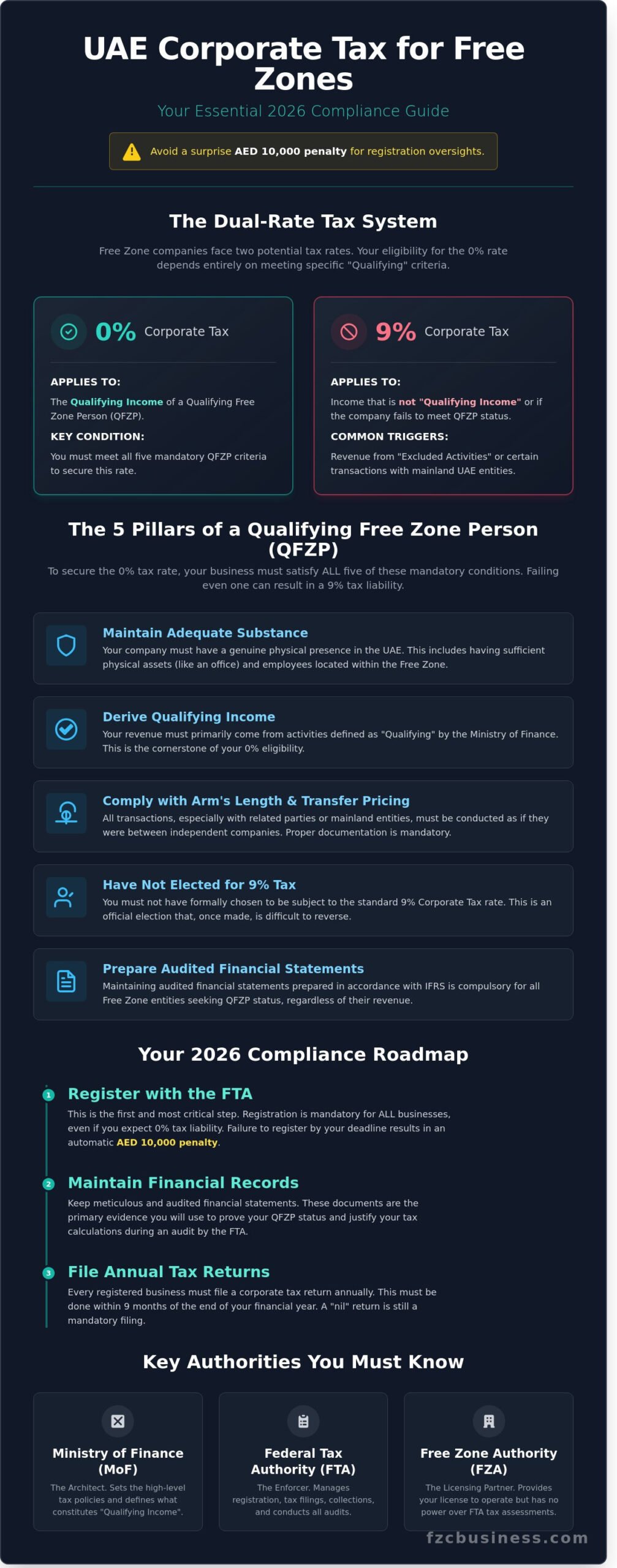
You’ll interact with three primary bodies during your business journey. The Ministry of Finance (MoF) is the architect; they set the high-level policy and issue the Cabinet Decisions that define “Qualifying Income.” The Federal Tax Authority (FTA) is the enforcer and collector; they handle your registration, filings, and audits. Finally, your specific Free Zone Authority (FZA) remains your licensing partner. While the FZA provides the space and license to operate, they do not have the power to override FTA tax assessments. Success requires keeping your FZA license active while ensuring your financial reporting meets FTA standards. Our expert guidance ensures you manage these relationships with a smooth experience, allowing you to focus on growth.
The Qualifying Free Zone Person (QFZP): Criteria for 0% Tax
Securing a 0% tax rate isn’t automatic for every business located in a tax-free jurisdiction. Under the Federal Decree-Law No. 47 of 2022, your business must earn the status of a Qualifying Free Zone Person (QFZP). This designation serves as the gateway to tax optimization, but it requires strict adherence to specific regulatory benchmarks. Understanding Official FTA Guidance is vital because any deviation can lead to immediate tax liabilities at the standard 9% rate.
To maintain your QFZP status and benefit from uae corporate tax for free zone companies, you must satisfy five mandatory pillars. These include maintaining adequate substance within the UAE, deriving qualifying income as defined by the Ministry, and ensuring you haven’t elected to be subject to the standard corporate tax regime. Additionally, you must comply with arm’s length principles and transfer pricing documentation under Cabinet Decision No. 55 of 2023. Finally, your business must prepare audited financial statements, regardless of its annual turnover. Failing even one of these conditions triggers a “break in the chain.” If this happens, your company loses its QFZP status for the current tax year and the subsequent four years, totaling a five-year disqualification period.
At Fast Zone Business, we prioritize QFZP alignment during the initial setup phase. We don’t just register a company; we architect a corporate structure designed to withstand FTA audits. Our expert guidance ensures your license activities and operational workflows are perfectly synced with the latest tax decrees from day one.
Maintaining Adequate Substance in the UAE
Adequate substance is the physical proof that your business actually operates within a Free Zone. You must employ a sufficient number of qualified employees and incur an appropriate amount of operating expenditure. Central to this is the Core Income-Generating Activities (CIGA) requirement. You must perform these activities locally rather than abroad. While you can outsource certain tasks to third parties or related entities within a Free Zone, you must retain full supervision and control over those activities. It’s not enough to have a virtual desk; the FTA expects a footprint that matches the scale of your revenue.
The De Minimis Requirement Explained
The de minimis rule acts as a safety valve for companies earning small amounts of non-qualifying income. To keep your 0% tax status, your non-qualifying revenue must not exceed the lower of 5% of your total revenue or AED 5 million. If you cross this threshold, your entire income becomes subject to the 9% tax rate. For the 2026 tax year, companies must monitor every transaction carefully. If a firm earns AED 100 million in total revenue, its non-qualifying limit is capped at AED 5 million, not AED 20 million, because the AED 5 million ceiling is the lower value. This calculation remains a critical monthly check for compliant businesses.
If you’re unsure if your current setup meets these rigorous standards, it’s wise to book a free consultation to audit your corporate structure before the next filing deadline.
Qualifying vs. Excluded Activities: Where Does Your Revenue Fall?
Determining where your revenue originates is the foundation of effective tax planning. The UAE introduced the corporate tax regime on June 1, 2023, creating a two-tier system for Free Zone entities. To benefit from the 0% rate, your income must be classified as “Qualifying Income.” You can find the full framework on the UAE Government Corporate Tax Information portal. This distinction ensures the UAE remains a competitive hub while meeting international transparency standards. If your business earns income from “Excluded Activities,” you risk losing your Qualifying Free Zone Person status for that tax period.
Qualifying activities include manufacturing and processing of goods, ship management, and reinsurance services. High-level financial services like fund and wealth management also fall under this bracket, provided they’re subject to the relevant regulatory oversight in the state. Headquarter services and intra-group financing are eligible too. This means if your Free Zone company provides centralized administrative or financial support to a subsidiary, that revenue stays tax-exempt. Our team provides the expert guidance needed to categorize these streams correctly.
Distribution of goods is a specific case that requires careful attention. For the 0% rate to apply, the distribution must take place in or from a “Designated Zone.” These are specific areas like Jebel Ali Free Zone (JAFZA) or Dubai Airport Freezone (DAFZA) that are fenced and have special VAT controls. If you’re distributing goods to a non-Free Zone person from a standard Free Zone that isn’t a “Designated Zone,” the 9% rate applies. It’s a technical distinction that can cost your business thousands of د.إ if overlooked.
Real estate income follows strict rules under the new law. Income derived from “Immovable Property” located in a Free Zone is taxed based on the transaction type and the party involved. If you lease commercial property to another Free Zone person, it’s generally considered qualifying. However, any income from transactions with individuals regarding real estate, or income from property located outside the Free Zone, will trigger the 9% tax rate. Managing uae corporate tax for free zone companies requires a deep understanding of these geographical and sector-based boundaries.
Profitable Activities Eligible for 0% Tax
Fund management and reinsurance are lucrative sectors where our in-depth knowledge ensures a smooth experience. To qualify, these services must be provided to professional clients or other regulated entities. Intra-group financing is another powerhouse for tax efficiency. It allows companies to move capital between related parties for business operations without incurring a tax liability on the interest income, provided the transactions meet arm’s length principles and support the group’s core goals.
Common Pitfalls: Revenue That Triggers the 9% Rate
The most frequent trap for uae corporate tax for free zone companies is B2C revenue. Any commercial transaction with a natural person, such as selling retail goods or consulting for individuals, is an “Excluded Activity.” This income is taxed at 9%. Additionally, income from Intellectual Property (IP) faces new scrutiny. Under guidelines effective through 2026, most royalties from “non-qualifying” IP or transactions with mainland entities will be taxed at the standard rate, regardless of your Free Zone status.
The Compliance Roadmap: Registration, Filing, and Deadlines
Registration isn’t optional. Every entity operating within a UAE Free Zone must register for Corporate Tax, regardless of whether they expect to pay the 9% rate or qualify for the 0% exemption. Under Federal Decree-Law No. 47 of 2022, failing to register within the timelines set by the Federal Tax Authority (FTA) results in a fixed penalty of AED 10,000. For most companies, the deadline to register is determined by the month their trade license was originally issued. If you haven’t checked your specific deadline yet, you’re already behind schedule.
Step-by-Step Registration via the EmaraTax Portal
The registration process happens through the EmaraTax portal. You’ll need digital copies of your Trade License, the Memorandum of Association (MOA), and the passport and Emirates ID of the authorized signatory. When you’re filling out the application, you must select “Taxable Person” and specifically identify as a Free Zone entity. A common error that causes significant delays is misclassifying the legal form or failing to link the correct owner profile. Our team ensures these details are accurate to prevent application rejections and unnecessary back-and-forth with the FTA.
The timeline for filing is strictly enforced. If your financial year ends on December 31, 2025, your first tax return and payment must be completed by September 30, 2026. This nine-month window provides time to finalize accounts, but it’s not a reason to delay. Understanding uae corporate tax for free zone companies requires recognizing that the tax period dictates your specific deadline. For a company with a financial year ending June 30, 2025, the filing is due by March 31, 2026. This illustrates why uae corporate tax for free zone companies involves more than just calculating profit; it requires meticulous calendar management. Missing this window leads to monthly penalties that can quickly erode your profit margins.
Record Keeping and Audit Requirements
Qualifying Free Zone Persons (QFZPs) face a specific hurdle; they cannot skip the annual audit. To maintain the 0% tax rate, you must have your financial statements audited by a qualified professional. This is a core requirement of the “Qualifying Income” regime. Additionally, the FTA mandates a 7-year record-keeping rule. You must store all invoices, contracts, and financial ledgers for seven years after the end of the relevant tax period. This ensures you’re prepared for any potential FTA audit years down the line.
Managing these documents is often the biggest administrative burden for new entrepreneurs. Utilizing PRO services streamlines your document management by ensuring every trade license renewal and corporate filing is archived correctly. You’ll need an FTA-approved auditor to sign off on your books; choosing one early prevents the year-end rush that often occurs in December and January. It’s a proactive step that protects your tax-exempt status and gives you peace of mind during the filing season.
Don’t risk penalties or the loss of your 0% tax status. Book a FREE consultation today to secure your compliance roadmap and ensure a smooth experience.
Expert Guidance: How Fast Zone Business Secures Your Tax Position
Securing a tax-efficient structure isn’t just about picking a business name. It’s about legal architecture. Fast Zone Business acts as your strategic partner to ensure your license activity aligns perfectly with the “Qualifying Income” criteria defined by the Federal Tax Authority. Since the UAE introduced the 9% rate on June 1, 2023, the margin for error has vanished. We provide a smooth experience by handling your Corporate Tax registration immediately after your trade license is issued, preventing the AED 10,000 penalty for late registration.
Choosing between Mainland and Free Zone involves more than just physical location. If your annual revenue exceeds AED 375,000, you’re officially in the tax net. We analyze your supply chain to determine the best path. If you sell mostly to local UAE clients, a Mainland setup might offer better deductions. For those targeting international markets, uae corporate tax for free zone companies remains a powerful tool for 0% tax, provided you maintain “adequate substance.” We help you document this substance through physical office leases and local management records.
We don’t just stop at the license. Our team integrates your Golden Visa application with your corporate strategy. Tax residency certificates often require a specific visa status to be valid for international tax treaties. We also bridge the gap with UAE banks. Financial institutions now require your Tax Registration Number (TRN) to keep accounts active. We ensure your documentation is flawless so you don’t face frozen assets or rejected transfers. Our “Hassle-Free” approach means we manage the paperwork while you focus on growth.
Beyond Setup: Ongoing Support and Compliance
Maintaining your tax position requires constant vigilance. Fast Zone Business conducts annual tax health checks to ensure your “Qualifying Free Zone Person” status remains intact. We handle the heavy lifting of liaising with government authorities on your behalf. This is vital because understanding uae corporate tax for free zone companies involves staying updated on new cabinet decisions. We also monitor your corporate bank account compliance, ensuring your financial reporting matches your declared business activities to avoid audits.
Start Your UAE Journey with Confidence
The Fast Zone Business advantage lies in our transparent pricing and deep local roots. We provide clear, upfront costs for all PRO services and license renewals, so there are no surprises. 2026 is the year to formalize your UAE corporate structure because the initial transition periods and “small business relief” windows will begin to close for many early adopters. Acting now secures your historical compliance record and sets a foundation for long-term profit repatriation. Our professional team is ready to simplify every bureaucratic hurdle in your path.
Our commitment to your success includes:
- Direct communication with FTA-certified consultants.
- Customized jurisdictional analysis (Mainland vs. Free Zone).
- Full integration of VAT and Corporate Tax registration.
- Streamlined Golden Visa processing for business owners.
Don’t leave your fiscal future to chance. Expert guidance is the difference between a thriving enterprise and costly administrative setbacks. Take the first step toward a compliant, tax-optimized future in the Emirates today.
Secure Your 0% Tax Status for 2026 and Beyond
Navigating uae corporate tax for free zone companies requires more than just knowing the rules; it demands precision in your financial reporting and operational substance. By 2026, every Free Zone entity must demonstrate adequate substance and ensure that non-qualifying revenue stays below the de minimis threshold of 5% or AED 5 million. Missing a single registration deadline can trigger an immediate AED 10,000 penalty. Don’t leave your 0% tax eligibility to chance when the regulatory environment is this rigorous.
Fast Zone Business serves as your one-stop destination for PRO and Tax services, backed by expert guidance in Dubai business setup. We’ve already helped over 3,000 entrepreneurs secure their commercial positions and maintain full compliance with Federal Tax Authority regulations. Our team handles the complex paperwork so you can focus on scaling your operations. Take the first step toward a worry-free tax year today.
Book your FREE Consultation with Fast Zone Business and let’s protect your revenue together.
Frequently Asked Questions
Do I need to register for UAE corporate tax if my Free Zone company makes zero profit?
Yes, you must register for corporate tax even if your company hasn’t generated any profit or is currently inactive. Federal Tax Authority Decision No. 3 of 2024 mandates that all juridical persons must complete registration within specific deadlines based on their license issuance month. Missing these deadlines leads to immediate fines. Our team provides expert guidance to ensure your registration is submitted accurately and on time.
Can a Free Zone company benefit from the Small Business Relief (SBR) in 2026?
Free Zone companies can claim Small Business Relief if they’re not a Qualifying Free Zone Person and their revenue stays below AED 3,000,000. This relief is available for tax periods ending on or before December 31, 2026, as per Ministerial Decision No. 73 of 2023. It’s a vital tool for startups to minimize their tax burden during their early growth stages. We’ll help you determine if this relief is your most cost-effective option.
What happens if my Free Zone company earns income from the UAE Mainland?
Mainland income is generally subject to the standard 9% tax rate if it exceeds the AED 375,000 profit threshold. For uae corporate tax for free zone companies, earning “non-qualifying” income from the mainland can jeopardize your 0% tax status if it exceeds the de minimis limit. This limit is the lower of 5% of your total revenue or AED 5,000,000. We’ll review your contracts to ensure your revenue streams are structured for maximum compliance.
Is an audit mandatory for all Free Zone companies under the new tax law?
Yes, maintaining audited financial statements is a strict requirement for any Free Zone entity that wants to benefit from the 0% tax rate. Article 11 of the Corporate Tax Law specifies that a Qualifying Free Zone Person must have an audit conducted by a registered firm. You’re also required to keep these records for 7 years. Fast Zone Business connects you with trusted auditors to ensure your records meet all legal standards without any hassle.
How does the UAE corporate tax affect my personal income as a business owner?
Personal income earned through employment, dividends, or personal investments remains exempt from corporate tax under Cabinet Decision No. 56 of 2023. If you’re a business owner, your salary or the dividends you receive from your Free Zone company aren’t taxed at the individual level. We provide a smooth experience in setting up your payroll to clearly distinguish between corporate profits and personal earnings. This clarity protects your personal wealth from corporate liabilities.
What are the penalties for late corporate tax registration in the UAE?
The penalty for failing to register for corporate tax within the timeframe set by the FTA is a fixed amount of AED 10,000. This fine was established by Cabinet Decision No. 75 of 2023 and applies to companies that missed deadlines as early as May 31, 2024. Don’t let administrative delays cost your business money. Our efficient registration service handles the entire process, ensuring you avoid these heavy penalties and maintain a clean compliance record.
Can I change my Free Zone jurisdiction to optimize my tax position?
You can migrate your business to a different jurisdiction, but the uae corporate tax for free zone companies applies uniformly across the entire country. Moving might offer lower administrative fees or better facilities, but the 0% tax eligibility always depends on meeting “substance” requirements and earning qualifying income. We use our in-depth knowledge of various zones to help you choose the location that best supports your specific business goals and operational needs.
How long does the corporate tax registration process take through Fast Zone Business?
Our team typically completes your corporate tax registration within 3 to 5 business days once we’ve received your documents. We manage the entire submission through the Federal Tax Authority portal, from document preparation to final TRN issuance. This action-oriented approach removes the bureaucratic hurdles from your plate. It’s a hassle-free solution that allows you to focus on your core business while we handle the technical tax requirements.