
How to Open a Corporate Bank Account in Dubai: A Complete 2026 Guide
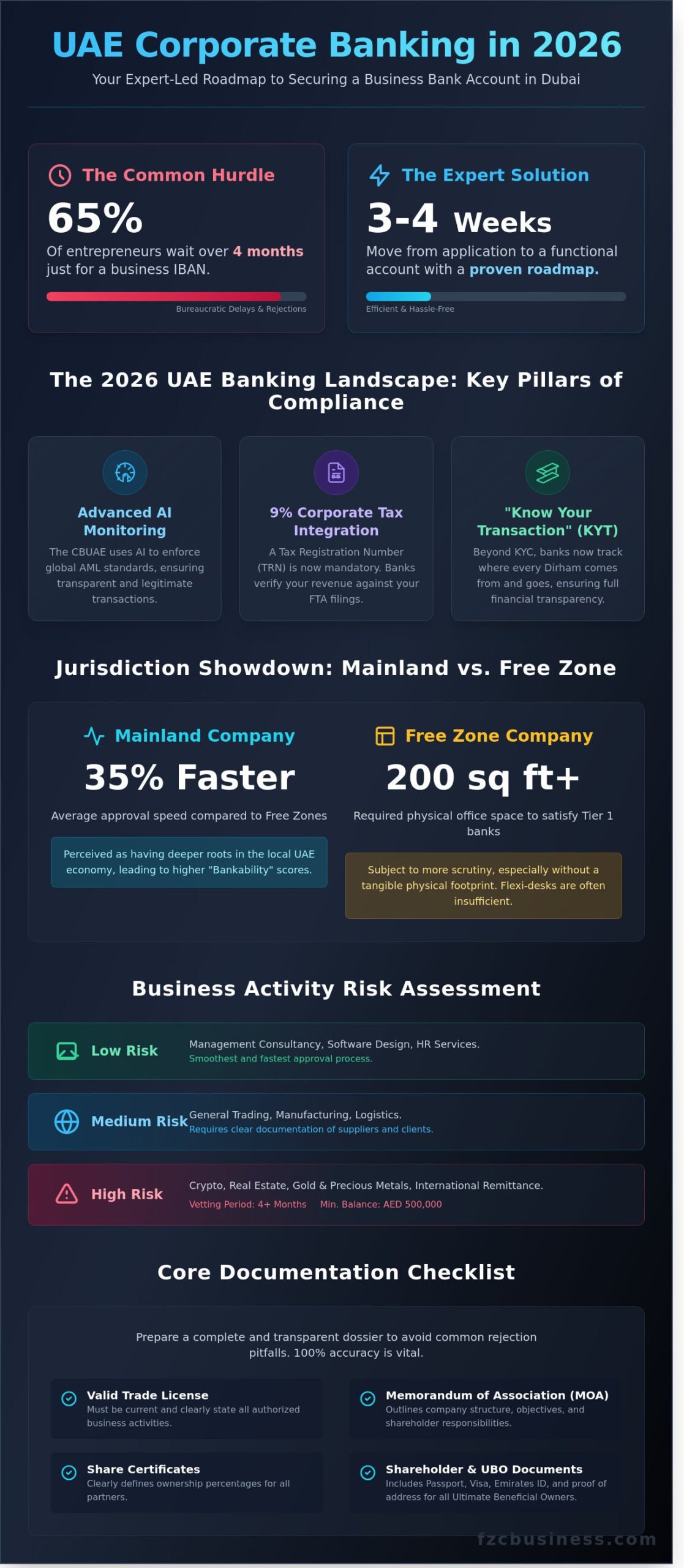
Why do 65% of entrepreneurs in the UAE wait over four months just to secure a basic business IBAN? You’ve likely realized that while getting a trade license is fast, learning how to open a corporate bank account in dubai is often where the momentum stalls. It’s exhausting to deal with high rejection rates and opaque KYC requirements that seem to change every week. You deserve a banking partner that supports your growth instead of hindering it with bureaucratic delays.
We’ve built this 2026 guide to help you master the complexities of UAE corporate banking with an expert-led roadmap to securing your account efficiently. You’ll gain total clarity on which local or international bank fits your specific business activity and how to prepare compliance-ready documentation. We’ll show you the exact steps to move from application to a functional account in just three to four weeks. This roadmap ensures a smooth, hassle-free experience so you can focus on generating revenue in AED rather than chasing bank relationship managers.
Key Takeaways
- Navigate the evolving 2026 UAE banking landscape with expert guidance on balancing global AML standards and business growth.
- Prepare a comprehensive documentation folder, including Trade Licenses and Emirates IDs, to ensure a smooth experience during bank verification.
- Evaluate whether traditional “Big Three” banks or digital neobanks like Wio offer the most efficient path for how to open a corporate bank account in dubai.
- Follow a methodical step-by-step roadmap to secure pre-approval and avoid the common KYC errors that lead to application rejection.
- Leverage professional banking relationships to transform a complex bureaucratic hurdle into a hassle-free setup for your enterprise.
The Landscape of Corporate Banking in Dubai in 2026
Dubai’s financial sector has transformed rapidly. By 2026, the Central Bank of the UAE (CBUAE) has fully integrated advanced AI-driven monitoring to align with global Anti-Money Laundering (AML) standards. This shift makes learning how to open a corporate bank account in dubai a more structured process than in previous years. Understanding Dubai’s economic landscape is vital because the city now prioritizes high-value, transparent entities over shell companies. The CBUAE issued Circular No. 24/2023, which set the stage for the rigorous compliance checks we see today. Banks don’t just look at your capital; they analyze your “Bankability.” This term refers to your company’s ability to prove legitimate cash flow and clear ownership structures.
The 9% Corporate Tax, established on 1 June 2023, changed everything for local lenders. By 2026, banks require your Tax Registration Number (TRN) before finalizing any account setup. They use tax data to verify that your declared business activity matches your actual transaction volume. This creates a data-sharing loop between the Federal Tax Authority (FTA) and financial institutions. If your tax filings don’t align with your bank statements, you’ll face immediate account freezes. Our team at Fast Zone Business provides expert guidance to ensure your documentation remains airtight under these 2026 regulations.
Compliance isn’t just a hurdle; it’s a standard for growth. Banks now employ “Know Your Transaction” (KYT) protocols alongside traditional KYC. They track where every Dirham comes from and where it goes. This ensures the UAE remains a white-listed, prestigious jurisdiction for international trade. While the process is stricter, it provides a more secure environment for legitimate entrepreneurs to scale their operations without fear of systemic instability.
Mainland vs. Free Zone: Does Your Jurisdiction Affect Banking?
Your choice of jurisdiction directly impacts your approval speed. Mainland companies often secure approvals 35% faster than Free Zone counterparts. This happens because Mainland entities are perceived to have deeper roots in the local economy. While some Free Zones like DIFC or ADGM are top-tier for transparency, others face more scrutiny. You’ll need a physical office space of at least 200 square feet to satisfy most Tier 1 banks. Flexi-desks are rarely enough for high-limit accounts in 2026. Banks want to see a physical footprint that proves your business is operational and not just a paper entity.
The Role of Business Activity in Account Approval
Your activity determines your risk rating and your “Bankability” score. Professional services like consultancy or IT development are generally low-risk. In contrast, sectors like Crypto, Real Estate, and International Remittance are flagged as high-risk. If you’re wondering how to open a corporate bank account in dubai for a high-risk sector, expect a minimum 4-month vetting period. Banks might demand a minimum average balance of AED 500,000 for these sectors. To succeed, you must frame your activity with a clear business plan that details your primary suppliers and clients. We help you present your business model in a way that meets bank compliance standards, ensuring a smooth experience from start to finish.
- Low-Risk: Management Consultancy, Software Design, HR Services.
- Medium-Risk: General Trading, Manufacturing, Logistics.
- High-Risk: Gold & Precious Metals, Crypto Assets, Real Estate Brokerage.
Securing a bank account is the final, most critical step in your setup journey. By 2026, the focus has shifted from “if” you can open an account to “how” you manage the ongoing compliance. Fast Zone Business offers in-depth knowledge to help you navigate these shifting sands, providing a hassle-free path to operational readiness.
Required Documents for Opening a Corporate Bank Account in Dubai
Preparing the right paperwork is the most critical stage of the setup process. If you want to know how to open a corporate bank account in dubai without facing multiple rejections, you must treat your document dossier as a professional portfolio. UAE banks, governed by Central Bank regulations, require 100% transparency regarding your company’s structure and its ultimate beneficial owners.
Your core corporate documents serve as the foundation of your application. You’ll need a valid Trade License, the Memorandum of Association (MOA), and Share Certificates. These documents must clearly outline the ownership percentages and the legal activities your company is authorized to perform. Banks typically cross-reference these activities with their internal risk appetite, so accuracy is vital from day one.
Ensuring these documents are properly attested or notarized is a crucial step that is often overlooked. Professional help from services like Insta Notary Services can prevent delays by making sure your paperwork meets the strict legal standards required by financial institutions.
Individual requirements for shareholders are non-negotiable. Every shareholder with more than a 5% stake must provide a clear passport copy, a valid UAE Residency Visa, and the original Emirates ID for verification. While some digital banks allow for remote applications, 90% of traditional institutions require a physical meeting with the authorized signatory to verify these original documents.
The “Source of Wealth” (SOW) dossier is often the most scrutinized element. You must prove exactly where your capital originated, whether it’s AED 100,000 or AED 1,000,000. This isn’t just a bank balance check. You’ll need to provide evidence such as audited financial statements from a previous business, property sale deeds, or a detailed history of personal savings. Banks use this to mitigate money laundering risks and ensure the funds entering the UAE financial system are legitimate.
Business proof helps the bank understand your operational model. Providing three signed contracts or formal invoices from previous ventures can significantly strengthen your case. If you’re a new startup, “Letters of Intent” (LOIs) from future partners or suppliers in the UAE provide the necessary proof of market presence. These documents demonstrate that your business is active and likely to maintain the minimum average balance requirements, which often range from AED 50,000 to AED 200,000 depending on the account tier.
The Shareholder KYC Checklist
Banks demand personal bank statements from the last 6 months to track your financial behavior. These statements must show a consistent history and should ideally be from a reputable international or local bank. Your proof of address must be a utility bill or a lease agreement dated within the last 90 days. A generic “care of” address or a PO Box won’t be accepted by compliance teams. You should also include a professional CV that highlights your 5 to 10 years of experience in your specific industry to build immediate credibility with the bank’s underwriters.
Corporate Proof of Substance
Economic Substance Regulations (ESR) have fundamentally changed the banking landscape. By 2026, using a virtual office without a physical presence or a dedicated desk may lead to an automatic rejection by 85% of Tier 1 banks. You must present a detailed business plan featuring 2-year financial projections to show long-term viability. For a smooth experience during the application, ensure your “Letters of Intent” are drafted on professional letterheads. Understanding these nuances is essential when learning how to open a corporate bank account in dubai in a competitive regulatory environment.
Traditional Banks vs. Digital Neobanks: Choosing the Right Fit
Selecting the right financial institution is a pivotal decision when you are learning how to open a corporate bank account in dubai. The UAE market has undergone a massive transformation since 2022, moving from a rigid, traditional landscape to a diverse ecosystem. Today, business owners must weigh the prestige and deep pockets of legacy banks against the speed and technological prowess of neobanks. Your choice will directly impact your company’s cash flow management and operational agility.
The “Big Three” local banks-Emirates NBD, Mashreq, and Abu Dhabi Commercial Bank (ADCB)-remain the heavyweights of the industry. These institutions provide a sense of security that global investors often look for. However, they’re known for rigorous compliance checks. Opening an account here often requires a minimum average monthly balance. For a standard corporate account, this typically starts at AED 50,000, but “Elite” or “Priority” tiers can demand upwards of AED 500,000. If your balance falls below the threshold, you can expect monthly “fall-below” fees ranging from AED 250 to AED 500.
Digital neobanks like Wio and Zand have completely rewritten the rules for the startup landscape. Wio Business, backed by ADQ and Etisalat, has become the go-to for many of our clients. They offer a transparent subscription model, often starting at just AED 99 per month, which removes the stress of maintaining a high minimum balance. This allows new entrepreneurs to reinvest their capital back into growth rather than leaving it idle in a bank vault.
International players like HSBC and Standard Chartered offer a different value proposition. These are ideal for businesses with heavy cross-border operations in Europe or the Americas. While they provide excellent global connectivity, their entry requirements are the most stringent in the UAE. They usually seek established companies with high annual turnovers and may require an initial deposit of AED 200,000 or more to initiate the relationship.
When to Choose a Traditional Bank
Traditional banks are indispensable for enterprises with complex operational needs. If your business model involves high-volume physical cash handling, you’ll need the extensive branch and CDM (Cash Deposit Machine) networks that only the Big Three provide. Furthermore, large-scale trading firms require sophisticated trade finance tools. Established banks offer robust support for Letters of Credit (LCs) and Bank Guarantees, which are essential for international trade. You’ll also benefit from a dedicated relationship manager who provides personalized expert guidance as your business scales.
The Digital Advantage for Startups and SMEs
For most new founders, digital banks are the most efficient path forward. The onboarding speed is the primary draw; while a traditional bank might take 4 to 8 weeks to approve an application, digital platforms often provide an IBAN within 48 to 72 hours. These platforms are significantly more “startup-friendly” because they don’t always require a physical office lease (Ejari). This is a major benefit for entrepreneurs using flexi-desks or co-working spaces. It’s the most hassle-free way to start your business journey in the UAE without bureaucratic delays.
Understanding these distinctions is the first step in mastering how to open a corporate bank account in dubai. Every business has a unique footprint, and the right bank should align with your specific transaction volume and long-term growth targets. Whether you prioritize a prestigious physical address on Sheikh Zayed Road or a seamless mobile app interface, the UAE banking sector has a solution tailored to your needs.
Step-by-Step Guide to the Application Process
Selecting the right banking partner is your first critical decision. You shouldn’t apply to every bank in the UAE simultaneously. Instead, choose a partner based on your projected monthly turnover and specific business activity. For example, a startup with an initial turnover of AED 100,000 has different requirements than a large-scale trading firm. Most local banks require a minimum average monthly balance ranging from AED 50,000 to AED 200,000. Aligning your business profile with a bank’s specific risk appetite ensures a smoother experience from the start.
The pre-approval stage is where you get an initial nod from the bank officer. This isn’t a final guarantee, but it indicates that your business activity is acceptable under their current policies. During this phase, the officer reviews your basic documents and business model. If they see a fit, they’ll proceed to the official application. Knowing how to open a corporate bank account in dubai effectively starts with this targeted approach to avoid unnecessary rejections.
Phase 1: Preparation and Pre-Screening
Your “Golden Folder” must be ready for immediate submission. This includes your memorandum of association, trade license, and six months of personal bank statements. Conduct a self-audit of your online presence before applying. 85% of bank rejections stem from inconsistent digital profiles. Banks verify your professional history on LinkedIn to ensure it matches your trade license activity. You also need an active UAE mobile number and a physical office verified by an Ejari certificate.
Phase 2: The Compliance Gauntlet
The Relationship Manager meeting is a formal interview where transparency is non-negotiable. You’ll need to explain your Ultimate Beneficial Owner (UBO) structure clearly. If any shareholder owns more than 25% of the company, their personal financial history will face scrutiny. Be prepared to discuss your anticipated transaction volumes and the geographic locations of your primary clients. Providing concrete evidence of your business model, such as draft contracts, helps the bank assess risk accurately.
During the compliance interview, you’ll face detailed follow-up questions regarding international transactions. If you plan to trade with partners in Europe or Asia, have a list of your top three suppliers and customers ready. Use specific company names and transaction values rather than vague estimates. This level of detail builds confidence with the compliance team. They need to see that you understand your supply chain and have done your due diligence on your own partners.
Final approval and account activation occur after the compliance team completes their deep-dive review. This process typically takes 10 to 15 working days from the date of your interview. Once the bank grants formal approval, you’ll receive your IBAN via a secure email. Your corporate debit card and chequebook are usually delivered via courier within 3 to 5 business days after the account goes live. Understanding how to open a corporate bank account in dubai involves managing these specific timelines to ensure your business operations aren’t delayed.
Overcoming Common Challenges with Professional Assistance
Statistics from the UAE financial sector indicate that 50% of self-submitted corporate bank applications fail during the initial compliance review. Most of these rejections stem from “Incomplete KYC” (Know Your Customer) protocols or minor documentation discrepancies. Banks in the Emirates operate under strict Central Bank regulations designed to maintain the country’s high financial standards. A single missing document or an unclear source of wealth statement can lead to an immediate rejection. Understanding how to open a corporate bank account in dubai involves more than just filling out forms; it requires a strategic presentation of your business model to meet specific institutional appetites.
Managing your expectations regarding timelines is essential for operational planning. Tier 1 banks, such as Emirates NBD or Mashreq, typically require 4 to 8 weeks for a full approval. Digital-first banks or Tier 2 institutions might process applications within 15 to 20 business days, provided the file is perfect. How Fast Zone Business streamlines your banking journey is by matching your specific business activity with the bank most likely to approve your niche, preventing months of wasted effort and multiple rejections.
Why Applications Get Rejected
Inconsistencies between your trade license activities and your formal business plan are a primary reason for rejection. If your license mentions “General Trading” but your business plan focuses exclusively on “Software Consultancy,” the compliance department will flag the application as high risk. Banks also look for “Economic Substance” within the UAE. This often means providing a valid Ejari (tenancy contract) for a physical office space, as virtual offices are increasingly scrutinized. Furthermore, negative news hits or Politically Exposed Person (PEP) status flags can halt an application instantly. Even a name similarity with a sanctioned individual can cause a 6-month delay if you don’t have the right PRO support to clear the confusion with the bank’s legal department.
The Fast Zone Advantage
Fast Zone Business adopts a “Hassle-Free” approach to documentation, ensuring every piece of paperwork meets the exact standards of UAE bank officers. We provide direct introductions to relationship managers who specialize in specific industries, from e-commerce to heavy manufacturing. This relationship-led strategy ensures your application is prioritized and understood by the people making the decisions. We help you navigate minimum balance requirements, which often range from AED 20,000 to AED 50,000, ensuring you choose a partner that fits your cash flow. Book a FREE Consultation with Fast Zone Business to assess your bankability and secure a professional review of your documents before you submit them to any institution. Our expert guidance ensures you avoid the common pitfalls that stall business growth in the UAE.
By partnering with professionals who have in-depth knowledge of the local banking landscape, you turn a complex bureaucratic hurdle into a smooth, manageable process. This allows you to focus on your core business goals while we handle the intricate details of your corporate financial setup.
Launch Your UAE Business Operations Today
Navigating the 2026 banking landscape requires more than just a trade license. Success depends on preparing precise documentation like your Memorandum of Association and selecting the right institution, whether it’s a traditional giant or a streamlined neobank. While strict KYC regulations remain a hurdle for many international investors, having a strategic roadmap simplifies the entire journey. Mastering the details of how to open a corporate bank account in dubai ensures your capital remains accessible and your business stays compliant with the latest Central Bank of the UAE directives.
At Fast Zone Business, we turn this complex process into a smooth, predictable experience. Our expert PRO team operates directly from the API Tower in Dubai, leveraging official partnerships with the country’s leading financial institutions to fast-track your application. We maintain a proven track record of resolving the most intricate KYC hurdles that often stall independent applications. Don’t let bureaucratic delays hold back your growth. Secure your UAE corporate bank account with Fast Zone Business and focus on your core commercial goals. Your vision for a successful Dubai enterprise is within reach, and we’re here to ensure the doors stay open for your success.
Frequently Asked Questions
How long does it take to open a corporate bank account in Dubai in 2026?
Opening a corporate bank account in Dubai in 2026 typically takes between 15 and 30 business days for traditional institutions. Digital banking platforms have streamlined this process, often providing account numbers within 48 to 72 hours. Our expert guidance ensures your documentation is perfect, preventing the common 10 day delays caused by incomplete KYC profiles.
Can I open a Dubai business bank account without a physical office?
You can open a business account using a Flexi-desk or virtual office lease provided by your Free Zone. While traditional banks like Mashreq may request a physical Ejari for mainland companies, most Free Zone entities successfully use shared office agreements. This flexibility allows you to maintain a lean operation while securing the necessary banking infrastructure for your startup.
What is the minimum balance required for a corporate account in the UAE?
Most banks require a monthly average balance ranging from AED 10,000 to AED 50,000 for standard corporate accounts. Premium accounts or those with specialized features might demand AED 200,000 or more. If your balance falls below the agreed limit, banks typically charge a monthly penalty fee of AED 250 plus VAT. It’s vital to choose a tier that matches your cash flow.
Can a non-resident open a corporate bank account in Dubai?
Non-residents can open a corporate bank account in Dubai, though the compliance requirements are stricter than for residents. Banks usually mandate a higher minimum balance, often starting at AED 100,000, and require proof of your business activities in your home country. Understanding how to open a corporate bank account in dubai as a non-resident is easier with our in-depth knowledge of specific bank appetites.
Do I need to be physically present in the UAE to open the account?
You must be physically present in the UAE for at least one day to sign the bank application forms and complete the mandatory KYC interview. While you can start the process remotely, the Central Bank of the UAE requires a face-to-face meeting with the bank officer or a certified representative. This ensures your identity is verified and your business intentions are clear.
What happens if my corporate bank account application is rejected?
If your application is rejected, you’ll receive a notification, though banks rarely provide specific reasons due to internal compliance policies. You should immediately review your business activity and source of funds documentation for any inconsistencies. We recommend waiting 30 days before applying to a different institution to ensure your profile is updated and more robust for a smooth experience.
Are digital banks like Wio as safe as traditional banks like Emirates NBD?
Digital banks like Wio are just as safe as traditional banks because they hold licenses from the Central Bank of the UAE. These platforms use the same high-level encryption and regulatory frameworks as Emirates NBD or FAB. They offer a smooth experience for tech-savvy entrepreneurs who prioritize speed and lower monthly fees over physical branch access.
What is the impact of UAE Corporate Tax on my business banking?
The UAE Corporate Tax of 9% on profits exceeding AED 375,000 makes precise bank reconciliation essential for your annual filings. Your bank account acts as the primary record for all taxable income and deductible expenses. Learning how to open a corporate bank account in dubai that integrates with accounting software will save you time and ensure compliance during the tax season.