
Corporate Bank Account UAE: The Ultimate 2026 Opening Guide
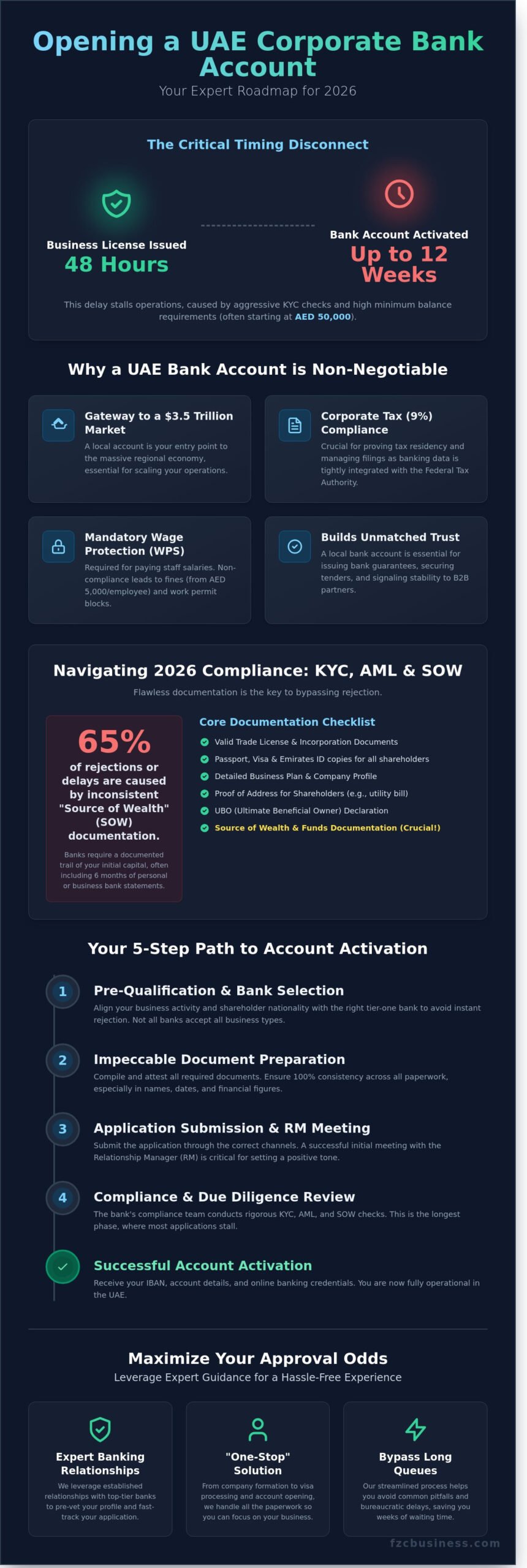
Why does it still take up to 12 weeks to open a corporate bank account uae when your business license is issued in just 48 hours? You aren’t alone if you feel frustrated by the gap between government efficiency and banking bureaucracy. Most entrepreneurs expect a quick start but find themselves stalled by aggressive KYC checks and minimum balance requirements that often start at AED 50,000. It’s a common hurdle that can pause your operations before they even begin.
At Fast Zone Business, we believe your focus should stay on your growth, not paperwork. We’ve developed an expert roadmap to help you master these complexities and secure successful account activation in 2026. You’ll learn how to align your business activity with the right tier-one bank and stay ahead of the latest UAE Corporate Tax compliance standards. This guide details the exact steps to bypass rejection risks and choose a banking partner that matches your specific industry needs for a smooth, hassle-free experience.
Key Takeaways
- Understand how the 2026 financial landscape and Corporate Tax regulations impact your strategic entry into the Middle East market.
- Identify the critical documentation needed to satisfy KYC and AML protocols, preventing the common pitfalls of “Source of Wealth” rejections.
- Discover how your choice of jurisdiction-Mainland versus Free Zone-directly dictates the ease of opening a corporate bank account uae.
- Follow a structured, step-by-step roadmap to navigate pre-qualification and document attestation for a truly hassle-free experience.
- Learn how to leverage expert banking relationships and “One-Stop” solutions to bypass long queues and maximize your approval odds.
The Strategic Importance of a UAE Corporate Bank Account in 2026
Securing a corporate bank account uae is no longer just a checkbox in the company formation process. In 2026, it serves as the definitive gateway to a $3.5 trillion regional market. The UAE’s transition to a more sophisticated financial hub means your banking setup dictates your ability to scale. Since the implementation of the 9% Corporate Tax in June 2023, the government has integrated banking data with tax compliance more tightly than ever before. You need a local account to prove your tax residency and manage your filings effectively.
Operating without a local account is virtually impossible for mainland and many free zone entities. If you plan to hire staff, you must enroll in the Wage Protection System (WPS). This mandatory electronic salary transfer system requires a UAE-based bank to ensure employees receive their payments according to Ministry of Human Resources and Emiratisation (MOHRE) standards. Failing to comply results in immediate work permit blocks and fines starting from AED 5,000 per employee. A local account isn’t just a tool; it’s your legal shield.
Trust remains the primary currency of Dubai’s B2B sector. Most large-scale developers and government entities require a local bank guarantee for tender participation. When you present a cheque from a reputable local institution, it signals to your partners that you’ve passed the rigorous vetting processes of the UAE financial system. This credibility is essential for securing high-value contracts in 2026’s competitive landscape. We offer expert guidance to help you build this foundation with confidence.
Regulatory Oversight by the Central Bank of the UAE
The Central Bank of the UAE (CBUAE) has significantly strengthened its framework to align with global standards. Following the country’s removal from the FATF “Grey List” in February 2024, banking stability and international trust have reached new heights. Banks now implement stringent Know Your Customer (KYC) guidelines to ensure every dirham moving through the system is legitimate. By 2026, these regulations favor businesses that maintain transparent, well-documented structures. Our team ensures your documentation is flawless, facilitating a smooth experience during the onboarding phase.
Benefits of Banking Within the UAE Financial Ecosystem
The UAE financial ecosystem offers unparalleled flexibility for international trade. Most institutions provide multi-currency accounts as a standard feature, allowing you to hold and transact in AED, USD, EUR, and GBP without constant conversion losses. This is particularly beneficial since the UAE Dirham has been pegged to the US Dollar at 3.6725 since 1997, providing a stable environment for global commerce. Beyond basic transactions, a corporate bank account uae provides access to:
- Corporate credit cards with high limits for business expenses.
- Trade finance options, including Letters of Credit (LC) and Standby Letters of Credit (SBLC).
- Regional investment platforms that are often restricted to local account holders.
- Advanced digital banking interfaces designed for 24/7 global operations.
Accessing these tools requires a strategic approach. We specialize in matching your specific business activity with the bank most likely to support your growth. This customized approach saves you time and prevents the frustration of rejected applications. Let us handle the bureaucratic hurdles so you can focus on your core business goals in the thriving UAE market.
Navigating 2026 Compliance: KYC, AML, and UBO Requirements
Securing a corporate bank account uae in 2026 requires more than just a valid trade license. The regulatory environment has shifted toward extreme transparency. Data from January 2024 suggests that 65% of application delays or rejections are caused by inconsistent “Source of Wealth” (SOW) documentation. Banks don’t just want to see your current balance; they require a clear, documented trail of how your initial capital was earned. If you’re transferring AED 100,000 to start your venture, expect to provide six months of personal or previous business statements to prove the origin of those funds.
Anti-Money Laundering (AML) protocols have become particularly stringent for sectors flagged as high-risk. This includes real estate brokerage, precious metal trading, and crypto-asset services. For these industries, banks perform “Enhanced Due Diligence,” which often involves third-party background checks and deeper scrutiny of your anticipated transaction volumes. This rigorous approach aligns with the World Bank ‘Doing Business’ data for UAE which highlights the nation’s push for a transparent regulatory framework. Additionally, since the 9% Corporate Tax rate became effective for many in 2023, banks now mandate proof of Tax Registration. Failing to provide a Tax Registration Number (TRN) can lead to account freezes or restricted outward remittances.
The “Know Your Customer” (KYC) Deep Dive
KYC isn’t a one-time form; it’s a comprehensive verification of your identity and business intent. You’ll need your original Passport, Emirates ID, and a valid Residency Visa. Banks also require your Memorandum of Association (MOA) and a detailed business plan. To prove your business model, you must present at least three sets of prospective or executed invoices, supplier price lists, and signed contracts. Compliance officers scrutinize your personal bank statements to ensure your lifestyle and previous financial history match the projected revenue of your new company. Our team can provide expert guidance to ensure your documents meet these specific institutional standards.
Ultimate Beneficial Ownership (UBO) Transparency
The UAE Cabinet Resolution No. 109 of 2023 reinforced the need for a central UBO registry. A UBO is any individual who ultimately owns or controls 25% or more of the company’s capital. Banks require 100% clarity on the ownership chain. If your UAE company is owned by another corporate entity, you must provide the full certificate of incumbency and constitutional documents for every parent company until an individual person is identified. UBO compliance serves as the definitive foundation of 2026 banking integrity and transparency.
- Individual Owners: Require clear CVs and proof of residential address (utility bills under 90 days old).
- Corporate Shareholders: Require attested board resolutions and certificates of good standing.
- Sanction Screening: All UBOs are screened against global watchlists before the account moves to the final approval committee.
The process is methodical. Compliance officers look for “red flags” such as high-volume cash transactions or vague business descriptions. Providing specific, data-backed answers during the interview stage is the only way to ensure a smooth experience. Most entrepreneurs find that having a dedicated partner to review their file before submission saves roughly 4 to 6 weeks of back-and-forth communication with the bank’s compliance department.
Mainland vs. Free Zone: How Your Jurisdiction Affects Banking
Your choice of jurisdiction is the primary factor that determines the speed and success of your application for a corporate bank account uae. Banks categorize licenses based on regulatory transparency and physical substance. Mainland companies generally enjoy a smoother onboarding experience because they operate under the direct oversight of the UAE Ministry of Economy and local departments like the Dubai DET. This alignment gives tier-1 banks like Emirates NBD and ADCB the confidence that your business is deeply rooted in the local economy.
The debate surrounding physical offices has intensified recently. While digital banks might accept a “flexi-desk” or virtual office, traditional legacy banks now almost exclusively require a physical lease, known as an Ejari for mainland firms, to approve high-turnover accounts. This requirement is a direct response to global anti-money laundering standards. If you opt for an offshore setup, expect significant hurdles. By 2026, offshore banking will face even tighter restrictions as the UAE continues to align with international tax transparency and substance requirements following its successful exit from the FATF grey list in February 2024. Most top-tier banks already view offshore entities as high-risk, often requiring minimum average balances exceeding AED 200,000 just to consider an application.
Mainland Business Banking Advantages
Mainland entities provide the most straightforward path to securing a corporate bank account uae. These companies can trade anywhere in the UAE and internationally without restrictions, a factor that appeals to bank compliance departments. Many banks offer specialized SME packages for mainland firms with lower minimum balance requirements, sometimes as low as AED 10,000 to AED 25,000. Our expert team ensures your documentation is flawless by leveraging Fast Zone Business mainland setup services, which are specifically designed to meet the stringent “Know Your Customer” (KYC) criteria that UAE banks demand. This proactive approach eliminates the bureaucratic friction that often delays account activation for new entrepreneurs.
Free Zone Banking: Strategic Selection
Free Zone banking requires a more strategic approach. Not all Free Zones are viewed equally by financial institutions. Top-tier jurisdictions like the Dubai International Financial Centre (DIFC) and Abu Dhabi Global Market (ADGM) have their own independent regulators, making them highly attractive to international commercial banks. For general trading or consultancy, zones like IFZA or Meydan are popular, but you must carefully match your license activity to the bank’s risk appetite. For example, a Free Zone company involved in high-risk sectors like crypto or gold trading will face much higher scrutiny than a software consultancy. To access premium banking features, we recommend the following strategies:
- Prioritize Substance: Opt for a physical office space over a flexi-desk if you anticipate a monthly turnover exceeding AED 100,000.
- Target Partner Banks: Use Free Zones that have established MoUs with specific banks to expedite the vetting process.
- Activity Alignment: Ensure your license activities are specific. Vague “General Trading” descriptions often trigger additional compliance queries that can stall your application for months.
- Capital Requirements: Be prepared to maintain higher average balances, typically starting from AED 50,000 for standard Free Zone corporate accounts.
Fast Zone Business provides the expert guidance needed to select a jurisdiction that doesn’t just look good on paper but actually works for your banking needs. We focus on a hassle-free experience that positions your business as a low-risk, high-value client to the UAE’s leading financial institutions.
Step-by-Step Guide to Opening Your Corporate Account
Opening a corporate bank account uae involves a structured methodology that demands precision to avoid lengthy delays or outright rejections. The process isn’t merely about filling out forms; it’s a rigorous compliance exercise where the bank evaluates your business’s legitimacy and financial risk profile.
Phase 1: Pre-qualification and Bank Selection
Success begins by matching your specific business activity with a bank’s risk appetite. A general trading license might face stricter scrutiny than a professional consultancy firm. We analyze your trade license first to ensure you approach a bank that welcomes your specific industry sector. For instance, some banks currently favor technology startups while others specialize in logistics or manufacturing. Choosing the wrong bank at this stage leads to automatic rejection based on internal policies you can’t see.
Phase 2: Document Preparation and Attestation
This is the “Hassle-Free” stage when managed correctly. You’ll need your Memorandum of Association (MOA), trade license, and proof of address. If your documents originate outside the UAE, they require attestation by the Ministry of Foreign Affairs (MOFA), which typically costs 2,000 AED per document. We ensure every stamp is in place so your application doesn’t stall due to clerical errors.
Phase 3: The Banker Interview
UAE regulations require the physical presence of all shareholders for a face-to-face interview. You don’t need to be a resident yet, but you must be physically in the country. Expect to discuss your business model, expected annual turnover, and primary suppliers or clients. Banks often ask for six months of personal or corporate bank statements from your home country to establish financial credibility.
Phase 4: Compliance Review and Account Activation
The bank’s internal compliance team performs an exhaustive Know Your Customer (KYC) check. This stage usually takes 10 to 20 working days for mainland companies and slightly longer for offshore entities. They’ll verify your source of wealth and check your name against global sanctions lists to ensure full regulatory compliance.
Phase 5: Initial Deposit and Online Banking Setup
Once approved, you’ll receive your IBAN. Most traditional banks require an initial minimum balance ranging from 50,000 AED to 200,000 AED to activate the account and enable online banking features. Once the funds clear, your digital tokens and chequebooks are issued, allowing you to start trading immediately.
Choosing Between Traditional and Digital Banks
Legacy institutions like Emirates NBD, ADCB, and Dubai Islamic Bank (DIB) offer high credit limits and dedicated relationship managers, but they often require higher monthly balances. In contrast, neo-banks like Wio and Zand provide a faster 48-hour onboarding process for startups. Digital platforms are ideal for companies with lower initial capital, as they offer transparent transaction costs and lower monthly maintenance fees starting around 100 AED. If your business requires complex trade finance or letters of credit, a traditional bank remains the superior choice.
The Secret to Success: The Pre-Approval Strategy
Applying to multiple banks at once is a common mistake that triggers red flags in the UAE banking system. It suggests desperation or a lack of transparency. Instead, Fast Zone Business performs “Soft Searches” before any formal submission. This expert guidance ensures your profile meets the bank’s criteria before your name enters their system. A rejected application is a permanent mark on your corporate history. By vetting your documents early, we maintain a 95% success rate for our clients’ corporate bank account uae applications, saving you months of potential frustration.
Maximizing Approval Odds with Fast Zone Business
Opening a corporate bank account uae is often the most stressful part of the company formation process. Statistics from 2023 indicate that approximately 35% of independent applications face significant delays or outright rejection due to incomplete documentation or misunderstood compliance requirements. Fast Zone Business operates as a one-stop destination, integrating your trade license, residency visa, and banking application into a single, synchronized workflow. We’ve built direct channels with leading institutions like Emirates NBD, Mashreq, and Wio Bank to bypass standard public queues. This relationship-driven approach reduces the average waiting time from several months to as little as 15 to 20 business days.
Our PRO services handle the heavy lifting of government document attestations, ensuring every Ministry of Foreign Affairs (MOFA) stamp is secured before the bank reviews your file. Once your account is active, our support continues. we provide immediate assistance for VAT registration and Corporate Tax compliance. This ensures your business meets the 9% tax threshold requirements and stays compliant with Federal Tax Authority (FTA) regulations from day one. By managing these technicalities, we allow you to focus on your core operations while we handle the bureaucracy.
- Synchronized Processing: We prepare your bank application while your trade license is being issued to save weeks of transit time.
- Direct Banker Access: Our clients benefit from dedicated relationship managers who understand the specific needs of Free Zone and Mainland entities.
- Full Compliance Support: We assist with the 9% Corporate Tax registration and ongoing VAT filings to keep your account in good standing.
Expert Guidance Through Bureaucratic Hurdles
Banks in the Emirates change their compliance rules frequently. Our consultants translate these shifting requirements into simple, actionable checklists. We manage the legal translation of foreign documents into Arabic, a requirement that often trips up international founders. In October 2023, we assisted a Free Zone technology startup that had been rejected twice previously. By restructuring their business profile and clarifying their source of funds, we secured a Tier-1 account for them in exactly 18 business days. It’s about presenting your business in a language that bank compliance departments trust.
Start Your Journey with a Free Consultation
A single mistake in your initial bank interview can lead to your profile being flagged or blacklisted across multiple UAE banks. Our expert assessment identifies these red flags before you submit a single paper. We evaluate your business activity, expected turnover, and shareholder background to match you with the right banking partner. Don’t risk a permanent rejection by going in unprepared. Our team ensures your profile is robust, transparent, and ready for approval. Ready to secure your financial future in the Middle East? Book your FREE consultation with Fast Zone Business today and experience a smooth, professional path to your new corporate bank account uae.
Future-Proof Your Business Finances in 2026
Establishing a corporate bank account uae requires more than just submitting paperwork; it demands a strategic approach to the Central Bank’s 2026 compliance standards. You’ve seen how jurisdiction choices between Mainland and Free Zone territories impact your banking options and why strict KYC protocols are now the industry baseline. Navigating these requirements alone often leads to lengthy delays or rejected applications. Fast Zone Business simplifies this journey by acting as your one-stop solution for both licensing and financial setup. We leverage our direct partnerships with major UAE banks to streamline the approval process. Our team ensures your documentation is 100% compliance-focused from day one, which significantly reduces the risk of administrative setbacks. It’s time to stop worrying about bureaucratic hurdles and start focusing on your market entry. We’re here to provide the expert guidance you need for a smooth, efficient experience that gets your business operational without the stress. Secure your UAE corporate bank account with expert guidance and take the first step toward your commercial success today.
Frequently Asked Questions
Can a non-resident open a corporate bank account in the UAE?
Yes, non-residents can open a corporate bank account in the UAE, although the requirements are more stringent than for residents. Banks typically require a minimum average balance ranging from AED 100,000 to AED 250,000 for non-resident entities. You’ll need to provide comprehensive proof of business activity and personal bank statements from your home country for the last six months.
Fast Zone Business provides expert guidance to help you navigate these complex compliance checks. Our team ensures your documentation is complete to facilitate a smooth experience with local financial institutions.
What is the minimum balance required for a UAE corporate account in 2026?
In 2026, most UAE banks require a monthly average balance between AED 10,000 and AED 50,000 for standard SME accounts. Digital banking platforms often offer lower thresholds, with some starting at AED 3,000 or even offering zero-balance options for the first six months of operation. It’s vital to maintain these levels to avoid monthly penalty fees.
If your balance falls below the agreed limit, banks typically charge a shortfall fee of AED 210 plus VAT. Choosing the right package based on your projected cash flow helps keep your business banking affordable and efficient.
How long does the corporate bank account opening process typically take?
The process to open a corporate bank account uae typically takes between 2 and 4 weeks once you’ve submitted all required documents. Digital-first banks can sometimes reduce this timeline to 5 working days for simple company structures. For businesses in high-risk industries or those with complex ownership patterns, the compliance review might extend to 8 weeks.
Our in-depth knowledge of bank requirements helps speed up this timeline. We review your application thoroughly before submission to prevent the back-and-forth requests that often cause unnecessary delays.
Do I need a physical office in Dubai to open a business bank account?
Yes, 85% of traditional UAE banks require a physical office address and a valid Ejari lease agreement to approve a corporate application. While some digital banks accept flexi-desk arrangements in Free Zones, most conventional institutions insist on a physical workspace to verify local substance. This requirement helps banks comply with Central Bank regulations regarding Anti-Money Laundering protocols.
Having a dedicated office space significantly increases your chances of approval. It demonstrates a long-term commitment to the UAE market, which builds trust with the bank’s compliance department.
Can I open a UAE bank account online without visiting the country?
No, you can’t complete the entire process remotely because the UAE Central Bank requires the physical presence of the account signatory for identity verification. You must visit the UAE for at least 1 business day to sign official bank forms and present your original passport. However, we handle all the preliminary digital submissions and paperwork before you arrive.
This approach ensures your visit is productive and hassle-free. We coordinate with the bank managers so you only need to attend a single meeting to finalize the verification process.
What are the typical monthly fees for business banking in the UAE?
Monthly maintenance fees for business accounts generally range from AED 0 for basic digital platforms to AED 525 for premium corporate packages. If you don’t maintain the minimum average balance, banks charge a penalty fee ranging from AED 210 to AED 500 per month. You should also account for outward remittance fees, which average AED 30 to AED 100 per transaction.
These costs vary depending on the specific bank and the volume of your transactions. We help you compare different banking partners to find the most cost-effective solution for your specific business needs.
How does UAE Corporate Tax affect my existing business bank account?
The UAE Corporate Tax, implemented on June 1, 2023, at a rate of 9% for profits above AED 375,000, requires you to maintain precise financial records. Banks now monitor account activity more closely to ensure tax compliance and will request your Tax Registration Number (TRN) for their records. You must ensure your corporate bank account uae statements align perfectly with your audited financial reports.
Failure to provide updated tax information can lead to account restrictions. Maintaining transparent records is now a critical part of keeping your business bank account in good standing.
What happens if my corporate bank account application is rejected?
If your application is rejected, the bank will provide a reason code related to your risk profile, industry type, or missing documentation. You can appeal the decision by providing additional evidence or apply to a different financial institution that better aligns with your business model. Rejections aren’t permanent, but they do require a change in strategy.
Fast Zone Business analyzes the rejection to identify specific gaps in your profile. We then prepare a stronger application for an alternative bank to ensure you achieve a successful outcome without further hurdles.