
Company Setup in Abu Dhabi: The Ultimate 2026 Guide
Launching a business in the UAE’s dynamic capital presents a world of opportunity, yet the path can seem filled with complexities. Are you weighing the differences between a Mainland and Free Zone license? Concerned about navigating the legal requirements and avoiding unforeseen delays or costs? This uncertainty is a common hurdle for many ambitious entrepreneurs looking to establish their presence.
This is precisely why a clear, strategic roadmap is essential for a successful company setup in Abu Dhabi. Our ultimate 2026 guide is designed to provide you with expert guidance, transforming complexity into clarity. We will walk you through the entire process-from choosing the right jurisdiction and legal structure for your business activity to securing your trade license and managing vital post-setup steps like opening a corporate bank account and processing visas. Prepare to move forward with confidence, equipped with the in-depth knowledge needed for a smooth and efficient launch.
Key Takeaways
- Understand why Abu Dhabi’s stable economy and strategic global position make it a premier destination for your new business venture.
- Learn the critical differences between a Mainland and Free Zone company to make the most informed decision for your operational needs.
- Master the complete timeline for your company setup in Abu Dhabi, from initial approvals to essential post-licensing steps like visas and bank accounts.
- Gain a clear overview of the potential costs involved, including typical government fees and other related expenses for a transparent financial plan.
Why Choose Abu Dhabi for Your Business Setup?
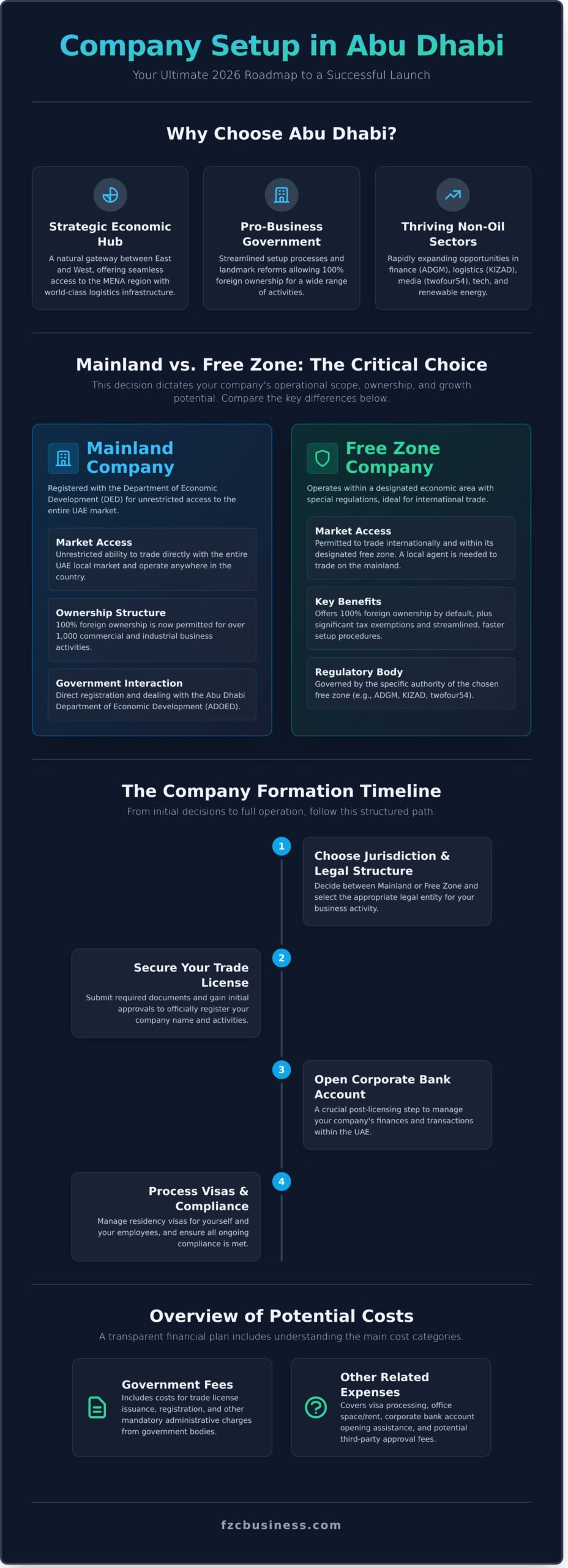
While often compared to its vibrant neighbour, Abu Dhabi stands on its own as a formidable global business hub and the strategic capital of the UAE. With a stable, high-income economy, world-class infrastructure, and a clear vision for the future, the emirate offers a compelling environment for entrepreneurs and established corporations alike. The government’s proactive support for foreign investment and economic diversification makes a company setup in Abu Dhabi a strategic move for long-term growth.
Understanding the incentives available, such as long-term residency, is a key part of the setup process. Watch this video for a clear overview of the UAE’s Golden Visa program:
Strategic Economic Hub
Abu Dhabi’s geographical location provides an unparalleled advantage, positioning it as a natural gateway between Eastern and Western markets. This strategic placement offers businesses seamless access to the wider MENA region. This connectivity is powered by state-of-the-art logistics infrastructure, including the deep-water Khalifa Port and the expanding Abu Dhabi International Airport, ensuring efficient global trade and supply chain management.
Pro-Business Government Initiatives
The Abu Dhabi government, through entities like the Department of Economic Development (ADDED), has actively streamlined the process for establishing a business. A landmark reform now permits 100% foreign ownership for a wide range of mainland activities, removing previous barriers to entry. This commitment to attracting global talent and capital is a core component of the wider Economy of the UAE. Furthermore, numerous incentives and support programs are available for startups and SMEs, fostering a fertile ground for innovation and enterprise.
Thriving Non-Oil Sectors
Moving decisively beyond its oil and gas legacy, Abu Dhabi is cultivating a diversified and sustainable economy. The emirate has established specialized economic zones to attract top-tier talent and investment in high-growth industries. Key examples include:
- Finance: Abu Dhabi Global Market (ADGM) is a leading international financial centre.
- Logistics & Industry: Khalifa Industrial Zone Abu Dhabi (KIZAD) offers exceptional manufacturing and logistics facilities.
- Media & Entertainment: twofour54 provides a dynamic ecosystem for media and creative companies.
Opportunities are also rapidly expanding in tourism, technology, and renewable energy, spearheaded by pioneering initiatives like Masdar City. This forward-thinking approach ensures that a company setup in Abu Dhabi is an investment in a resilient and future-focused economy.
Mainland vs. Free Zone: Choosing the Right Jurisdiction in Abu Dhabi
The first and most critical decision in your company setup in Abu Dhabi is choosing the right jurisdiction. This choice dictates your company’s operational scope, ownership structure, and long-term growth potential. An Abu Dhabi Mainland company is registered with the Department of Economic Development (DED) and can trade directly with the entire UAE market. In contrast, a Free Zone company operates within a designated economic area, offering specific benefits like tax exemptions and streamlined regulations. Understanding the nuances of each is fundamental, a process you can begin exploring on Abu Dhabi’s official business portal.
To provide clear, expert guidance, here is a direct comparison of the key differences:
| Feature | Mainland Company | Free Zone Company |
|---|---|---|
| Ownership | 100% foreign ownership for over 1,000 activities | 100% foreign ownership is standard |
| Scope of Trade | Unrestricted trade across the UAE and internationally | Primarily within the free zone and internationally |
| Taxes | Subject to 9% Corporate Tax on profits over AED 375,000 | Often 0% Corporate Tax for qualifying income |
| Regulations | Governed by UAE Federal Laws and DED regulations | Governed by the specific free zone authority’s rules |
Abu Dhabi Mainland Company Formation
Opting for a mainland license grants unparalleled market access. This jurisdiction is essential for businesses aiming to trade without restriction across Abu Dhabi and the other emirates or for those planning to bid on lucrative government contracts. While a physical office space is a mandatory requirement, recent reforms now permit 100% foreign ownership for a vast range of business activities, making it a highly attractive option for investors focused on the local economy.
Exploring Abu Dhabi’s Premier Free Zones
Abu Dhabi’s free zones are specialized ecosystems designed to foster growth in specific industries. Each offers unique infrastructure, networking opportunities, and regulatory benefits. Key options include:
- ADGM (Abu Dhabi Global Market): A leading international financial hub for banking, asset management, and fintech firms.
- KIZAD (Khalifa Industrial Zone): The ideal choice for industrial, logistics, trade, and manufacturing businesses.
- Masdar City: A pioneering zone for renewable energy, cleantech, and sustainability-focused ventures.
- twofour54: The capital’s dedicated media and entertainment hub for creative professionals and companies.
How to Choose: A Decision Framework
To ensure a smooth and successful company setup in Abu Dhabi, our experts recommend you consider these strategic questions:
- Primary Market: Will you be serving the local UAE market directly, or are your clients primarily international?
- Business Activity: Is your specific activity better suited for a specialized free zone ecosystem?
- Budget: Are you seeking more cost-effective startup packages? Free zones often provide flexible and affordable options.
- Long-Term Goals: Is bidding for government tenders a key part of your business strategy? If so, a mainland license is necessary.
The Step-by-Step Process for Company Formation in Abu Dhabi
Navigating the company setup in Abu Dhabi involves a structured, sequential process. While the core steps are consistent, specific requirements can vary significantly between mainland and free zone jurisdictions. Executing each stage correctly is critical to prevent delays and ensure a smooth launch. Partnering with a business setup consultant provides the expert guidance needed to manage these complexities efficiently, allowing you to focus on your business goals.
Step 1: Define Your Business Activity & Legal Structure
The foundation of your company is its business activity and legal form. You must select your specific activity from the official list provided by the Abu Dhabi Department of Economic Development (ADDED). This choice directly influences your legal structure options, which commonly include a Limited Liability Company (LLC), Sole Proprietorship, or a Branch Office. Your decision here will determine capital requirements, ownership regulations, and the necessary approvals for your license.
Step 2: Trade Name Reservation and Initial Approval
Your company’s trade name must comply with UAE regulations-it must be unique, not in use, and adhere to public morals. The name is reserved through the ADDED portal or the respective free zone authority. Once approved, you will apply for Initial Approval. This certificate serves as a preliminary consent from the authorities, confirming they have no objection to the business being established and allowing you to proceed with subsequent steps like drafting legal documents.
Step 3: Legal Documentation (MOA) and Office Space
A crucial document in the formation process is the Memorandum of Association (MOA), which outlines the company’s objectives, share capital, and partner details. This document must be drafted in both Arabic and English, signed by all partners, and notarized. Concurrently, you must secure a physical office address. For mainland companies, this requires a registered tenancy contract, known as a Tawtheeq, which is mandatory for license issuance.
Step 4: Final License Submission and Issuance
With all prerequisites in place, you can proceed to the final submission. This stage involves compiling and submitting all required documentation to the relevant authority. Key documents typically include:
- Completed application form
- Initial Approval certificate
- Notarized Memorandum of Association (MOA)
- Registered tenancy contract (Tawtheeq)
- Passport copies of all shareholders and managers
Upon successful review and payment of all government fees, your official trade license will be issued, legally permitting you to commence business operations in Abu Dhabi. Note that certain specialized activities may require additional external approvals from relevant ministries.
Essential Post-Setup Procedures: Visas, Bank Accounts, and Compliance
Securing your trade license is a major milestone, but it is just the beginning of making your business fully operational. The steps that follow are critical for legal compliance and day-to-day activities. For entrepreneurs new to the UAE, navigating these administrative hurdles can be complex and time-consuming. This is precisely where the in-depth knowledge of expert consultants provides immense value, ensuring a smooth and compliant transition from licensing to operation.
Securing Your Establishment Card and Company Stamp
Your Establishment Card is one of the first documents you must obtain after your license is issued. It functions as your company’s official registration with the immigration authorities (ICP), allowing you to apply for investor and employee visas. The application is processed through the relevant immigration channels. Concurrently, you must create an official company stamp, which is mandatory for validating all official documents, contracts, and banking forms.
Navigating the Investor & Employee Visa Process
As a business owner or partner, securing your own residency is the next priority. The process involves several key stages: applying for an entry permit, completing a medical fitness test, and providing biometrics for your Emirates ID. Once your investor visa is stamped, your company is fully activated to sponsor employee visas, enabling you to build your team by following a similar, well-defined procedure.
Opening a Corporate Bank Account in Abu Dhabi
Opening a corporate bank account in the UAE requires careful preparation due to the strict due diligence and Know Your Customer (KYC) policies enforced by local banks. A strong, professional application is essential for success. Typically, banks will require a comprehensive set of documents, including:
- Your company’s trade license and constitutional documents
- Passport, visa, and Emirates ID copies for all shareholders
- A detailed business plan outlining your activities and financial projections
- Proof of business address and shareholder address
Understanding Your Tax Obligations
Compliance with the UAE’s tax framework is non-negotiable. Businesses must assess their requirement to register for Value Added Tax (VAT), a 5% tax on most goods and services, if their turnover exceeds the mandatory threshold of AED 375,000. Furthermore, the introduction of UAE Corporate Tax requires businesses to maintain proper accounting records and file returns. Timely registration and accurate bookkeeping are crucial to avoid penalties and ensure your company setup in Abu Dhabi remains fully compliant.
Costs Associated with Setting Up a Company in Abu Dhabi
Understanding the financial commitment is a crucial step in your company setup in Abu Dhabi. While costs can be more favorable than in Dubai for certain industries, a transparent breakdown is essential for effective planning. The total investment varies significantly depending on your chosen jurisdiction-mainland or free zone-and your specific business activities. To provide clarity, we have grouped the primary expenses into one-time setup fees and recurring annual costs.
One-Time Government and Registration Fees
These are the initial, one-off charges required to legally establish your enterprise. While figures are approximate and subject to change, they typically include:
- Trade Name Reservation: Approximately AED 600 – AED 2,000, depending on the name’s classification.
- Initial Approval Certificate: A mandatory step costing around AED 150.
- Memorandum of Association (MOA) Attestation: Fees for notarization can range from AED 1,500 upwards.
- Establishment Card: Essential for immigration purposes, costing around AED 600.
Recurring Annual Costs
Effective budgeting requires factoring in ongoing operational expenses. The most significant recurring cost is the annual trade license renewal, which varies based on your business activity and legal structure. Other key annual costs include office rent-with options ranging from premium physical offices to cost-effective flexi-desk packages in free zones-and the renewal fees for investor and employee visas, which are necessary to maintain legal residency and operational status.
Factoring in Professional Service Fees
Engaging a business setup consultant is an investment in efficiency and compliance. While this involves a professional fee, the value lies in streamlined processes and the avoidance of costly errors. Expert PRO services manage all government liaison, document processing, and submissions, saving you invaluable time. This expert guidance ensures your company setup in Abu Dhabi is a smooth, hassle-free experience, allowing you to focus on your core business objectives from day one.
To avoid surprises and create a precise budget, it is vital to get a detailed, personalized quote based on your unique business requirements. To receive a transparent cost breakdown for your venture, contact our team for a free consultation.
Launch Your Abu Dhabi Venture with Confidence
Embarking on your business venture in Abu Dhabi is a strategic move, positioning you within a thriving economic hub. As this guide has detailed, your success hinges on navigating critical decisions with clarity-from selecting the optimal jurisdiction between a Mainland or Free Zone to executing the essential post-setup procedures for visas, bank accounts, and ongoing compliance.
While the path is clear, achieving a seamless launch requires in-depth knowledge and precision. The entire process of your company setup in abu dhabi doesn’t have to be a burden on your time and resources. Fast Zone Business acts as your dedicated partner, transforming complexity into a streamlined, hassle-free experience. We are your one-stop solution, providing expert guidance on all jurisdictions and managing the intricate paperwork and approvals for you.
Allow us to handle the details so you can focus on your core business goals. Take the definitive step towards your entrepreneurial future. Book a FREE consultation with our Abu Dhabi setup experts today! Your journey to success in the UAE’s capital begins with a single, confident step.
Frequently Asked Questions About Company Setup in Abu Dhabi
Can a foreigner own 100% of a mainland company in Abu Dhabi?
Yes, following recent amendments to the UAE Commercial Companies Law, foreign investors can now own 100% of a mainland company in Abu Dhabi for a wide range of commercial and industrial activities. This has eliminated the previous requirement for an Emirati sponsor holding 51% of the shares for most business types. However, certain strategic sectors may still have specific ownership restrictions, making it essential to verify your chosen activity with the Abu Dhabi Department of Economic Development (ADDED).
How long does it typically take to set up a company in Abu Dhabi?
The timeline for a company setup in Abu Dhabi is highly efficient. Initial approvals and trade name reservation can often be secured within a few business days. The complete process, including the issuance of your trade license, typically takes between one to two weeks. The exact duration depends on the complexity of your business activity and the speed of obtaining necessary external approvals. Partnering with an expert ensures all documentation is submitted correctly, preventing unnecessary delays and ensuring a smooth process.
Do I still need a Local Service Agent (LSA) for a mainland professional license?
Yes, for professional licenses established as a Sole Proprietorship or a Civil Company, a Local Service Agent (LSA) is still a mandatory requirement. While you retain 100% ownership and full operational control of your business, the LSA acts as your official representative for government-related administrative tasks, such as license and visa renewals. The LSA has no shareholding in your company and is typically paid a fixed annual fee for their services, which is contractually agreed upon.
What is the minimum capital requirement for starting a business in Abu Dhabi?
For most Limited Liability Companies (LLCs) in Abu Dhabi, there is no longer a stipulated minimum share capital requirement. Previously, a significant amount was required, but regulations now state that the capital should simply be “sufficient” to achieve the company’s objectives. This provides greater flexibility for entrepreneurs. However, it is crucial to state a reasonable amount in your Memorandum of Association (MOA), as this figure reflects the liability of the shareholders and adds credibility to your business.
Is it possible to set up a company in Abu Dhabi remotely?
Yes, it is largely possible to complete the initial stages of your company setup in Abu Dhabi remotely. Key steps such as document submission, name reservation, and initial approval can be managed online without your physical presence in the UAE. However, the final stages, including visa stamping, Emirates ID biometrics, and medical tests, will require you to be in the country. Expert business setup consultants can handle the entire remote process efficiently, guiding you on when your presence is mandatory.
What are the main differences between setting up in Abu Dhabi versus Dubai?
The primary differences lie in cost, industry focus, and regulatory procedures. Abu Dhabi can offer more competitive licensing and office rental costs, particularly for industrial and manufacturing sectors. The emirate’s economy is heavily focused on energy, government contracts, and heavy industry. In contrast, Dubai is a global hub for trade, logistics, tourism, and finance. Each emirate has its own economic department and specific registration processes, like Abu Dhabi’s Tawtheeq system for tenancy contracts.
What is Tawtheeq and why do I need it for a mainland company?
Tawtheeq is the official tenancy contract registration system mandated by the Abu Dhabi government. For any mainland company formation, you must have a registered physical office address, and the Tawtheeq certificate serves as legal proof of this lease agreement. This document is a critical prerequisite for obtaining your trade license from ADDED. It ensures transparency in the real estate market and is essential for all subsequent government transactions, including employee visa applications and utility connections.