

UAE Corporate Tax Audit Preparation: The Complete 2026 Compliance Guide
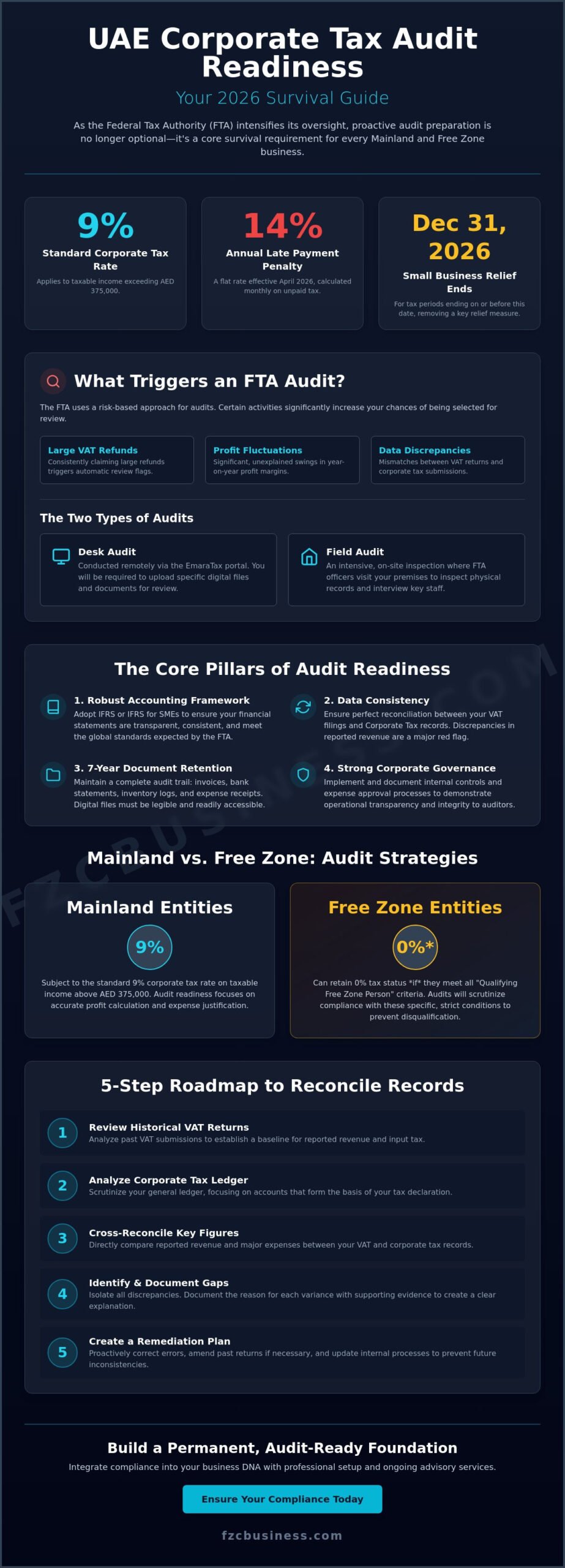
What if the most dangerous threat to your UAE business growth isn’t market competition, but a single missing document in your 2026 tax file? As the Federal Tax Authority (FTA) intensifies its oversight, proactive uae corporate tax audit preparation is no longer a luxury; it’s a survival requirement for every Mainland and Free Zone entity. You might feel confident in your current operations, but the transition to a 9% corporate tax regime has left many entrepreneurs vulnerable to the flat 14% annual late payment penalty introduced in April 2026.
It’s natural to feel overwhelmed by the shifting definitions of Qualifying Free Zone Persons or the sunsetting of Small Business Relief for tax periods ending December 31, 2026. You want to focus on scaling your company, not deciphering complex regulatory updates. This guide provides the clarity you need to master FTA requirements through a structural approach to documentation and daily compliance. You’ll gain a clear, actionable checklist for audit readiness and the confidence that your business structure meets every 2026 regulation. We’ll show you how to integrate these processes seamlessly so you can focus on your core objectives without administrative hurdles.
Key Takeaways
- Understand the 9% standard rate and how the Federal Tax Authority (FTA) selects entities for review.
- Learn how to align your accounting framework with IFRS standards to ensure seamless uae corporate tax audit preparation.
- Discover the specific criteria Free Zone entities must meet to retain their 0% tax status and avoid disqualification.
- Implement a five-step roadmap to reconcile VAT returns with your corporate tax ledger and identify historical gaps.
- See how professional business setup and PRO services create a permanent, audit-ready legal file for your company.
Understanding the UAE Corporate Tax Framework in 2026
The UAE business environment has undergone a radical transformation. Since the 2023 rollout, companies have moved from a tax-free model to a structured 9% corporate tax regime. This change aligns the nation with international best practices and requires a disciplined approach to financial reporting. For a foundational Overview of UAE Taxation, it’s evident that the system is designed to be transparent yet rigorous. If your business earns a taxable income exceeding AED 375,000, the 9% rate applies. This threshold protects smaller enterprises, but it also means that as you scale, your uae corporate tax audit preparation must become more sophisticated.
2026 represents a critical juncture for the local economy. Most businesses established during the initial 2023-2024 rollout are now entering their third tax cycle. The Federal Tax Authority (FTA) is no longer in a “grace period” mode. They are looking for consistency across historical filings and current ledgers. If your records show discrepancies between your VAT returns and your corporate tax submissions, you’ll likely face increased scrutiny. Small Business Relief is also ending for tax periods finishing on or before December 31, 2026, meaning many companies will face their first real tax liability soon.
To better understand how these elements interact with your daily bookkeeping, watch this helpful video:
The Scope of FTA Tax Audits
The FTA uses a risk-based approach to select companies for review. While some audits are entirely random, others are triggered by “high-risk” profiles. These profiles often include businesses claiming large VAT refunds or those with significant fluctuations in year-on-year profit margins. You should prepare for two types of inquiries. A desk audit is conducted remotely via the EmaraTax portal, where you’ll be asked to upload specific digital files. A field audit is more intensive; FTA officers visit your business premises to inspect physical records and interview staff. Legally, the FTA has the right to access your premises and seize original documents if they suspect non-compliance.
Key Tax Deadlines for the 2026 Cycle
Compliance isn’t just about accuracy; it’s about timing. Your tax return and payment are due nine months after the end of your financial year. For businesses with a financial year ending December 31, 2025, the hard deadline is September 30, 2026. Missing this window is costly. As of April 2026, the late payment penalty is a flat 14% per year, calculated monthly. You must also ensure your Tax Registration Number (TRN) details are current. Any changes in your business structure or address must be updated on the portal within 20 business days to avoid administrative fines.
Core Pillars of UAE Corporate Tax Audit Readiness
Successful uae corporate tax audit preparation begins with the quality of your source data. The FTA expects businesses to maintain records that clearly support every entry in their tax return. This starts with a robust accounting framework. Most UAE businesses adopt International Financial Reporting Standards (IFRS) or IFRS for SMEs to ensure consistency. By following these global standards, you provide the UAE Federal Tax Authority with a transparent view of your financial health, reducing the risk of administrative adjustments or penalties.
Consistency between your VAT filings and Corporate Tax records is equally vital. Discrepancies in revenue reporting or input tax recovery are common triggers for an audit. You must ensure that your general ledger reconciles perfectly with your submitted VAT returns. Additionally, the law mandates a seven-year document retention period. This isn’t just about keeping invoices; it’s about maintaining a complete audit trail that includes bank statements, inventory logs, and expense receipts. Digital storage is acceptable, provided the files are legible and readily accessible during a desk or field audit.
Corporate governance also plays a significant role in demonstrating transparency. Well-documented processes for expense approvals and internal controls show the FTA that your tax positions are based on deliberate, compliant business practices rather than accidental bookkeeping errors. Maintaining this level of discipline prevents the confusion that often leads to heavy penalties during a review.
Essential Financial Documentation
Your financial file must be comprehensive. While not every company is legally required to provide audited financial statements, they are mandatory for Qualifying Free Zone Persons and companies with revenue exceeding AED 50 million. Even if you fall below these thresholds, maintaining a clean trial balance and updated general ledgers is non-negotiable. You should conduct monthly bank reconciliations for all corporate accounts to catch errors before they reach your year-end report. Accurate inventory records are also critical, as they directly impact the calculation of your cost of goods sold and, consequently, your taxable profit.
Operational and PRO Documents
Compliance extends beyond the accounting department. Your legal standing is the foundation of your tax status. This requires keeping valid trade licenses and ensuring your Memorandum of Association (MoA) reflects your current business activities. Many entrepreneurs overlook the role of professional management in this area. Effective PRO services are essential for maintaining an audit-ready legal file, including labor contracts and government approvals that justify your operational expenses. Board resolutions and copies of significant contracts should also be archived, as they provide the necessary context for large transactions or changes in corporate structure. If you need assistance organizing your regulatory files, our team can provide expert VAT and Corporate Tax Assistance to streamline your compliance journey.
Mainland vs. Free Zone: Tailoring Your Audit Strategy
Mainland and Free Zone entities face distinct challenges during an FTA review. For Mainland companies, the focus usually lies on optimizing the 9% tax rate through legitimate, documented deductions. Conversely, Free Zone entities must prove they meet every stringent requirement to remain a Qualifying Free Zone Person (QFZP). Failing a single condition can result in losing the 0% tax benefit for five years. This high stakes environment makes specialized uae corporate tax audit preparation essential for businesses operating in these zones.
Intra-group transactions are under high scrutiny in the 2026 cycle. The FTA expects these “connected person” transactions to follow the arm’s length principle. You must document that prices charged between sister companies or partners match what independent parties would pay in the open market. Lack of transfer pricing documentation is a frequent trigger for tax adjustments. For detailed filing instructions that support these positions, consult the Federal Tax Authority’s Corporate Tax Returns Guide to ensure your submissions align with official standards.
The Qualifying Free Zone Person (QFZP) Test
Maintaining a 0% tax rate requires more than just a Free Zone address. You must demonstrate “adequate substance” within the UAE. This includes having a physical office, local employees, and incurring sufficient operating expenditure in the country. You must also adhere to the “De Minimis” rule for non-qualifying revenue. If your income from excluded activities exceeds 5% of your total revenue or AED 5 million, you risk losing your tax-exempt status entirely. Administrative errors, such as failing to elect for QFZP status on your return, can be just as damaging as financial discrepancies.
Mainland Expense Deductibility
Mainland businesses must be meticulous with expense records. The FTA applies the “wholly and exclusively” rule; every deduction must be for business purposes only. Interest expenses are capped at 30% of your EBITDA, and entertainment costs are generally limited to 50% deductibility. Owner-managers should be particularly careful with salary and benefit records. If a salary is deemed excessive compared to market rates for similar roles, the FTA may reclassify the excess as a non-deductible distribution of profit. Clear labor contracts and benchmarking data are your best defense during an audit.
The 5-Step Roadmap for Stress-Free Tax Audit Preparation
Moving from theory to practice requires a methodical approach. You cannot wait for an official notice to begin your uae corporate tax audit preparation. Instead, you must build a “defense file” that stands up to the most rigorous FTA inspection. This roadmap ensures your business remains resilient as the 2026 compliance cycle intensifies.
- Step 1: Conduct a “Tax Health Check.” Identify historical gaps in your records before they become liabilities.
- Step 2: Reconcile all VAT returns with the Corporate Tax ledger. Ensure your reported revenue and input tax match across all filings for the financial year.
- Step 3: Organize digital archives. Use a standardized, FTA-friendly naming convention such as “YYYY_Category_InvoiceNumber” to allow for rapid document retrieval.
- Step 4: Review all related-party transactions. Verify that your transfer pricing files contain the benchmarking data required to prove arm’s length pricing.
- Step 5: Appoint a certified tax agent. Secure professional representation to manage communications with the FTA and protect your legal rights.
By following these steps, you transform compliance from a source of anxiety into a routine business function. If you find gaps during this process, you can address them through voluntary disclosures rather than waiting for an auditor to discover them. To ensure your roadmap is executed perfectly, you can secure expert VAT and Corporate Tax Assistance today.
Performing an Internal Tax Health Check
A Tax Health Check is a proactive diagnostic tool for 2026 compliance that identifies potential risks before they attract official attention. During this internal review, you should focus on identifying discrepancies between bank entries and physical invoices. Common errors often involve the inconsistent application of depreciation for fixed assets or accruals for end-of-service benefits. You must ensure that your accounting treatments remain uniform across all tax periods. If you’ve changed your accounting method, you need to document the justification and ensure it aligns with IFRS standards.
Managing the Audit Process with the FTA
When the FTA issues a “Notice of Audit,” you must respond within the legal timeframe specified in the notice, which is typically five business days for desk audits. Designating a single point of contact for the FTA auditor is a strategic necessity. This person should be the only one providing documents and answers to prevent conflicting information. When presenting your digital archives, ensure they are categorized logically. Clear, well-labeled files minimize follow-up inquiries and demonstrate that your business maintains a high standard of corporate governance. Avoid providing extra, unrequested information; stick strictly to the scope defined by the auditor to keep the process efficient.
The Fast Zone Advantage: Building Compliance into Your Business DNA
Most entrepreneurs view tax audits as a year-end accounting hurdle. In reality, the most effective uae corporate tax audit preparation begins the moment you decide to register your entity. By embedding compliance into your initial structure, you eliminate the risk of historical errors that often trigger FTA penalties. Fast Zone Business acts as your strategic partner, ensuring that your foundation is built to withstand the scrutiny of the 2026 tax cycle. We don’t just set up companies; we build audit-ready enterprises.
We understand that managing a business in a new regulatory environment is demanding. Our approach prioritizes resource optimization, allowing you to focus on growth while we handle the administrative complexities. From securing a corporate bank account that facilitates transparent reporting to managing labor contracts, we ensure every piece of your corporate puzzle fits the FTA’s requirements. With the late payment penalty now at a flat 14% per year, having a partner who understands these financial stakes is a critical competitive advantage.
From Company Formation to Tax Compliance
Choosing between a Mainland or Free Zone jurisdiction is more than a geographic choice; it’s a tax strategy. Your business setup in Dubai must be perfectly aligned with your intended tax treatment. If your Memorandum of Association (MoA) doesn’t accurately reflect your business activities, you risk losing Qualifying Free Zone Person status or facing disallowed deductions. We provide the expert guidance needed to avoid these common setup errors, ensuring your legal documents support your financial positions from day one. This proactive alignment is the first step in a successful uae corporate tax audit preparation strategy.
Comprehensive Support for UAE Entrepreneurs
Compliance isn’t a one-time event; it’s an ongoing commitment. Our PRO services ensure your trade licenses and visas are renewed on time, maintaining your legal standing and avoiding administrative fines that can flag your business for an audit. We also provide direct access to VAT and Corporate Tax Assistance, helping you reconcile ledgers and manage the complexities of the 9% corporate tax regime. This comprehensive support model removes the friction from your professional journey, allowing you to scale with confidence. Contact Fast Zone Business today to secure your business future and ensure your company is fully prepared for the 2026 audit cycle.
Secure Your Business Future with Proactive Compliance
The transition to a 9% corporate tax regime has turned financial oversight into a core strategic pillar for every UAE entity. Mastering uae corporate tax audit preparation is no longer about avoiding a single review; it’s about building a resilient foundation that supports long-term growth. By reconciling your VAT returns with corporate ledgers and maintaining strict substance requirements, you protect your business from the flat 14% late payment penalties and the risk of losing Free Zone tax benefits.
Don’t let administrative hurdles distract you from your entrepreneurial goals. Fast Zone Business serves as a trusted partner for thousands of UAE entrepreneurs, offering specialized knowledge across Dubai Mainland and Free Zone jurisdictions. Our comprehensive PRO and government liaison services ensure your legal files remain audit-ready at all times. Get a Professional Tax Compliance Consultation with Fast Zone Business to streamline your operations and gain total clarity on your 2026 obligations. Your success in this new regulatory landscape starts with the right expert guidance today.
Frequently Asked Questions
What is the penalty for not maintaining proper tax records in the UAE?
Failure to keep the required records results in administrative fines starting at AED 10,000 for the first violation. If the offense is repeated within a specific timeframe, the penalty increases to AED 20,000. These fines apply to each instance where a business cannot provide the documentation mandated by the FTA to support its tax positions.
Do Free Zone companies need to prepare for a corporate tax audit?
Yes, Free Zone companies must prioritize uae corporate tax audit preparation to protect their “Qualifying” status. The FTA conducts reviews to ensure these entities meet strict substance requirements and adhere to the “De Minimis” revenue thresholds. Failing to prove compliance during an audit can result in the retrospective application of the 9% tax rate on all taxable income.
Can I manage my corporate tax audit preparation without an auditor?
You can handle day to day record-keeping internally, but professional assistance is essential for the final preparation phase. A certified tax agent identifies subtle risk areas, such as transfer pricing discrepancies, that an internal team might miss. Professional guidance ensures your records meet the specific qualitative standards and formatting requirements expected by the FTA auditors.
How long does a typical FTA corporate tax audit take?
The duration varies depending on the business’s size and the audit’s scope, but most field audits are completed within 10 to 15 business days. Desk audits can take several weeks as the FTA reviews digital files uploaded via the EmaraTax portal. Maintaining organized, standardized digital archives is the most effective way to reduce the time an auditor spends reviewing your company.
What are the most common mistakes businesses make during a tax audit?
The most frequent errors include inconsistent revenue reporting between VAT and corporate tax filings and missing original source documents. Many businesses also fail to document “connected person” transactions with appropriate benchmarking data. These mistakes often lead to the reclassification of deductible expenses and the subsequent issuance of administrative penalties during the final assessment.
Is audited financial reporting mandatory for all UAE businesses in 2026?
No, audited financial statements are only mandatory for specific categories, including Qualifying Free Zone Persons and entities with annual revenue exceeding AED 50 million. However, the FTA expects all businesses to maintain accurate, IFRS-compliant ledgers regardless of their size. Even if an audit isn’t legally required for your filing, it remains a critical component of uae corporate tax audit preparation.
How does VAT registration affect my corporate tax audit readiness?
VAT registration creates a permanent data trail that the FTA uses to cross-reference your corporate tax submissions. If your quarterly VAT returns show revenue figures that don’t match your annual corporate tax ledger, it triggers an immediate red flag for an audit. Readiness requires a perfect reconciliation between these two systems to ensure data integrity across all government portals.
What should I do if I receive a tax audit notification from the FTA?
You must acknowledge the notice immediately and prepare the requested documents within the timeframe specified, which is often as short as five business days. Appoint a single point of contact to manage all auditor communications and prevent conflicting information. Review your “defense file” one last time to ensure every entry is supported by valid, legible invoices and bank statements.
