

What Are the Disadvantages of a Free Zone Company? The 2026 Reality Check
Choosing a UAE Free Zone because it’s the “default” option for expats might actually be the most restrictive decision you make for your business in 2026. While the promise of 100% ownership and tax incentives is compelling, many entrepreneurs discover too late that they’ve essentially built a geographic fence around their operations. You’re likely concerned that these boundaries will prevent you from bidding on government contracts or selling directly to customers in the local market. Understanding exactly what are the disadvantages of a free zone company is vital before you commit your capital to one of the 50 plus jurisdictions currently operating in the Emirates.
It’s natural to feel overwhelmed by differing regulations and the rising anxiety of corporate bank account rejections. This article provides a professional reality check on the operational limitations and hidden challenges you’ll face, such as the strict physical office requirements now demanded by most banks for KYC compliance. We’ll examine the specific trade restrictions and economic substance rules that could lead to unexpected fines if handled incorrectly. This guide offers a clear framework to help you decide if a Free Zone fits your specific goals or if a Mainland setup is the more efficient path for your long-term growth.
Key Takeaways
- Understand the “geographic fence” limitation that prevents Free Zone entities from trading directly with the UAE mainland without a local agent.
- Evaluate what are the disadvantages of a free zone company concerning mandatory physical office leases within specific jurisdictions and the resulting real estate constraints.
- Navigate the regulatory complexities of 40+ independent Free Zone authorities to avoid compliance failures and corporate bank account rejections.
- Determine if the unrestricted market access and government bidding capabilities of a Mainland setup outweigh the traditional incentives of a Free Zone.
- Implement a strategic framework for jurisdiction selection based on 2026 banking success rates and operational flexibility.
What is a Free Zone Company and Its Primary Limitations?
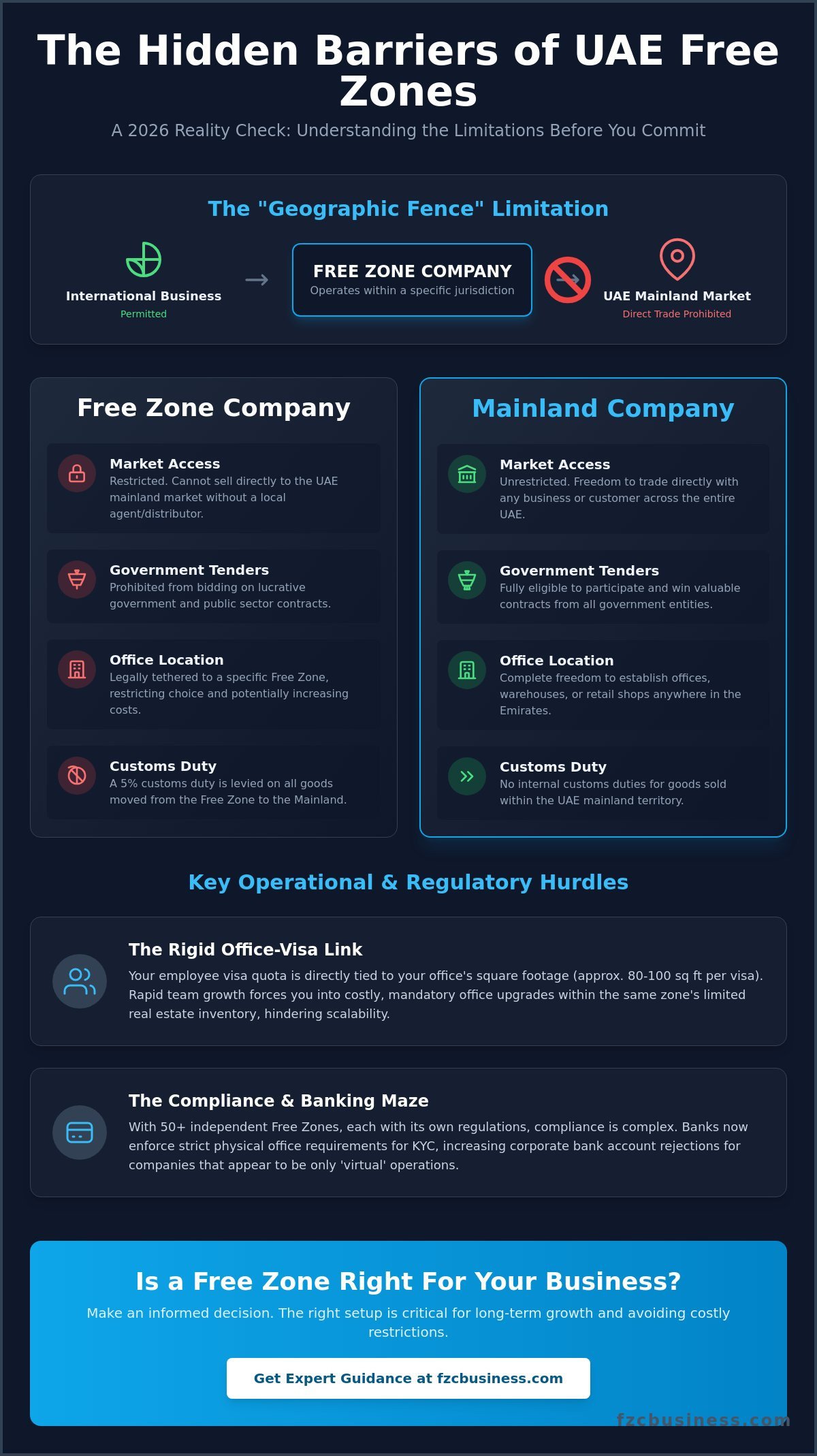
A Free Zone company is an entity registered within a specific geographic enclave designed to boost international trade. To understand the legal framework, you should first ask: What is a Free Zone Company? These zones operate as independent jurisdictions with their own regulations, separate from the UAE Mainland. While they offer tax benefits, the primary challenge involves the ‘geographic fence’ that restricts your physical and commercial presence. You’re legally limited to conducting business within that specific zone or internationally.
One of the most critical aspects of what are the disadvantages of a free zone company is the ‘Onshore vs Offshore’ distinction. In the UAE legal context, Mainland is considered onshore, while Free Zones are effectively offshore jurisdictions. This means your license doesn’t grant you the right to operate across the street if that street is outside your zone’s boundaries.
To better understand this concept, watch this helpful video:
The Local Market Access Barrier
Establishing a retail shop or a corporate office in a prime location like downtown Dubai is impossible with a Free Zone license. Your physical footprint must remain within your chosen zone. If you want to sell products to customers in the local UAE market, you cannot do so directly. You must engage a local distributor or a service agent to act as a bridge. This requirement introduces additional layers of cost and complexity that many entrepreneurs overlook. Additionally, Free Zone entities are generally prohibited from bidding on government contracts or participating in public sector tenders. These lucrative opportunities are typically reserved for Mainland companies. If you’re unsure which path fits your model, consulting with Fast Zone Business can clarify your options.
The 5% Customs Duty Reality
Logistics and pricing strategies are heavily impacted by the UAE’s customs regulations. Moving physical goods from a Free Zone into the Mainland is legally treated as an import. This triggers a 5% customs duty on the value of the goods. Managing these transactions requires a significant administrative effort, including the preparation of ‘Bill of Entry’ documents for every local sale. This administrative burden is another factor to consider when evaluating what are the disadvantages of a free zone company for trading businesses. The UAE Mainland is defined as the ‘Customs Territory’, while Free Zones are considered outside this territory for duty purposes. This distinction can lead to higher end-user prices or squeezed profit margins if you haven’t accounted for these hidden costs in your business plan.
Physical and Geographic Constraints of Free Zone Setup
One of the most immediate physical hurdles involves your office location. Unlike a Mainland entity that can set up shop in any commercial building across the city, a Free Zone company is legally tethered to the specific zone that issued its license. This means if you’re licensed in a northern Emirate to save on initial costs, you cannot legally rent a small office in a Dubai business hub to be closer to your clients. You’re locked into the real estate inventory provided by that specific authority. This lack of choice often forces entrepreneurs into suboptimal spaces or higher rents than they might find on the open market.
When evaluating what are the disadvantages of a free zone company, the lack of scalability is a recurring pain point for growing teams. Your visa quota is directly linked to the square footage of your leased office. In the UAE, the standard rule of thumb is approximately 80 to 100 square feet per visa. If your business scales rapidly and you need to hire five new employees, you can’t simply add desks to your current room. You’ll likely be forced to upgrade to a larger, more expensive office suite within the same zone’s limited inventory to qualify for those additional visas. This rigid structure can stifle a fast-growing startup that needs personnel flexibility without the immediate overhead of a massive office lease.
The ‘Flexi-Desk’ Visa Limitation
Many entrepreneurs start with ‘Flexi-desk’ or virtual office packages to keep entry costs low. However, these options often carry a hidden price when it comes to long-term operations. In 2026, UAE banks have significantly tightened their compliance standards. Most financial institutions now view companies without a permanent, physical office as “high risk,” making it exceptionally difficult to secure Corporate Bank Account Opening services. If you plan to hire more than one or two people, you’ll quickly outgrow the flexi-desk visa limit. For a detailed look at how these requirements differ, you can review our guide on how to start a business in Dubai.
Commute and Logistics for Employees
Geographic isolation is a significant factor in talent acquisition. While zones like RAKEZ or Fujairah offer attractive pricing, they are a considerable distance from the talent pools residing in Dubai or Abu Dhabi. Expecting high-level professionals to endure a two-hour daily commute is unrealistic, which may force you to settle for local talent or pay a premium to attract commuters. This isolation also impacts your networking capabilities. Being physically removed from the central business districts means you’ll spend more time on the road for client meetings and industry events. Research into Free Zone vs. Mainland: A 2026 Comparison suggests that zones often struggle with regional integration, which can limit your company’s ability to build a robust local network. If these logistical hurdles sound daunting, consulting with a formation expert can help you identify a jurisdiction that balances cost with accessibility.
Regulatory Hurdles and Banking Challenges
With over 50 free zones operating across the UAE in 2026, the regulatory landscape has become increasingly fragmented. Each authority maintains its own independent rulebook and administrative procedures. This lack of standardization means that a business model perfectly acceptable in IFZA might be strictly prohibited in DMCC. For entrepreneurs, this inconsistency creates a constant need for specialized research and often leads to confusion during the setup phase. You’re not just following UAE law; you’re following the specific, sometimes idiosyncratic, rules of a micro-jurisdiction.
Compliance requirements have also intensified significantly. Authorities now enforce rigorous Anti-Money Laundering (AML) and Ultimate Beneficial Ownership (UBO) filings to align with international standards. These aren’t optional suggestions. They’re mandatory tasks that carry heavy penalties for non-compliance. These ongoing administrative burdens and the associated costs are major factors when evaluating what are the disadvantages of a free zone company in today’s environment. You’ll need to allocate time and resources every year just to stay on the right side of your specific authority’s regulations.
The Corporate Bank Account Struggle
Securing a bank account is often the hardest part of the journey. While northern emirate free zones offer lower initial license fees, they’re frequently “red-flagged” by major UAE banks due to perceived lower oversight. Financial institutions now demand proof of “Economic Substance,” which usually means a physical office lease rather than a virtual desk. If you choose a jurisdiction solely on price, you’ll likely face repeated rejections during the corporate bank account UAE guide process. Banks want to see a genuine operational footprint before they’ll approve your application. This banking barrier can delay your actual business launch by months.
Limited Business Activities
Free zones generally operate with “closed” lists of permitted business activities. If your business needs to pivot or expand into a new sector, you’ll find the process remarkably rigid. You often cannot simply add an activity to an existing license. Instead, many authorities force you into a “multi-license trap” where you must pay for a second license and double your annual renewal fees just to conduct diverse operations. Plus, obtaining external approvals from bodies like the Dubai Health Authority (DHA) or the Knowledge and Human Development Authority (KHDA) is often more complex for free zone entities than for their mainland counterparts. These operational bottlenecks are critical to consider when asking what are the disadvantages of a free zone company for a business that plans to evolve over time.
Free Zone vs. Mainland: A 2026 Comparison
Historically, the primary motivation for choosing a Free Zone was the ability to retain 100% foreign ownership. In 2026, this is no longer a unique selling point. The UAE has updated its commercial laws to allow 100% foreign ownership for Mainland companies across most commercial and industrial sectors. This regulatory shift has fundamentally changed how entrepreneurs evaluate what are the disadvantages of a free zone company. When the ownership advantage is removed, the geographic and trade restrictions of a Free Zone become much harder to justify for businesses targeting the local market.
While Free Zones still offer specialized infrastructure and 100% exemptions on import and export duties, the cost gap between jurisdictions is narrowing. Many SMEs now find that a Mainland setup is more competitive over a three to five year period. Mainland entities enjoy the freedom to operate anywhere in the UAE and, crucially, can bid directly for government contracts. If your growth strategy involves public sector tenders or high-volume local trade, a Free Zone license may act more as a barrier than a benefit.
When Mainland is the Better Choice
Mainland formation is the superior option if your primary client base consists of other UAE-based businesses or government entities. It provides the flexibility to open multiple branches across different Emirates under a single corporate umbrella, something a Free Zone entity cannot do without significant extra costs. To see how these benefits apply to your specific industry, review our Dubai Mainland License Guide for a detailed breakdown of the 2026 requirements.
Decision Matrix for Entrepreneurs
To choose the right path, you must compare several operational factors that impact your bottom line. Consider these key elements:
- Market Reach: Mainland offers unrestricted UAE access; Free Zones are limited to their zone or international markets.
- Office Flexibility: Mainland allows you to lease any commercial space; Free Zones require leasing within their specific boundary.
- Visa Costs: While Free Zone visa packages are often bundled, Mainland visas offer more flexibility for large-scale recruitment.
- Government Tenders: Only Mainland companies can participate in most UAE government procurement processes.
Taxation is another critical factor. While the 9% corporate tax now applies across the UAE, Free Zone companies can potentially access a 0% rate on specific activities. To maintain a 0% tax status, Free Zone companies must ensure their revenue falls strictly under the category of ‘Qualifying Income’ as defined by the UAE Ministry of Finance. If your income does not meet these strict criteria, you will be subject to the standard tax rate regardless of your location. If you are ready to scale your operations without geographic limits, we recommend exploring Mainland Company Formation as a robust alternative to the Free Zone model.
How to Mitigate the Disadvantages with Fast Zone Business
While we’ve detailed what are the disadvantages of a free zone company, these hurdles don’t have to stall your professional progress. Success in the UAE depends on expert positioning and strategic foresight. We don’t just process paperwork; we build a corporate foundation that anticipates the banking and regulatory shifts of 2026. By choosing the right partner, you can turn potential limitations into a structured path for growth.
One effective method we utilize is the ‘Mainland Branch’ strategy. This allows your existing Free Zone entity to establish a physical presence on the Mainland, granting you the local market access you need without losing your original jurisdiction’s specific benefits. It’s a sophisticated approach that balances the trade-offs discussed in previous sections. We also leverage our deep relationships with Free Zone Authorities to ensure your business activities are classified correctly from day one, avoiding the ‘multi-license’ trap and unnecessary fee doubling.
Expert Jurisdictional Selection
Professional guidance is always a better investment than the ‘wrong’ license. We’ve seen many entrepreneurs lose months of operational time because they chose a remote zone that major banks simply won’t touch. Our process matches your specific activity to zones with the highest banking approval rates. For instance, we recently helped a tech consultancy transition from a remote northern emirate to a Dubai-based hub. This move didn’t just improve their brand perception; it finally unlocked their corporate bank account after three previous rejections. We help you skip the trial and error by identifying ‘bank-friendly’ zones that suit your specific business model.
Comprehensive PRO & Support Services
Staying compliant with the Federal Tax Authority (FTA) and the latest corporate tax regulations is a full-time commitment. Our PRO services handle the administrative heavy lifting, from visa renewals to labor ban removals. We ensure your filings are accurate and timely, protecting you from the steep penalties associated with non-compliance. This allows you to focus on your core objectives while we manage the regulatory complexities of the 2026 landscape. We provide a clear roadmap that anticipates your future needs, whether that involves adding new activities or scaling your workforce.
Don’t let jurisdictional confusion hold your business back. Contact Fast Zone Business for a free consultation on your setup strategy and ensure your UAE venture is built for long-term success.
Secure Your Business Future in the UAE
Success in the Emirates requires more than just a license; it demands a strategic alignment between your business model and the local regulatory framework. We’ve explored how geographic boundaries and rigid office requirements can limit your reach. While understanding what are the disadvantages of a free zone company is the first step, the second is choosing a jurisdiction that supports your long-term scalability. With 100% foreign ownership now standard for Mainland entities, the traditional reasons for choosing a Free Zone have shifted significantly.
Navigating these choices doesn’t have to be a burden. We offer deep expertise across 40 plus UAE Free Zones and specialize in high-growth Mainland setups. Our team provides direct assistance with Corporate Bank Account Opening to ensure your operations launch without the common delays of KYC rejections. By prioritizing resource optimization and regulatory compliance, we help you focus on your core objectives rather than administrative hurdles.
Start your hassle-free UAE business journey with Fast Zone Business today and build your company on a foundation of clarity and confidence. Your professional journey in the UAE deserves a partner that understands the intricacies of the 2026 market.
Frequently Asked Questions
Can a Free Zone company have an office in Mainland Dubai?
No, a Free Zone company cannot legally lease or operate an office in Mainland Dubai. Your physical operations must remain within the specific geographic boundaries of the jurisdiction that issued your license. If your business requires a central location in a Dubai business hub or a retail storefront on a mainland street, you’ll need to pursue a Mainland license instead.
Do I still need a local sponsor for a Mainland company in 2026?
You don’t need a local sponsor for the majority of commercial and industrial activities in 2026. The UAE has legalized 100% foreign ownership for most Mainland business sectors, removing a significant barrier for international entrepreneurs. This regulatory shift has made Mainland setups a direct competitor to Free Zones for investors who want full control and unrestricted market access.
Is it harder to open a bank account for a Free Zone company?
Opening a corporate bank account is generally more complex for Free Zone entities, especially those using virtual offices or flexi-desks. Banks in 2026 prioritize physical “Economic Substance” and often reject applications that lack a permanent office lease. This banking hurdle is a key factor when evaluating what are the disadvantages of a free zone company compared to Mainland entities that banks perceive as having a more stable local presence.
Can I sell products directly to UAE customers with a Free Zone license?
No, you cannot sell products directly to the local UAE market with a Free Zone license. You’re legally required to engage a local distributor or a service agent to facilitate Mainland sales. This requirement introduces additional costs and administrative layers that can impact your profit margins and operational speed.
What happens if I do business outside my Free Zone without a Mainland license?
Conducting business outside your designated zone without the appropriate license can lead to heavy fines and legal penalties. UAE authorities monitor commercial activities to ensure jurisdictional compliance. Engaging in unauthorized trade puts your license at risk and can cause significant complications during your annual company renewal process.
Are Free Zone companies exempt from the 9% UAE Corporate Tax?
Free Zone companies are only exempt from the 9% corporate tax if they earn “Qualifying Income” and meet strict economic substance requirements. Any taxable income exceeding AED 375,000 that doesn’t meet these specific criteria is subject to the standard 9% rate. Navigating these tax rules is a critical part of understanding what are the disadvantages of a free zone company in the 2026 fiscal landscape.
Which is cheaper: Free Zone or Mainland company formation?
Free Zone formation often features lower initial licensing fees, but Mainland companies can be more economical for businesses targeting the local market. While a Free Zone setup might save you money upfront, the long-term costs of customs duties and third-party distributors can make it the more expensive choice. You should evaluate your total cost of operations rather than focusing solely on the setup price.
How many visas can I get with a Free Zone license?
The number of visas available to your company is directly proportional to the square footage of your leased office space. Most authorities allow one visa for every 80 to 100 square feet of physical office area. Virtual offices or flexi-desk packages typically limit you to a very small visa quota, which can restrict your ability to scale your team quickly.
