

Choosing the Right Business Activity in Dubai: The 2026 Strategic Guide
In 2026, your business activity is no longer just a label; it’s the primary factor determining your UAE Corporate Tax liability and banking success. Choosing the right business activity in Dubai can be the difference between a 0% tax rate on qualifying income and a 9% tax on profits exceeding AED 375,000. It’s natural to feel overwhelmed by the subtle differences between Mainland and Free Zone activity lists. You’ve likely worried that a single wrong choice today could restrict your company’s growth or lead to unexpected government approval requirements tomorrow.
You deserve a setup process that’s transparent and strategically sound. This guide empowers you to master the complexities of modern licensing to ensure your venture remains legally compliant and tax-efficient. We’ll explore the strategic nuances of activity selection, compare jurisdictional lists, and provide a clear roadmap for long-term scalability. By the end of this article, you’ll have the clarity needed to turn regulatory hurdles into a competitive advantage for your new venture.
Key Takeaways
- Understand how the Department of Economy and Tourism (DET) uses specific activity codes to define your legal operational boundaries and licensing requirements.
- Distinguish between Professional, Commercial, and Industrial licenses to ensure your corporate structure aligns perfectly with your primary revenue streams.
- Learn a strategic 5-step framework for choosing the right business activity in dubai that balances local market access with specific jurisdictional benefits.
- Evaluate how your selected activity influences your status as a Qualifying Free Zone Person and your eligibility for the 0% corporate tax rate in 2026.
- Identify potential Economic Substance Regulations (ESR) and banking hurdles early to maintain a frictionless and compliant business environment.
What is a Business Activity in Dubai and Why Does it Matter?
A business activity is the specific nature of operations permitted under your UAE trade license. It dictates what you can sell, who you can sell to, and how you earn revenue. When you’re choosing the right business activity in dubai, you’re essentially setting the legal boundaries for your entire operation. The Department of Economy and Tourism (DET) maintains a unified list of thousands of activities to ensure every enterprise fits within the regulatory framework of Dubai’s diverse economy. Every activity has a unique code, and getting this code right is the first step toward a successful setup.
In 2026, this selection aligns directly with the D33 economic agenda, which aims to double the size of Dubai’s economy over the next decade. Choosing an activity that fits these high-growth sectors can often lead to faster approvals. Beyond the DET, your activity code is the very first detail a UAE bank examines during corporate account opening. If your license says “Consulting” but your transactions look like “Trading”, your account faces immediate risk of closure due to high-risk profile mismatches. It’s not just a name; it’s your corporate identity in the eyes of the government and financial institutions.
To better understand the relationship between your activity and your company’s legal zone, watch this helpful video:
The Legal Necessity of Accurate Activity Selection
Operating outside the scope of your license is a serious compliance breach in 2026. The DET and various Free Zone authorities have increased their monitoring of business conduct through digital reporting and on-site inspections. If your activity requires external approvals from bodies like the Dubai Health Authority (DHA) or the Knowledge and Human Development Authority (KHDA), failing to secure these before starting operations can lead to heavy fines. Your activity also dictates your legal structure. Certain professional activities are better suited for a Sole Establishment, while others require a Limited Liability Company (LLC) to operate effectively.
Impact on Operational Freedom and Location
Your chosen activity determines where you can work and what kind of space you must lease. While digital and professional services often permit “flexi-desk” arrangements in Free Zones, industrial or high-volume trading activities usually require a physical warehouse or office on the Mainland. Since the implementation of recent reforms, 100% foreign ownership is now available for most Mainland activities, removing the old requirement for a local Emirati partner. Resolution No. 11 of 2025 has further blurred the lines between jurisdictions, making it even more vital to select a code that offers maximum flexibility across both Free Zone and Mainland environments.
Categorising Your Business: Professional, Commercial, and Industrial Licenses
Dubai’s regulatory framework divides companies into distinct categories based on their operational nature. Identifying your category is a critical step in choosing the right business activity in dubai because it determines your legal structure and ownership rights. These categories ensure that businesses operate within a defined scope that the government can regulate effectively for tax and safety purposes. Your category will also dictate which government departments must approve your license before you can begin trading.
- Professional Activities: These licenses cover services provided through intellectual or artistic effort. Common examples include IT development, management consulting, and marketing services.
- Commercial Activities: This category is for businesses involved in trading, retail, or specialized services that require capital, such as real estate brokerage or general trading.
- Industrial Activities: If your business involves manufacturing, processing, or packaging goods, you’ll need an industrial license. These typically require a physical plant and specific environmental clearances.
- Tourism and Craftsmanship: Specialized licenses exist for the hospitality sector, including travel agencies and hotels, as well as for artisans and traditional craftsmen.
Professional vs. Commercial: Which is Right for You?
The distinction between professional and commercial licenses often centers on liability and ownership. Professional licenses frequently allow for a Sole Establishment, providing the owner with 100% control while maintaining personal liability for business debts. In contrast, commercial activities usually necessitate a Limited Liability Company (LLC) structure. This LLC framework protects your personal assets from business liabilities; this is vital for high-capital trading ventures. While many entrepreneurs used to require a Local Service Agent (LSA) for professional setups, current regulations have expanded 100% foreign ownership across both categories. If you are unsure which structure best fits your five-year plan, consulting with a mainland company formation expert can clarify these legal nuances before you commit to a registration path.
Combining Multiple Activities Under One License
Efficiency is key when setting up your venture. The Department of Economy and Tourism (DET) generally permits you to group up to 10 related activities under a single trade license. This “Rule of 10” allows you to diversify your revenue streams without paying for multiple separate licenses. However, restrictions apply when mixing categories. You generally cannot mix professional consulting with industrial manufacturing on the same document. Mixing trading and consulting is sometimes possible but often requires a more expensive “General Trading” license or specific approvals. Each additional activity may increase your annual renewal costs through “knowledge dirham” and “innovation dirham” fees, so it’s best to select only the activities you intend to perform immediately.
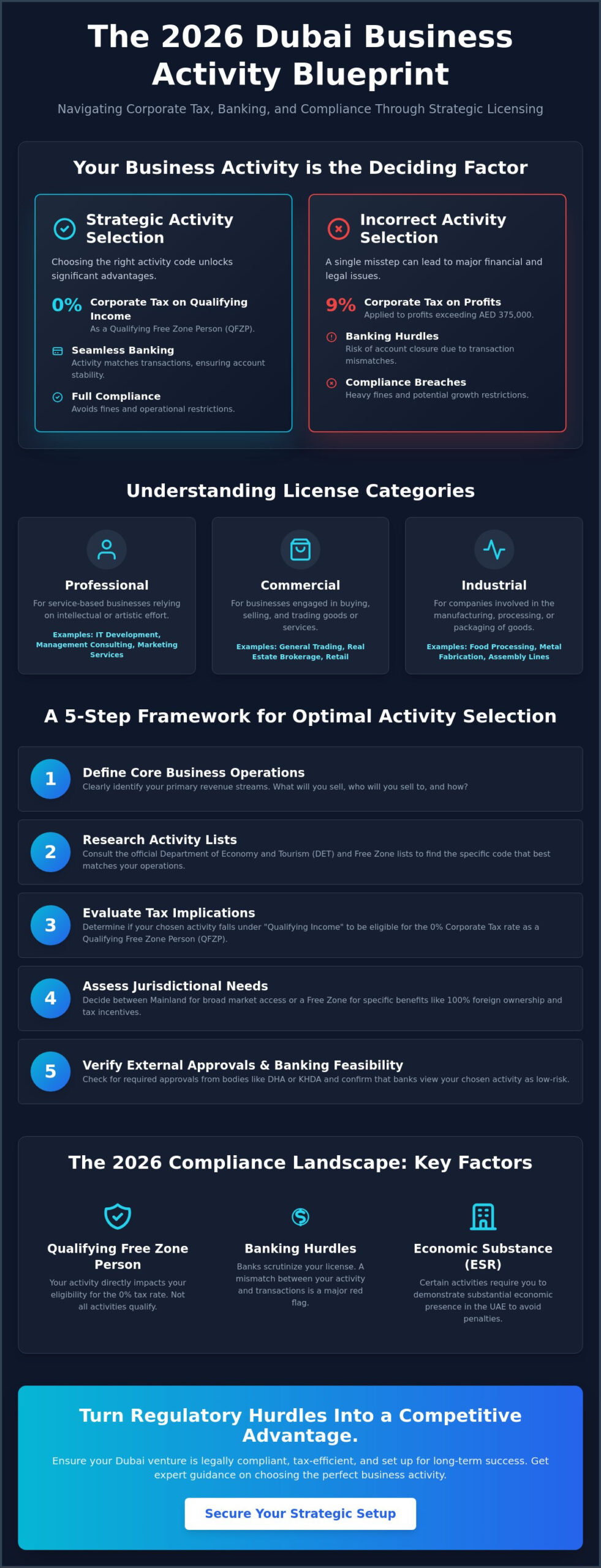
A 5-Step Framework for Choosing the Right Business Activity
Selecting a license category is only the beginning. To secure your company’s future, you need a tactical approach that accounts for market access, staffing needs, and tax obligations. Follow this 5-step framework to ensure you’re choosing the right business activity in dubai with precision and foresight.
- Define your core revenue stream: Match your primary business model to the most accurate Department of Economy and Tourism (DET) activity code. This code serves as the foundation for all future regulatory interactions.
- Determine your target market: Decide if your clients are primarily based within the local UAE market or internationally. This decision dictates whether you should opt for a Mainland setup for unrestricted local trade or a Free Zone for specific international advantages.
- Check for external approvals: Identify if your activity requires a “No Objection Certificate” (NOC) from third-party regulators. Bodies like the Central Bank, Dubai Health Authority (DHA), or the Knowledge and Human Development Authority (KHDA) must approve certain specialized activities before a license is issued.
- Assess your visa quota: Different activities and office sizes trigger different visa allocations. Ensure your chosen activity supports the number of staff you intend to hire in your first year of operation.
- Validate against tax lists: Verify your activity against the UAE’s 2026 Corporate Tax ‘Qualifying Activity’ list. This step is vital to determine if your income will be eligible for the 0% tax rate or subject to the standard 9% corporate tax.
Identifying Your Primary vs. Secondary Activities
Prioritize the activity that defines your brand and core operations. While you can add multiple activities, the “Primary Activity” is what the Ministry of Labour (MOHRE) uses to classify your business for employee work permits and skill level requirements. Identify your primary activity by selecting the operation expected to generate at least 80% of your total revenue. Secondary activities should only include supporting services that don’t conflict with the legal requirements of your primary choice.
Navigating Third-Party Approvals
High-regulation sectors like Education, Healthcare, Engineering, and Legal services require more than just a DET application. These sectors involve a two-stage process: “Initial Approval” and “Final License”. You cannot sign a lease or finalize your setup until the relevant government body clears your professional qualifications and business plan. Fast Zone Business manages this entire PRO workflow for government clearances, ensuring your applications move through these authorities without administrative delays. This professional oversight is essential for choosing the right business activity in dubai when your venture falls under strict regulatory scrutiny.
The 2026 Compliance Landscape: Tax and Banking Implications
The introduction of corporate tax has fundamentally changed the stakes when choosing the right business activity in dubai. As of 2026, the standard corporate tax rate is 9% on taxable income exceeding AED 375,000. Your specific activity code determines whether you can achieve “Qualifying Free Zone Person” status, potentially unlocking a 0% tax rate on qualifying income. Registration is mandatory for all. Every business must register for corporate tax through the EmaraTax portal to avoid a fine of AED 10,000. This makes regulatory compliance a day-one priority for every new venture.
Banking institutions have also tightened their criteria based on activity risk profiles. While “General Trading” licenses offer operational breadth, they often face significant hurdles during the Know Your Customer (KYC) process at tier-1 banks. Compliance departments view these licenses with higher scrutiny because it’s harder to monitor diverse, high-volume transaction types. Conversely, specialized professional or service-based activities often enjoy a smoother path to account approval. Beyond banking, specific activities trigger Economic Substance Regulations (ESR). These require mandatory annual reporting to prove that your core income-generating operations actually occur within the UAE.
Choosing an Activity That Banks Love
Banks categorize activities into low, medium, and high-risk tiers. Professional services, such as management consulting or IT development, are generally viewed as low-risk. This perception significantly accelerates the process for corporate bank account opening. To navigate the KYC process successfully, you’ll need to provide clear documentation proving your professional expertise and a detailed business plan that matches your DET activity code. High-risk activities, including those involving third-party payments or unregulated trading, may require additional security deposits or extended vetting periods.
Qualifying Income and Your Business Activity
The link between your license and your tax bill is now absolute. In Free Zones, the 0% tax rate only applies to income derived from “Qualifying Activities” as defined by the Ministry of Finance. If your activity doesn’t meet these specific criteria, your entire profit margin could be subject to the standard 9% rate. Mainland companies benefit from Small Business Relief if their revenue stays at or below AED 3 million, a provision currently available for tax periods ending on or before 31 December 2026. Qualifying Income is revenue generated from specific activities conducted by a Qualifying Free Zone Person with other Free Zone persons or from designated non-excluded activities.
Simplifying Your Dubai Setup with Fast Zone Business
2026 is the year of the Mainland for ambitious entrepreneurs. With the UAE’s non-oil foreign trade exceeding USD 1 trillion in 2025, the opportunity for growth within the local market has never been more significant. Our consultants specialize in choosing the right business activity in dubai by mapping your specific commercial vision to the most efficient DET activity codes. We deliver a frictionless setup experience by managing Mainland and Free Zone applications simultaneously. This dual-track approach ensures you don’t lose momentum while we navigate the administrative hurdles on your behalf.
Strategic selection is about more than just a license. It’s about building a foundation that supports your five-year plan. We ensure your chosen activity aligns with current corporate tax incentives and banking requirements. Our team stays ahead of regulatory shifts, such as the 2026 e-invoicing mandates, to keep your business ahead of the curve. We transform a complex regulatory requirement into a clear, actionable roadmap for your success.
Our Expert-Led Activity Mapping Process
We actively prevent “Activity Creep”, which occurs when businesses select too many unrelated codes and face inflated licensing costs. By analyzing your revenue streams, we customize your license to include up to 10 related activities. This provides maximum operational flexibility without triggering unnecessary government fees. If you’re ready to define your corporate scope with precision, you can book a free activity consultation with Fast Zone Business to review your business plan against the latest unified activity list.
Total Support: From Activity Choice to Bank Account
Our commitment to your venture extends far beyond the initial registration. Our PRO services handle all government documentation and external approvals required for your specific activity. This professional oversight is vital for high-regulation sectors where errors can lead to significant delays. We also ensure your activity choice supports your long-term residency goals, including UAE Golden Visa requirements for investors and specialized talents.
Success in Dubai requires a partner who understands the intricacies of the local landscape. We coordinate your license issuance with corporate bank account opening and VAT registration to provide a comprehensive, all-encompassing solution. This integrated model allows you to focus on your core business objectives while we manage the compliance details. Start your journey today with a professional activity audit to ensure your Dubai venture is built for long-term scalability and tax efficiency.
Secure Your Commercial Future in Dubai
Your journey toward a successful UAE venture begins with a single, strategic decision. Choosing the right business activity in dubai is no longer just a licensing formality; it’s a critical financial move that impacts your corporate tax liability and banking relationships. By following a structured framework and aligning your operations with the latest 2026 regulations, you ensure your business remains both compliant and competitive in a fast-evolving market.
At Fast Zone Business, we provide the expert guidance needed to navigate this complex landscape. Our specialized Mainland and Free Zone setup teams possess deep expertise in over 2,000 DET activity codes, ensuring your license is optimized for growth. We offer comprehensive PRO and banking support to manage every administrative hurdle, allowing you to focus on your core objectives. Don’t leave your regulatory compliance to chance. Get a Free Consultation on Your Dubai Business Activity today and build your venture on a foundation of clarity and confidence. Dubai’s thriving economy is ready for your vision, and we’re here to make the process seamless.
Frequently Asked Questions
Can I change my business activity after the license is issued?
Yes, you can modify or add activities to your license at any time. This process involves filing an amendment application with the Department of Economy and Tourism or your specific Free Zone authority. You’ll need to pay an amendment fee and secure any new external approvals required for the updated scope. It’s a standard procedure, but it’s vital to ensure the new activity doesn’t conflict with your existing corporate tax structure or banking profile.
What is the most common business activity for freelancers in Dubai?
Professional services are the most popular choice for solo entrepreneurs in the region. Activities like IT consulting, digital marketing, and media production are frequently selected under freelance permits in Free Zones. When choosing the right business activity in dubai as a freelancer, you must ensure the code matches your specific service delivery. This alignment is essential for smooth corporate bank account opening and verifying contracts with local clients.
Do I need a separate license for every activity I perform?
You don’t need a separate license if your activities are related and fall within the same category. The Department of Economy and Tourism typically allows you to group up to 10 related activities on a single trade license. If you intend to perform activities from different categories, such as mixing industrial manufacturing with professional consulting, you may face restrictions. In such cases, you might need a second license or a specialized “General Trading” permit.
How much does it cost to add an additional activity to my Dubai license?
The cost depends on your specific licensing authority and the nature of the activity. On the Mainland, you’ll encounter standard amendment fees along with “knowledge” and “innovation” dirham charges. Some Free Zones include a certain number of activities in their base package, while others charge a fixed fee per additional code. Since these government fees are subject to periodic updates, it’s best to request a current breakdown during your license amendment process.
Which business activities allow for 100% foreign ownership on the Mainland?
Most commercial and professional activities now permit 100% foreign ownership on the Dubai Mainland. This follows the 2021 regulatory reforms that removed the general requirement for a local Emirati partner to hold a 51% stake in most sectors. While strategic industries like defense or oil and gas still have specific ownership restrictions, the vast majority of retail, consulting, and trading ventures can be fully owned by international investors.
What is the ‘General Trading’ activity and is it still a good choice in 2026?
A General Trading license allows you to trade in multiple unrelated goods under a single license. It offers high operational flexibility but often faces stricter scrutiny from UAE bank compliance departments during the KYC process. In 2026, many entrepreneurs prefer specialized trading licenses to enjoy faster bank account approvals. If your business has a clear focus, a specialized license is usually more efficient and cost-effective than a General Trading permit.
How do I know if my chosen activity requires special government approval?
You can determine if an activity requires external clearance by checking the DET’s unified activity list for “regulated” codes. Activities in sectors like healthcare, legal services, education, and engineering always require a No Objection Certificate (NOC) from relevant bodies like the DHA or KHDA. When choosing the right business activity in dubai, identifying these requirements early is crucial. Failing to secure these third-party approvals will prevent the final issuance of your trade license.
Does my business activity affect my eligibility for a UAE Golden Visa?
Yes, your business activity is a decisive factor for Golden Visa eligibility, particularly under the “Specialized Talent” and “Investor” categories. Certain high-tech, scientific, and professional activities are prioritized for 10-year residency permits to support the UAE’s D33 economic goals. If your activity involves a capital investment of at least AED 2 million, you may also qualify through the Investor track. Always align your license selection with your long-term residency objectives.
