

UAE Free Zone License Requirements: The Definitive 2026 Setup Guide
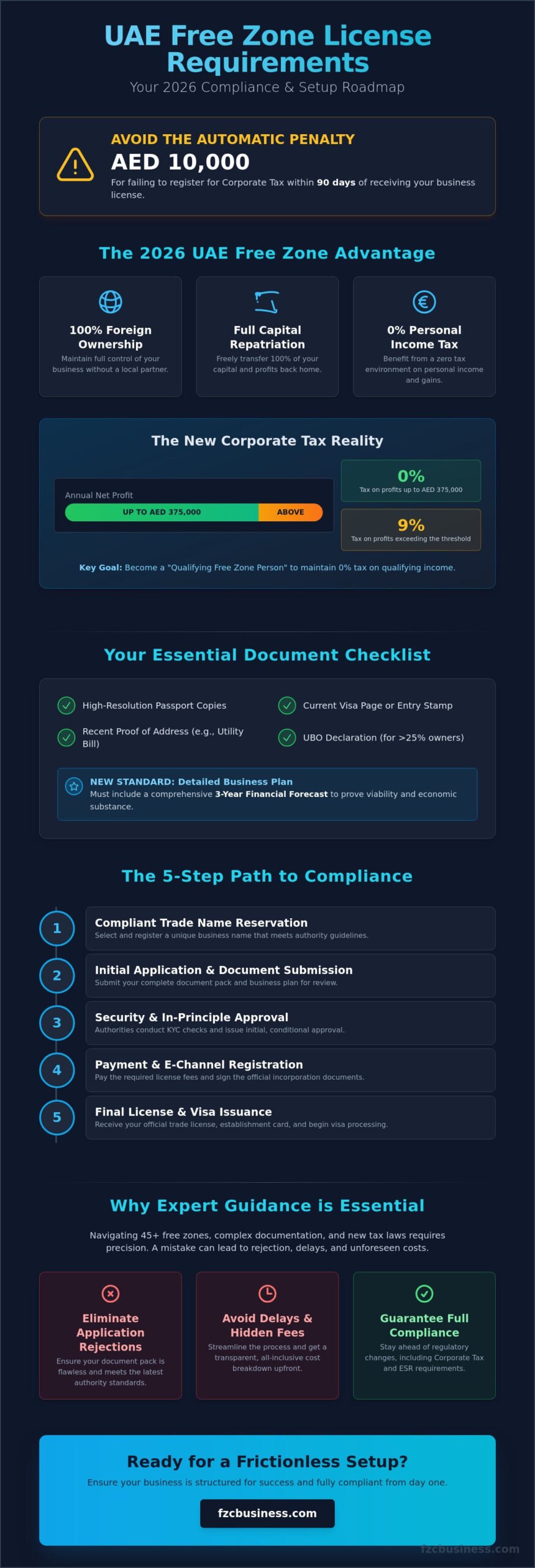
Did you know that failing to register for corporate tax within 90 days of receiving your license now results in an automatic AED 10,000 penalty? In 2026, securing a business permit is a high-stakes compliance task that requires a precise understanding of the latest uae free zone license requirements. You’re likely feeling the weight of choosing between 45 plus jurisdictions while trying to avoid hidden costs and the risk of application rejection. It’s natural to feel overwhelmed by the need to align your operations with the 9% corporate tax threshold and FTA registration deadlines.
We believe the setup process should empower your vision, not obstruct it. This guide provides a definitive roadmap to master the essential documentation and legal criteria needed for a successful launch. You’ll gain access to a complete document checklist and a clear breakdown of the 2026 regulatory environment. By following this frictionless path to company formation, you can focus on your core objectives while we ensure your business structure remains robust, efficient, and fully compliant from day one.
Key Takeaways
- Master the latest uae free zone license requirements to ensure full compliance with the 2026 corporate tax regime and avoid the AED 10,000 late registration penalty.
- Prepare a comprehensive document pack, including passport copies and the now-standard three-year financial forecast, to meet updated authority standards.
- Distinguish between professional and commercial license types to correctly map your business activities and secure the right legal framework for your operations.
- Navigate the five-step application process with precision, from compliant trade name reservation to obtaining final in-principle approval from the authorities.
- Eliminate the risk of application rejections and hidden fees by utilizing expert guidance to streamline your entire company formation journey.
Understanding the 2026 UAE Free Zone Landscape
UAE free zones are specialized economic areas designed to drive international trade and attract global talent. These zones offer entrepreneurs 100% foreign ownership, full capital repatriation, and zero personal income tax. By 2026, these jurisdictions have transitioned from simple tax havens into sophisticated regulatory ecosystems. They provide world-class infrastructure and industry-specific clusters that allow businesses to scale rapidly within a secure legal framework.
The introduction of the 9% corporate tax on profits exceeding AED 375,000 has redefined the landscape. Meeting uae free zone license requirements now involves proving you’re a “Qualifying Free Zone Person” to maintain a 0% tax rate on qualifying income. This shift ensures the UAE remains a premier global hub while aligning with international transparency standards. To see the scale of these options, you can review a complete list of UAE free zones across the seven emirates.
To better understand the differences between these jurisdictions, watch this helpful video:
Distinguishing between “Regulated” and “Non-Regulated” zones is essential for your setup strategy. Regulated zones, such as the Dubai International Financial Centre (DIFC) or Abu Dhabi Global Market (ADGM), operate under their own common law frameworks and independent judicial systems. Most other free zones are non-regulated; they follow UAE federal laws while providing specialized perks for sectors like media, logistics, or technology.
Why Choose a Free Zone Over Mainland in 2026?
Free zones remain the premier choice for businesses that don’t require direct trade with the UAE mainland market. While mainland companies offer total geographic flexibility within the country, free zones provide “Designated Zone” status, which is vital for VAT-exempt international trading. In 2026, the choice often hinges on office needs. While a flexi-desk satisfies uae free zone license requirements for many, a physical office lease has become a crucial factor for successfully opening a corporate bank account.
Top Free Zones for 2026 Startups
Selecting the right jurisdiction is a strategic decision based on your industry and budget. SHAMS in Sharjah remains a leader for creative and media startups due to its cost-effective packages. For industrial or manufacturing needs, RAKEZ in Ras Al Khaimah offers proximity to major ports and heavy-duty infrastructure. IFZA in Dubai continues to attract professional service providers with its rapid digital registration. The Northern Emirates are currently seeing a surge in tech-focused hubs, offering competitive alternatives to Dubai’s more established zones.
Core Documentation and Legal Requirements
Meeting uae free zone license requirements starts with a precise and complete document pack. While individual zones have specific nuances, a core set of records is universal across all jurisdictions. You’ll need high-resolution passport copies, current visa pages or entry stamps, and recent proof of residential address, such as a utility bill. These basics form the foundation of your KYC (Know Your Customer) profile with the authorities.
In 2026, a superficial business summary is no longer enough. Most authorities now demand a detailed business plan featuring a three-year financial forecast. This document isn’t just a formality; it proves your company’s viability and helps the zone assess your potential economic substance. Seeking expert guidance on setting up a business can ensure your financial projections meet these rigorous standards. Additionally, the Ultimate Beneficial Owner (UBO) declaration is a non-negotiable requirement. You must disclose any individual holding 25% or more of the company’s shares to maintain transparency.
If you’re currently employed within the UAE, check if you need a No Objection Certificate (NOC) from your current sponsor. While many free zones have removed this hurdle for specific consultancy and creative activities, it remains a standard requirement for many administrative and industrial sectors. Clearing this step early prevents eleventh-hour delays in your application process.
Shareholder and Director Criteria
You must decide between a Free Zone Establishment (FZE) for a single shareholder or a Free Zone Company (FZCO) for two or more owners. While directors don’t always need to be UAE residents, appointing a local company secretary can significantly speed up official filings. Be aware that certain professional licenses require the appointed manager to prove specific academic qualifications or industry-related certifications before the license is granted.
The Role of the Service Agent and PRO
Modern free zones don’t require a local service agent, but the complexity of the 2026 regulatory environment makes professional support invaluable. Fast Zone Business manages the government interface for you, ensuring your Memorandum of Association (MOA) correctly defines your business powers and operational limits. This document is the legal foundation of your entity; it dictates how your business functions and scales. If you’re feeling overwhelmed by the paperwork, our PRO services can audit your application to ensure it’s rejection-proof before submission.
Mapping Your Business Activities to License Types
Selecting the correct activity is the most critical step in meeting uae free zone license requirements. Your license type dictates your legal boundaries, your tax obligations under the 2026 regime, and your eligibility for specific banking facilities. Authorities categorize thousands of activities, and selecting the wrong one can lead to operational delays or legal penalties. You must choose a structure that matches your primary source of income.
- Professional License: This is designed for service-based businesses, specialized consultancies, and freelancers. It’s the standard choice for designers, IT consultants, and management experts who sell expertise rather than physical products.
- Commercial/Trading License: If you’re involved in the import, export, and distribution of physical goods, this license is mandatory. It allows you to warehouse products within the free zone and trade them internationally.
- Industrial License: This is required for manufacturing, processing, or packaging goods. To secure this, you’ll need to provide proof of a physical production facility and meet specific environmental and safety standards.
- E-Commerce License: In 2026, rules for digital marketplaces and social selling have tightened. This license is essential if you’re processing payments through a website or selling products via social media platforms.
The Danger of Activity Mismatch
Activity mapping is the strategic alignment of your business license with your actual revenue-generating operations. Choosing an activity that doesn’t perfectly reflect your business model is a common mistake that often blocks corporate bank account opening. Banks perform deep due diligence; if your transactions don’t align with your licensed activities, they’ll flag your account as high-risk or reject the application entirely.
Many entrepreneurs fall into the “General Trading” trap. While it sounds flexible because it allows you to trade multiple unrelated goods, it comes with significantly higher setup costs. More importantly, in the 2026 regulatory climate, general trading licenses face intense scrutiny from tax authorities and financial institutions. It’s almost always more efficient to list specific, related activities under a standard commercial license.
Dual-Licensing and Branch Setup
A common concern is whether a free zone entity can trade directly on the UAE mainland. The 2026 Dual License solution allows companies in specific zones to obtain a mainland permit without leasing a separate office. This provides a cost-effective way to expand your local reach. Alternatively, you can establish a branch of an existing foreign or local company. While a branch doesn’t require separate share capital, a new incorporation often provides better liability protection. We can help you conduct a cost-benefit analysis to determine which path offers the most frictionless growth for your unique professional journey.
The 5-Step Application Process and 2026 Compliance
Securing your business permit in 2026 is a rapid process, but the uae free zone license requirements demand strict adherence to a specific sequence. While some jurisdictions can issue a license in as little as 24 hours, the journey to a fully operational, compliant entity follows a structured five-step path. Missing a single detail in these early stages can lead to delays in your residency or banking applications.
- Step 1: Trade Name Reservation. You must submit three potential names for approval. Avoid restricted terms, religious references, or names that imply government affiliation. Your chosen name must end with the legal suffix of your structure, such as FZE or FZCO.
- Step 2: Initial Approval. The authority reviews your business activity and shareholder background. This “in-principle” nod confirms that your venture is welcome within the zone’s specific ecosystem.
- Step 3: Document Submission and Legal Signing. You’ll finalize the application and sign the Memorandum of Association. Most free zones now utilize digital signatures for remote setups, though some still require a physical presence or a notarized Power of Attorney.
- Step 4: License Issuance and Lease Agreement. Once you pay the registration fees, the authority issues your trade license. Simultaneously, you’ll receive your lease agreement for your flexi-desk or physical office space.
- Step 5: Visa Processing and E-Channel Registration. This activates your immigration file, allowing you to begin the residency process for yourself and your employees.
Post-Licensing Compliance: The 2026 Checklist
Your obligations don’t end when you receive your license. You must register for Corporate Tax with the Federal Tax Authority (FTA) within 90 days of license issuance. If you miss this window, you’ll face an immediate AED 10,000 penalty. You also need to determine if your activities trigger Economic Substance Regulations (ESR) filings. For businesses in high-risk categories, implementing AML/CFT reporting protocols is mandatory to maintain your license in good standing.
E-Channel and Immigration Essentials
Residency depends on the E-Channel system, which centralizes visa and residency services for free zone entities. Your office size determines your visa quota; a standard flexi-desk typically grants between one and three visas. After your entry permit is issued, you’ll complete a medical fitness test and Emirates ID biometrics. This entire cycle usually takes 10 to 15 working days. To ensure you meet every deadline without stress, start your application with expert support to guarantee a frictionless setup.
Frictionless Setup: Why Expert Guidance is Essential
Attempting to navigate the 2026 regulatory environment alone often leads to expensive setbacks. While the digital portals are accessible, the nuance of activity mapping and document attestation remains complex. A single error in fulfilling uae free zone license requirements can trigger application rejections or, worse, missed tax registration deadlines. These administrative hurdles consume time that should be spent on your market entry strategy. Professional guidance ensures your application is “right first time,” protecting you from the AED 10,000 late registration penalties mentioned earlier.
We specialize in making the free zone company setup process entirely seamless. Our team acts as your dedicated partner, managing every interaction with government authorities and free zone registries. For example, a recent client faced a four-week delay due to an incorrect activity classification under the new 2026 guidelines. After stepping in, we rectified the filing and secured their trade license in just seven working days. This efficiency allows you to transition from planning to operational status without the typical stress of bureaucratic delays.
Our commitment extends beyond the initial setup. We provide long-term support that grows with your business, from managing annual license renewals to facilitating Golden Visa applications for your key stakeholders. By maintaining your corporate standing and tax compliance, we allow you to focus on your core professional journey.
The Fast Zone Advantage
- Broad Jurisdiction Expertise: We analyze over 40 UAE free zones to identify the specific jurisdiction that offers the best tax benefits and infrastructure for your sector.
- Comprehensive PRO Services: Our team handles everything from initial approvals to corporate bank account opening assistance, ensuring a unified formation experience.
- Transparent Pricing Model: You’ll receive a clear breakdown of costs upfront. We eliminate hidden admin fees and surprises, providing you with a predictable budget for your launch.
Next Steps for Your Business
To begin your journey, ensure you have your passport copy and a basic outline of your business activities ready. Every venture is unique, and a generic package rarely meets the specific needs of a modern enterprise. We’ll help you refine your activity list to ensure it satisfies both licensing authorities and banking compliance teams. Book your free business setup consultation with Fast Zone today to receive a bespoke quote and a clear roadmap for your 2026 UAE expansion.
Secure Your UAE Business Future in 2026
The 2026 business landscape offers unprecedented growth opportunities for those who approach the setup process with precision. Success depends on more than just submitting paperwork; it requires a strategic alignment of your business activities with the latest uae free zone license requirements and federal tax regulations. By mastering your documentation and ensuring early corporate tax registration, you protect your venture from unnecessary penalties and build a solid foundation for long-term scalability.
Choosing the right jurisdiction from the start ensures your entity remains compliant while optimizing your operational costs. We’re here to eliminate the administrative friction that often slows down ambitious entrepreneurs. With expertise across 40 plus UAE free zones and a 99% bank account opening success rate, our certified tax and legal compliance partners provide the clarity you need to launch with confidence. Our methodical approach transforms a complex regulatory task into a clear, actionable path toward your professional goals.
Start your UAE Free Zone journey with Fast Zone Business today and focus on your core objectives while we handle the regulatory complexities. Your vision deserves a seamless start in one of the world’s most dynamic markets.
Frequently Asked Questions
What is the minimum capital requirement for a UAE free zone license in 2026?
Most free zones do not require you to deposit a minimum share capital into a bank account to secure your license. While you must state the share capital in your Memorandum of Association, it is often treated as a book entry rather than a physical deposit. Some specific jurisdictions or high-risk activities may still require proof of capital; we recommend checking the specific rules of your chosen zone during the planning phase.
Can I get a free zone license without renting a physical office?
You can obtain a license using a “flexi-desk” or “virtual office” solution in many jurisdictions. These packages satisfy the uae free zone license requirements for the permit itself and allow for a limited number of residency visas. However, you should note that a physical office lease is now a crucial factor for successfully opening a corporate bank account in the current regulatory environment.
How long does it take to get a UAE free zone license?
A business license can be issued in as little as 24 hours in digital-first zones like Meydan or Dubai South. The complete formation cycle, which includes the Establishment Card and your residency visa, typically takes between 10 and 15 working days. This timeline depends on the speed of your medical fitness results and the processing of your Emirates ID.
Do I need a local UAE partner for a free zone company?
You do not need a local UAE partner or sponsor to establish a free zone company. One of the primary advantages of these zones is the ability for foreigners to have 100% ownership of their entities. You maintain full control over your business operations and the right to fully repatriate your profits to your home country.
Can a free zone company trade directly with mainland UAE customers?
Free zone companies are generally restricted from trading directly with the UAE mainland market without a mainland distributor or agent. To sell physical goods or specific services on the mainland, you must either partner with a local distributor, open a mainland branch, or use a dual-licensing scheme. This ensures your business remains compliant with the geographic restrictions of your license.
Is Corporate Tax applicable to all free zone companies in 2026?
All free zone companies must register with the Federal Tax Authority and file annual returns regardless of their profit levels. While the standard rate is 9% on profits exceeding AED 375,000, many entities can benefit from a 0% rate if they meet the criteria for a “Qualifying Free Zone Person.” You must register within 90 days of receiving your license to avoid an automatic AED 10,000 penalty.
What is the difference between an FZE and an FZCO?
The primary difference lies in the number of shareholders allowed within the corporate structure. A Free Zone Establishment (FZE) is limited to a single shareholder, which can be either an individual or a corporate entity. A Free Zone Company (FZCO) is designed for multiple shareholders, typically allowing between two and fifty partners to own the business jointly.
What happens if my business license expires?
Allowing your license to expire leads to immediate financial penalties and the suspension of your legal business activities. Your corporate bank account will likely be frozen, and your residency visas may be placed in a grace period or cancelled. It is vital to initiate the company renewal process at least 30 days before the expiry date to ensure a frictionless transition and continuous compliance.
