

Challenges Opening a Business Bank Account in Dubai: 2026 Strategy Guide
Securing a corporate bank account in the UAE is no longer a matter of simply submitting the right paperwork; it’s about proving your business narrative aligns with a bank’s specific risk appetite. If you’ve faced opaque rejection reasons or onboarding timelines that stretch beyond eight weeks, you’re not alone. Many entrepreneurs find the 50,000 AED minimum balance requirements and the intense scrutiny of the 2025 AML Decree-Law to be significant barriers to entry.
We understand that these hurdles can stall your momentum. This 2026 strategy guide promises to help you overcome the common challenges opening a business bank account in dubai by providing expert insights into the latest Central Bank KYC guidance and documentation standards. You’ll gain a clear roadmap to approval, learn how to select a bank that matches your specific business activity, and discover practical steps to significantly reduce your time to onboard. We’ll break down the shift toward continuous, risk-based compliance and show you how to position your company as a low-risk, high-value client.
Key Takeaways
- Understand why the 2026 banking landscape prioritizes “Compliance First” protocols and how the maturity of UAE Corporate Tax impacts your application.
- Discover why the Emirates ID is the critical “Golden Key” to unlocking corporate accounts and how to bridge residency documentation gaps effectively.
- Identify which industries banks currently favor and how to navigate the specific challenges opening a business bank account in dubai for high-risk sectors.
- Access a comprehensive pre-approval checklist to ensure your documentation, including personal CVs and invoices, meets strict 2026 standards.
- Learn how a strategic pre-compliance audit can identify potential red flags and streamline your onboarding timeline to avoid opaque rejections.
The 2026 Banking Landscape: Why Scrutiny is Higher Than Ever
The UAE financial sector has undergone a fundamental transformation over the last few years. By 2026, the era of rapid, unchecked onboarding has been replaced by a “Compliance First” mandate. Banks have pivoted away from aggressive growth to prioritize rigorous risk mitigation. This shift is directed by the Central Bank of the United Arab Emirates (CBUAE), which now sets strict parameters to protect the nation’s standing as a premier global financial hub. You’ll find that banks are no longer just service providers; they’re the primary gatekeepers of the economy.
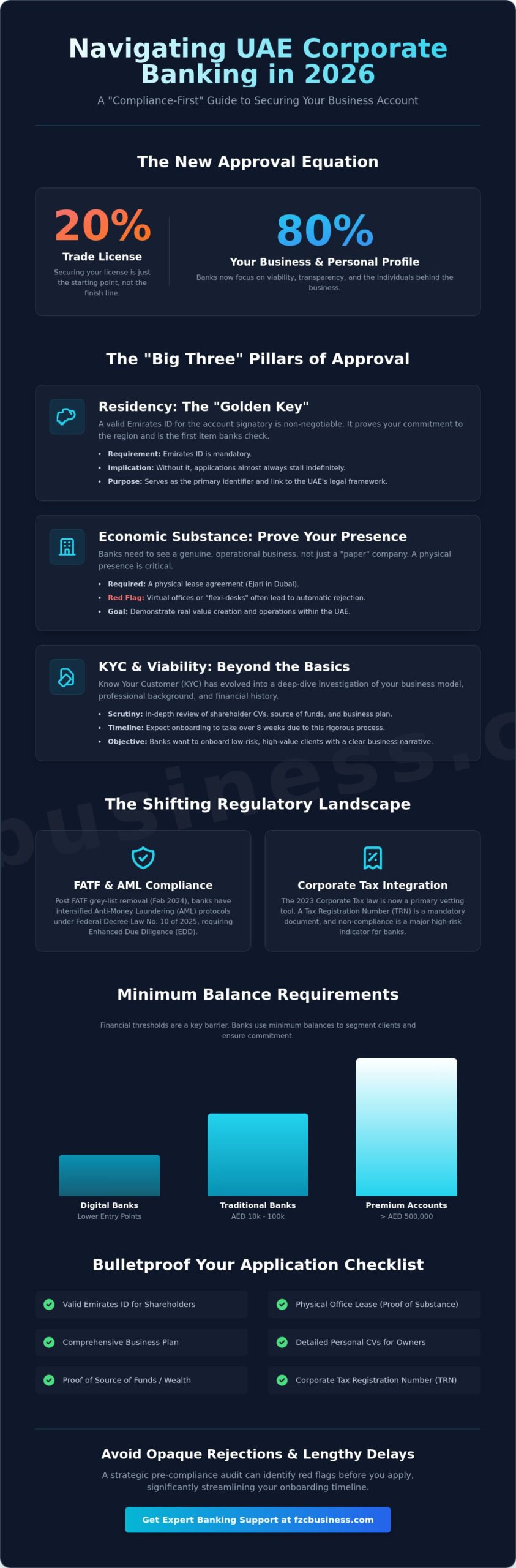
Many entrepreneurs mistakenly believe that securing a trade license is the hardest part of the setup process. In reality, your license represents only about 20% of the approval equation. The remaining 80% of the bank’s decision rests on your personal profile, your business model’s viability, and your ability to prove financial transparency. This shift in priority is one of the primary challenges opening a business bank account in dubai for those who aren’t prepared for deep institutional scrutiny.
To better understand the practicalities of this process, watch this helpful video:
FATF Compliance and AML Regulations
Since the UAE’s removal from the FATF grey list in February 2024, local banks have doubled down on Anti-Money Laundering (AML) protocols. The current regulatory framework, governed by Federal Decree-Law No. 10 of 2025, mandates Enhanced Due Diligence (EDD) for any business with links to high-risk jurisdictions. You must demonstrate genuine “Economic Substance” by showing a physical presence and local operations. Banks are no longer interested in “paper” companies; they want to see real value creation within the UAE. If you can’t show a clear path of funds or a legitimate reason for operating in Dubai, your application won’t make it past the initial screening.
The Corporate Tax Impact on Onboarding
The introduction of corporate tax in 2023 has matured into a powerful vetting tool for banks in 2026. Most institutions now require a Tax Registration Number (TRN) as a mandatory part of the onboarding file. This integration provides banks with a verified view of your financial history and compliance record. It’s a double-edged sword: while transparency can speed up the process for legitimate firms, it creates a significant barrier for those with disorganized records. Banks now view tax non-compliance as a high-risk indicator. If you can’t provide tax registration or proof of exemption, it’s a red flag that often leads to an immediate rejection of your account application.
The “Big Three” Challenges: KYC, Residency, and Substance
While the regulatory landscape provides the context, the practical challenges opening a business bank account in dubai revolve around three critical pillars: KYC, Residency, and Substance. Banks have moved beyond simple identity verification. They now conduct deep-dive investigations into your professional background and financial history. You’ll find that institutions are increasingly selective, focusing on clients who can prove a long-term commitment to the region.
The Emirates ID has become the non-negotiable “Golden Key” for corporate banking. Without it, your application will likely stall indefinitely. This residency requirement is underscored by the U.S. State Department Investment Climate Statement, which highlights the UAE’s robust but stringent financial regulations designed to combat illicit activity. Beyond identity, banks demand proof of “Substance.” In 2026, a virtual office or a “flexi-desk” often triggers an automatic rejection. Banks prefer to see a physical lease that proves your business actually exists and operates in the local market.
Financial thresholds also present a hurdle. While digital banks might offer lower entry points, traditional institutions typically require minimum monthly balances ranging from AED 10,000 to AED 100,000. Premium or high-tier accounts can demand balances exceeding AED 500,000. Managing these liquidity requirements is essential for maintaining a healthy banking relationship.
Crafting a Compliance-Ready Business Profile
A Business Profile is a strategic document, not just a summary. It’s your primary opportunity to convince a compliance officer of your legitimacy. To pass the 2026 vetting process, your profile must include these five essential elements:
- Verified Suppliers: List established companies you work with.
- Target Customers: Show a clear, documented market for your services.
- Expected Transaction Volume: Provide realistic monthly projections.
- Source of Wealth: Clearly document where your startup capital originated.
- Business Rationale: Explain exactly why your business needs to be in the UAE.
Keep in mind that “General Trading” licenses face significantly more scrutiny than “Professional” or service-based licenses. This is due to the inherent complexity of tracking physical goods across borders.
The Residency vs. Non-Resident Dilemma
Opening an account as a non-resident shareholder is one of the most persistent challenges opening a business bank account in dubai. In 2026, banks view non-resident accounts as high-risk, often subjecting them to months of enhanced due diligence. One effective way to bypass this bottleneck is by obtaining a Golden Visa, which provides the long-term residency status banks prefer. Alternatively, appointing a local manager with a valid residency visa to act as a signatory can bridge the gap and instill confidence in the bank’s compliance team. If you’re unsure which residency path fits your goals, you can explore efficient visa and banking solutions tailored to your company structure.
Industry-Specific Flags and Risk Appetites
Every bank in the UAE operates with a specific “risk appetite” that dictates which industries they’re willing to support. Your business activity is often the first filter a compliance officer applies. In 2026, industries such as cryptocurrency, precious metals, and multi-level marketing are firmly in the “Red Zone.” These sectors face the most intense challenges opening a business bank account in dubai because they’re perceived as high-risk for money laundering. If your business falls into these categories, you’ll need to provide extensive documentation of your transaction history and regulatory compliance.
On the other end of the spectrum, tech startups and e-commerce ventures have become “bank favorites.” Their digital-first models provide a clear, traceable audit trail that compliance teams find reassuring. Banks are eager to onboard scalable, transparent businesses that contribute to the UAE’s digital economy. Your jurisdiction also plays a massive role. While many entrepreneurs prefer the ease of a Free Zone, traditional Tier 1 banks often maintain a higher “Trust Factor” for companies licensed by the Department of Economy and Tourism (DET).
Mainland Credibility and Banking Success
Tier 1 financial institutions generally view Dubai Mainland licenses with a higher degree of confidence. The primary reason is the requirement for a physical office space verified by an Ejari tenancy contract. This document acts as a verified anchor, proving your business has genuine economic substance in the country. When you hold a mainland license, you’re seen as a long-term player in the local market. We provide comprehensive Mainland company formation services designed to position your business as a credible candidate for the UAE’s most prestigious banks.
Navigating Free Zone Banking Hurdles
Free Zones are popular for their flexibility, but they can present unique obstacles during the onboarding process. In 2026, some banks have established “Pre-Approved” status for specific, highly-regulated Free Zones, which can speed up your application. Digital-first banks often offer a “fast-track” process for these entities, making them ideal for SMEs. However, don’t expect the same treatment if you’re using an offshore structure. Most traditional banks now view offshore entities as a major compliance risk due to the lack of local physical presence. If you’re operating through an offshore setup, you’ll likely face the steepest uphill battle in the current banking environment.
The Pre-Approval Checklist: How to Bulletproof Your Application
Success in UAE corporate banking requires a methodical approach that starts long before you visit a branch. To mitigate the challenges opening a business bank account in dubai, you must treat your application as a high-stakes pitch. Start by identifying the bank’s “sweet spot.” Some institutions favor high-volume retail, while others specialize in consultancy or professional services. Matching your activity to the right bank is the most effective way to avoid an immediate mismatch rejection.
You need to go beyond basic legal documents. Banks in 2026 want to see your professional story. This includes detailed CVs for all shareholders and a clear rationale for why you’ve chosen the UAE. Utilize a “soft application” or pre-screening process. This involves submitting a summary of your profile to a Relationship Manager (RM) before formally entering the system. If they flag a concern early, you can address it without a formal rejection on your record.
Prepare for the interview with precision. Your meeting with the RM is a test of your business’s legitimacy. Be ready to explain your revenue model, your target clients, and your expected transaction volumes. After the meeting, manage the compliance query loop aggressively. Respond to every request for additional information within 24 to 48 hours to keep your file moving through the system.
Essential Documentation for 2026
- Corporate Documents: Trade License, Memorandum of Association (MOA), and Articles of Association (AOA). If these are from outside the UAE, they must be fully attested.
- Financial History: 6 months of personal or corporate bank statements from a previous entity to prove your financial track record.
- Proof of Local Presence: A valid Ejari (tenancy contract) or a recent utility bill in the company or shareholder’s name.
Rejection Recovery: What to do if a Bank Says No
Rejection is common, but it isn’t the end of the road. Always ask for the specific reason for the decline. While banks often cite “internal policy” to avoid disclosing risk parameters, persistent follow-up can sometimes reveal a fixable documentation gap. If the rejection is final, observe a 30-day cooling-off period before re-applying to the same institution. During this time, consider pivoting from a Tier 1 Bank to a Digital EMI (Electronic Money Institution). These platforms often have more flexible onboarding criteria for startups while still providing essential transactional tools. If you’re struggling to navigate these hurdles, you can partner with our banking specialists to bulletproof your next application.
Strategic Banking Support with Fast Zone Business
Entering the UAE banking system solo is the leading cause of account rejection in 2026. Banks prioritize applications that arrive through verified corporate service channels, as these files have already undergone a level of professional vetting. When you face the challenges opening a business bank account in dubai alone, you’re often left guessing why a rejection occurred. We eliminate that guesswork by acting as your expert advocate and ensuring your file is “bank-ready” before it reaches a compliance officer’s desk.
Our “Pre-Compliance” Audit is designed to identify red flags that lead to automatic denials. We review your source of wealth, transaction projections, and supplier lists to ensure they meet the latest CBUAE standards. By choosing to bundle Corporate Bank Account opening with your company formation, you ensure your legal structure and banking profile are perfectly aligned from day one. This synergy is supported by our direct lines to dedicated Relationship Managers who understand the specific risk appetites of various Tier 1 and Tier 2 institutions.
The Fast Zone Advantage
Efficiency is the hallmark of our service model. Our PRO services team manages the complex attestation requirements and documentation gaps that often stall applications for weeks. We’ve seen the impact of this expertise firsthand. In one case, we helped a Free Zone startup bypass the typical 12-week wait, achieving full account activation in just 15 days. This result was possible because of a strategic “warm introduction” to a bank that had a high appetite for their specific tech-focused activity. We know which banks are currently favoring your industry, saving you months of wasted effort on cold applications.
Ready to Start Your Dubai Journey?
Don’t let compliance hurdles or opaque rejection reasons delay your market entry. Our team at API Tower, Dubai, is here to provide the expert guidance required to navigate the regional banking landscape with clarity and confidence. We offer a supportive, personalized approach that adapts to your unique professional journey, allowing you to focus on your core business objectives rather than administrative hurdles. Consult with a Fast Zone Banking Expert Today to streamline your onboarding and secure your financial foundation in the UAE.
Secure Your Financial Foundation in Dubai
Success in 2026 requires moving beyond basic licensing. You must demonstrate genuine economic substance and maintain a thorough, compliance-focused profile to satisfy the Central Bank’s rigorous KYC standards. Navigating these requirements effectively means understanding the specific risk appetites of different institutions. This strategic approach is the only way to overcome the common challenges opening a business bank account in dubai and ensure your operations remain uninterrupted.
We bridge the gap between your business goals and banking requirements. Our team leverages direct partnerships with Tier 1 UAE banks to facilitate smoother, more efficient onboarding. We provide expert PRO support for all necessary document attestations, ensuring every piece of paperwork meets strict local standards. We don’t just submit applications; we conduct a comprehensive pre-compliance audit to ensure your file is bulletproof before it reaches a bank’s desk. It’s time to move past administrative delays and focus on your core objectives.
Get Expert Help with Your Corporate Bank Account Opening
Your business vision deserves a frictionless start. Let’s turn your banking hurdles into a clear path for long-term growth and financial stability in the UAE.
Frequently Asked Questions
Can a non-resident open a business bank account in Dubai in 2026?
Yes, non-residents can open accounts, but they face significantly higher scrutiny and longer approval timelines. Banks require evidence of a strong connection to the UAE or a resident manager to act as a signatory. Without a local residency visa, expect enhanced due diligence and requests for comprehensive personal bank statements from your home country. This remains one of the primary challenges opening a business bank account in dubai for international investors.
How much minimum balance is required for a Dubai corporate account?
Minimum balance requirements vary based on the institution and account tier. Traditional banks typically require between AED 10,000 and AED 100,000 to avoid monthly maintenance fees. However, digital-first banks like Wio or Mashreq NeoBiz offer zero-balance business accounts, though these often come with a monthly subscription fee ranging from AED 99 to AED 249. Higher-tier corporate accounts for large enterprises may require balances exceeding AED 500,000.
What is the fastest way to open a business bank account in the UAE?
The fastest route to activation is through digital-first banking platforms like Wio or RAKBANK’s digital wing. These institutions prioritize speed and often complete onboarding within 48 to 72 hours if your documentation is perfect. To ensure a quick turnaround, have your Emirates ID, trade license, and Ejari ready. Working with a professional service provider to pre-vet your application can also prevent the delays caused by missing information.
Why did the bank reject my corporate account application without a reason?
Banks often reject applications without specific feedback to protect their internal risk-scoring models. Under the latest Central Bank guidelines, institutions aren’t obligated to disclose why a file was declined. Common hidden reasons include a lack of “Economic Substance,” high-risk business activities, or an unclear Ultimate Beneficial Ownership (UBO) structure. If your application is rejected, it’s best to wait 30 days before approaching a different institution with a revised profile.
Do I need a physical office to open a bank account in Dubai?
Most traditional banks in 2026 require a physical office verified by an Ejari tenancy contract to prove “Economic Substance.” While some digital banks may accept virtual office addresses for specific service-based startups, a physical workspace is generally seen as a sign of commitment and legitimacy. If you’re aiming for a Tier 1 bank account, having a physical lease is a non-negotiable requirement for a successful application.
Can I open a bank account for a Freelance Visa in Dubai?
Yes, you can open an account with a Freelance Visa, but it’s typically a personal account designed for professional use rather than a full corporate account. Many banks offer specific “Freelancer” packages that allow you to receive payments for services. However, if your business grows or you hire employees, you’ll eventually need to transition to a formal company structure and a dedicated corporate bank account.
What is KYC and why is it so strict in the UAE?
KYC stands for “Know Your Customer,” a process used by banks to verify the identity and legitimacy of their clients. It’s exceptionally strict in the UAE because of the 2025 AML Decree-Law and the country’s commitment to global FATF standards. Banks must ensure that funds entering the system aren’t linked to illicit activities. This involves deep-diving into your source of wealth and verifying every shareholder’s background and professional history.
Are digital banks as good as traditional banks for UAE businesses?
Digital banks are excellent for startups and SMEs due to their lower fees and efficient apps. They’re often the best solution for those facing challenges opening a business bank account in dubai through traditional routes. However, traditional banks are still superior for businesses that require complex trade finance, physical branch access, or high-value international transfers. Your choice should depend on your specific transaction volume and the complexity of your business model.
