

Expert Advice on UAE Company Law: Navigating the 2026 Regulatory Landscape
What if your choice of corporate structure is the single most important factor determining whether you pay a 9% tax or qualify for a 0% exemption in 2026? It’s natural to feel some anxiety as you transition from older regulations to the rigorous standards set by Federal Decree-Law No. 20 of 2025. You want the benefits of 100% foreign ownership, but the pressure of AML audits and the new e-invoicing framework can feel like a significant administrative hurdle.
This guide provides a clear roadmap to master the uae company formation requirements 2026, ensuring your business remains compliant while maximizing your strategic growth. You’ll learn how to align your setup with the updated Tax Procedures Law and the latest electronic invoicing guidelines to avoid costly penalties. We’ll explore how to choose the right jurisdiction to secure your Golden Visa and optimize your corporate tax position for long term success in the Emirates.
Key Takeaways
- Understand how the transition to 2026 legal amendments shifts the UAE toward a digital-first corporate governance model.
- Identify the specific uae company formation requirements 2026 for LLCs and Sole Establishments to ensure your company constitution is robust.
- Evaluate the strategic differences between Mainland Federal Law and Common Law jurisdictions to protect your operational freedom and assets.
- Master the 2026 compliance landscape by integrating AML protocols and Corporate Tax strategies into your core business structure.
- Streamline your market entry by leveraging professional support for licensing, residency visas, and corporate bank account opening.
The 2026 UAE Corporate Landscape: Why Expert Advice is Non-Negotiable
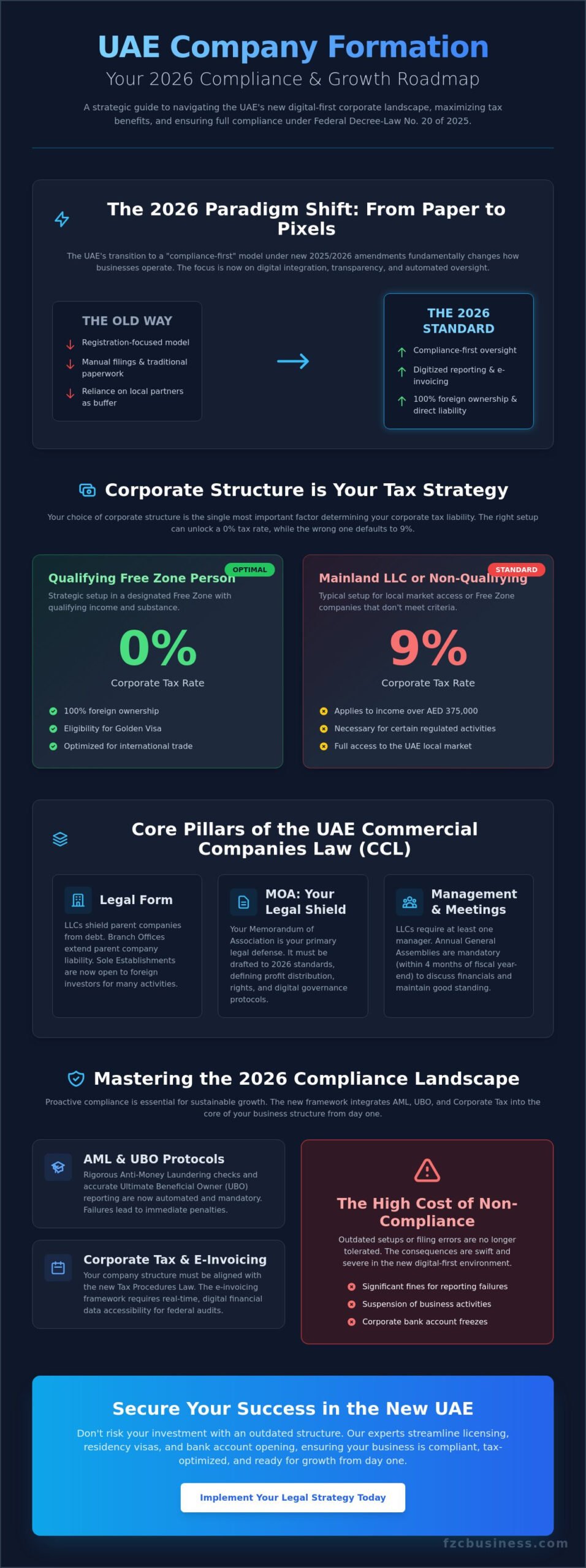
The UAE’s business environment has undergone a massive transformation. Moving from Federal Decree-Law No. 32 of 2021 to the 2025 and 2026 amendments represents a fundamental pivot in how companies operate. UAE Company Law in 2026 isn’t just a set of rules for registration; it’s a comprehensive framework for digital-first corporate governance. This shift means the Ministry of Economy has moved from a registration-focused model to a “compliance-first” oversight strategy. You must recognize that the uae company formation requirements 2026 prioritize transparency and digital integration over traditional paperwork.
To better understand this concept, watch this helpful video:
Major Legal Milestones for 2026
Federal Decree-Law No. 20 of 2025 serves as the backbone for the current regulatory era. It effectively digitizes corporate reporting and governance, making manual filings a thing of the past. One of the most significant changes is how 100% foreign ownership interacts with commercial dispute resolution. Since you no longer need a UAE national partner for most activities, the legal burden shifts entirely to your internal documentation. For a broader context, this UAE corporate law overview explains the foundational structures that these new amendments build upon. The digital economy focus now requires businesses to maintain real-time data accessibility for federal audits. This ensures that the UAE remains a top-tier global hub for secure investment.
The Cost of Non-Compliance in the New Era
Efficiency is the new standard. Failing to meet the updated uae company formation requirements 2026 leads to immediate administrative penalties. These aren’t just minor fees. Late license renewals or failures in Ultimate Beneficial Owner (UBO) reporting can trigger significant fines and even suspension of activities. Expert guidance from Fast Zone Business prevents common pitfalls in Memorandum of Association (MOA) drafting. Without a local partner to act as a buffer, your MOA is your primary legal shield. It defines your rights, profit distribution, and dispute resolution paths. Your legal standing also directly impacts your corporate bank account stability. Banks in 2026 conduct rigorous, automated compliance checks. Any discrepancy in your legal filings can lead to account freezes or rejection of transactions. Proactive legal alignment is a requirement for sustainable growth.
Core Pillars of the UAE Commercial Companies Law (CCL)
The Commercial Companies Law (CCL) is the bedrock for any enterprise in the UAE. Understanding the uae company formation requirements 2026 starts with selecting the correct legal form for your specific goals. While Limited Liability Companies (LLCs) remain the standard for most commercial activities, the rise of Sole Establishments for foreign investors is a direct result of recent ownership liberalizations. Your Memorandum of Association (MOA) acts as your company’s constitution; it must be drafted to reflect 2026 standards for digital governance and profit distribution. Expertly structuring your share capital from day one is essential to facilitate future scalability, ensuring you can onboard new investors without rewriting your entire legal foundation.
Statutory requirements for management have become more precise. You’re required to appoint at least one manager for an LLC, though many choose to establish a board of directors for better oversight. Shareholder meetings are no longer just a formality. The law mandates at least one General Assembly per year, held within four months of the financial year-end. These meetings must address financial performance and auditor reports to maintain your license’s good standing. If you’re planning your market entry, our team provides expert Mainland Company Formation services to align your governance with these new standards.
Company Types and Legal Obligations
Choosing between an LLC and a Branch Office involves assessing liability. In 2026, an LLC provides a separate legal personality, shielding the parent company from local debts. Conversely, a Branch Office remains a legal extension of the head office, meaning the parent company retains full liability for UAE operations. For startups seeking maximum protection, a Subsidiary structured as an LLC is often superior to a Foreign Branch. Holding companies also face specific statutory requirements under the CCL, including restrictions on direct commercial operations and mandatory oversight of subsidiary management to ensure financial transparency across the group.
Governance and Management Standards
Governance standards have tightened under Federal Decree-Law No. 20 of 2025. Directors now face clearer fiduciary duties, with increased personal liability for acts of negligence or breach of the MOA. Management must adhere to mandatory reporting cycles, which often differ between mainland and free zone jurisdictions. Regarding compliance timelines, all entities must register their Ultimate Beneficial Owner (UBO) data within 15 days of obtaining a license to meet the uae company formation requirements 2026. Maintaining these standards is not just about avoiding fines; it’s about building the institutional credibility required for corporate banking and international trade.
Strategic Comparison: Mainland vs. Free Zone Legal Frameworks
Selecting a jurisdiction is the most consequential decision in your setup process. It determines whether your business operates under UAE Federal Civil Law or the independent Common Law frameworks of the DIFC and ADGM. This choice fundamentally alters your uae company formation requirements 2026, specifically regarding how you manage commercial disputes, trust structures, and asset protection. Mainland companies enjoy full, unrestricted access to the local UAE market and government contracts. In contrast, Free Zone entities benefit from regulatory autonomy but must navigate geographic limitations when trading physically within the mainland.
Your jurisdiction choice now dictates your Corporate Tax (CT) standing. Under the current framework, qualifying Free Zone persons can still leverage a 0% tax rate on qualifying income, provided they maintain adequate substance. However, mainland companies are subject to the standard 9% rate on profits exceeding AED 375,000. This fiscal distinction makes the legal structure a primary driver of your bottom line. For a comprehensive breakdown of onshore regulations and setup steps, consult our Dubai Mainland License Guide.
Mainland (Onshore) Legal Dynamics
The Department of Economy and Tourism (DET) remains the primary oversight body for onshore entities. While 100% foreign ownership is now the standard for over 1,000 commercial and industrial activities, “strategic impact” sectors still require careful legal vetting. Activities involving oil and gas, defense, or telecommunications often have specific capital requirements or partnership nuances. A physical office with a verified Ejari (tenancy contract) is a non-negotiable legal requirement for mainland compliance. This physical presence isn’t just a formality; it’s the foundation for your business license and residency visa quotas.
Free Zone Legal Autonomy
Free zones provide a specialized legal environment with their own distinct regulatory bodies. In 2026, the “Dual Licensing” regime is a game-changer, allowing free zone companies to obtain a mainland permit to operate onshore without needing a separate physical office. Zones like SHAMS or IFZA offer significant legal flexibility, especially for the creative and tech sectors. These jurisdictions simplify the uae company formation requirements 2026 by bundling licensing with visa processing. To understand the specific regulations and benefits of each hub, refer to our Free Zone Company Setup Guide. These zones allow for rapid scaling while maintaining the benefits of 100% ownership and simplified customs procedures.
Corporate Compliance 2026: AML, UBO, and Corporate Tax
Compliance in the Emirates has transitioned from a periodic task to a continuous operational requirement. Under Federal Decree-Law No. 47 of 2022, the tax landscape is now a primary consideration for every business owner. While previous sections detailed how your jurisdiction affects your tax rate, the uae company formation requirements 2026 mandate that every entity, regardless of profit levels, must register with the Federal Tax Authority (FTA). Beyond tax, you’re required to maintain a robust Anti-Money Laundering (AML) and Counter-Terrorism Financing (CTF) framework. This includes identifying and verifying your Ultimate Beneficial Owner (UBO) to the Ministry of Economy to ensure full transparency in the corporate registry.
Expert alignment of your Economic Substance Regulations (ESR) with your legal filings is no longer a luxury. If your business performs “Relevant Activities,” you must demonstrate genuine economic presence within the UAE to avoid substantial administrative penalties. Ensuring your corporate documents accurately reflect your physical operations and management decisions is the only way to safeguard your license. For comprehensive support in meeting these standards, our team provides specialized VAT and Corporate Tax Assistance to keep your business fully aligned with federal mandates.
Navigating the Federal Tax Authority (FTA)
The 9% Corporate Tax rate applies to all taxable profits exceeding AED 375,000. However, businesses with a total revenue below AED 3 million may still qualify for Small Business Relief, provided they meet specific filing criteria. It’s vital to distinguish between a “Taxable Person” and an “Exempt Person” early in your journey. Proper bookkeeping isn’t just for internal tracking; it serves as your primary legal defense during an FTA audit. With the mandatory implementation of e-invoicing in 2026, your digital records must be accurate, real-time, and fully compliant with the latest Ministry of Finance guidelines.
The Role of PRO Services in Compliance
PRO services act as your first line of defense against the administrative fines that often plague new entrepreneurs. Managing government approvals, labor contracts, and visa legalities requires a deep understanding of evolving local regulations. Missing a single deadline for a labor contract or a license renewal can lead to system blocks and financial penalties. Some industry professionals report that PRO-managed documentation reduces legal risk by 40% by ensuring every filing meets the exact uae company formation requirements 2026. This professional oversight allows you to focus on core growth while experts handle the complexities of the Ministry of Human Resources and Emiratisation (MOHRE).
Implementing Your Legal Strategy with Fast Zone Business
Mastering the uae company formation requirements 2026 is only the first step toward market leadership. Realizing your business goals requires a partner who can translate complex legal frameworks into a clear, actionable roadmap. Fast Zone Business serves as this bridge, transforming the intricacies of the 2025 and 2026 amendments into a streamlined setup process. We don’t just facilitate registration; we engineer a corporate structure designed for long term stability and full regulatory compliance.
Our “Seamless Setup” promise ensures that every phase of your journey is handled with professional precision. This begins with the strategic drafting of your Memorandum of Association (MOA) and extends to the critical task of Corporate Bank Account Opening. In the current regulatory climate, having a legally sound structure is the only way to clear rigorous KYC checks and maintain banking stability. We also help you leverage your corporate standing to secure long term residency. By aligning your business setup with the UAE Golden Visa criteria, you can ensure your future in the Emirates is as secure as your company’s legal foundation.
The Fast Zone Advantage
We maintain deep expertise across both Dubai Mainland and diverse Free Zones like SHAMS and RAKEZ. Every business is unique, so we reject one-size-fits-all solutions. Our team provides personalized MOA customization to protect your specific interests and shareholder rights from day one. Beyond the initial setup, we offer ongoing support for company renewals and compliance management. This proactive approach ensures you never fall foul of the Ministry of Economy’s evolving standards or the new e-invoicing mandates.
Your 2026 Roadmap to Success
Success in the UAE market follows a logical, methodical path. Follow these steps to ensure your venture is built on solid ground:
- Step 1: Initial Legal Consultation: We help you select the precise business activity and legal form that matches your operational needs.
- Step 2: Structure Optimization: We align your setup for maximum tax efficiency and bank approval, ensuring you meet all uae company formation requirements 2026.
- Step 3: Document Execution: Our PRO team handles all government liaison and document submissions, providing a frictionless experience.
Don’t let administrative hurdles delay your growth. Contact Fast Zone Business today for expert advice on your UAE company setup and take the first step toward a compliant, successful future.
Secure Your Future in the 2026 UAE Business Landscape
The transition to Federal Decree-Law No. 20 of 2025 has redefined the standards for corporate success in the Emirates. You’ve seen how critical it is to choose the right jurisdiction and draft a robust Memorandum of Association that protects your interests. Staying ahead of the uae company formation requirements 2026 means more than just obtaining a license; it requires a proactive approach to AML audits, UBO reporting, and the new e-invoicing mandates.
Fast Zone Business provides the specialized expertise needed to navigate these complexities with confidence. We offer direct support for Federal Decree-Law No. 20 of 2025 compliance, ensuring your structure is optimized for both growth and legal protection. From seamless corporate bank account facilitation to specialized Golden Visa support, our team handles the administrative weight so you can focus on your core objectives. Don’t leave your compliance to chance in this digital-first era.
Get Expert Advice on Your UAE Company Setup Now and build your business on a foundation of professional excellence. We’re ready to help you turn these regulatory challenges into strategic advantages for your sustainable growth.
Frequently Asked Questions
What is the primary legislation governing companies in the UAE for 2026?
Federal Decree-Law No. 20 of 2025 is the central legislation governing commercial entities in the Emirates. This law updated the previous Commercial Companies Law to integrate digital-first governance standards and revised ownership provisions. It establishes the legal framework for all mainland companies and sets the baseline for corporate transparency across the country.
Can a foreigner truly own 100% of a mainland UAE company in 2026?
Yes, 100% foreign ownership is now the standard for more than 1,000 commercial and industrial activities on the UAE mainland. While strategic sectors such as oil, gas, and defense still involve specific local participation rules, most entrepreneurs can maintain full control of their enterprise. This shift has eliminated the previous requirement for a UAE national service agent for most license types.
What are the mandatory compliance filings for a Dubai-based company?
Every Dubai-based entity must maintain an updated Ultimate Beneficial Owner (UBO) register and register with the Federal Tax Authority for Corporate Tax. You’re also required to submit annual financial statements and, if your turnover exceeds AED 375,000, register for and file regular VAT returns. Meeting these uae company formation requirements 2026 is essential to keep your trade license active and in good standing.
How does the UAE Corporate Tax affect my company’s legal structure?
The 9% Corporate Tax on profits exceeding AED 375,000 makes your choice of jurisdiction a primary fiscal decision. Free Zone companies must maintain “adequate substance” and meet specific qualifying criteria to benefit from a 0% rate on qualifying income. If your structure doesn’t align with these legal substance requirements, you’ll be taxed at the standard mainland rate.
What happens if I fail to register my company’s Ultimate Beneficial Owner (UBO)?
Failure to register your UBO data within 15 days of obtaining your license triggers immediate administrative penalties from the Ministry of Economy. These fines can escalate quickly and may lead to the suspension of your business license or restrictions on your government transactions. Maintaining this register is a core part of the UAE’s commitment to global anti-money laundering standards.
Is expert advice necessary for a Free Zone setup vs. a Mainland setup?
Professional guidance is vital because the uae company formation requirements 2026 differ significantly between mainland and free zone jurisdictions. A mainland setup offers unrestricted market access but requires an Ejari, while free zones offer tax advantages but limit physical onshore operations. An expert ensures your MOA and licensing activities are correctly matched to your long term business goals.
Can I change my company’s legal structure after it has been established?
Yes, you can amend your legal structure, such as converting a Sole Establishment into a Limited Liability Company (LLC). This process involves drafting a new Memorandum of Association and obtaining approvals from the Department of Economy and Tourism or the relevant Free Zone authority. It’s a common step for businesses looking to onboard new partners or scale their operations.
What are the legal requirements for a Golden Visa through company formation?
Investors can secure a 10-year Golden Visa by establishing a company with a capital investment of at least AED 2 million. The company must be a registered legal entity in the UAE, and the investor must provide proof of the investment and maintain valid health insurance. This residency status is directly linked to your company’s continued compliance with federal commercial laws.
