
What to Do After Your UAE Trade License is Issued: The 2026 Checklist
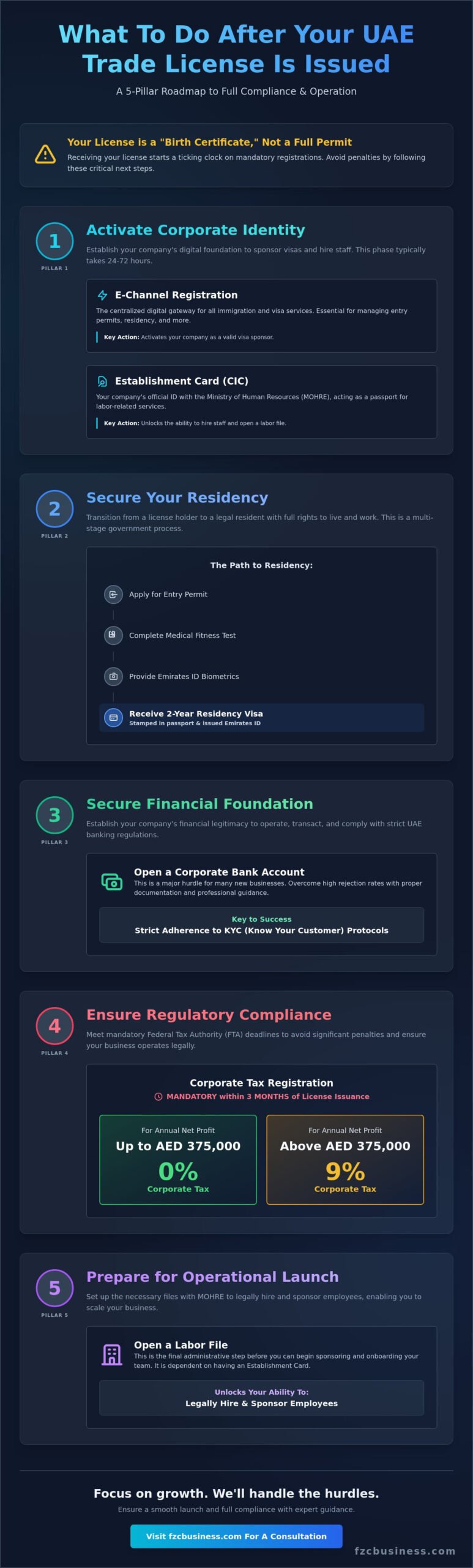
What if your brand-new UAE trade license is actually just a “birth certificate” rather than a full permit to operate? Many entrepreneurs believe the hard part is over once the license arrives, but the reality is that the clock starts ticking immediately on strict regulatory deadlines. You’re likely feeling the pressure of navigating E-Channel registrations, visa applications, and the mandatory three-month window for Corporate Tax registration. Knowing exactly what to do after your uae trade license is issued is the difference between a smooth launch and facing avoidable penalties from the Federal Tax Authority.
It’s natural to feel overwhelmed by the sequence of government registrations and the fear of missing tax deadlines. This guide provides a complete, chronological roadmap to move from receiving your license to being fully operational and compliant. We’ll outline our five-pillar activation strategy, covering everything from the AED 7,325 E-Channel setup to securing your 2-year residency visa. You’ll also learn the specific requirements for opening a corporate bank account and how to handle the 9% Corporate Tax threshold for income exceeding AED 375,000. By the end of this checklist, you’ll have the expert guidance needed to focus on growth while we handle the bureaucratic hurdles.
Key Takeaways
- Activate your firm’s digital identity by registering for the E-Channel system and obtaining an Establishment Card to facilitate all future government and visa services.
- Navigate the multi-stage residency process effectively, including medical fitness tests and Emirates ID issuance, to transition from a license holder to a legal UAE resident.
- Gain expert insights on what to do after your uae trade license is issued to overcome corporate bank account rejection through strict adherence to 2026 KYC protocols.
- Ensure full regulatory compliance by registering for Corporate Tax within the mandatory three-month window and identifying your eligibility for the 0% tax threshold.
- Prepare for a successful operational launch by opening a Labor File with the Ministry of Human Resources to sponsor employees and scale your business.
Activating Your Corporate Identity: E-Channel and Establishment Card
Receiving your trade license is a major milestone, but it doesn’t mean you’re ready to hire or reside in the country yet. Understanding what to do after your uae trade license is issued starts with activating your digital corporate identity. This phase involves two critical government registrations: the E-Channel system and the Establishment Card. These steps bridge the gap between having a legal entity and having the authority to sponsor visas or interact with the Ministry of Human Resources and Emiratisation (MOHRE). In the broader UAE economic landscape, these digital systems ensure transparency and efficiency for the thousands of new businesses launching every year.
The activation process typically takes between 24 and 72 hours following the issuance of your license. While the sequence is similar across the country, the specific portal you use depends on your jurisdiction. Mainland companies register directly with the Federal Authority for Identity and Citizenship (ICP), whereas Free Zone companies often process these through their respective authority’s portal. Skipping this phase will halt your residency application and prevent you from hiring staff, effectively leaving your business in a state of administrative limbo.
To better understand the initial steps of setting up your business, watch this helpful video:
Registering for the E-Channel System
The E-Channel system is the centralized digital gateway for all immigration and visa services in the UAE. It’s the platform where you’ll manage entry permits, residency renewals, and even fine payments. For many Free Zone jurisdictions, you’ll need to pay a refundable security deposit to activate this service. This is a standard requirement to ensure compliance with immigration rules. You’ll access this through the ICP portal or your Free Zone’s dedicated dashboard.
Don’t view this as just another fee. It’s a mandatory prerequisite for your own residency visa. Without an active E-Channel account, the system won’t recognize your company as a valid sponsor. This digital setup streamlines the entire immigration process, allowing for the smooth experience we promise at Fast Zone Business. Once registered, your company is officially visible to the immigration authorities, clearing the path for your visa medical and Emirates ID applications.
Obtaining Your Company Establishment Card
While the E-Channel handles immigration, the Establishment Card (also known as a CIC) connects your business with MOHRE. This card acts as the official ID card for your company within the labor system. You’ll need to submit a copy of your Trade License, the partner’s passport, and your Memorandum of Association (MOA) to complete this registration. The Establishment Card is the primary document allowing a company to hire staff. Without it, you cannot create labor contracts or open a labor file. This step ensures your business is recognized as a legitimate employer in the eyes of the UAE government, protecting both your rights and those of your future employees.
Navigating the Residency Visa and Emirates ID Process
Moving from being a legal entity owner to a legal resident is the next critical step in understanding what to do after your uae trade license is issued. This isn’t just a paperwork exercise; it’s a multi-stage government process that transforms your status from a visitor or license holder into a resident with full rights to live and work. According to World Bank Doing Business data, the UAE has consistently streamlined these administrative procedures to support the growing 4.6% annual increase in work visa approvals. In 2026, this process has become heavily digitized, but it still requires physical presence for health and security checks.
Entry Permit and Change of Status
Once your E-Channel is active, the Federal Authority for Identity, Citizenship, Customs & Port Security (ICP) issues your electronic entry permit. If you’re already in the country on a tourist or cancelled visa, you must perform an “In-Country” status change. This legalizes your presence under your new company without requiring you to fly out and back in. A common pitfall is delaying this step. If your current visa expires before the change of status is finalized, you’ll incur daily overstay fines. It’s vital to trigger this immediately after your license is active to ensure a smooth experience.
Medical Fitness and Biometrics
The next phase involves a mandatory medical fitness test at government-approved centers, such as those in Al Muhaisnah or Al Quoz in Dubai. This test screens for communicable diseases and is a non-negotiable requirement for all residency applicants. Following a successful medical result, you’ll attend a biometrics appointment at an ICP center. Here, they capture your fingerprints and eye scan for your physical Emirates ID card.
The 2026 digital-first approach means your digital ID is often available on the UAE Pass app within 24 hours of approval, even before the physical card arrives. Your Emirates ID is valid for 2 years and serves as your primary identification for everything from renting a home to opening a personal bank account. If you’re looking to save time, our visa and immigration services can expedite these appointments through dedicated PRO channels, helping you avoid the 14-day average wait times often discussed by independent applicants. Focusing on these steps ensures you’re legally protected as you begin your operational journey.
Securing Your Financial Foundation: Banking and VAT
Establishing a financial presence is often cited as the most difficult stage of the post-licensing journey. While government bodies issue licenses with impressive speed, banks operate under a different set of global risk parameters. Knowing what to do after your uae trade license is issued requires you to pivot from administrative setup to rigorous financial due diligence. In 2026, UAE banks have intensified their “Know Your Customer” (KYC) protocols to align with international anti-money laundering standards. This means you must present a transparent business model, a clear source of funds, and documented proof of your company’s physical presence.
Choosing the Right Corporate Bank Account
Traditional institutions like Emirates NBD and ADCB remain the preferred choice for established businesses requiring complex trade finance or high-limit credit facilities. These banks offer stability but often require a significant minimum average monthly balance and can take up to two months to fully approve an application. For a more agile start, many new entrepreneurs opt for digital neobanks like Wio or Mashreq Neo. These platforms prioritize a smooth experience, with account activation sometimes occurring in as little as two weeks for low-risk activities.
A major shift in the 2026 banking landscape is the strict enforcement of the physical office requirement. Most traditional banks now demand a valid Ejari (tenancy contract) or a physical office address before they’ll even consider an application. Virtual offices or simple flexi-desks are increasingly scrutinized and can lead to immediate rejection for certain business categories. For a deeper dive into which bank fits your specific profile and current turnover, consult our corporate bank account UAE guide for the latest bank comparisons and success rates.
Tax Registration with the Federal Tax Authority (FTA)
Your financial foundation isn’t complete without addressing Value Added Tax (VAT). The standard VAT rate in the UAE is 5%, and registration becomes mandatory once your taxable supplies and imports exceed AED 375,000 per annum. You don’t have to wait for that milestone; you can register voluntarily if your turnover is between AED 187,500 and AED 375,000. This is often a strategic move for B2B companies that want to reclaim VAT paid on their own business expenses.
Once the Federal Tax Authority approves your application, they’ll issue a Tax Registration Number (TRN). The TRN is the identifier required for all B2B transactions in the UAE. Without this number, you cannot legally issue tax invoices or claim input tax credits from your suppliers. Managing this process correctly from the start ensures you stay compliant and avoid the heavy fines associated with late registration. Our team provides expert guidance to ensure your tax setup is handled with precision, allowing you to focus on your core business goals.
Ensuring Regulatory Compliance: Corporate Tax and ESR
The UAE tax environment changed fundamentally on June 1, 2023, and by 2026, enforcement is at an all-time high. A critical part of what to do after your uae trade license is issued involves registering with the Federal Tax Authority (FTA) for Corporate Tax. Many business owners mistakenly believe that being in a Free Zone or having low turnover exempts them from the registration process. This is a costly assumption. Every legal entity must register, regardless of its tax liability or location. Compliance isn’t optional; it’s the foundation of your business’s longevity in the region.
Mandatory Corporate Tax Registration
New businesses incorporated on or after March 1, 2024, must register for Corporate Tax within three months of their incorporation date. If you miss this window, the FTA imposes a penalty of AED 10,000 for late registration. Under Federal Decree-Law No. 47 of 2022, a 9% tax rate applies to taxable income exceeding AED 375,000. While a 0% rate exists for income below this threshold and for “Qualifying Free Zone Persons,” you still need a Tax Registration Number (TRN) to file your annual return. Filing is mandatory even if your tax due is zero. This ensures the government has a clear record of your financial standing and eligibility for incentives.
UBO and ESR Compliance
Beyond tax, you must submit an Ultimate Beneficial Owner (UBO) declaration to the Department of Economy and Tourism (DET) or your specific Free Zone authority. This filing identifies the individuals who actually own or control at least 25% of the company. Failure to maintain an updated UBO register can lead to immediate license suspension and heavy administrative fines. It’s a security measure designed to maintain the UAE’s status as a transparent global business hub.
While separate Economic Substance Regulations (ESR) filings have been integrated into the Corporate Tax framework since January 1, 2023, businesses in sectors like shipping, banking, or intellectual property must still ensure their operations meet “adequate substance” criteria. This means you must prove that your core income-generating activities happen within the UAE. Managing these recurring deadlines requires specialized knowledge of the local regulatory calendar. Our PRO services take this burden off your shoulders by tracking filing dates and ensuring every document meets the latest government standards. Don’t risk your license’s standing on a missed deadline; book a free consultation today to secure your company’s compliance.
Operational Launch: Labor Files and Employee Sponsorship
The final phase of what to do after your uae trade license is issued is transitioning from a “Partner-only” entity to a fully functional employer. While your own residency is secure, you can’t legally hire staff until you establish a relationship with the Ministry of Human Resources and Emiratisation (MOHRE). This involves opening a Labor File. This file serves as the legal foundation for all future employment contracts and work permits. In the UAE, labor relations are highly regulated to ensure the protection of both parties. Failing to follow this sequence will stall your operational launch and prevent you from scaling your team.
Opening Your Labor File
Opening your labor file is the first step in the recruitment process. You must distinguish between your “Personal” file and the “Company” file. The company file is what allows the entity to sponsor others. Once this file is active, you’ll apply for an electronic quota. This quota determines how many employees your business can support based on your office space. Generally, the government allows for 100 square feet per employee, though this varies by jurisdiction. Our guide on how to start a business in Dubai includes a checklist for office space requirements to help you plan your hiring capacity effectively.
Wage Protection System (WPS) Setup
Compliance with the Wage Protection System (WPS) is mandatory for mainland companies and most free zone entities. The UAE government uses this electronic salary transfer system to monitor that employees are paid the correct amount on time. You’ll need to integrate your corporate bank account with the WPS portal. This is usually done through a dedicated exchange house or your bank’s online platform. It’s an efficient way to ensure transparency across the labor market and maintain a smooth experience for your staff.
Missing salary deadlines is a serious offense. If you don’t pay at least 80% of your total workforce’s salaries through WPS, the government may block your company’s labor file. This block stops you from renewing existing visas or issuing new ones. Monthly salary transfers must occur within specific windows to avoid administrative fines. Your employment contracts must also be fully compliant with the latest UAE Labour Law. These documents must clearly state the basic salary, allowances, and end-of-service benefits to be valid within the WPS framework. Following these steps ensures you remain compliant while allowing you to focus on your core business goals.
Launch Your UAE Business with Confidence
Launching your venture in the UAE is a significant achievement, but the real work begins with operationalizing your license. You now have a clear roadmap for what to do after your uae trade license is issued, from activating the E-Channel system to establishing your Labor File with MOHRE. It’s vital to remember that the 90-day deadline for Corporate Tax registration is a critical milestone that requires immediate attention to avoid the AED 10,000 late penalty. Each step in this checklist ensures your company remains in good standing with the Federal Tax Authority and the Ministry of Human Resources.
Fast Zone Business acts as your one-stop destination for these complex requirements. We offer expert guidance on 2026 Corporate Tax registration and provide hassle-free Emirates ID and visa processing for you and your team. As a trusted partner for UAE bank account opening, we help you navigate the strict KYC protocols that often stall new entrepreneurs. Our mission is to customize our services to meet your specific needs at every stage of your business journey.
Book a FREE Consultation with Fast Zone Business to handle your post-license compliance and ensure your business starts on solid ground. Your vision for growth deserves a foundation built on compliance and efficiency. We’re ready to help you turn your trade license into a thriving, fully operational reality. Your success in the UAE starts with the right partner by your side.
Frequently Asked Questions
Can I start my business immediately after getting the trade license?
No, the trade license is the legal birth of the company, but you need an active Establishment Card and E-Channel registration to operate fully. These administrative steps usually take 24 to 72 hours to complete. Once these are active, you can legally issue invoices and enter contracts. However, you must also prioritize your corporate bank account setup to manage transactions effectively and remain compliant with local regulations.
How long does it take to get an Emirates ID after the license is issued?
The process typically takes 10 to 14 days from the date of your medical fitness test. After your license is active, you’ll apply for an entry permit and undergo mandatory medical screening. Once your biometrics are captured at an ICP center, your digital Emirates ID is often available within 24 hours on the UAE Pass app. The physical card follows via courier shortly after the residency is approved.
Is it mandatory to open a corporate bank account in the UAE?
Yes, it’s a legal and practical necessity for business operations. UAE law requires companies to separate personal and business finances to ensure transparency and compliance with anti-money laundering regulations. Without a corporate account, you cannot register for the Wage Protection System (WPS) or pay your employees. It’s a critical step in knowing what to do after your uae trade license is issued to ensure financial legitimacy.
Do I need to register for Corporate Tax even if I am in a Free Zone?
Every legal entity in the UAE must register for Corporate Tax with the Federal Tax Authority. This requirement applies regardless of whether your business is in a Free Zone or on the mainland. Even if you qualify for the 0% tax rate on income up to AED 375,000, you must still obtain a Tax Registration Number (TRN) and file an annual tax return to remain compliant with Federal Decree-Law No. 47 of 2022.
What is the “Change of Status” process for UAE visas?
Change of Status is the legal procedure that transitions your current visa to your new residency visa without you leaving the country. If you’re currently in the UAE on a tourist or cancelled visa, you must apply for this adjustment once your new entry permit is issued. This step officially activates your new residency status, allowing you to proceed with your medical fitness test and biometrics without the need for an exit-entry flight.
Can I sponsor my family as soon as my trade license is issued?
You can begin the family sponsorship process once your own residency visa is stamped and your Emirates ID is processed. To sponsor dependents, you must meet the minimum monthly salary requirement of AED 4,000, or AED 3,000 if accommodation is provided. You’ll also need a registered tenancy contract in your name. This ensures you have the adequate financial and housing stability required by the GDRFA for your dependents.
What happens if I don’t register for VAT on time?
Late registration for VAT results in an immediate administrative penalty of AED 10,000. This fine applies if your business exceeds the mandatory threshold of AED 375,000 in taxable supplies and fails to notify the Federal Tax Authority within 30 days. Beyond the initial fine, you may face additional penalties for late filing and non-payment of tax due. Proactive registration is essential for maintaining a smooth experience with the tax authorities.
How do I open a Labor File to hire my first employee?
You must apply for a Labor File through the Ministry of Human Resources and Emiratisation (MOHRE) portal. This requires your trade license, establishment card, and the passport copies of the company partners. Once the file is open, you can apply for employment quotas based on your office size. This is a vital part of what to do after your uae trade license is issued to transition from a partner-only entity to an active employer.