
Tax Implications of Moving Business to UAE from UK: 2026 Strategy Guide
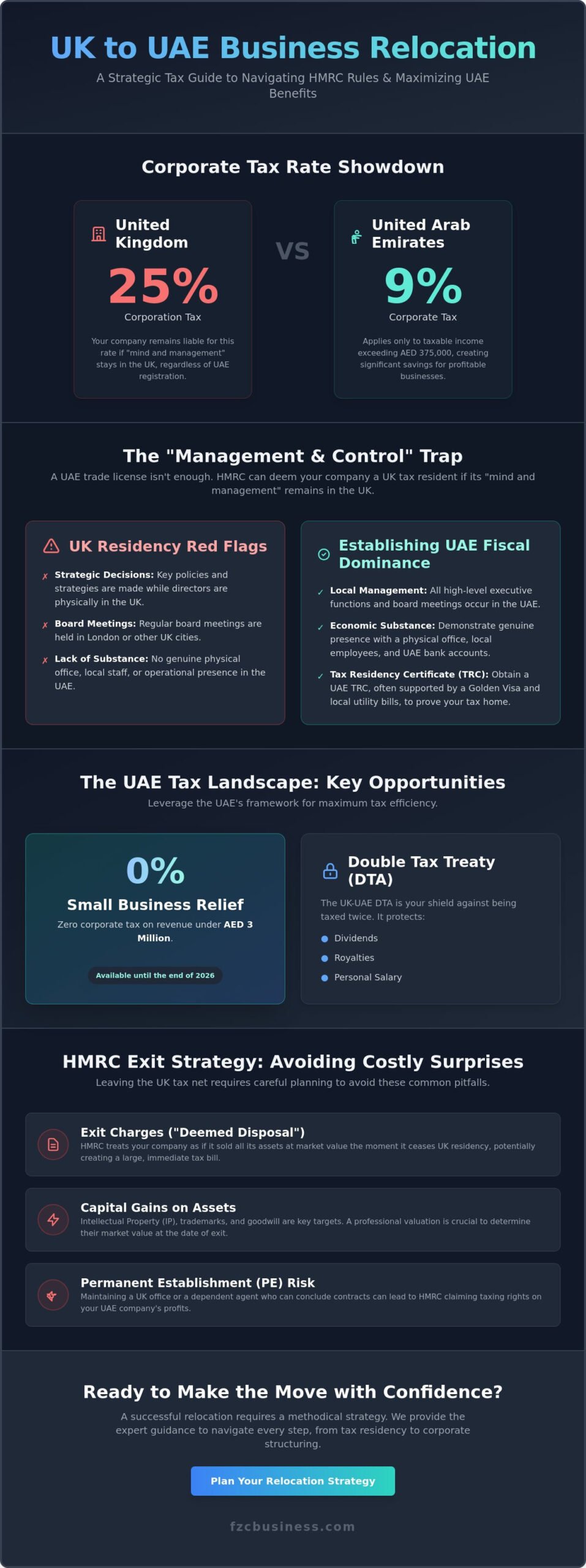
Registering a company in Dubai won’t protect you from a 25% UK corporation tax bill if your “mind and management” remains in London. To truly benefit from a relocation, you must master the tax implications of moving business to uae from uk before you book your flight. While the UAE’s 9% corporate tax rate on income above AED 375,000 is a powerful draw, HMRC’s exit rules and residency tests require a methodical approach to ensure a smooth experience.
You’re right to feel concerned about the complexities of Permanent Establishment risk and the UK’s five year “Boomerang Trap” for capital gains. We’ll show you how to navigate these hurdles and leverage the UK-UAE Double Tax Treaty for maximum efficiency. This strategy guide provides a clear roadmap for establishing tax residency, choosing the right corporate structure, and utilizing the Small Business Relief that allows for zero taxable income on revenue under AED 3 million until the end of 2026. You’ll gain the in-depth knowledge needed to move your operations with total confidence.
Key Takeaways
- Master the “Management and Control” test to ensure your business is legally recognized as a UAE entity and avoids unintended UK tax residency.
- Navigate the tax implications of moving business to uae from uk by planning for HMRC exit charges and asset disposal rules before your relocation.
- Leverage the 2026 UAE tax framework, including the 9% corporate tax threshold and Small Business Relief for companies earning under AED 3 million.
- Apply the UK-UAE Double Taxation Agreement tie-breaker rules to protect your dividends, royalties, and personal salary from being taxed twice.
- Choose the optimal jurisdiction between Mainland and Free Zone to align your corporate structure with your long-term residency and growth goals.
Understanding Tax Residency: UK vs. UAE Jurisdictions
A UAE trade license is a powerful tool, but it isn’t a magic shield against HMRC. Many entrepreneurs assume that registering a company in a Dubai Free Zone automatically removes them from the UK tax net. This is a dangerous misconception. To truly benefit from the tax implications of moving business to uae from uk, you must legally shift your business’s “tax seat” to the Middle East. HMRC uses the Statutory Residence Test (SRT) to determine if you’ve actually left the UK. If you maintain too many “ties” such as a home or regular work days in Britain, you might find yourself taxed as a UK resident on your global income regardless of where your company is registered.
The Management and Control Trap
HMRC can deem a foreign-registered company as a UK tax resident if its “mind and management” remains in the UK. This often happens when directors continue to make strategic decisions or hold board meetings while physically present in London. Central Management and Control is defined by UK case law as the location where the highest level of strategic decisions and policy making actually occurs. To protect your business, you must ensure that all key executive functions happen in the Emirates. This is where Economic Substance Regulations (ESR) come into play. You need to demonstrate genuine substance by having a physical office, local staff, and local board meetings to maintain international tax credibility and avoid being pulled back into the UK’s 25% corporation tax bracket.
Establishing UAE Fiscal Dominance
Securing a Golden Visa is one of the most effective ways to anchor your residency and simplify the tax implications of moving business to uae from uk. This long-term visa status provides the stability needed to apply for a UAE Tax Residency Certificate (TRC). Within the 2026 UAE Tax Landscape, the TRC acts as a vital document to invoke the Double Taxation Agreement. It proves to HMRC that you’re a tax resident of the UAE, not the UK. You’ll need to show documented evidence of your life in Dubai, such as utility bills and lease agreements, to satisfy treaty requirements. By moving your “fiscal dominance” to the UAE, you ensure your business profits are subject to the UAE’s 9% corporate tax regime rather than the significantly higher UK rates. The UAE determines corporate residency based on the place of incorporation or where the business is effectively managed locally, ensuring both Mainland and Free Zone entities can qualify for these benefits if they maintain proper substance.
HMRC Exit Strategy: Avoiding Unexpected UK Tax Bills
Leaving the UK tax net requires more than just a one-way ticket to Dubai. When a company ceases to be a UK tax resident, HMRC triggers “Exit Charges” that can catch unprepared directors off guard. This process essentially treats the company as having sold all its assets at fair market value immediately before the move. Understanding the tax implications of moving business to uae from uk means preparing for this “Deemed Disposal” to ensure your relocation doesn’t create a dry tax charge on profits you haven’t actually realized yet.
The 2026 tax year brings additional layers of complexity with the overhaul of the Foreign Income and Gains (FIG) regime. While the Temporary Repatriation Facility allows for a 12% flat rate on remitted funds for some, migrating a corporate structure requires a clean break to avoid ongoing liabilities. You must align your departure with the UAE Corporate Tax Law to ensure that once you exit the UK, you’re immediately protected by the UAE’s competitive 9% regime.
Capital Gains and Asset Migration
Intellectual property (IP), trademarks, and goodwill are the primary targets for HMRC during a migration. If your UK company owns a valuable brand or software code, moving that asset to a UAE entity is viewed as a disposal. You’ll need a professional valuation to establish the market price at the date of exit. Keeping a “branch” in the UK while the headquarters moves to Dubai might seem like a safe middle ground, but it often results in the worst of both worlds: full UK corporation tax on branch profits and complex reporting requirements. A clean break is usually the most tax-efficient path for long-term growth.
The Permanent Establishment (PE) Risk
Even if your company is registered in Dubai, HMRC can claim taxing rights if you maintain a “Permanent Establishment” in the UK. This risk is high if you keep a physical office or employ a “dependent agent” in Britain who has the authority to conclude contracts on your behalf. To avoid this, your business setup in Dubai mainland must have its own physical substance, including dedicated office space and local management. Servicing UK clients from Dubai is perfectly legal, provided the decision-making and contract execution happen within the Emirates. If you’re unsure about your current exposure, you can book a free consultation to evaluate your specific corporate structure and ensure your move remains hassle-free.
The 2026 UAE Tax Landscape: Corporate Tax and VAT
The UAE’s tax regime is no longer a “zero-tax” environment, but it remains one of the most competitive jurisdictions globally for British entrepreneurs. Understanding the tax implications of moving business to uae from uk requires a firm grasp of the thresholds introduced in June 2023. While the UK’s corporation tax sits at 25% for profits over £250,000, the UAE offers a significantly lower 9% rate. This rate only applies to taxable income exceeding AED 375,000 (approximately £80,000). For many small and medium enterprises, this creates a massive opportunity for capital reinvestment and growth.
Beyond corporate levies, the UAE maintains a highly attractive personal tax environment. You’ll benefit from the following fiscal advantages:
- 0% Personal Income Tax: There’s no tax on salaries, dividends, or personal investment gains, contrasting sharply with the UK’s 45% additional rate.
- 5% Value Added Tax (VAT): VAT registration is only mandatory if your taxable turnover exceeds AED 375,000. Most cross-border services provided from the UAE to UK clients are zero-rated as exports.
- Small Business Relief (SBR): If your revenue stays below AED 3 million, you can elect to be treated as having zero taxable income until the end of 2026.
9% Corporate Tax vs. UK 25% Rate
The effective tax savings are substantial when you compare a business generating £200,000 in annual profit. In the UK, you’d face a tax bill of £50,000 at the 25% rate. In the UAE, the first AED 375,000 is taxed at 0%. Based on current exchange rates, only the remaining profit (roughly AED 555,000) is taxed at 9%, resulting in a bill of approximately £10,750. This represents a saving of nearly £40,000 per year. Businesses operating as a “Qualifying Free Zone Person” (QFZP) can even access a 0% rate on qualifying income, provided they maintain adequate substance and produce audited financial statements.
Withholding Tax and Dividend Repatriation
Repatriating profits to the UK is a major concern for relocating founders. The UAE currently maintains a 0% withholding tax rate on dividends and interest payments made to non-residents. Under the UK-UAE Double Taxation Agreement, these dividends are typically protected from being taxed again in the UK, provided your residency status is correctly structured. As of May 2026, the UAE government has confirmed that the withholding tax rate remains at 0% for all corporate entities. This allows for the seamless flow of capital between your Dubai headquarters and your personal global accounts without losing a significant percentage to bureaucratic “leakage.”
The UK-UAE Double Taxation Agreement (DTA) Explained
The UK-UAE Double Taxation Agreement (DTA) acts as the legal referee between HMRC and the UAE’s Federal Tax Authority. Its primary purpose is to ensure that the same income isn’t taxed in both jurisdictions. When you analyze the tax implications of moving business to uae from uk, the DTA provides the “Tie-Breaker” rules that determine your residency status if both countries claim you as a taxpayer. These rules prioritize where you have a permanent home, followed by your “center of vital interests” (personal and economic ties). If your life is firmly rooted in Dubai, the treaty prevents the UK from taxing your UAE-sourced salary and business profits.
For your corporate structure, the treaty hinges on the “Place of Effective Management” (POEM) clause. Even if a company is incorporated in the UAE, it can be deemed a UK resident if its effective management happens in Britain. To win this argument, you must prove that the real strategic decisions occur within the Emirates. This protection extends to royalties and technical fees, which are often subject to reduced or zero withholding tax rates under the treaty, allowing for efficient cross-border operations.
Claiming Treaty Benefits
You don’t automatically receive treaty protection; you must actively claim it. This starts with obtaining a Tax Residency Certificate (TRC) from the UAE’s Federal Tax Authority. To secure this, you’ll need to demonstrate financial substance. Successfully opening a corporate bank account in the UAE is a critical step in this process. It provides the documented trail of local transactions and management that HMRC requires to accept your departure. When filing your UK tax return, you’ll use these documents to claim relief under the DTA, ensuring your UAE income is excluded from UK calculations. If you need help navigating these requirements, you can book a free consultation to ensure your setup meets all treaty standards.
Social Security and National Insurance
Moving your business to the UAE significantly changes your social security obligations. The UAE does not levy social security taxes on expatriate employees or business owners. In contrast, your UK National Insurance (NI) contributions typically stop once you’ve successfully broken residency. However, many entrepreneurs choose to continue making voluntary Class 2 or Class 3 NI contributions. This ensures you maintain your 35 year record required for a full UK state pension. While you’ll enjoy a 0% social security environment in Dubai, planning these voluntary payments allows you to protect your long term UK benefits while maximizing your current take home pay.
Executing Your Relocation: The Fast Zone Roadmap
Transitioning your corporate headquarters from London to Dubai requires more than just paperwork; it demands a strategic roadmap. While the previous sections detailed the legal theory, execution is where many entrepreneurs encounter friction. Properly managing the tax implications of moving business to uae from uk involves a synchronized approach to licensing, residency, and local tax registration. By following a methodical path, you can ensure your business remains compliant with both the UK’s exit requirements and the UAE’s evolving regulatory framework.
Your relocation begins with choosing the right jurisdiction, a decision that dictates your future tax filing obligations. Whether you opt for a mainland entity or a free zone, you’ll need to secure a Golden Visa or an Investor Visa to anchor your personal tax residency. This status is vital for proving to HMRC that your life and business have genuinely moved. Fast Zone Business provides expert guidance through every stage, from initial government approvals to PRO services, ensuring a smooth experience that lets you focus on growth rather than red tape.
Mainland vs. Free Zone: Tax Implications
The choice between jurisdictions often hinges on your client base and substance requirements. A Free Zone company setup is typically the preferred route for UK entrepreneurs serving international markets. These zones allow for “Qualifying Free Zone Person” status, which can grant a 0% corporate tax rate on qualifying income, provided you maintain audited accounts and physical substance. Mainland setups, however, are often favored for businesses that require a physical UK presence or a local branch, as they provide the most robust access to the UAE-UK Double Tax Treaty and carry fewer restrictions on domestic trade.
Your First 90 Days in the UAE
The first three months of your relocation are critical for establishing your fiscal presence. You don’t want to leave your tax status to chance. Follow this essential checklist to solidify your move:
- Emirates ID and Residency: Complete your medical tests and biometrics to secure your residency visa.
- Corporate Bank Account: Establish local banking to facilitate business operations and prove “Management and Control.”
- FTA Registration: Register for Corporate Tax and VAT (if you meet the AED 375,000 threshold) within the mandatory government deadlines.
Fast Zone Business acts as your “one-stop destination” for this entire transition, handling the bureaucratic hurdles of government departments on your behalf. Our team ensures that your setup is not just fast, but fully optimized for long-term tax efficiency. Don’t let complex regulations slow your progress. To get started with a customized relocation plan, book a FREE consultation with our experts today and take the first step toward a hassle-free business future in the UAE.
Secure Your Global Business Future in the UAE
Relocating your corporate headquarters to the Emirates is a strategic leap that requires technical precision. Success depends on more than just registration; you must establish genuine substance and manage the “Place of Effective Management” to satisfy both HMRC and the UAE Federal Tax Authority. By leveraging the 9% corporate tax regime and the protections of the UK-UAE Double Taxation Agreement, you’re positioning your enterprise for unparalleled growth. Navigating the tax implications of moving business to uae from uk effectively ensures you avoid the “Boomerang Trap” and unexpected exit charges that often catch the unprepared.
Fast Zone Business serves as your one-stop destination for this transition. We provide expert guidance on choosing between Mainland and Free Zone setups while specializing in Golden Visa and Investor residency applications. Our team handles the complex PRO services and banking support to ensure your experience is efficient and smooth. You can focus on your core business goals while we manage the bureaucratic hurdles and ensure your structure is optimized for 2026 and beyond.
Start Your Business Relocation to Dubai with Fast Zone Business today. Your path to a tax-efficient, global headquarters in the world’s most competitive market is ready for you.
Frequently Asked Questions
Do I still pay UK tax if I live in Dubai but my company is in the UK?
Yes, a UK-incorporated company remains a UK tax resident and is subject to the 25% corporation tax on its global profits. Even if you reside in Dubai, the entity’s location of incorporation keeps it within the UK tax net. You must formally migrate the company’s “tax seat” or manage it entirely from the UAE to change this status. This involves proving that all strategic management and control have shifted to the Emirates.
Will the UAE 9% Corporate Tax apply to my UK-sourced income?
The 9% UAE corporate tax applies to the global income of a UAE resident company, including profits earned from UK clients. This tax only applies to taxable income exceeding the AED 375,000 threshold. Understanding the tax implications of moving business to uae from uk helps you utilize the Double Taxation Agreement. This ensures you aren’t paying twice on the same revenue while benefiting from the UAE’s lower effective rates.
How long do I need to stay in the UAE to be considered a tax resident?
You generally need to spend at least 183 days in the UAE within a 12 month period to qualify for a Tax Residency Certificate. However, you can also qualify by spending 90 days in the country if you hold a valid residency visa and have a permanent place of residence. This shorter 90 day window is a vital tool for entrepreneurs who need to travel internationally while maintaining their fiscal seat in Dubai.
Can HMRC tax my Dubai salary if I visit the UK for more than 90 days?
HMRC can tax your global income if you fail the Statutory Residence Test (SRT). While 90 days is a common benchmark, your status depends on your “ties” to the UK, such as family, accommodation, or work days. Exceeding 90 days in a tax year significantly increases the risk of being classified as a UK resident. This could subject your tax-free Dubai salary to UK income tax rates reaching 45%.
What is the “Exit Charge” for moving my UK company to the UAE?
The “Exit Charge” is a tax on the unrealized capital gains of your company’s assets at the time of migration. HMRC treats the move as a “deemed disposal,” meaning you’re taxed as if you sold your intellectual property, goodwill, and equipment at market value. Proper valuation before you leave is essential to avoid unexpected bills during the tax implications of moving business to uae from uk.
Do I need a physical office in Dubai to qualify for the 0% or 9% tax rates?
Yes, maintaining a physical office is a core requirement for Economic Substance Regulations (ESR) in the UAE. To qualify for the 0% rate as a “Qualifying Free Zone Person,” you must demonstrate “adequate substance,” which includes having a physical presence and local management. Mainland companies also require a physical office to secure their trade license and satisfy the Federal Tax Authority’s compliance standards for 2026.
Is it better to start a new company in Dubai or move my existing UK entity?
Starting a new UAE entity is usually the most efficient and “hassle-free” approach for British entrepreneurs. Moving an existing UK company involves complex “migration of residency” rules and heavy exit charges on your accumulated goodwill. By establishing a fresh entity in a Free Zone or Mainland, you create a clean break from the UK system. This simplifies your accounting and ensures you start with a structure fully optimized for the UAE’s 2026 tax landscape.