
Top UAE Offshore Company Benefits: The 2026 Strategic Guide
What if the most effective way to protect your global wealth in 2026 is by choosing a jurisdiction that actually welcomes regulation? You’ve probably noticed that the UAE corporate landscape has shifted significantly since the 2023 tax laws took effect. It’s natural to feel overwhelmed by the 9% corporate tax rate or the strict Ultimate Beneficial Ownership (UBO) requirements that now apply to the 1.4 million companies operating in the Emirates. However, understanding the core uae offshore company benefits is still the key to achieving legitimate tax optimization and robust asset security.
We’re here to help you master the strategic advantages of UAE offshore structures, ensuring your business remains a powerful global holding vehicle that balances privacy with international standards. You’ll learn how to navigate the AED 375,000 tax threshold and how to utilize Small Business Relief before the December 31, 2026, deadline. This guide provides a clear roadmap to securing a corporate bank account and maintaining Qualifying Free Zone Person status so you can focus on growth instead of red tape.
Key Takeaways
- Understand the critical structural differences between offshore and free zone entities to choose the most cost-effective vehicle for your international trade.
- Learn how to legally maintain a 0% tax rate on all foreign-sourced income by staying outside the scope of the standard UAE Corporate Tax regime.
- Explore the core uae offshore company benefits including high-level confidentiality and robust asset shielding to protect your global wealth from external liabilities.
- Identify the specific advantages of RAK ICC and JAFZA jurisdictions to determine which setup aligns with your long-term expansion and banking requirements.
- Master a streamlined, hassle-free approach to offshore registration that eliminates the need for physical office space or local residency.
What is a UAE Offshore Company in 2026?
A UAE offshore company is a non-resident legal entity that allows you to manage international assets and business operations without being physically based in the country. It’s a strategic tool for those seeking specific uae offshore company benefits like privacy and asset shielding. In 2026, the UAE has solidified its position as a global financial hub with over 1.4 million active companies. This structure is distinct from “onshore” entities because offshore firms can’t conduct business within the UAE borders or apply for residency visas for their staff. This separation is a fundamental part of UAE corporate structures, ensuring that these entities remain strictly for international operations and global wealth management.
One of the most significant uae offshore company benefits is the jurisdiction’s “white-listed” status. Unlike many traditional tax havens that face international scrutiny, the UAE maintains high transparency standards and adheres to global anti-money laundering protocols. This reputation makes it easier for offshore entities to engage in cross-border trade and maintain credible banking relationships worldwide. It provides a balance of high-level confidentiality while remaining fully compliant with international regulatory frameworks.
RAK ICC vs. JAFZA: Choosing Your Base
Choosing between the Ras Al Khaimah International Corporate Centre (RAK ICC) and the Jebel Ali Free Zone (JAFZA) depends on your specific goals. RAK ICC is the go-to choice for cost-conscious entrepreneurs. First-year registration fees here typically range from AED 10,000 to AED 15,000. It offers a smooth experience for setting up international holding companies quickly. JAFZA, with setup costs starting at approximately AED 14,000, is the premium alternative. It’s the only offshore jurisdiction that permits the company to own real estate within Dubai, making it essential for high-net-worth investors. If you need expert guidance on which jurisdiction fits your 2026 strategy, selecting the right base is the first step toward a hassle-free setup.
Permitted Activities for Offshore Entities
Offshore companies aren’t just shells; they’re versatile tools for global business. Common activities allowed under this structure include:
- International trading and professional consulting services.
- Acting as a holding company for subsidiaries in other countries.
- Owning and managing intellectual property like trademarks or patents.
- Managing global real estate portfolios, though property ownership within the UAE is restricted to specific JAFZA structures.
While these companies can’t trade directly with UAE residents or rent physical office space in the country, they’re perfect for entrepreneurs who want to centralize their global operations. The 5.6% projected economic growth for the UAE in 2026 further strengthens the stability of the environment where your holding company is registered.
Tax Efficiency and Financial Benefits in the Corporate Tax Era
The UAE corporate tax landscape changed significantly on June 1, 2023, with the introduction of a 9% tax on taxable income exceeding AED 375,000. While this marked a shift from a “tax-free” to a “tax-efficient” jurisdiction, the core uae offshore company benefits remain intact for international investors. Most offshore entities that generate 100% of their income from outside the UAE borders continue to enjoy a 0% corporate tax rate. This makes the offshore structure a premier choice for global holding companies and international traders who don’t require a physical presence in the Emirates.
VAT is another win for offshore owners. Since these companies aren’t permitted to trade within the UAE, they generally fall outside the scope of the 5% Value Added Tax. There are also no withholding taxes on dividends, royalties, or capital gains. You can repatriate 100% of your profits and capital to your home country without local restrictions. This high degree of financial freedom is a major reason why entrepreneurs rely on this Guide to UAE company formation to build their global wealth strategies.
Navigating the 2026 Corporate Tax Landscape
Compliance is non-negotiable in 2026. While the 0% rate applies to foreign income, you must still register with the Federal Tax Authority (FTA) if your business meets specific criteria. Small Business Relief is a vital tool for those with revenue under AED 3 million, but it’s only available for tax periods ending on or before December 31, 2026. Additionally, the “de minimis” rule allows certain entities to earn a small amount of non-qualifying income, up to 5% of total revenue or AED 5 million, without losing their tax-exempt status. If you want to ensure your structure is fully compliant, you can book a free consultation with our team for expert guidance on these evolving rules.
Double Taxation Avoidance Agreements (DTAA)
The UAE has built a powerful network of over 100 tax treaties to prevent international investors from being taxed in two countries on the same income. These DTAAs are a significant part of the uae offshore company benefits, allowing you to shield your global assets from aggressive tax authorities in your home jurisdiction. By obtaining a Tax Residency Certificate, you can prove your status in the UAE and leverage these treaties to minimize your global tax burden. This strategic layer transforms a standard offshore company into a sophisticated vehicle for long-term wealth preservation and international expansion.
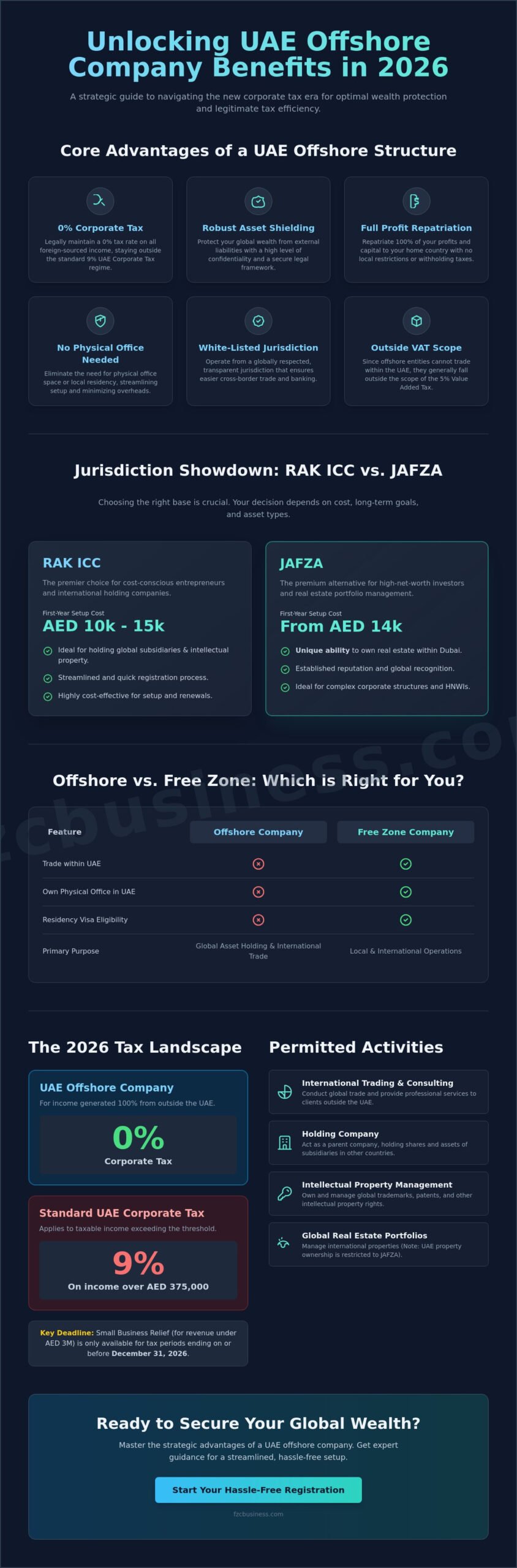
Offshore vs. Free Zone: Which Structure is Right for You?
Choosing between an offshore entity and a free zone company is a pivotal decision for your 2026 business strategy. Both structures allow 100% foreign ownership, but they serve completely different operational purposes. While a free zone company is a resident entity with the right to trade within its specific zone, an offshore company is strictly a non-resident vehicle. This distinction is the foundation of uae offshore company benefits, as it allows for a leaner, more cost-effective setup for those who don’t need a physical footprint in the Middle East.
The most immediate difference lies in physical infrastructure. Free zone companies must lease at least a “flexi-desk” or a physical office to maintain their license. In contrast, offshore companies require no office space at all. They use the address of their registered agent, such as Fast Zone Business, as their legal domicile. This absence of rent significantly lowers your long-term operational costs. However, you must remember that offshore structures do not qualify for UAE residency visas. If your goal is to live in Dubai or sponsor employees, a free zone setup is the only viable path.
Business scope also varies. An offshore company is designed for international trade, global consultancy, or holding assets. It cannot trade directly with UAE mainland companies or provide services within the country. Free zone entities have more flexibility, allowing for local trade through a distributor and the ability to hire a local workforce. With over 1.4 million companies now operating in the UAE, selecting the right jurisdiction is about matching your structure to your 2026 growth targets.
When to Choose an Offshore Company
An offshore structure is the ideal choice if you’re looking to manage a global intellectual property portfolio or hold shares in subsidiaries across different continents. It’s the most efficient way to access uae offshore company benefits like asset shielding and high-level privacy without the overhead of a physical office. This is perfect for digital nomads and international consultants who don’t need to live in the UAE. To see how this compares to other options, read our guide on Free Zone Company Setup in the UAE.
When a Free Zone Setup is Superior
A free zone setup is superior if you require a UAE residency visa for yourself or your family. It’s also necessary if you plan to store physical goods in a warehouse or conduct business within the Emirates’ thriving local markets. While the initial setup and annual renewals are higher than offshore costs, the ability to operate locally and gain residency provides a different set of strategic advantages. For a step-by-step breakdown of this process, check out our guide on How to Start a Business in Dubai.
Asset Protection, Privacy, and Global Banking
Operating from a globally recognized financial hub provides a distinct reputational advantage that traditional tax havens simply can’t match. In 2025 alone, approximately 250,000 new companies were registered in the UAE, signaling massive international trust in the country’s legal framework. One of the standout uae offshore company benefits is the high level of confidentiality provided to business owners. Unlike many jurisdictions, company registries in RAK ICC and JAFZA are not accessible to the general public. This ensures that your corporate data and ownership details remain private while you conduct global operations.
Asset shielding is another critical pillar of the offshore structure. By placing global wealth into a UAE offshore entity, you create a robust legal wall between your personal assets and potential creditors or lawsuits. This structure is particularly effective for succession planning. It allows for the smooth inheritance of assets and shares without the complications of lengthy probate court proceedings in multiple countries. With nearly 37,794 trademarks registered in 2025, a 74% increase over four years, the UAE has proven it’s a secure environment for protecting intellectual property and corporate holdings alike.
Corporate Bank Account Opening for Offshore Firms
Opening a corporate bank account in 2026 requires a methodical approach due to heightened global compliance standards. While it’s more complex than in previous years, a successful application is entirely achievable with the right documentation. You’ll need to provide your Memorandum of Association (MOA), Articles of Association (AOA), and clear proof of your source of funds. Banks prioritize transparency and look for a clear business logic behind the offshore setup. For a detailed breakdown of the current banking requirements, see our Corporate Bank Account UAE Guide. Our team provides the expert guidance needed to ensure your application is processed through a smooth experience.
Confidentiality and Compliance (CRS & FATCA)
The UAE effectively balances owner privacy with international reporting obligations like the Common Reporting Standard (CRS) and FATCA. While your information isn’t public, the UAE authorities maintain an Ultimate Beneficial Owner (UBO) register. A UBO is defined as any natural person who ultimately owns or controls 25% or more of the company’s shares. Staying compliant with these regulations is essential for the long-term stability of your firm. By adhering to these standards, you enjoy the core uae offshore company benefits while maintaining a clean record that satisfies global tax authorities. If you’re ready to secure your assets under a trusted structure, start your business in Dubai UAE with our specialized offshore setup services today.
How to Set Up Your UAE Offshore Company Hassle-Free
Setting up a business in a foreign country can be daunting, but the UAE has streamlined its offshore registration to be as efficient as possible for international investors. By following a structured, methodical approach, you can unlock all the uae offshore company benefits without getting bogged down in administrative bureaucracy. The process is designed to be completed remotely, meaning you don’t need to be physically present in the Emirates to establish your legal entity.
The first step is selecting the right jurisdiction. As we explored in earlier sections, RAK ICC is generally the most cost-effective choice for international holding companies, while JAFZA is the required path for those holding Dubai-based real estate. Once your jurisdiction is set, you’ll need to choose and approve a unique company name. The authorities typically require at least three name options to ensure your final choice doesn’t conflict with existing registrations or sensitive terminology. After name approval, you must draft your Memorandum and Articles of Association (MOA and AOA). These documents are the legal backbone of your firm, detailing the share structure and operational rules.
The final step involves the submission of all documents. In the UAE, offshore companies must be registered through a licensed agent. You cannot submit these applications directly to the registrar. This is where a partner like Fast Zone Business becomes essential. We handle the communication with government bodies and ensure your file is complete before submission, which is the key to a smooth experience.
The Fast Zone Advantage: Your Registered Agent
Choosing the right registered agent is the difference between a fast setup and a long, drawn-out ordeal. Fast Zone Business acts as your one-stop destination, providing expert guidance on complex tasks like document attestation and government approvals. We understand the specific nuances of the 2026 regulatory landscape, including the latest anti-money laundering (AML) and UBO requirements. Our team manages the entire process, from the initial filing to providing the PRO support needed for banking introductions. This comprehensive model allows you to focus on your core business goals while we manage the technical hurdles.
Timeline and Next Steps
Speed is a hallmark of the UAE’s corporate environment. You can typically expect your company registration to be finalized within 3 to 7 working days once all documents are signed and submitted. However, your responsibilities don’t end at registration. To keep enjoying uae offshore company benefits, you must stay on top of annual maintenance. This includes license renewals, compliance checks, and ensuring your UBO register is up to date. If you’re ready to secure your financial future, book your FREE Consultation at Fast Zone Business to begin your journey today.
Secure Your Global Assets in 2026
Establishing a non-resident entity remains a premier strategy for international wealth management and business expansion. You’ve seen how choosing between RAK ICC and JAFZA allows you to tailor your setup to your specific needs, whether you’re holding global intellectual property or Dubai real estate. By staying outside the scope of the standard 9% corporate tax on foreign-sourced income, you can maximize your uae offshore company benefits while maintaining full international compliance. The combination of high-level privacy and access to the UAE’s network of 100+ tax treaties provides a level of security that traditional jurisdictions simply can’t match.
Fast Zone Business is here to ensure your registration is a smooth experience from start to finish. As a registered agent for both JAFZA and RAK ICC, we’ve provided expert guidance to over 1000+ entrepreneurs navigating the complex 2026 tax landscape. Don’t let bureaucratic hurdles delay your global expansion goals. Book a FREE Consultation with our Experts today to begin your journey toward a secure and tax-efficient future. Your success in the UAE starts with the right partner by your side.
Frequently Asked Questions
What are the main benefits of a UAE offshore company?
The primary uae offshore company benefits include 100% foreign ownership, zero tax on foreign-sourced income, and robust asset protection. These entities allow you to manage international business operations and hold global assets with a high degree of privacy. Because the UAE is a white-listed jurisdiction, your company maintains a strong reputational advantage when dealing with international vendors and clients.
Can an offshore company in the UAE get a residency visa?
No, a UAE offshore company does not qualify the owner or employees for a residency visa. It’s a non-resident legal structure designed for international business rather than local operations. If you need a UAE residency visa or a Golden Visa, you’ll need to establish a Free Zone or Mainland company instead. This distinction is vital for entrepreneurs planning to relocate to the Emirates in 2026.
Is a UAE offshore company exempt from corporate tax in 2026?
Yes, offshore companies are generally exempt from the 9% corporate tax if their income is 100% foreign-sourced. Since these entities can’t trade within the UAE, they usually stay outside the scope of the tax regime introduced on June 1, 2023. However, you must still maintain accurate financial records and comply with the Federal Tax Authority’s reporting standards for non-resident entities to ensure your 0% status remains secure.
Can I open a bank account for a UAE offshore company?
You can open a corporate bank account, but the process involves strict compliance checks in 2026. Banks require detailed documentation, including your Memorandum of Association and clear proof of the source of your funds. While it’s more rigorous than opening a personal account, working with a registered agent helps streamline the application. Most successful applicants have a clear business logic and transparent ownership structure.
What is the difference between a UAE offshore company and a Free Zone company?
The main difference lies in residency and the scope of business activities. A Free Zone company is a resident entity that requires a physical office and provides residency visas. An offshore company is a non-resident entity with no office requirement and no visa eligibility. While both allow 100% foreign ownership, the offshore structure is strictly for international trade, whereas Free Zone firms can operate within their specific zones.
Do I need a physical office for a UAE offshore company?
No, a physical office is not required for an offshore setup in the UAE. Your company will use the address of your registered agent, such as Fast Zone Business, as its legal headquarters. This significantly reduces your annual overhead costs compared to Free Zone or Mainland companies. It’s an efficient solution for digital nomads and holding companies that don’t need a physical footprint in the country.
Is the owner’s information public for a UAE offshore company?
No, the UAE maintains high levels of confidentiality, and company registries for offshore jurisdictions are not public. While the authorities require an Ultimate Beneficial Owner (UBO) register for compliance with anti-money laundering laws, this data is not accessible to the general public. This is one of the most sought-after uae offshore company benefits for high-net-worth individuals seeking privacy for their global holdings.
Which is better for asset protection: RAK ICC or JAFZA?
Both jurisdictions offer excellent asset shielding, but JAFZA is the better choice if you intend to own real estate in Dubai. RAK ICC is typically preferred for its cost-effectiveness and speed when setting up international holding companies or managing intellectual property. Your choice should depend on your specific asset types and long-term investment strategy. Both provide a secure legal environment that protects your wealth from external creditors and legal liabilities.