

UAE Business Legal Structures Explained: The 2026 Entrepreneur’s Guide
What if the 100% ownership you secured on the Mainland actually makes your 2026 corporate bank account application more difficult? Since the 2021 update to the UAE Commercial Companies Law, many entrepreneurs believe the choice is now simple, but the reality involves deeper operational nuances that affect your bottom line. You likely feel that selecting a jurisdiction should be a smooth experience, yet the fear of choosing a structure that limits your future visa options or expansion plans remains a significant burden. This uae business legal structures explained guide is designed to provide expert guidance, helping you master the complexities of company types to identify the perfect framework for your business growth in 2026.
It’s natural to want a hassle-free start that avoids unnecessary bureaucratic hurdles. We promise to give you a clear decision-making framework that balances ownership benefits with the practicalities of local banking and legal compliance. You’ll gain in-depth knowledge of long-term operational costs for each structure, ensuring your setup is both efficient and affordable. We’ll examine the specific differences between LLCs, Sole Establishments, and Free Zone entities to ensure your 2026 launch is backed by a reliable partner and a solid legal foundation.
Key Takeaways
- Understand the fundamental differences between Mainland, Free Zone, and Offshore jurisdictions to ensure your framework supports long-term operational growth.
- Leverage the 2021 Commercial Companies Law through our uae business legal structures explained to capitalize on 100% foreign ownership and direct trade with government entities.
- Evaluate specialized hubs like Meydan Free Zone to benefit from tailored environments designed for global trade and efficient business scaling.
- Identify how specific industry activities and license types impact your corporate bank account lead times and overall regulatory compliance.
- Master the transition from bureaucracy to business by utilizing comprehensive PRO services that handle complex government approvals and visa requirements.
Understanding UAE Business Legal Structures in 2026
Choosing the right framework is the first step toward a successful venture. A legal structure serves as the DNA of your company, defining your ownership rights, liability limits, and operational boundaries. By 2026, the landscape of uae business legal structures explained revolves around three primary jurisdictions: Mainland, Free Zone, and Offshore. Each offers distinct advantages depending on whether you intend to trade locally or operate as an international hub.
2026 stands as a pivotal year for entrepreneurs because it marks the full maturity of the Federal Corporate Tax regime and the widespread adoption of 100% foreign ownership for mainland companies. The 2021 amendments to United Arab Emirates corporate law removed the requirement for a local Emirati partner in most commercial activities, making the mainland more attractive than ever for global investors. This evolution ensures a transparent, stable environment for business growth.
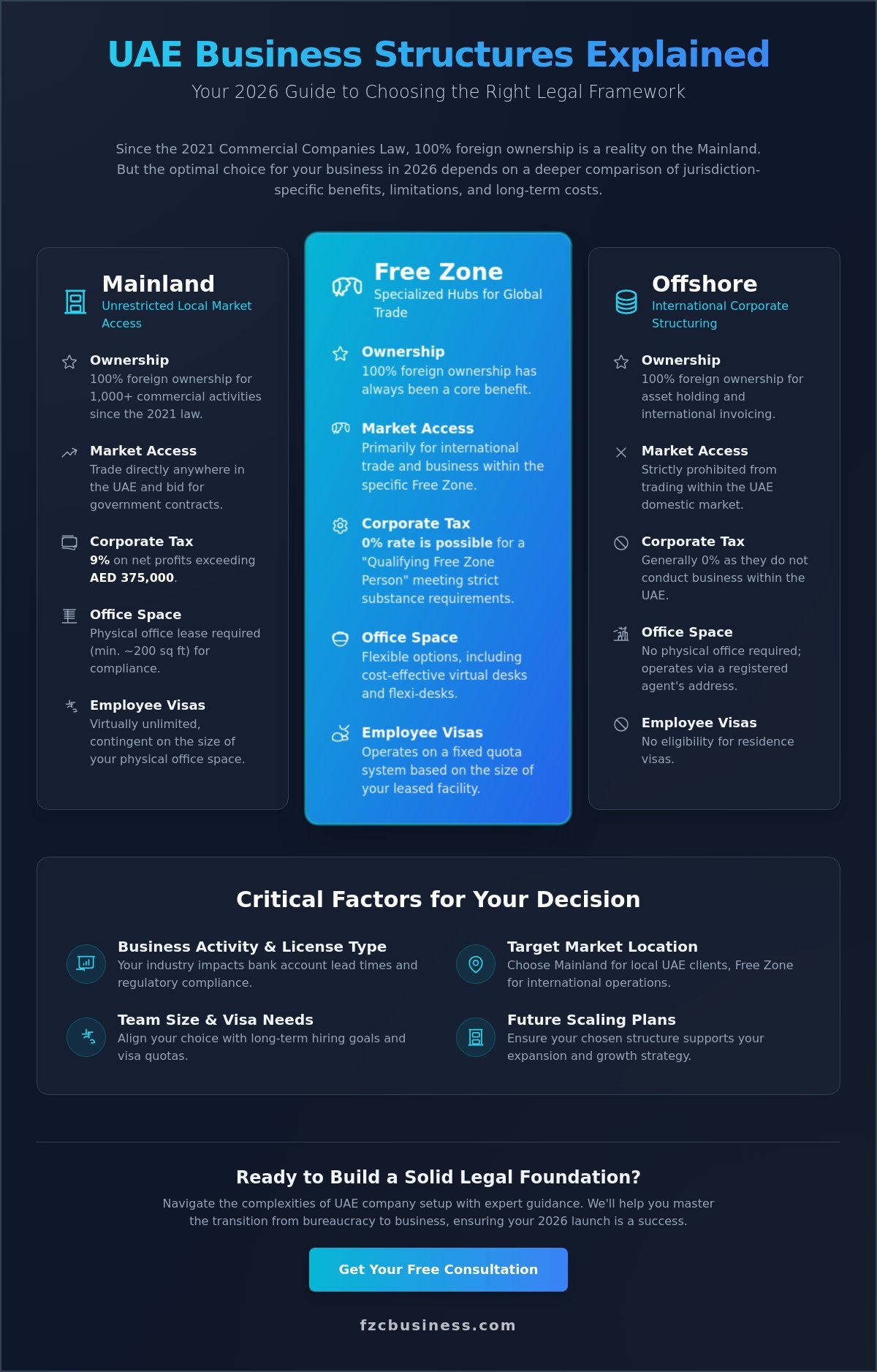
Your choice of structure also dictates your ability to build a team. Mainland licenses allow for virtually unlimited employee visas, provided you have the physical office space to support them. In contrast, Free Zones typically offer fixed visa quotas based on the size of your leased facility. At Fast Zone Business, we provide expert guidance to ensure your structure aligns with your long-term hiring goals.
Mainland vs. Free Zone vs. Offshore: The Core Differences
Mainland entities can trade anywhere in the UAE and bid for lucrative government contracts. These are regulated by the Department of Economy and Tourism (DET). Free Zone Authorities (FZA) govern specific zones like DMCC or IFZA, where trading is generally restricted to the zone itself or international markets. While Free Zones often permit virtual desks, Mainland licenses usually require a physical office lease of at least 200 square feet to remain compliant.
Structure-Based Tax Implications in 2026
Tax compliance is now a standard part of the UAE business journey. Mainland firms pay a 9% Corporate Tax on annual net profits that exceed AED 375,000. Free Zone entities might maintain a 0% rate, but only if they qualify as a “Qualifying Free Zone Person” by meeting specific substance requirements. Your legal structure also impacts your VAT timeline. Registration with the Federal Tax Authority is mandatory once your taxable supplies and imports exceed AED 375,000 over a 12-month period. Using a professional service ensures a smooth experience during this registration process.
This guide provides the clarity you need regarding uae business legal structures explained for the modern market. Making an informed decision today prevents bureaucratic hurdles tomorrow, allowing you to focus on your core business objectives with confidence.
Mainland Business Structures: Unrestricted Local Market Access
Mainland registration offers the most versatile path for entrepreneurs. You can trade directly with private consumers and government bodies across all seven emirates without geographic restrictions. The Federal Decree-Law No. 32 of 2021 revolutionized this space. It removed the requirement for a UAE national to hold 51% of shares in most commercial companies. This legal shift made business setup in Dubai Mainland the primary choice for international investors seeking full operational control. Understanding how uae business legal structures explained apply to your industry is the first step toward a successful launch.
Limited Liability Company (LLC): The Investor’s Choice
The LLC remains the most popular structure because it protects your personal assets. Shareholders are only liable for the amount of capital they’ve invested. You can have between 1 and 50 partners. Since the 2021 legal update, 100% foreign ownership is the standard for 1,000+ commercial and industrial activities. This removes the need for a local partner to hold equity. Some strategic sectors like oil and gas or defense still require UAE national participation, but most retail and service businesses enjoy full control. It’s a robust framework for those planning to scale quickly.
Sole Establishment and Civil Companies
Professional services often use these structures. A Sole Establishment is owned by one individual who retains 100% control of the operations. A Civil Company allows two or more partners to practice a profession like medicine, law, or engineering. These structures require a National Service Agent (NSA). The NSA is a UAE national who handles administrative tasks and government liaisons but holds no equity in the business. You should remember that these entities carry unlimited personal liability. This means your personal assets aren’t shielded from business debts, unlike the protection offered by an LLC.
Foreign Branch and Representative Offices
A Branch Office acts as an extension of your parent company. It carries out the same commercial activities and generates profit under the parent’s license. In contrast, a Representative Office exists solely for marketing and promotion. It can’t sign contracts or trade products. International brands use these to test the market before committing to a full LLC setup. Choosing between these depends on whether you want to generate revenue immediately or simply build brand awareness. Fast Zone Business provides the expert guidance needed to choose the right path for your expansion, ensuring your uae business legal structures explained align with your long-term goals.
Free Zone Entities: Specialized Hubs for Global Trade
Free Zones offer a streamlined “One-Stop-Shop” environment that simplifies the setup process for international investors. This model is why these jurisdictions remain the primary choice for tech startups and export-heavy companies. When you explore options like Meydan Free Zone, IFZA, or RAKEZ, you’ll find that the respective authorities manage everything from licensing to residency visas in a single location. This efficiency is a core reason why uae business legal structures explained in this guide focus so heavily on these specialized hubs.
A significant advantage for businesses operating within designated zones is the customs duty benefit. Goods imported into these zones for processing or re-export are exempt from the standard 5% customs duty. This makes the UAE a powerhouse for global logistics. However, there’s a specific limitation you must understand. Free Zone companies can’t trade directly with the UAE mainland. To sell products in the local market, you must appoint a locally licensed distributor or a commercial agent. This structure protects the local economy while giving you a tax-efficient base for global operations.
FZE vs. FZ-LLC: Understanding the Difference
Choosing the right entity depends on your ownership goals and long-term vision. A Free Zone Establishment (FZE) is designed for a single shareholder, which can be either an individual or a corporate entity. If you’re a solo entrepreneur, this is the most straightforward path. In contrast, a Free Zone Limited Liability Company (FZ-LLC) allows for multiple shareholders, usually between 2 and 50. If you plan to bring on new investors or scale through venture capital in the future, the FZ-LLC is the better choice. It provides a more robust framework for equity distribution and corporate governance.
Industry-Specific Free Zone Advantages
The UAE has developed specialized clusters to foster innovation across different sectors. For digital nomads and content creators, SHAMS Media City provides affordable packages that don’t require physical office space. This flexibility is vital for the creative economy. E-commerce businesses often gravitate toward zones with integrated logistics and warehousing to manage fulfillment efficiently.
Professional services requiring high prestige or a specific legal framework often look toward the DIFC or ADGM. These zones operate under their own common law-based regulations, which is a unique feature of how uae business legal structures explained apply to financial and legal sectors. Each zone offers a distinct mix of cost-effectiveness and market reputation. We customize our services to help you select the hub that aligns with your specific operational needs.
Critical Factors When Choosing Your UAE Legal Structure
Selecting the right setup is about more than just initial costs. It’s about how your choice impacts daily operations and long-term growth. When analyzing how uae business legal structures explained apply to your specific goals, the first filter is always your activity. For instance, recruitment and real estate activities are strictly regulated by the Ministry of Human Resources and Emiratisation (MOHRE) and the Real Estate Regulatory Agency (RERA). These sectors often require a Mainland license because Free Zone entities face restrictions when trading directly within the local UAE market.
Scalability is another vital consideration. You can’t always change your mind easily once the license is issued. While it’s possible to convert a Sole Establishment into a Limited Liability Company (LLC) as you take on new partners, the process involves significant legal documentation and administrative fees. It’s often more efficient to start with the structure you expect to need in 24 months rather than what fits your budget today.
Your employee headcount is also tied to your physical footprint. In most jurisdictions, the government allots one visa for every 9 to 10 square meters of office space. If you plan to scale a sales team quickly, a virtual office in a Free Zone might limit your growth compared to a Mainland warehouse. You should also prepare for the “Banking Hurdle.” Certain structures face longer corporate bank account opening lead times, sometimes stretching to 90 days. Banks often view Mainland LLCs as more stable and transparent than newer offshore setups.
The 100% Ownership Law: Exceptions You Must Know
Federal Decree-Law No. 26 of 2020 changed the landscape by allowing 100% foreign ownership of Mainland companies. However, “strategic impact” sectors like Oil & Gas, Telecommunications, and Defense still require a local partner who holds at least 51% of the shares. The Positive List is the government-approved list of activities for full foreign ownership. Since late 2021, this list has expanded to include over 1,000 commercial and industrial activities, effectively opening the retail and manufacturing sectors to global entrepreneurs without the need for a local service agent.
Banking and Visa Requirements by Structure
Banks prioritize transparency and physical presence. A Mainland LLC usually enjoys a higher “trust score” with UAE financial institutions because it requires a physical lease and more rigorous local vetting. If you’re a solopreneur, your choice of structure directly impacts your freelance visa Dubai eligibility. Specific Free Zones offer freelance permits that don’t require a physical office, making them ideal for consultants. Regardless of the path, you must provide a professionally translated Memorandum of Association (MOA) and Articles of Association (AOA) to satisfy bank compliance departments.
Ready to navigate these requirements without the stress? Book a free consultation with our experts to secure your license today.
Setting Up for Success with Fast Zone Business
Launching a venture in a new market requires more than just a good idea; it demands a partner who understands the local regulatory pulse. Fast Zone Business delivers on a hassle-free promise by managing the heavy lifting of UAE bureaucracy. We act as your dedicated liaison, ensuring that the details of uae business legal structures explained throughout this guide are implemented correctly for your specific entity. This allows you to focus on growth and strategy while we navigate the administrative requirements that often slow down new entrepreneurs.
Our comprehensive PRO services are designed to eliminate friction. We handle all government approvals, official stamps, and visa processing for your team and family. Every step of how to start a business in Dubai begins with a free consultation. This initial session is vital for identifying the most cost-effective jurisdiction and legal form for your 2026 launch. Beyond the initial setup, we provide ongoing support including VAT registration to keep you compliant with Federal Tax Authority rules, bank account opening assistance, and proactive license renewal alerts.
The Fast Zone Advantage: Expertise and Efficiency
We don’t believe in one-size-fits-all solutions. Our team creates customized roadmaps tailored to your specific industry and scale. By leveraging direct government affiliations, we significantly speed up the Initial Approval phase, often bypassing the common delays that independent applicants face. Transparency is a core value of our service. We provide clear cost breakdowns in AED so you don’t encounter hidden fees during the Mainland or Free Zone setup process. Our expertise ensures that the uae business legal structures explained during your consultation align perfectly with your long-term expansion plans.
Next Steps: Your 2026 Launch Timeline
Starting your business is a methodical process that we’ve refined into three distinct phases to ensure speed and accuracy:
- Phase 1: Activity selection and name reservation (24-48 hours). We help you choose the right business activities and secure your trade name with the authorities immediately.
- Phase 2: Documentation and MOA signing (3-5 days). Our team prepares the Memorandum of Association and coordinates the signing process, whether you prefer digital or in-person methods.
- Phase 3: Visa processing and bank account application (2-4 weeks). We finalize your residency permits and introduce you to our network of banking partners to streamline your corporate account opening.
Ready to turn your entrepreneurial vision into a reality? Book your FREE consultation with Fast Zone Business today!
Launch Your UAE Venture with Confidence in 2026
Navigating the local regulatory landscape requires more than just a general overview. Selecting the right path between a Mainland license for local market access and a Free Zone entity for specialized trade depends on your specific 2026 growth targets. Having these uae business legal structures explained ensures you don’t face unnecessary delays or compliance hurdles during the registration process. Success in the Emirates hinges on aligning your corporate framework with current laws regarding 100% foreign ownership and specialized licensing requirements.
Fast Zone Business acts as your one-stop destination for every stage of this journey. Our team provides expert guidance on 100% foreign ownership and serves as a trusted partner for corporate bank account opening. We streamline the entire process through comprehensive PRO and Visa services, allowing you to focus on your core operations while we handle the bureaucracy. Don’t let administrative complexity slow your momentum. Start your hassle-free UAE business setup with a FREE consultation!
The UAE market offers unparalleled opportunities for those who move quickly and stay compliant. It’s time to turn your entrepreneurial goals into a reality with a partner that understands the intricacies of the local economy.
Frequently Asked Questions
What is the most common legal structure for foreigners in the UAE?
The Limited Liability Company (LLC) and the Free Zone Company are the most frequent choices for foreign entrepreneurs. Free Zone entities are popular because they offer 100% foreign ownership and 0% corporate tax for qualified income. Mainland LLCs are preferred by those who want to trade directly with the local market without any geographic restrictions. Our expert guidance helps you identify which of these uae business legal structures explained fits your specific 2026 commercial goals.
Can I change my business structure from a Free Zone to Mainland later?
You can’t directly convert a Free Zone license into a Mainland license because they’re governed by different regulatory bodies. To move your operations, you must register a new legal entity with the Department of Economy and Tourism (DET) and then liquidate the original Free Zone company if it’s no longer needed. This process requires careful planning to transfer assets and employees. We provide a smooth experience by managing these transitions to ensure your operations continue without interruption.
Do I need a local partner for an LLC in 2026?
You don’t need a local Emirati partner for the majority of commercial and industrial activities in 2026. Since the 2021 amendments to the Commercial Companies Law, foreigners can own 100% of a Mainland LLC in over 1,000 business categories. Only a few strategic sectors, like defense or oil and gas, still require a local majority shareholder. Our team offers the in-depth knowledge required to confirm your specific activity’s ownership eligibility immediately.
What is the difference between a Branch and a Subsidiary in the UAE?
A Branch is a legal extension of a parent company and doesn’t have a separate legal identity or limited liability. In contrast, a Subsidiary is a separate legal entity where the parent company owns at least 51% of the shares. This means the parent company’s assets are protected from the subsidiary’s liabilities. Choosing between them depends on your tax strategy and how much risk you want to isolate within the UAE market.
How many visas can I get with a Mainland LLC structure?
A Mainland LLC structure allows you to apply for an unlimited number of visas, provided you lease a physical office space of sufficient size. The general rule used by the Ministry of Human Resources and Emiratisation is one visa for every 9 square meters of office area. This makes the Mainland setup the most scalable option for businesses planning to hire large teams. We act as your one-stop destination to handle all PRO services and visa processing efficiently.
Is an Offshore company a valid legal structure for trading within the UAE?
An Offshore company isn’t a valid legal structure for conducting trade or providing services within the UAE’s borders. These entities are strictly for international business, holding global assets, or managing offshore bank accounts. If you intend to sell products to local customers, you must establish a Mainland or Free Zone entity instead. Our expert guidance ensures you don’t face legal penalties by choosing the wrong jurisdiction for your intended activities.
What are the minimum capital requirements for a UAE legal structure?
Most Mainland LLCs don’t have a fixed minimum capital requirement, as the law only requires capital to be “sufficient” for the company’s purpose. However, certain Free Zones have specific requirements, often ranging from AED 10,000 to AED 50,000 depending on the license type. Understanding these uae business legal structures explained is vital for your initial budgeting. We help you navigate these regulations to ensure a hassle-free setup that meets all government compliance standards.
How long does it take to finalize the legal setup of a company in Dubai?
Finalizing a legal setup in Dubai typically takes between 3 to 10 working days depending on the chosen jurisdiction. A Mainland “Instant License” can be issued in as little as 5 minutes for specific activities that don’t require external approvals. Free Zone setups usually take about 7 working days once all documents are submitted. Our action-oriented team prioritizes speed to get your business operational as quickly as possible.
