

Business Plan for Dubai Company Setup: The Ultimate 2026 Strategic Guide
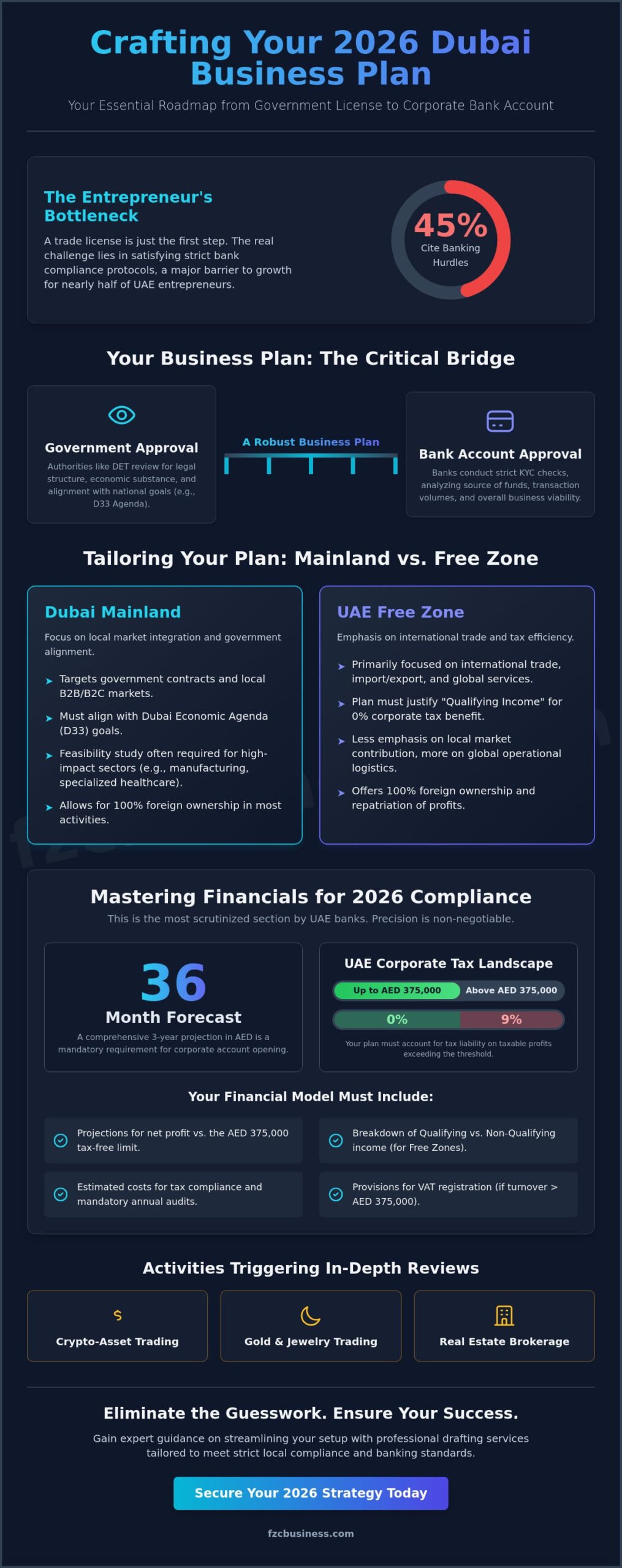
Did you know that approximately 45% of entrepreneurs in the UAE cite banking hurdles as their primary barrier to growth? It’s a staggering figure that highlights a critical gap; your trade license is only half the battle. To thrive in the 2026 market, a robust business plan for dubai company setup must act as a bridge between government compliance and strict bank KYC protocols. You’ve probably realized that a generic template won’t cut it when you’re trying to secure 100% foreign ownership or open an account with a major local bank.
We understand the frustration of managing the conflicting demands of different jurisdictions and the lack of concrete local data for your financial forecasts. It’s exhausting to guess what a compliance officer wants to see in your three-year projection. This guide promises to eliminate that guesswork by providing a clear, actionable roadmap for your 2026 strategy. You’ll learn the essential components required for bank account approval and gain clarity on jurisdiction-specific documents to ensure your setup is smooth and efficient.
Key Takeaways
- Understand why a formal feasibility study is mandatory for securing specific licenses and meeting the 2026 regulatory requirements from UAE authorities.
- Learn how to craft a robust business plan for dubai company setup that aligns with the UAE’s strategic growth sectors to ensure long-term market viability.
- Discover the critical differences between tailoring your business plan for Mainland government contracts versus specialized Free Zone international trade.
- Master the 36-month financial forecasting techniques required to overcome the “banking bottleneck” and ensure a smooth corporate account opening process.
- Gain expert guidance on streamlining your setup journey with professional drafting services tailored to meet strict local compliance and 100% ownership standards.
Why a Business Plan is Mandatory for Your Dubai Company Setup in 2026
Establishing a commercial presence in the UAE requires more than just an initial investment. A business plan for dubai company setup functions as a critical dual-purpose document that satisfies both government regulators and financial institutions. While the Department of Economy and Tourism (DET) focuses on your legal structure, banks and free zone authorities use your plan to assess economic substance. To build a strong foundation, it’s helpful to understand What is a Business Plan? and how its core components apply to the specific regulatory environment of the Middle East.
The Dubai Economic Agenda (D33) has set a clear trajectory for the city to become a top three global economic hub by 2033. By 2026, authorities will prioritize businesses that demonstrate a clear contribution to this AED 32 trillion goal. Even though 100% foreign ownership is now standard across most Mainland activities, the DET often requires a detailed operational roadmap for high-impact sectors. This ensures that new entities aren’t just shell companies but active participants in the local economy. Manufacturing, specialized healthcare, and large-scale industrial licenses specifically demand a formal feasibility study before the initial approval is granted.
To better understand the practical steps of establishing your presence, watch this helpful video:
The Difference Between License Approval and Banking Approval
Obtaining a trade license is often a streamlined process, but securing a corporate bank account is significantly more rigorous. UAE banks operate under strict UAE Central Bank compliance standards to prevent money laundering. High-risk activities, such as crypto-asset trading, gold jewelry trading, and real estate brokerage, trigger mandatory, in-depth business plan reviews. Your plan must clearly outline your source of funds, expected transaction volumes, and key suppliers to pass the Know Your Customer (KYC) hurdles. Partnering with experts at Fast Zone Business ensures your roadmap meets these high banking standards from day one.
Planning for the 2026 UAE Corporate Tax Landscape
The 2026 fiscal year will see a fully matured corporate tax environment. Your business plan for dubai company setup must account for the 9% Corporate Tax on taxable profits exceeding AED 375,000. For Free Zone entities, documenting “Qualifying Income” within the plan is essential to justify the 0% preferential rate. Precise cash flow projections are vital for SMEs to manage the 9% tax liability once annual taxable profits exceed the AED 375,000 threshold. Investors should include the following in their financial models:
- Projections for annual net profit against the AED 375,000 tax-free limit.
- Detailed breakdown of income sources to distinguish between Qualifying and Non-Qualifying revenue.
- Estimated costs for tax compliance and mandatory annual audits.
- Provisions for Value Added Tax (VAT) registration if taxable turnover exceeds AED 375,000.
Key Elements of a Successful Dubai Business Plan
A professional business plan for dubai company setup serves as a foundational document that bridges your global ambitions with local regulatory expectations. It’s the first document a licensing authority or a UAE bank reviews to gauge your long-term commitment. To ensure a smooth experience, your executive summary must align with the Dubai Economic Agenda (D33). This government initiative aims to double the size of Dubai’s economy by 2033. Highlighting how your venture contributes to sectors like fintech, green energy, or advanced manufacturing demonstrates that you understand the region’s strategic direction.
Detailed financial projections are mandatory. Most UAE banks require a comprehensive three-year forecast in AED before they’ll consider opening a corporate account. This data should reflect the current economic stability highlighted in the U.S. Department of State’s UAE Investment Climate Statement, which notes the country’s robust regulatory reforms and attractiveness to foreign capital. Your plan must also specify your operational structure. Choosing between a physical office for mainland operations or a virtual desk in a Free Zone affects your overhead and your ability to hire staff. Finally, identify your management team clearly. The qualifications of your General Manager are vital, as they often carry the legal responsibility for the company’s compliance.
Crafting a Market Entry Strategy for the UAE
Success depends on a SWOT analysis tailored to Dubai’s unique competitive landscape. You’re competing in a market where 88% of the population consists of expatriates. This means your target audience is highly diverse and mobile. Identifying specific demographics helps you refine your marketing spend. For a deeper look at the administrative steps required to launch, review our guide on how to start a business in Dubai to align your strategy with the registration timeline.
Defining Your Business Activity and Legal Structure
Accuracy in your business activity code is vital. You must match your operations to the specific Department of Economy and Tourism (DET) or Free Zone codes. Misalignment leads to delays or fines. Your plan should clearly justify the choice between a Limited Liability Company (LLC), a Branch, or a Sole Establishment. Additionally, you must document your Economic Substance Regulations (ESR) compliance if you’re engaging in “relevant activities” like banking, insurance, or investment fund management. Our team provides expert guidance to ensure your legal structure is optimized for tax efficiency and growth.
Tailoring Your Plan for Dubai Mainland vs. Free Zone Jurisdictions
Your business plan for dubai company setup must align with the specific legal framework of your chosen jurisdiction. Choosing between the Mainland and a Free Zone isn’t just about cost. It’s a strategic decision that dictates your market reach and operational structure. Mainland licenses allow for unrestricted trade within the local UAE market and participation in lucrative government tenders. Free Zones, conversely, offer a specialized environment often optimized for international trade and specific industry niches like media or technology.
Mainland Business Planning: The DET Perspective
The Department of Economy and Tourism (DET) oversees Mainland licensing. Since the 2020 amendments to the Commercial Companies Law, foreigners can achieve 100% ownership in over 1,000 commercial and industrial activities. Your plan must account for a physical office space, verified by a registered Ejari (tenancy contract). This physical presence is a mandatory requirement for Mainland entities. For a deep dive into these regulations, consult our Dubai Mainland License Guide. Your strategy should emphasize local market penetration and the ability to scale across all seven Emirates without geographical restrictions.
Free Zone Specialization: IFZA, SHAMS, and Meydan
Free Zones like IFZA, SHAMS, and Meydan cater to entrepreneurs who focus on global markets. When drafting a business plan for dubai company setup within a Free Zone, you must highlight the “export” nature of your services or goods. Some Free Zones require specific plan formats if you’re applying for specialized professional activities or manufacturing licenses. These hubs offer 100% corporate and personal tax exemptions and full repatriation of profits. You can learn more about these benefits in our Free Zone Company Setup Guide.
Choosing the right path depends on your primary revenue source. Consider these two different models as a guide:
- Retail Setup (Mainland): A brand planning to open multiple boutiques in Dubai Mall or Mall of the Emirates requires a Mainland license. They need to operate legally in these high-traffic areas. Their business plan focuses on local footfall, UAE-based distribution, and local logistics.
- Tech Startup (Free Zone): A software development firm targeting clients in Europe and North America finds a better home in a Free Zone like IFZA. Their plan prioritizes remote work flexibility and international banking facilities over local storefront presence.
Making this distinction early prevents costly restructuring later. Fast Zone Business provides the expert guidance needed to evaluate these jurisdictions against your five-year growth projections. We ensure your documentation meets the exact standards of the relevant authorities, whether you’re targeting the local heart of Dubai or a global audience from a specialized hub.
Financial Forecasting and Banking Compliance in 2026
The “Banking Bottleneck” remains the single biggest hurdle for new entrepreneurs in the UAE. In 2026, your business plan for dubai company setup serves as a high-stakes compliance document rather than a mere roadmap. UAE banks have moved toward a strict risk-based approach; this means your financial plan is the most scrutinized document in your entire application package. If your numbers don’t align perfectly with your stated business activity, the bank’s compliance department will likely reject your application without a second review.
Your revenue projections must cover a 36 month period with granular detail. Avoid “hockey stick” growth curves that lack evidence. Instead, base your targets on documented market rates and realistic customer acquisition costs. You must also clearly document your source of wealth. Whether it’s personal savings, a previous business exit, or an inheritance, you’ll need bank statements and legal documents to prove the legitimacy of your initial investment capital. Most banks expect to see a minimum initial deposit or proof of liquidity ranging from AED 50,000 to AED 200,000 for corporate accounts.
Expense planning requires precision to maintain liquidity during the first year. You must account for the following recurring costs:
- Visa and Residency Costs: Budget between AED 3,500 and AED 8,000 per employee depending on the specific free zone or mainland requirements.
- Annual License Renewals: These typically range from AED 12,000 to AED 35,000 and are mandatory for staying operational.
- PRO Service Fees: Professional services are essential for managing government interactions, labor contracts, and document notarization.
- VAT and Audit Fees: Budget for quarterly filing costs and annual mandatory audits required by many free zone authorities.
Winning Over UAE Banks with Your Financial Plan
UAE banks look for transparency and aggressive risk mitigation. They want to see that you understand the local regulatory environment and have a clear path to profitability. A strong corporate profile highlights your professional background and explains how you’ll manage cross-border transactions safely. Common red flags that lead to rejection include transactions with high-risk jurisdictions, inconsistent cash flow projections, or an unclear ownership structure. Review our Corporate Bank Account UAE Guide to learn how to structure your profile for immediate approval.
VAT and Tax Planning for New Entities
Taxation is a core part of the UAE’s modern economic landscape. You must document your VAT registration threshold in your business plan; registration is mandatory once your taxable turnover exceeds AED 375,000. Voluntary registration is available at AED 187,500, which can be beneficial for reclaiming input VAT on setup costs. Projecting these tax liabilities early ensures you maintain a healthy cash flow and avoid heavy penalties from the Federal Tax Authority. VAT compliance is a mandatory legal requirement for all trading companies operating within the UAE.
Effective financial planning saves time and prevents costly administrative delays. If you’re ready to secure your financial future in the Emirates, book a free consultation with Fast Zone Business today.
How Fast Zone Business Streamlines Your Planning and Setup
Drafting a business plan for dubai company setup requires more than a simple template; it demands precise alignment with the evolving standards of UAE authorities. Fast Zone Business provides customized drafting services that meet the 2026 regulatory requirements of the Department of Economy and Tourism (DET) and various Free Zone entities. We ensure your documentation reflects the necessary capital requirements and activity descriptions needed for immediate approval, preventing the common back-and-forth that delays most startups.
Our team provides expert guidance on jurisdiction selection to match your specific strategic goals. Whether your model requires a 100% foreign-owned Mainland license or the specialized infrastructure of a Free Zone like DMCC or IFZA, we identify the path that offers the best tax and operational advantages. We also bridge the gap between registration and operation by assisting with the critical step of corporate bank account opening. Through our network of partner banks, we help you navigate the strict KYC (Know Your Customer) protocols that often result in a 4 to 12-week waiting period for independent applicants.
- Strategic Drafting: We craft plans that satisfy both government regulators and potential investors.
- Document Clearance: Our comprehensive PRO services handle all approvals with the Ministry of Human Resources and Emiratisation (MOHRE) and other bodies.
- Operational Readiness: We focus on getting your trade license issued and your bank account active in the shortest possible timeframe.
The “One-Stop” Advantage for Entrepreneurs
Coordinating between different government departments often leads to significant delays and administrative confusion. Fast Zone Business acts as your single point of contact, removing the hassle of managing multiple portals and physical offices. We integrate deep local market insight into your feasibility study so your revenue projections reflect the actual costs of operating in the UAE. You can visit Fast Zone Business for a free consultation to simplify your entry into the Dubai market and avoid costly entry errors.
Beyond Setup: Renewals and Golden Visa Support
Your initial company structure dictates your future residency options and long-term stability. We ensure your business plan for dubai company setup aligns with Golden Visa eligibility criteria, such as the 2 million AED investment threshold or specific executive salary requirements. Our team provides ongoing support for company and visa renewals, ensuring you remain compliant with evolving UAE labor laws and corporate tax regulations. It’s not just about the launch; it’s about sustained growth. Book a FREE Consultation with Fast Zone Business to secure your business future in the UAE.
Accelerate Your Dubai Launch Today
Navigating the UAE’s evolving regulatory landscape requires more than just an idea. By 2026, a robust business plan for dubai company setup serves as your primary tool for securing trade licenses and meeting strict banking compliance standards. Whether you’re targeting the local market through a Mainland entity or leveraging 100% foreign ownership in a Free Zone, your strategy must be precise. Fast Zone Business provides the expert guidance needed to bridge the gap between planning and execution. We handle the complexities of PRO services and banking integrations while positioning you for long-term residency through Golden Visa applications. You can focus on your core operations while we manage the bureaucratic hurdles. Our team ensures your transition into the Dubai market is efficient and fully compliant with the latest 2026 mandates. Don’t leave your success to chance when professional support is a click away. We’re ready to turn your strategic vision into a functional, profitable reality.
Book Your FREE Business Setup Consultation Now
Frequently Asked Questions
Is a business plan legally required for a Dubai trade license?
A business plan isn’t legally mandatory for every mainland trade license, but it’s a strict requirement for most Free Zone applications and regulated activities. While the Department of Economy and Tourism often skips this for basic retail, 85% of Free Zones require a formal document to approve your office space and activity. Our team provides expert guidance to ensure your plan meets these specific jurisdictional standards for a smooth experience.
What is the most important part of a business plan for a UAE bank account?
The most critical section for a UAE bank account is the detailed cash flow projection paired with clear proof of fund sources. Banks like Emirates NBD or Mashreq prioritize these elements to meet Anti-Money Laundering regulations. You’ll need to demonstrate a clear 12-month financial roadmap and identify your primary suppliers and clients to pass the compliance stage without any unnecessary delays.
Can I use a generic business plan template for my Dubai company setup?
You shouldn’t rely on generic templates because they lack the localized regulatory data required for a successful business plan for dubai company setup. Templates often ignore the UAE Corporate Tax Law of 2023 or specific Free Zone compliance rules. We recommend a customized approach that reflects the current 2026 market conditions and specific licensing costs in AED to avoid rejection by authorities.
How long should a business plan for a Dubai startup be?
A professional business plan for a Dubai startup should typically span 15 to 25 pages. It needs to be concise enough for quick review by authorities but detailed enough to include a 3-year financial forecast. Focus on high-impact sections like the executive summary and local competitor analysis to ensure a hassle-free process during the initial approval stages with the licensing body.
Do Free Zones have different business plan requirements than the Mainland?
Yes, Free Zones generally have stricter business plan requirements compared to the Mainland Department of Economy and Tourism. Authorities like DMCC or Dubai Silicon Oasis require a comprehensive 3-year strategy to justify your presence in their specific ecosystem. Mainland setups are often faster, but certain professional activities still demand a clear operational roadmap before the government issues your final trade license.
How much detail is needed for the financial projections in a Dubai business plan?
Financial projections must cover a minimum of 3 years and include detailed monthly cash flow for the first 12 months. You’ve got to account for the AED 375,000 VAT registration threshold and the 9% Corporate Tax on profits exceeding AED 375,000. Providing specific figures for setup costs and operational expenses shows authorities you’ve a viable, long-term strategy in the UAE market.
Should I include my UAE Golden Visa strategy in my business plan?
You should definitely include your Golden Visa strategy if you’re applying under the entrepreneur or investor categories. To qualify for the 10-year residency, your plan must demonstrate a minimum capital of AED 2,000,000 or approval from a recognized UAE incubator. Clearly outlining this path helps align your business goals with the UAE’s strategic vision and simplifies the visa recommendation process.
What are the common reasons a business plan is rejected by Dubai authorities?
Rejections usually happen because of unrealistic financial forecasts or a lack of local market research. About 30% of rejected plans fail because they don’t clearly define the business activity as per the official DET or Free Zone lists. Using vague descriptions instead of specific UAE terminology leads to bureaucratic hurdles that can stall your company setup for several weeks.
