

Common Mistakes in UAE Company Formation: 2026 Expert Guide
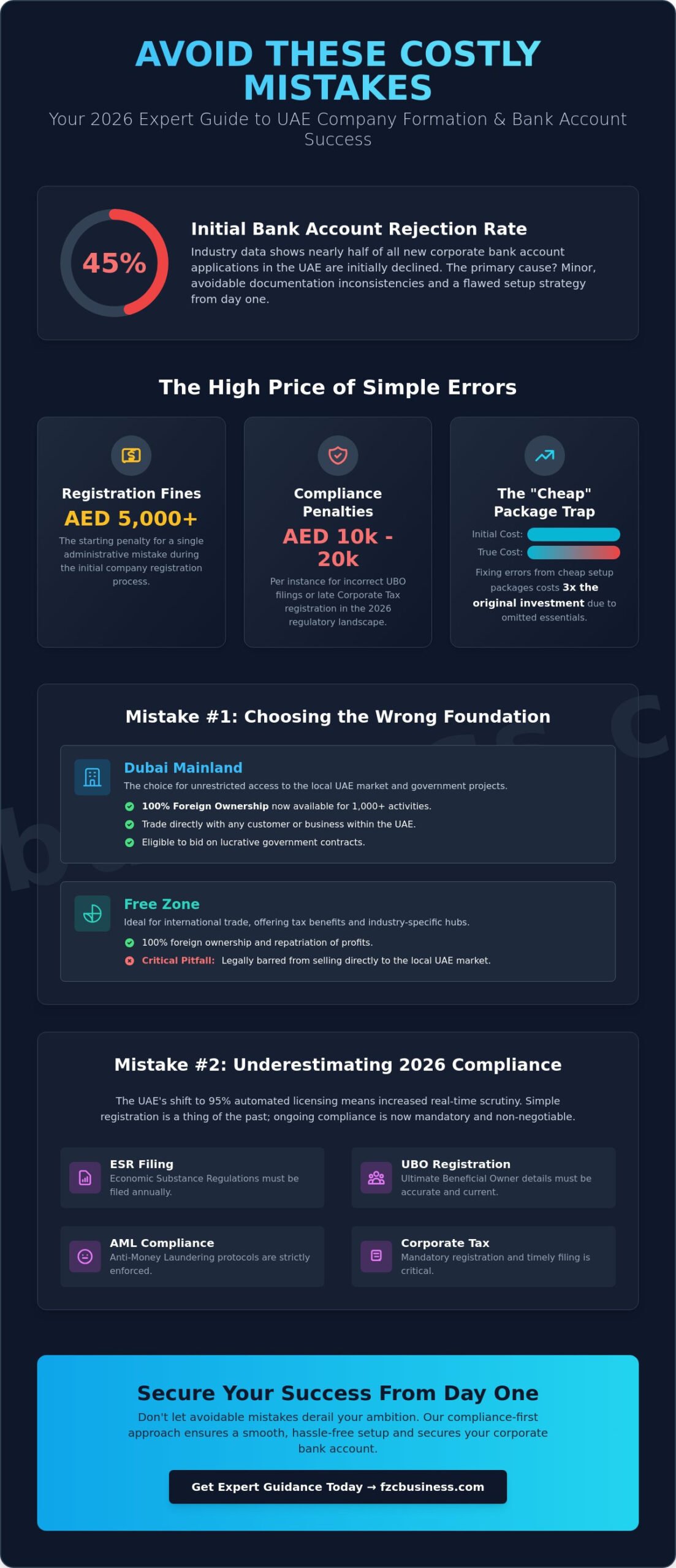
Industry data from 2024 shows that 45% of new corporate bank account applications in the UAE are initially declined because of minor documentation inconsistencies. You’ve likely heard that Dubai is the premier global hub for growth, but the reality is that one wrong step during registration can lead to administrative fines starting at 5,000 AED. It’s frustrating to feel stuck between Mainland and Free Zone benefits while worrying about hidden costs that weren’t in the initial quote. Falling into these common mistakes in uae company formation shouldn’t be the price of your ambition.
We’re here to ensure your journey is a smooth experience from day one. This 2026 expert guide provides a compliance-first roadmap to help you avoid legal pitfalls and secure a functional corporate bank account without the typical anxiety. You’ll gain expert guidance on the latest tax and AML laws, ensuring your business stays fully compliant as regulations evolve. We’ll walk you through the exact steps to achieve a hassle-free setup so you can focus on your core business goals.
Key Takeaways
- Learn how to differentiate between Dubai Mainland and Free Zone structures to ensure your business foundation supports your long-term growth objectives.
- Identify and avoid the common mistakes in uae company formation that lead to unnecessary costs and legal delays in the 2026 regulatory environment.
- Master the latest 2026 compliance requirements, including ESR and UBO registration, to maintain a hassle-free and legally sound operation.
- Discover the specific documentation strategies needed to overcome the 40% banking rejection rate and secure your corporate account efficiently.
- Understand the importance of drafting a robust Memorandum of Association (MOA) to protect your interests and future-proof your business against internal disputes.
The Evolving Landscape of UAE Company Formation in 2026
The UAE has solidified its status as the world’s premier business destination in 2026. Entrepreneurs no longer view Dubai or Abu Dhabi as mere tax havens; they see a sophisticated regulatory environment designed for global scale. Company formation is now a multi-layered regulatory process. It requires more than just picking a name and paying a fee. If you don’t align your initial setup with your long-term residency goals, you risk facing significant hurdles during bank account opening or Golden Visa applications. Many investors fall for “cheap” setup packages advertised online. These deals often omit essential costs like corporate tax registration or mandatory health insurance. Fixing these errors later costs three times the original investment. Understanding UAE corporate law is the first step toward a sustainable venture.
To better understand these pitfalls, watch this helpful video:
Avoiding common mistakes in uae company formation starts with choosing the right jurisdiction for your specific activity. Whether you opt for a mainland license or a specialized free zone, your choice dictates your market access. Our team at Fast Zone Business provides expert guidance to ensure your structure matches your commercial goals from day one. We focus on creating a smooth experience that lets you focus on growth while we handle the technical details.
Why 2026 is a Turning Point for Investors
The “zero-bureaucracy” initiative has transformed government approvals into a seamless digital experience. In 2026, 95% of licensing processes are automated through unified digital platforms. This speed comes with increased scrutiny. The shift from simple registration to mandatory ongoing compliance means authorities track corporate transparency in real-time. If your corporate structure is opaque or lacks proper documentation, you won’t pass the initial vetting process. The current environment favors transparent, well-organized companies over “paper-only” entities.
The High Cost of Amateur Errors
Administrative errors are expensive in the current market. Average fines for late Corporate Tax registration or incorrect Ultimate Beneficial Owner (UBO) filings now range from AED 10,000 to AED 20,000 per instance. Beyond the financial loss, an incorrect setup limits your visa quotas and prevents future expansion into mainland markets. Regulatory friction refers to the operational slowdown and administrative resistance encountered when a company’s legal structure fails to meet the stringent requirements of local authorities. Preventing common mistakes in uae company formation is essential for maintaining your business momentum and securing your investment.
Choosing the Wrong Jurisdiction and Activity: A Costly Foundation
Selecting where to plant your business roots isn’t just about the initial price tag. It’s about the long-term operational freedom of your enterprise. One of the most common mistakes in uae company formation involves rushing into a Free Zone because of lower upfront costs, only to realize later that you’re legally barred from selling directly to the local UAE market. While the UAE offers three primary jurisdictions; Mainland, Free Zone, and Offshore; each serves a distinct strategic purpose. Choosing the wrong one can lead to restrictive trade barriers or the inability to bid on lucrative government contracts.
Mainland vs Free Zone: Beyond the Setup Fee
Many entrepreneurs believe they still need a local Emirati partner to own 51% of a Mainland company. This is no longer the case. Since the implementation of Federal Decree-Law No. 26 of 2020, foreigners can enjoy 100% ownership of Mainland companies for over 1,000 commercial and industrial activities. If your goal is to trade directly with the public or provide services to government entities, you should prioritize Business Setup in Dubai Mainland: The Ultimate 2026 Guide to understand these rights. Unlike Free Zones, which often limit your physical presence to a specific geographic area, a Mainland license allows you to open branches across the Emirates and requires a physical office space verified by an Ejari (lease contract).
The Trap of Misaligned Business Activities
The Department of Economic Development (DED) maintains a strict list of thousands of business activities. Selecting an activity that sounds “close enough” is a recipe for disaster. Banks in the UAE are highly sensitive to activity mismatch. If your trade license says “General Trading” but your business plan focuses on “Financial Consultancy,” your corporate bank account application will likely face immediate rejection. Industry data suggests that nearly 35% of setup delays are caused by this lack of alignment.
- Activity Creep: Performing services outside your license scope can result in fines starting from AED 5,000.
- Third-Party Approvals: Certain sectors require more than just a DED license. For example, healthcare ventures need Dubai Health Authority (DHA) clearance, while transport businesses require Roads and Transport Authority (RTA) approval.
- Banking Red Flags: High-risk activities like crypto-assets or gold trading require specific licenses that must match your banking profile exactly to pass compliance.
It’s easy to get overwhelmed by the nuances of jurisdiction and activity codes. Our team provides the expert guidance needed to ensure your foundation is compliant from day one. Don’t let a simple administrative error at the start jeopardize your future growth. Ensuring your license correctly reflects your intended operations is the only way to guarantee a smooth experience as you scale your business in 2026.
Neglecting 2026 Compliance Standards: ESR, UBO, and AML
By 2026, the UAE’s regulatory environment has matured into a sophisticated framework where compliance isn’t just a checkbox; it’s a pillar of operational survival. The Ministry of Economy and the Federal Tax Authority (FTA) have synchronized their databases, meaning gaps in your documentation are flagged almost instantly. One of the most frequent common mistakes in uae company formation involves assuming that small or medium enterprises (SMEs) are exempt from federal oversight. This oversight often results in administrative fines starting from AED 20,000 or the immediate suspension of trade licenses.
Fast Zone Business provides the expert guidance needed to navigate these hurdles, ensuring your venture starts on a foundation of total transparency. You can learn more about our comprehensive setup services to avoid these costly pitfalls. It’s vital to realize that the “grace periods” seen in previous years have concluded. Today, the authorities prioritize data accuracy and timely filings across all jurisdictions, including free zones and the mainland.
UBO and ESR: What Every Founder Must Know
Founders must declare their Ultimate Beneficial Owner (UBO) during the registration phase. This process requires submitting a UBO register that identifies any individual holding 25% or more of the company’s shares or voting rights. It’s a mandatory step designed to increase corporate transparency and align with international standards. Failure to maintain an updated UBO register at your business premises can lead to penalties ranging from AED 15,000 to AED 100,000 under Cabinet Decision No. 53 of 2021.
Economic Substance Regulations (ESR) apply if your business conducts “Relevant Activities.” These include banking, insurance, investment fund management, shipping, and intellectual property business. You’re required to submit an annual notification and, if you earn income from these activities, a full ESR report. Missing the ESR filing deadline results in a flat fine of AED 50,000. Providing inaccurate information to the Ministry of Finance can trigger an additional AED 50,000 penalty.
The 2026 Corporate Tax Landscape
The transition from a tax-free setup to a tax-ready accounting structure is a major hurdle for new entrepreneurs. Many business owners forget to register for Corporate Tax within the specific deadlines set by the FTA, which varies based on the month your license was issued. A late registration fine of AED 10,000 is now standard. You must implement robust accounting software from day one to ensure your financial statements are ready for potential audits. For the 2026 fiscal year, businesses with taxable profits exceeding AED 375,000 are subject to a standard corporate tax rate of 9%.
AML and CFT Filings
Anti-Money Laundering (AML) and Combatting the Financing of Terrorism (CFT) filings are no longer exclusive to banks. If your business falls under Designated Non-Financial Businesses and Professions (DNFBPs), such as real estate, gold dealing, or legal services, you must register on the goAML portal. Overlooking these filings is among the common mistakes in uae company formation that can lead to your company being blacklisted by the Central Bank. Regular reporting of suspicious transactions and maintaining a dedicated compliance officer are now essential requirements for these sectors.
The Banking Barrier: Why Most New Companies Fail to Open Accounts
Securing a trade license is a major milestone, but it doesn’t guarantee a functional business. One of the most common mistakes in uae company formation is treating the corporate bank account as an afterthought. Data from local financial consultants indicates that banks reject roughly 40% of new applications due to poor documentation or perceived risk. Your choice of jurisdiction and specific business activity directly dictates your banking success.
Banks in the UAE operate under strict Central Bank regulations to combat money laundering and ensure transparency. If your corporate profile is messy or your shareholding structure is opaque, you’ll face immediate rejection. You need a clean, transparent profile that clearly outlines who owns the company and where the startup capital originates. Avoiding the common mistakes in uae company formation requires a proactive approach to financial compliance, which you can explore further in our Corporate Bank Account UAE: The Ultimate 2026 Opening Guide.
The KYC (Know Your Customer) Challenge
The KYC process is the primary hurdle for new entrepreneurs. Banks scrutinize your business plan and founder profile to assess risk. They look for industry experience and a clear rationale for why you’re operating in the UAE. Red flags that trigger instant rejection include non-resident shareholders from high-risk countries, lack of a physical office, or engaging in high-risk activities like crypto-trading without specialized licensing. Professional PRO services bridge this gap by auditing your documents before submission, ensuring your application meets the specific compliance standards of your chosen bank.
Strategic Banking Preparation
Applying for an account without a pre-screened profile is a recipe for failure. You must select the right bank for your specific activity; for instance, some banks favor mainland retail businesses while others specialize in Free Zone tech startups. Documentation is key. You’ll need a valid Ejari (tenancy contract) for your physical premises and a verifiable “Proof of Address.” Many entrepreneurs forget that banks often require a minimum average balance, which can range from AED 25,000 to over AED 500,000 depending on the account tier. Never submit an application until you’ve verified that your business activity is on the bank’s approved list.
Don’t let banking hurdles stall your growth. Our experts help you prepare a bulletproof profile to ensure a smooth approval process.
Strategic Setup: How to Future-Proof Your UAE Business
Setting up a business in the Emirates isn’t just about securing a trade license; it’s about building a foundation that survives shifting regulations. Avoiding common mistakes in uae company formation requires a proactive strategy that begins long before you submit your first document. You should start with a feasibility study that evaluates jurisdiction benefits against your specific 2026 growth targets. For example, while a Free Zone offers 100% ownership, a Mainland license might be necessary if your primary revenue comes from direct government contracts within the UAE.
Your Memorandum of Association (MOA) and Shareholder Agreement act as your legal insurance. These documents must be robust enough to handle dispute resolutions and clear exit strategies. Many entrepreneurs overlook these details, leading to expensive litigation later. It’s also vital to align your corporate structure with your long-term residency goals. Integrating your setup with a Golden Visa application can provide 10 years of stability for you and your family, ensuring your personal and professional lives are equally secure.
Partnering with a “one-stop” consultant is the most effective way to manage these moving parts. Instead of juggling different agents for visas, licensing, and office space, a single point of contact ensures nothing falls through the cracks. This holistic approach prevents the common mistakes in uae company formation that often stem from fragmented communication between different service providers.
The 90-Day Post-Setup Checklist
The work doesn’t end when the license is issued. Within the first 90 days, you must secure your establishment card and complete your e-channel registration for visa processing. You’ll also need to register with the Ministry of Human Resources and Emiratisation (MOHRE) to ensure labour law compliance. Since the 9% Corporate Tax was implemented, setting up accounting systems that meet Federal Tax Authority (FTA) audit standards is no longer optional; it’s a critical requirement for every new entity.
The Fast Zone Business Advantage
Our expert guidance ensures a smooth experience for entrepreneurs entering the UAE market. We don’t believe in a one-size-fits-all approach. Instead, we customize our services to meet the specific needs of your business journey, whether you’re a tech startup or a global consultancy. We handle the bureaucratic hurdles so you can focus on your core operations. Our in-depth knowledge of the 2026 regulatory environment allows us to provide a hassle-free transition from your home country to the Dubai business landscape.
Ready to start your journey? Book your FREE consultation with Fast Zone Business experts today and ensure your company is built to last.
Future-Proof Your UAE Market Entry
Success in the 2026 business landscape depends on getting the details right from day one. Choosing the wrong jurisdiction or failing to meet updated ESR and AML compliance standards are common mistakes in uae company formation that can lead to heavy fines or license suspension. Regulatory data from 2024 shows that many new startups struggle with corporate bank account opening because of incomplete documentation. You don’t have to be part of that statistic.
Fast Zone Business provides a smooth experience as your one-stop destination for Mainland and Free Zone setups. We offer expert PRO services for all government and immigration approvals, ensuring every regulatory box is checked. Our team provides direct assistance with Corporate Bank Account opening to bypass the banking barrier efficiently. We’ve designed our process to be hassle-free so you can focus on your growth goals. Expert guidance ensures your foundation is solid and compliant with the latest Ministry of Economy mandates.
Launch your UAE business correctly—Book a FREE Consultation with Fast Zone Business
The UAE remains the world’s premier hub for innovation and trade. Take the first step with confidence and watch your enterprise thrive in this dynamic economy.
Frequently Asked Questions
What is the most common mistake made during UAE company formation?
The most common mistakes in uae company formation involve choosing an incorrect jurisdiction or activity code that doesn’t align with your operational needs. Data from local registration authorities indicates that roughly 15% of new entrepreneurs misclassify their license type during the initial application. This error leads to operational restrictions and unnecessary costs. Our expert guidance ensures your structure aligns with your long-term goals to avoid these costly delays.
Can I change my business activity after the trade license is issued?
You can change or add business activities after your trade license is issued by applying for an amendment through the relevant Department of Economy and Tourism (DET) or Free Zone authority. This process requires an amendment fee and updated legal documents like your Memorandum of Association. It’s a standard procedure that allows your business to pivot as market demands shift in the UAE’s dynamic economy.
Do I really need a physical office for a Free Zone company in 2026?
Most Free Zone authorities in 2026 require a physical office space or a “flexi-desk” arrangement to maintain a valid trade license. While some zones offer virtual packages, a physical lease is essential if you plan to sponsor more than 2 or 3 employee visas. Banks also require a physical address to complete their mandatory Know Your Customer (KYC) checks before opening your account.
Why was my UAE corporate bank account application rejected?
UAE corporate bank account applications are frequently rejected due to incomplete documentation or a lack of clear business proof. Banks follow strict Anti-Money Laundering (AML) protocols updated in 2024. If your business profile doesn’t show a clear source of funds or a detailed business plan, the compliance department will likely decline the application. Providing a solid 12-month financial projection increases your approval chances.
What are the penalties for failing to register a UBO in the UAE?
Failing to register Ultimate Beneficial Owner (UBO) data results in administrative penalties starting at AED 15,000 and reaching up to AED 100,000 according to Cabinet Resolution No. 109 of 2023. Repeated violations can lead to the suspension of your trade license for a minimum of 12 months. Our PRO services ensure your company remains compliant with all Ministry of Economy reporting requirements to avoid these heavy financial burdens.
Is a local sponsor still required for a Dubai Mainland company?
A local sponsor is no longer required for over 1,000 commercial and industrial activities on the Dubai Mainland. Since the 2021 amendments to the Commercial Companies Law, foreign investors can enjoy 100% ownership in most sectors. Some specific strategic sectors like oil and gas or defense still require local participation, but the majority of entrepreneurs now setup without a local partner for a smooth experience.
How does my business setup affect my eligibility for a Golden Visa?
Your business setup affects Golden Visa eligibility through the total value of your investment and your role as a company owner. Entrepreneurs who establish a company with a capital of at least AED 2 million can qualify for the 10-year residency. This long-term visa provides a stable foundation for your family and professional life, and we provide the in-depth knowledge needed to navigate the specific application requirements.
What is the difference between a trade license and a commercial license?
A trade license is the general document issued by the authorities, while a commercial license is a specific category for companies engaged in buying and selling goods. The Department of Economy and Tourism (DET) classifies licenses into categories like Commercial, Industrial, and Professional. Selecting the correct category is vital because it determines your legal liability and the specific activities you’re permitted to perform. Identifying these common mistakes in uae company formation early saves significant time.
