

Risks of Setting Up a Business in Dubai: 2026 Strategic Mitigation Guide
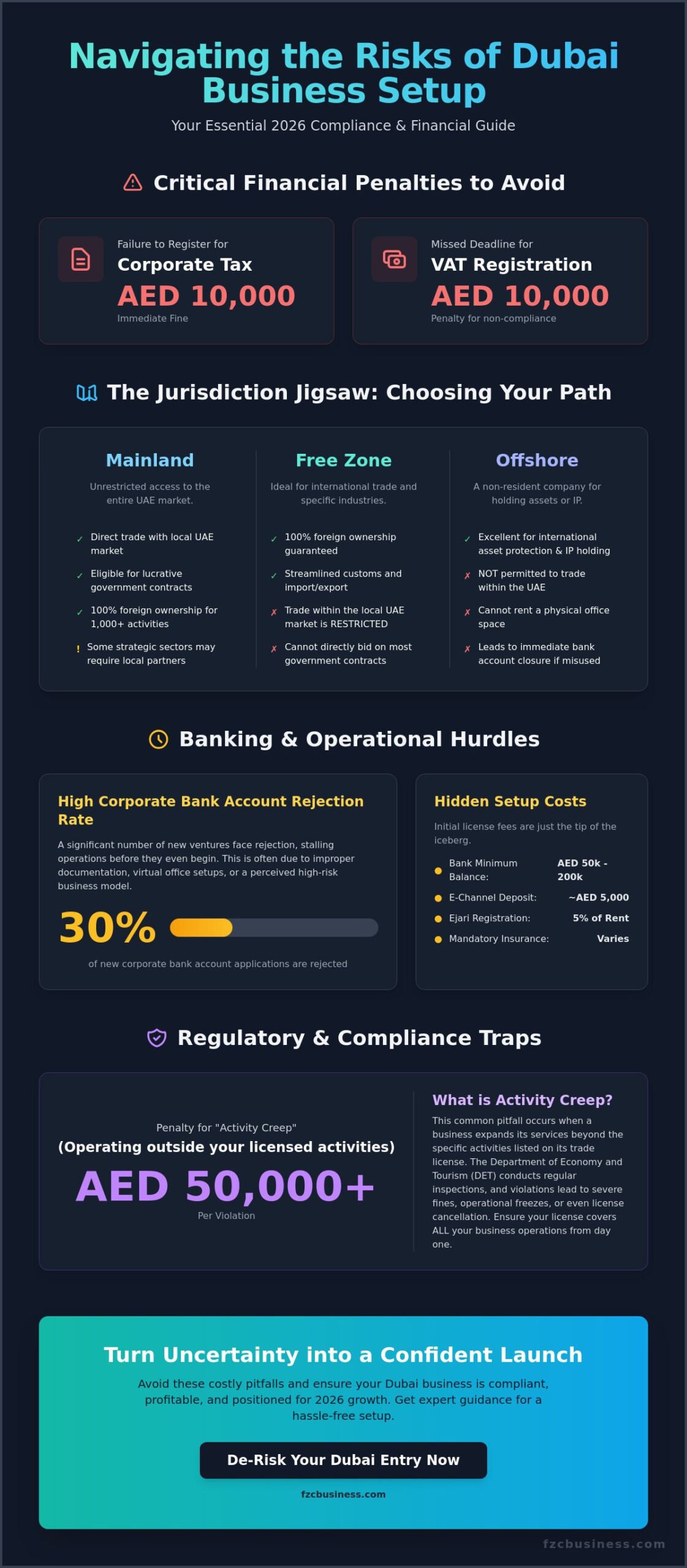
Did you know that failing to register for Corporate Tax within the specific deadlines set by the Federal Tax Authority can result in an immediate AED 10,000 fine? While the UAE offers unparalleled growth, the risks of setting up a business in dubai often hide in the fine print of shifting regulations and 2026 compliance mandates. You’re likely worried about hidden government fees or the 30% bank account rejection rate that often stalls new ventures. It’s natural to feel anxious about these bureaucratic hurdles when your priority is driving revenue.
This strategic guide provides the expert guidance you need for a smooth and hassle-free launch. We’ll identify the legal and financial pitfalls that can drain your capital and offer proven strategies to ensure your setup is both compliant and profitable. You’ll gain a clear roadmap to avoid penalties, understand your total cost of ownership in AED, and select the jurisdiction that best supports your 2026 growth targets. We’re here to turn your uncertainty into a confident, efficient business start.
Key Takeaways
- Learn how to strategically select between Mainland and Free Zone jurisdictions to prevent structural limitations on your UAE market reach.
- Identify hidden financial pitfalls beyond initial license fees and master the 2026 Corporate Tax requirements to protect your capital in AED.
- Discover expert methods to navigate the risks of setting up a business in dubai, including strategies to overcome the high rejection rate for new corporate bank accounts.
- Understand how to avoid severe DED penalties and labor bans by implementing professional compliance and PRO service frameworks for a hassle-free launch.
Navigating the Jurisdiction Jigsaw: Structural Risks in 2026
Selecting a legal structure is the most critical decision for any entrepreneur entering the UAE market. One of the primary risks of setting up a business in dubai is selecting a jurisdiction that inadvertently throttles your growth. You must balance the allure of tax incentives with the reality of actual market access. Understanding Dubai’s economic overview helps you realize that while the city is a global hub, its regulatory borders are strictly enforced to maintain economic stability. Choosing the wrong path can lead to expensive restructuring costs later.
To better understand these structural challenges and how they impact your journey, watch this helpful video:
The choice between Mainland and Free Zone isn’t just about cost. Free Zones offer 100% ownership and streamlined customs, but they restrict your trade to within that specific zone or international markets. If you want to sell products directly to customers in the local market or provide services to mainland entities, a Free Zone license creates a legal barrier. It’s also vital to debunk the “Ownership Myth.” While the 2021 Commercial Companies Law allows 100% foreign ownership for over 1,000 activities, exceptions remain. Strategic sectors like oil and gas, utilities, and security still require specific local involvement or government approvals.
Avoid the trap of choosing an “Offshore” entity for active trading. Offshore companies are designed for holding assets or managing intellectual property. They don’t permit you to rent a physical office or trade within the UAE. Attempting to run a local operation through an offshore license is a fast track to heavy fines and bank account closures. Our expert guidance ensures you choose a structure that matches your 2026 revenue goals.
The Consequences of Wrong Jurisdiction Choice
Choosing the wrong location leads to immediate operational roadblocks. Most UAE banks reject “Virtual Office” setups for high-risk activities, often requiring a physical lease of at least 200 square feet before opening a corporate account. Additionally, if you plan to bid for lucrative government contracts, a mainland license is usually mandatory. For a smooth experience and detailed clarity on these differences, review our guide on Business Setup in Dubai Mainland.
License Activity Mismatch
License Activity is the legal boundary of your operational rights. “Activity Creep” is a common trap where businesses expand into services they aren’t licensed for. The Department of Economy and Tourism (DET) conducts regular inspections to ensure compliance. Fines for unauthorized business activities under DED regulations can exceed AED 50,000 per violation. We provide in-depth knowledge to help you select the precise activities that keep your business compliant and your journey hassle-free.
Financial Pitfalls: Beyond the Initial License Fee
Don’t get caught in the “sticker price” trap. While a free zone license might start at AED 12,500, the true setup cost often doubles when you factor in mandatory extras. These include Ejari registration fees (typically AED 200 plus 5% of your annual rent), professional indemnity insurance, and refundable visa deposits. One of the primary risks of setting up a business in dubai is underestimating the working capital needed for these non-negotiable overheads. You’ll also need to budget for corporate bank account opening fees and minimum balance requirements, which can range from AED 50,000 to AED 200,000 depending on the bank.
The 2026 financial landscape is dominated by the reality of Corporate Tax. The Federal Tax Authority (FTA) now enforces a 9% tax on profits exceeding AED 375,000. Failure to register for Corporate Tax by your specific deadline results in an immediate AED 10,000 fine. VAT compliance is equally rigid; if your taxable turnover exceeds the AED 375,000 threshold and you miss the registration window, you’ll face another AED 10,000 penalty. These aren’t just administrative hurdles; they’re direct hits to your startup’s liquidity.
Hidden Costs of Visa and Immigration
Your visa cost is only the beginning of your immigration expenses. You must account for the “E-Channel” deposit system, which often requires a refundable security bond of AED 5,000, creating unexpected cash flow bottlenecks. Medical insurance is mandatory for every employee and sponsored family member. Basic plans start around AED 600, but comprehensive coverage required for senior staff can be significantly higher. To avoid the recurring costs of two-year renewals and gain long-term stability, many founders are now opting for Golden Visa applications to secure their residency for a decade.
Tax and Audit Risks in the UAE
The 2026 landscape introduces complex risks like “Deemed Distribution” and transfer pricing audits. The FTA now scrutinizes transactions between related parties to ensure they meet “arm’s length” standards. Relying on DIY accounting software often leads to miscalculations that trigger expensive audits. According to the U.S. government’s guide to UAE market challenges, regulatory inconsistencies can complicate financial planning for foreign entities. You can mitigate these risks of setting up a business in dubai by securing professional VAT and Corporate Tax assistance early in your journey. Our team ensures your books are audit-ready from day one, protecting your investment from avoidable penalties.
The Banking and Operational Bottleneck
Setting up your legal entity is only the first hurdle. The real friction begins when you attempt to operationalize your company. Data indicates that 50% of new startups face initial corporate account rejection. This “banking nightmare” happens because Dubai financial institutions have some of the strictest compliance standards globally. Without a functional account, you can’t pay employees, settle with suppliers, or receive client payments. Additionally, skipping Ejari (tenancy) registration for your physical office is a critical mistake. If you don’t register your lease with the Dubai Land Department, the Department of Economy and Tourism (DET) won’t renew your trade license, leading to immediate operational suspension.
The UK Government’s Assessment of UAE Business Risks notes that administrative and regulatory complexities remain a primary concern for foreign investors. Mismanaging these requirements creates a domino effect of delays. For instance, relying on an inexperienced team to handle government portals often results in document errors that take weeks to rectify. This is why most successful entrepreneurs depend on professional PRO services for government document clearances. These experts act as a buffer, ensuring your paperwork aligns with the latest 2026 regulations before it reaches a government official’s desk.
Why Corporate Bank Accounts are Rejected
Dubai banks have intensified their Anti-Money Laundering (AML) and Know Your Customer (KYC) protocols. If you’re from a jurisdiction classified as high-risk, expect an exhaustive investigation into your source of wealth. Beyond compliance, the risk of “Low-Balance” accounts is a common trap. Many banks require a minimum monthly balance ranging from AED 20,000 to AED 100,000. If your balance dips below this threshold, you’ll face monthly fees of AED 250 or more; some banks may even close the account entirely. It’s a smart strategic move to secure your Corporate Bank Account before you commit to large inventory purchases or hire a full team.
Labor and Immigration Operational Risks
Managing a workforce in Dubai requires strict adherence to Ministry of Human Resources and Emiratisation (MOHRE) guidelines. One of the significant risks of setting up a business in dubai is failing to meet MOHRE compliance deadlines. For example, every employee must be enrolled in the Involuntary Loss of Employment (ILOE) insurance scheme. Missing this deadline results in an AED 400 fine per employee, which can quickly drain a startup’s budget.
- Labor Bans: If you cancel an employee’s visa without following the correct legal steps, the system may trigger a Labor Ban. This prevents you from hiring a replacement for that position for a set period.
- Partner Visa Complexity: Cancelling a Partner Visa is more difficult than a standard employment visa. It requires notarized board resolutions and, in some cases, a liquidation audit.
- Administrative Buffer: PRO services provide the expert guidance needed to navigate these risks, ensuring a hassle-free experience for your HR department.
These operational risks of setting up a business in dubai are manageable with the right local partner. By prioritizing compliance and banking from day one, you protect your capital and ensure your business remains in good standing with UAE authorities.
Regulatory Compliance and Penalty Avoidance
Dubai’s regulatory framework for 2026 demands absolute precision from every business owner. The Department of Economy and Tourism (DET) and the Federal Tax Authority (FTA) have synchronized their digital systems to identify non-compliance in real-time. One of the most significant risks of setting up a business in dubai involves failing to maintain an accurate Ultimate Beneficial Ownership (UBO) register. Under Cabinet Decision No. 109, administrative penalties for UBO reporting failures start at AED 50,000 and can escalate to AED 100,000 for repeat violations. Authorities now perform regular audits to ensure that the individuals who truly own and control the company are transparently documented.
You must also avoid the temptation of “shortcuts” like license renting or third-party proxy arrangements. These practices violate the UAE Anti-Fronting Law. Government inspectors use advanced data analytics to detect businesses where the legal owner doesn’t match the operational reality. Engaging in these illegal structures risks immediate license cancellation, heavy financial penalties, and potential legal prosecution for all parties involved. Staying compliant isn’t just about following rules; it’s about protecting your right to operate in the region.
The Cost of Non-Renewal
Expired trade licenses trigger immediate financial and operational consequences. The DET imposes monthly fines that can reach AED 5,000 for prolonged delays. Beyond the cash drain, an expired license triggers a “red flag” in the UAE Central Bank system. This often leads to the immediate freezing of corporate bank accounts, making it impossible to pay suppliers or receive client payments. Utilizing professional Company Renewal services prevents blacklisting by ensuring your documentation remains current with all relevant authorities.
Navigating MOHRE and Labor Law
Compliance with the Ministry of Human Resources and Emiratisation (MOHRE) is a high-stakes area for 2026. The latest UAE Labor Law mandates specific fixed-term contracts for all employees. If you fail to register these contracts correctly, you face fines of AED 5,000 per worker. Managing your workforce also requires strict adherence to the Wages Protection System (WPS). This electronic salary transfer system monitors every payment; missing a deadline by even 15 days can lead to a complete block on your company’s ability to issue new visas or renew existing ones.
- Absconding Cases: You must file a legal report within 10 days of an employee’s unexplained absence.
- False Reporting: Filing a fake absconding case to avoid visa cancellation fees carries a penalty of AED 50,000.
- Contract Accuracy: Every job description and salary detail must match the MOHRE-approved offer letter to avoid labor disputes.
Managing these risks of setting up a business in dubai requires constant vigilance and local expertise to ensure your venture remains on the right side of the law.
De-Risking Your Dubai Entry with Fast Zone Business
Entering a new market involves variables that can threaten your capital if not managed correctly. Fast Zone Business acts as a one-stop destination, consolidating these risks under a single expert partner. Instead of managing multiple vendors for licensing, visas, and legal translations, you work with one dedicated team. This model eliminates the fragmented communication that often leads to costly delays and ensures your corporate structure is built for long-term stability. By centralizing your operations with us, you gain a clear overview of your compliance status from day one.
The Fast Zone Advantage
We provide expert guidance on How to Start a Business in Dubai, ensuring you don’t fall into common traps like selecting incompatible activity codes. Our team maintains direct links with government authorities, including the Department of Economy and Tourism (DET) and various Free Zone authorities. These relationships allow us to speed up approvals that might otherwise take weeks. We manage the entire immigration and visa lifecycle for owners and employees, pre-vetting all documentation to eliminate the risks of setting up a business in dubai related to administrative rejections. It’s about moving fast without compromising on legal integrity.
Taking the Next Step Securely
Every business setup requires a customized strategy. Whether you’re targeting the 100% foreign ownership benefits of a Free Zone or the local market access of a Mainland license, our PRO Services ensure your application meets the specific 2026 regulatory standards. Before you sign any incorporation documents, we perform a rigorous “Compliance Review.” This audit identifies potential red flags in your business plan, such as insufficient share capital or conflicting activities, before they become permanent legal hurdles. We’ve helped thousands of entrepreneurs navigate these complexities with a focus on transparency and efficiency.
- Confirm your trade name adheres to UAE naming conventions to avoid immediate rejection and extra fees.
- Verify that your chosen activity codes match your actual 5-year revenue model.
- Audit your office lease agreement for “Ejari” or “Tawtheeq” compatibility to ensure visa eligibility.
- Check that your corporate structure meets the latest Economic Substance Regulations (ESR) requirements.
- Ensure all foreign documents have the necessary UAE Embassy attestations from your country of origin.
Don’t leave your investment to chance in a fast-moving market. Our consultants are ready to help you audit your business plan against current UAE regulations. Book your FREE Consultation with Fast Zone Business today to secure your commercial future in Dubai.
Master Your UAE Market Entry for 2026
The 2026 landscape for UAE entrepreneurship offers immense growth, yet the risks of setting up a business in dubai remain high for those without a clear roadmap. Success hinges on precise jurisdiction selection and a deep understanding of regulatory frameworks like the UAE Corporate Tax Law. Failing to align with specific Mainland or Free Zone requirements can lead to operational delays or unexpected overhead. You must prioritize compliance and secure reliable banking channels from the start to protect your capital. It’s vital to have a partner who understands the nuances of the local market.
Fast Zone Business serves as your one-stop destination for a smooth setup experience. Our team provides expert guidance on Mainland and Free Zone regulations, ensuring your structure is robust and future-proof. We’ve built a proven track record in facilitating Corporate Bank Accounts and Golden Visa applications; this removes the bureaucratic bottlenecks that often stall progress. Let us handle the complexities so you can focus on scaling your operations in the Middle East. Your vision deserves a foundation built on expertise and efficiency.
Secure your business future: Book a FREE Consultation with Fast Zone Business today
Frequently Asked Questions
What is the most common reason for business failure in Dubai?
The primary reason for business failure is insufficient cash flow and inadequate market research. Many entrepreneurs underestimate the initial operational costs and the competitive nature of the local market. Data from 2024 indicates that nearly 50% of new ventures struggle due to poor financial planning. You must conduct a thorough feasibility study to mitigate the risks of setting up a business in dubai and ensure your capital covers at least 12 months of expenses.
Can I lose my trade license if I don’t have a physical office?
You can face license suspension or non-renewal if you fail to maintain a valid physical office address or Ejari. UAE Cabinet Decision No. 58 of 2020 mandates that every legal entity must have a registered office to comply with Ultimate Beneficial Owner regulations. While virtual offices are permitted for certain activities, mainland businesses generally require a minimum of 140 square feet of physical space. Failing to provide this during renewal results in a blocked status in the government system.
What are the penalties for late VAT registration in 2026?
The penalty for late VAT registration is fixed at AED 10,000. If your taxable turnover exceeds the mandatory threshold of AED 375,000, you have 30 days to apply for registration with the Federal Tax Authority. In 2026, the tax authorities continue to strictly enforce these timelines to ensure compliance. Missing this deadline triggers an immediate fine, and additional monthly penalties may apply if the non-compliance persists over a long period.
Is it risky to set up a business in a Free Zone instead of Mainland?
Choosing a Free Zone isn’t inherently risky, but it limits your ability to trade directly within the UAE mainland without a local agent. If your business model requires physical retail space or government contracts in Dubai, a Free Zone license might restrict your growth. Federal Decree-Law No. 26 of 2020 allows 100% foreign ownership on the mainland for over 1,000 activities. We provide expert guidance to help you choose the jurisdiction that minimizes the risks of setting up a business in dubai based on your specific goals.
How long does it realistically take to open a corporate bank account?
It realistically takes between 4 and 12 weeks to secure a corporate bank account in the UAE. Banks have implemented rigorous Know Your Customer and Anti-Money Laundering protocols since 2023, which lengthens the vetting process. Digital banks often process applications faster, sometimes within 10 working days, but they may have lower transaction limits. Traditional Tier 1 banks require more documentation and physical presence, making the process more time-consuming for international investors.
What happens if I forget to renew my business license in Dubai?
Forgetting to renew your license results in monthly fines ranging from AED 200 to AED 500 and the suspension of your company’s legal activities. If the license remains expired for more than 6 months, the Department of Economy and Tourism may blacklist your company and its partners. This status prevents you from sponsoring visas or renewing existing ones. It’s vital to track your expiry date to avoid these costly administrative hurdles and potential legal bans.
Are there risks involved in sponsoring family members on a partner visa?
The main risk involves the financial liability of providing mandatory health insurance and ensuring you meet the minimum salary requirement of AED 4,000. As a sponsor, you’re legally responsible for your dependents’ residency status and medical coverage. Failure to renew their visas on time results in daily fines of AED 50 per person. You must also ensure your partner visa remains valid, because its cancellation automatically triggers the grace period for all sponsored family members.
How can I avoid labor bans for my employees in the UAE?
You can avoid labor bans by strictly adhering to the terms of the MoHRE employment contract and Federal Decree-Law No. 33 of 2021. Ensure that employees complete their notice periods and that all final settlements are paid within 14 days of contract termination. Labor bans are typically triggered by absconding reports or contract breaches. Keeping clear documentation of all employee interactions and payments helps maintain a smooth experience for both the employer and the staff.
