

Business Bank Account for Non-Residents in UAE: The 2026 Guide
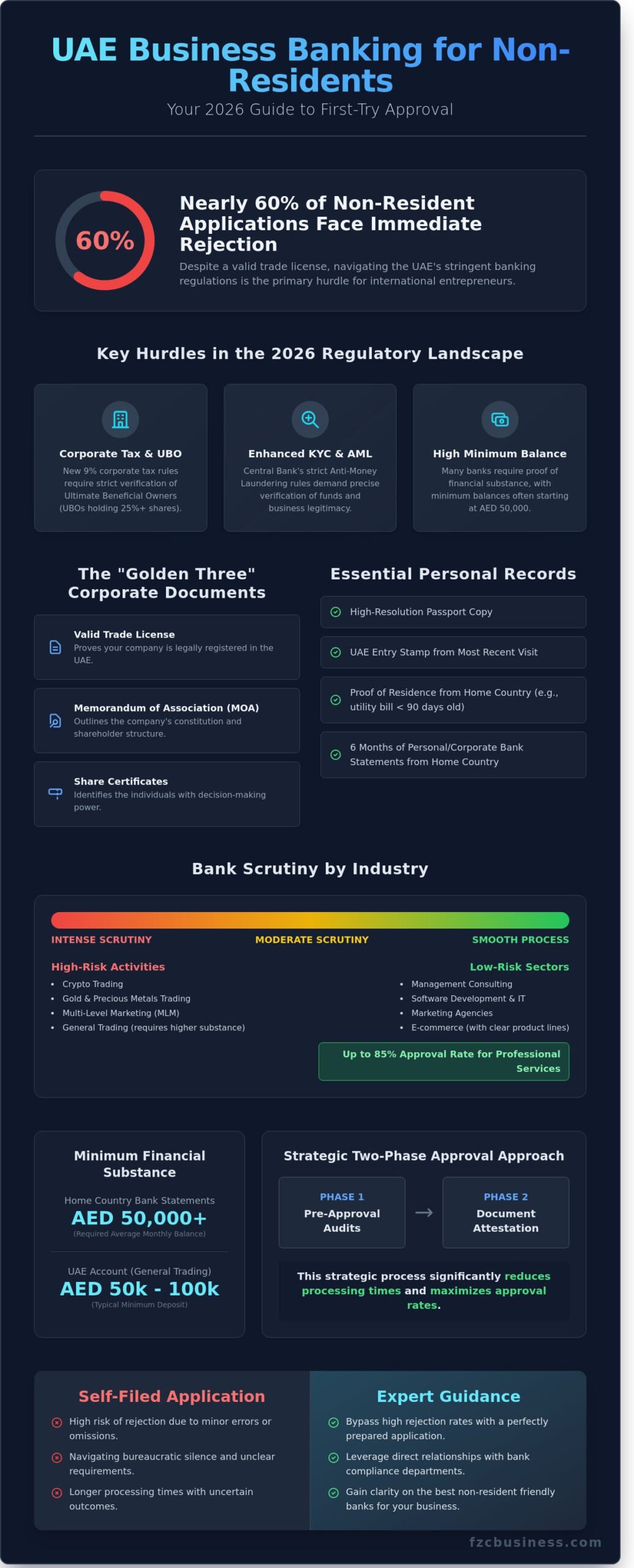
Why do nearly 60% of international entrepreneurs face immediate rejection when applying for a UAE corporate account despite having a valid trade license? While the Emirates offer a world-class financial ecosystem, securing a business bank account for non-residents in uae has become significantly more complex following the 2026 Corporate Tax updates and enhanced KYC protocols. You’ve likely felt the frustration of navigating high minimum balance requirements, which often start at AED 50,000, only to be met with bureaucratic silence. It’s a common struggle for those trying to manage global transactions without a local residency visa.
We’re here to provide the expert guidance you need to turn those rejections into a functional corporate tool. This 2026 guide reveals the exact requirements and strategic steps to ensure your application is approved on the first try. You’ll gain clarity on which banks are currently the most non-resident friendly and how to meet compliance standards without the typical stress. We’ll walk you through the bank options and professional shortcuts that allow you to focus on your business goals rather than paperwork hurdles.
Key Takeaways
- Understand the 2026 regulatory landscape and how to navigate UAE Central Bank AML rules while maintaining 100% foreign ownership.
- Master the “Golden Three” documentation requirements and essential personal records needed to secure your corporate banking infrastructure.
- Evaluate the pros and cons of traditional banking giants versus digital disruptors to find the best business bank account for non-residents in uae.
- Learn a strategic two-phase approach to pre-approval audits and document attestation that significantly reduces processing times.
- Discover how to bypass the high rejection rates of self-filed applications by leveraging expert guidance and direct relationships with bank compliance departments.
Opening a Business Bank Account for Non-Residents in UAE: 2026 Reality Check
Non-resident investors often worry that a lack of local residency blocks access to UAE banking. The reality in 2026 is clear: you can fully own a company and manage a business bank account for non-residents in uae without living in the country. The Economy of the United Arab Emirates remains a global magnet for capital, but the path to opening an account requires navigating a more sophisticated regulatory landscape than in previous years.
Banks distinguish between residency for tax purposes and residency for account operations. While holding a “Partner Visa” serves as a powerful tool to speed up the process, it’s not a legal prerequisite for every bank. Central Bank Anti-Money Laundering (AML) rules are the primary hurdle. These regulations ensure the UAE stays off international “grey lists,” meaning banks must verify the source of your funds and the legitimacy of your business model with surgical precision.
To better understand this concept, watch this helpful video:
Banks are highly selective based on your industry. High-risk activities like crypto trading, gold bullion, or multi-level marketing face intense scrutiny. Conversely, low-risk sectors like management consulting, software development, and marketing agencies enjoy a much smoother experience. At Fast Zone Business, we’ve seen that a well-prepared application focusing on low-risk profiles significantly reduces wait times.
The Legal Framework for Non-Resident Banking
The UAE Central Bank guidelines for 2026 emphasize transparency. Since the full implementation of the 9% Corporate Tax on profits exceeding AED 375,000, banks have integrated tax registration checks into their reporting. You must clearly identify the Ultimate Beneficial Owner (UBO). Anyone holding 25% or more of the company shares must provide personal bank statements and proof of residence from their home country. This framework ensures that the business bank account for non-residents in uae isn’t used for tax evasion or illicit transfers.
Why 2026 is Different for International Investors
Digital KYC (Know Your Customer) verification is now the standard. Many banks have replaced physical meetings with biometric scans and AI-driven document verification. This shift allows for remote applications, though some traditional banks still require a one-time visit. Current trends show that approval rates for professional service licenses are as high as 85%, while general trading licenses for non-residents require a higher minimum balance, often starting at AED 50,000 to AED 100,000, to prove financial substance.
Essential Requirements and Documentation for Non-Resident Corporate Banking
Opening a business bank account for non-residents in uae requires meticulous attention to detail. Compliance standards have tightened significantly as of 2026, meaning your application must be airtight before submission. UAE banks prioritize the “Golden Three” documents to establish legal standing: a valid Trade License, the Memorandum of Association (MOA), and Share Certificates. These documents prove your company is legally registered and clearly identify the individuals who hold decision-making power.
You’ll also need to provide comprehensive personal documentation. This includes high-resolution passport copies and the UAE entry stamp from your most recent visit. Banks require proof of residence from your home country, typically a utility bill or government-issued document dated within the last 90 days. To verify your professional standing and financial stability, you must provide 6 months of personal or corporate bank statements from your home country. These statements should demonstrate consistent cash flow, as many UAE banks now look for an average monthly balance of at least AED 50,000 for entry-level corporate accounts.
Supporting your application with business proof is non-negotiable. This involves submitting recent invoices, signed contracts, or a detailed business plan that justifies the need for a UAE-based account. If you’re targeting local clients, showing intent through draft agreements can expedite the approval process.
The Corporate Profile: What Banks Look For
Your business plan is the most critical tool for satisfying compliance officers. It shouldn’t be a simple summary. It needs to detail your top five suppliers, your top five customers, and your projected annual turnover for the first three years. While virtual offices are common in Free Zones, having a physical office with a registered Ejari (tenancy contract) significantly increases your approval rating. In 2026, 85% of successful non-resident applications included a physical office lease rather than a virtual desk.
- Mainland Companies: Must provide a Department of Economy and Tourism (DET) license and a physical Ejari.
- Free Zone Companies: Require a Certificate of Incorporation and a Lease Agreement from the specific Free Zone Authority.
KYC and Due Diligence for Non-Residents
Banks perform deep dives into your financial background through Know Your Customer (KYC) protocols. You must provide a “Source of Wealth” declaration to explain how you accumulated your total net worth over time. This is different from the “Source of Funds,” which refers specifically to the money used for the initial account deposit. A common pitfall is failing to properly attest documents. If your paperwork originates outside the UAE, it must be legalized by the Ministry of Foreign Affairs in the country of origin and the UAE Embassy.
Economic Substance Regulations (ESR) require non-resident companies to demonstrate they conduct core income-generating activities and maintain a physical presence within the UAE to satisfy 2026 banking compliance standards. If you’re worried about these strict requirements, obtaining expert guidance can prevent your application from being rejected or delayed for several months.
Choosing the Right Bank: Traditional vs. Digital Platforms for Non-Residents
Selecting the right financial partner defines how smoothly your company operates. For those seeking a business bank account for non-residents in uae, the choice generally falls between established traditional giants and the new wave of digital disruptors. By 2026, the gap between these two options has narrowed in terms of technology, yet they serve very different business models and operational needs.
Traditional Banks: Stability and High-Touch Service
Institutions like Emirates NBD, ADCB, and Mashreq remain the preferred choice for companies with high transaction volumes or complex trade finance requirements. These banks offer a level of stability that global investors trust. You should choose a traditional bank if your business requires letters of credit, high-value corporate loans, or a dedicated Relationship Manager. This personal connection is vital in the UAE; a good manager can expedite internal approvals and provide bespoke financial advice tailored to your sector.
However, these benefits come with strict criteria. Most traditional banks require a minimum average balance ranging from AED 50,000 to AED 200,000 for non-resident accounts. Additionally, you must account for the physical presence requirement. Non-resident directors must fly into the UAE for at least one face-to-face meeting with a bank officer to verify identities and sign original documents. It’s a standard compliance step that ensures the bank meets its “Know Your Customer” (KYC) obligations.
Digital Banking: Speed and Accessibility
Digital platforms like Wio Bank and Zand have transformed the market for SMEs and startups. These banks prioritize speed, often allowing you to initiate the application for a corporate bank account UAE via a smartphone app. For a business bank account for non-residents in uae, digital banks are often more flexible with balance requirements. Many offer tiers that start with zero-balance or a low monthly fee of AED 100 to AED 500, making them ideal for new ventures.
Security is a top priority for these disruptors. Both Wio and Zand are fully licensed and regulated by the Central Bank of the UAE, ensuring your funds have the same legal protections as those in a legacy bank. Non-residents can manage these accounts effectively without a local phone number by using international roaming or integrated authentication systems. This accessibility allows you to control your finances from anywhere in the world without the bureaucratic hurdles of traditional branch visits.
Transaction capabilities also differ significantly between the two. Digital banks excel at fast, multi-currency transfers with transparent exchange rates. While traditional banks might take 24 to 48 hours for international wires, digital platforms often settle transfers within the same business day for major currencies like EUR or GBP. Fast Zone Business provides expert guidance to help you choose the platform that matches your specific transaction volume and growth goals.
Navigating the Application Process: A Strategic Step-by-Step Approach
Opening a business bank account for non-residents in uae involves a methodical five-phase strategy. It isn’t just about filling out forms; it’s about presenting a narrative that fits the risk appetite of local financial institutions. Success depends on how well you align your corporate profile with current Central Bank of the UAE regulations.
Phase 1 begins with a pre-approval audit. You must match your business activity to a bank that understands your specific sector. Phase 2 requires meticulous document preparation. You’ll need your Memorandum of Association (MOA), six months of personal bank statements, and proof of address from your home country. All foreign documents must have UAE Embassy attestation to be considered valid.
Phase 3 is the initial submission. This stage triggers the “Compliance Query” round where banks verify your source of wealth and business model. Phase 4 often involves a physical interview. While some digital banks allow remote onboarding, most traditional banks require a one-day visit to Dubai to meet a relationship manager. Finally, Phase 5 is account activation. Once the account is live, you must maintain the required average monthly balance, which typically ranges from AED 50,000 to AED 200,000 for non-resident entities.
The Pre-Compliance Audit
Banks identify “red flags” early in the process. High-risk indicators include cash-heavy business models or owners from jurisdictions under increased international monitoring. Choosing the right free zone company setup UAE is vital because certain banks have “white-listed” specific zones for faster processing. Avoid “General Trading” licenses if your business is specific. In 2026, banks prefer professional service licenses, such as “IT Consultancy” or “Marketing Management,” because they offer transparent transaction trails that are easier to audit.
Handling Bank Queries and Rejections
Expect “Additional Information Requests” (AIR) during the compliance review. You must respond to these within a 48 to 72-hour window. Delays often lead to the immediate closure of your file. If a bank rejects your application, don’t rush an appeal. In 85% of cases, an appeal is unsuccessful. A more effective strategy is a “New Application” with a different bank while refining your business plan to address the previous compliance concerns. The typical timeline for a business bank account for non-residents in uae currently sits between 4 and 8 weeks, depending on the complexity of your corporate structure.
Maximizing Approval Rates with Fast Zone Business Setup Experts
Statistics show that 90% of self-filed applications for a business bank account for non-residents in uae face significant delays or outright rejection. Most entrepreneurs struggle with the intricate KYC (Know Your Customer) requirements and the rigorous Anti-Money Laundering (AML) checks that UAE banks enforce. These rejections aren’t just minor setbacks; they can prevent your business from operating for months. Fast Zone Business eliminates this risk through direct relationships with bank compliance departments across the Emirates. We know which banks are currently onboarding specific industries, ensuring your application lands on the right desk.
Our “Pre-Approval” guarantee is a core part of our mission to provide a smooth experience. We don’t submit your application until our internal experts confirm your profile meets every specific bank’s criteria. From the moment you research how to start a business in Dubai to the day you receive your final bank token, we provide expert guidance at every turn. This proactive approach saves you time and protects your corporate reputation from unnecessary application denials.
A One-Stop Solution for International Entrepreneurs
We bridge the gap between company formation and financial operations. Many consultants leave you with a trade license and no way to move funds. Fast Zone Business is a one-stop destination that integrates setup with tailored PRO services. Our team handles all government and bank documentation to ensure flawless paperwork. In February 2024, we assisted a non-resident consultant in opening a corporate account in under 4 weeks by matching their activity with a partner bank’s specific 2026 risk profile.
Take the First Step Toward Your UAE Business Goals
Successful entrepreneurs start their banking journey at the same time they initiate company setup. Waiting until your license is printed to look for a bank leads to costly downtime. Our banking specialists synchronize these processes, so your account is ready shortly after your license is finalized. You can focus on your core business while we handle the bureaucratic hurdles. Book your free consultation with a Fast Zone specialist today to secure your business bank account for non-residents in uae with total confidence.
- Do you have a comprehensive 12-month business plan?
- Is your source of wealth documentation ready for verification?
- Have you identified your primary target markets and suppliers?
- Is your business activity compatible with your chosen bank’s appetite?
Secure Your UAE Corporate Banking Future Today
The 2026 regulatory environment requires a precise strategy for documentation and compliance. Success hinges on selecting the right institution and passing rigorous pre-compliance checks. Opening a business bank account for non-residents in uae is a critical milestone that demands expert oversight to avoid common rejection pitfalls. Fast Zone Business brings 10+ years of UAE company formation expertise to your application process. We serve as official banking partners with Emirates NBD and RAKBANK, providing you with a direct line to established financial institutions. Our specialists perform hassle-free pre-compliance document auditing to ensure your file is flawless before submission. This methodical approach minimizes delays and maximizes your approval rates. You don’t need to navigate complex banking hurdles alone when professional guidance is available. We’re here to bridge the gap between your international ambitions and the local banking sector. Take the first step toward financial readiness in a thriving market. Book a FREE Consultation with our Banking Experts today. Your business deserves a smooth start in the Emirates.
Frequently Asked Questions
Can a non-resident open a business bank account in the UAE without a visa?
Yes, you can open a business bank account for non-residents in uae without a residency visa, but options are often limited to specific account types. Most local banks require a UAE residency visa for full-featured corporate accounts. However, non-residents can still access banking services by choosing offshore structures or digital banking platforms that cater to international entrepreneurs. Expect rigorous compliance checks during this process.
What is the minimum balance required for a non-resident business account in 2026?
Minimum average monthly balances for non-resident accounts typically range from AED 50,000 to AED 200,000. High-tier institutions like Emirates NBD or ADCB often set these thresholds at the higher end for international entities to mitigate risk. If your balance falls below the agreed limit, banks usually charge a monthly penalty fee ranging from AED 250 to AED 500.
How long does it take to open a corporate bank account for a non-resident?
The approval process generally takes between 4 to 8 weeks in 2026. This timeline includes the mandatory enhanced due diligence required for non-resident profiles. Providing a complete document set, including six months of certified bank statements from your home country, ensures a smooth experience. Our expert guidance helps speed up this timeline by ensuring your application is right the first time.
Do I need to be physically present in the UAE to open the account?
Yes, you must be physically present in the UAE for the final signature and identity verification. While you can initiate the application remotely, UAE Central Bank regulations require at least one face-to-face meeting with a bank officer. This visit usually requires only 1 to 2 business days. It’s a vital step to ensure your account remains compliant with local anti-money laundering laws.
Which UAE banks are the most friendly toward non-resident business owners?
Wio Bank, Mashreq Bank, and Emirates NBD are currently the most accessible options for a business bank account for non-residents in uae. Wio Bank offers a digital-first approach that’s popular with tech startups. Traditional banks like ADCB also provide specialized services for international clients, provided you can maintain a higher capital requirement and provide clear proof of business activity.
Will my UAE business bank account be affected by 2026 Corporate Tax?
Your account will be subject to the 9% UAE Corporate Tax if your taxable income exceeds the AED 375,000 threshold. Banks now require all corporate clients to provide a Tax Registration Number to ensure full compliance with Federal Tax Authority regulations. If your annual revenue is below AED 3 million, you might still qualify for small business relief, which simplifies your reporting requirements.
Can I open a multi-currency account as a non-resident?
Most UAE banks provide multi-currency accounts that support AED, USD, EUR, and GBP as standard features. This is a crucial tool for non-residents who manage international trade and want to avoid constant currency conversion costs. You can hold and manage these different currencies within a single banking portal. Transaction fees for international transfers will vary depending on the specific bank’s fee schedule.
What happens if my business bank account application is rejected?
If your application is rejected, the bank will notify you, though they rarely disclose the specific internal risk reason. You should immediately review your business plan and documentation for any inconsistencies or missing information. We provide a hassle-free re-application strategy by matching your business profile with a different bank that has a higher risk appetite for your specific industry or nationality.
