

Securing an SME Loan in the UAE Without a Credit History: A 2026 Guide
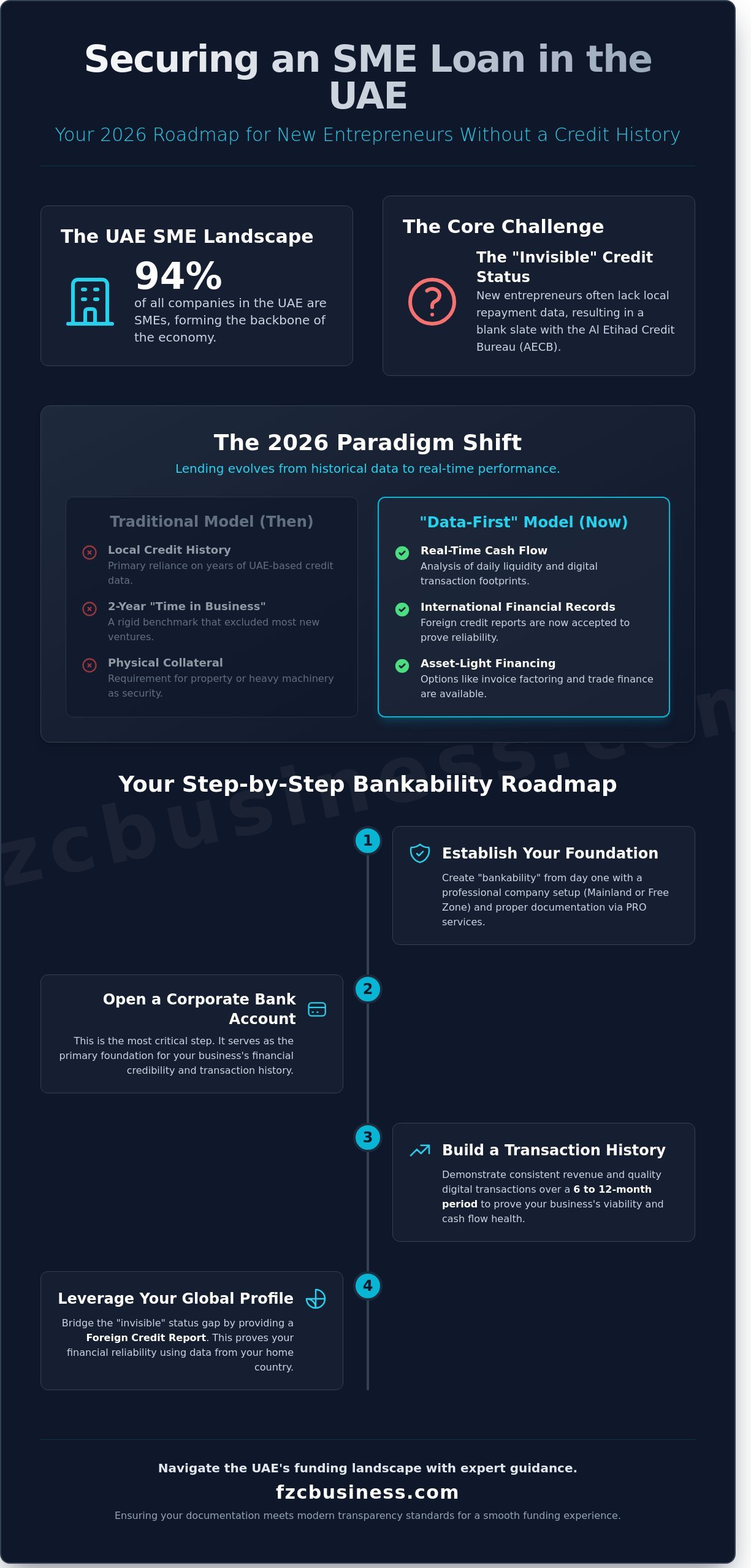
What if the “No” you received from a traditional bank wasn’t a dead end, but a signal that you’re simply looking in the wrong place? According to the UAE Ministry of Economy, SMEs represent 94% of all companies operating in the country, yet many entrepreneurs face immediate rejection because of an “invisible” credit status. You’ve launched your venture with a clear vision, but securing an sme loan in uae without a credit history often feels like an impossible hurdle when you lack local records or physical collateral. It’s a common struggle. You shouldn’t have to stall your growth because of rigid requirements that don’t account for the reality of a modern startup.
This guide provides the exact roadmap to making your new UAE business bankable and securing funding even with a zero-credit starting point in 2026. We’ll break down how to leverage alternative lending criteria and access government-backed sources like the Emirates Development Bank. Our goal is to help you create a financial profile that commands respect from day one. You’ll gain the expert guidance needed for a smooth experience, turning your business into a trusted entity that lenders are eager to support.
Key Takeaways
- Understand the 2026 shift toward “Data-First” lending and how to leverage daily cash flow instead of years of local credit history.
- Discover the specialized protocols for securing an sme loan in uae without a credit history by utilizing your international financial track record.
- Navigate the local funding landscape by comparing traditional commercial bank loans with government-backed schemes like the MBRIF.
- Learn how professional setup and PRO services establish “bankability” from day one, ensuring your documentation meets strict bank requirements.
- Identify the critical steps for opening a corporate bank account that serves as the primary foundation for your business’s financial credibility.
The Reality of SME Financing in the UAE for New Entrepreneurs in 2026
Entering the Dubai or Abu Dhabi market in 2026 presents a unique paradox for founders. While the UAE government targets a 50% contribution to GDP from SMEs by 2030, many new arrivals find themselves “invisible” to the Al Etihad Credit Bureau (AECB). This invisibility occurs because the AECB requires localized historical repayment data to generate a score. If you haven’t managed a loan or credit card within the Emirates, your profile remains a blank slate. This lack of history isn’t an automatic rejection. Instead, it serves as a requirement for higher transparency in other areas of your business operations.
To better understand how banks evaluate these applications, watch this helpful video:
Securing an sme loan in uae without a credit history is no longer the roadblock it was five years ago. By January 2026, UAE banks have transitioned toward ‘Data-First’ lending models. This approach prioritizes your real-time cash flow and digital transaction footprints over years of past credit cycles. It’s vital to distinguish between your personal credit score and your corporate profile. While lenders still look at your personal behavior, the health of your business bank account takes center stage in the 2026 lending environment.
Understanding the AECB and Your Business Profile
The AECB tracks every financial move, from utility payments to credit card cycles. New expats often arrive with high scores from their home countries, but these don’t automatically transfer to the UAE system. You start with a blank slate. To bridge this gap, many banks now accept a Foreign Credit Report. This document allows you to prove your financial reliability using data from your previous country of residence. It’s a critical tool for securing an sme loan in uae without a credit history during your first 12 months of operation.
Why Traditional Banks Are Hesitant (and How to Pivot)
Traditional lenders remain cautious because their risk assessment models historically relied on a two-year “Time in Business” benchmark. However, the 2026 market favors the “Quality of Transactions.” If your business shows consistent revenue through digital gateways, you’ve found the sweet spot. This shift is supported by broader UAE Entrepreneurship Policies that encourage banks to support innovation over traditional collateral. If you’re operating in a Free Zone or on the Mainland, getting expert guidance from a partner like Fast Zone Business ensures your documentation meets these modern transparency standards. We help you move from being an “invisible” entity to a credible borrower through methodical financial structuring.
How Banks Evaluate SMEs Without a UAE Credit History
UAE lenders are rapidly evolving their assessment models to support the growing entrepreneurial ecosystem. They recognize that a lack of local credit history doesn’t automatically equate to high risk. Instead of relying solely on years of data from the Al Etihad Credit Bureau (AECB), banks now prioritize cash-flow-based lending. This method analyzes your daily liquidity and transaction volume rather than historical debt cycles. If your business demonstrates consistent revenue over a 6 to 12-month period, you become a viable candidate for securing an sme loan in uae without a credit history.
The landscape is shifting toward global integration. By 2026, new international protocols will allow UAE banks to access and verify credit reports from an entrepreneur’s home country more efficiently. This change benefits expats who have strong financial backgrounds in markets like the UK, India, or Europe. For businesses that don’t own property or heavy machinery, the “asset-light” approach is a game changer. Lenders now offer trade finance and invoice factoring, where the loan is secured against your accounts receivable or confirmed purchase orders rather than traditional collateral.
Your choice of banking partner is the most critical factor in this process. Tier-1 traditional banks often have rigid criteria, while newer digital-first banks and specialized SME lenders are more comfortable with alternative data. Finding the right fit requires understanding which institutions value your specific industry and transaction patterns.
Alternative Metrics: What Lenders Look for Instead
Lenders focus on operational health when credit scores are absent. Maintaining a minimum average monthly balance is a primary requirement. Most UAE banks expect to see between AED 25,000 and AED 50,000 in your account to demonstrate stability. Consistent VAT filings with the Federal Tax Authority (FTA) also serve as concrete proof of active operations. Furthermore, banks evaluate the “Reputation Score” of your business partners. If you’re a supplier for government entities or established multinationals, lenders view your future revenue as highly secure.
The Power of Corporate Bank Account Activity
Your first 6 months of banking activity act as your “real” credit history in the Emirates. Banks scrutinize this period for returned cheques or frequent balance dips below the required threshold. To maintain a healthy profile, ensure all utility bills, office rents, and employee salaries are processed through the corporate account from day one. This builds a pattern of professional reliability that lenders trust. If you’re just starting, you should review our guide on how to open a corporate bank account in the UAE to set the right foundation.
Navigating these requirements is much simpler with the right strategy. You can book a free consultation with our team to evaluate your current cash flow and identify the best lending options for your specific business stage.
Navigating Funding Options: Traditional Banks vs. Government Schemes
Choosing between a commercial bank and a government-backed fund is a critical decision for new entrepreneurs. Commercial banks often require 2 to 3 years of audited financial statements and a high credit score. This makes securing an sme loan in uae without a credit history through traditional channels difficult. Government schemes serve as a bridge, offering guarantees that lower the entry barrier for startups and small businesses.
Government-Backed SME Support Programs
The Emirates Development Bank (EDB) is a primary driver of SME growth in the region. In April 2021, the EDB launched a strategy to provide AED 30 billion in financial support to 13,500 SMEs by 2025. Their credit guarantee scheme is particularly effective for new businesses. The EDB guarantees up to 50% of the loan facility to partner commercial banks, which significantly lowers the risk for the lender. This program prioritizes sectors that align with the UAE’s long-term industrial goals:
- Manufacturing: Supporting local production and the diversification of supply chains.
- Technology: Funding for AI, robotics, and advanced software development.
- Healthcare and Food Security: Loans for medical tech and local agricultural innovations.
- Green Energy: Financing for renewable energy projects and sustainable infrastructure.
The Mohammed bin Rashid Innovation Fund (MBRIF) focuses on tech-driven startups through its Guarantee Scheme. It targets seven specific sectors including health, transport, and space. For Abu Dhabi-based entities, the Khalifa Fund provides specialized support and interest-free loans. These programs focus more on your business plan and potential economic impact than on a long credit history. Expert guidance from Fast Zone Business can help you align your application with these specific government mandates.
Fintech and Non-Traditional Lenders
Fintech platforms offer flexible alternatives to the rigid structures of legacy banks. Peer-to-peer (P2P) lending allows businesses to borrow directly from individual and institutional investors. This model relies on real-time data and cash flow analysis rather than historical credit reports. Invoice discounting is another powerful tool for B2B startups. It allows you to access up to 80% of the value of your outstanding invoices immediately, providing vital liquidity without waiting for 60-day or 90-day payment terms.
Revenue-based financing is an emerging trend expected to dominate the UAE e-commerce sector by 2026. Instead of fixed monthly payments, you repay a percentage of your monthly revenue. This ensures your debt obligations fluctuate with your actual income. For high-growth startups, venture debt provides a way to extend your cash runway without further diluting your equity. It’s an efficient solution for companies that have already secured initial venture capital but need additional working capital to scale operations quickly.
Step-by-Step Guide: Preparing Your SME for Loan Approval
Preparation is the bridge between a rejected application and a funded business. When you’re securing an sme loan in uae without a credit history, your operational setup speaks for you. Start by choosing a legal structure that banks trust. While free zones offer 100% ownership, many local lenders prefer Dubai Mainland licenses because they signal a long-term commitment to the local economy and allow for unrestricted trade across the Emirates.
Next, you must open and actively manage a corporate bank account. Lenders look for consistent cash flow over a six-month to one-year period. Pair this with VAT registration. Even if your turnover hasn’t hit the mandatory AED 375,000 threshold, voluntary registration at AED 187,500 creates a verified financial trail. Banks see VAT returns as government-stamped proof of your revenue, which is a critical component of securing an sme loan in uae without a credit history.
Your business plan needs to be “bank-ready.” This means including realistic three-year projections, a clear Debt Service Coverage Ratio (DSCR), and a defined exit strategy. Don’t handle the paperwork alone. Expert PRO services ensure every government approval from the Ministry of Human Resources and Emiratisation (MOHRE) to the Department of Economy and Tourism (DET) is flawless. This prevents technical rejections that could delay your funding by months.
The Importance of Jurisdiction in Funding
Banks maintain “Appetite Lists” that categorize business activities by risk level. Mainland companies often face fewer hurdles because they operate under direct DET oversight, providing higher transparency for credit officers. If you’re in a Free Zone, you can overcome financing limitations by partnering with specific banks that specialize in your zone’s industry niche. For instance, a tech firm in Dubai Internet City may find better success with a digital-first bank than a traditional retail lender.
Crafting the Ultimate SME Loan Application
Gather your trade license, Memorandum of Association (MOA), passport copies, and a valid Ejari. Your “Use of Funds” sentence must be precise. Instead of saying “for growth,” write: “This AED 250,000 facility will purchase three specialized delivery vehicles to service 15 new corporate contracts in Sharjah.” Providing audited financials, even if your revenue is below the legal requirement of AED 50,000,000, demonstrates a level of professional maturity that builds immediate lender confidence.
Ready to build a bankable business? Book your free consultation with our setup experts today.
The Foundation of Funding: How Proper Setup Facilitates Financing
Your company’s path toward securing an sme loan in uae without a credit history begins the day you register your trade license. Bankability isn’t a fluke; it’s the result of meticulous planning and administrative precision. When you register your trade license, you’re essentially creating a financial resume that local lenders will scrutinize before approving any capital injections. Banks in the UAE prioritize stability, and a license that exactly matches your business activities reduces perceived risk.
Professional PRO services act as a shield against the administrative failures that often trigger loan rejections. Industry data suggests that roughly 30% of business loan applications in the UAE face delays or denials due to inconsistent documentation or expired legal permits. Precise filings, timely visa renewals, and accurate activity descriptions build a profile of reliability. This operational transparency is what lenders look for when traditional credit scores aren’t available to prove your worthiness.
There’s a powerful synergy between your legal structure and your financial trust. Holding a valid residency visa linked to a properly structured Mainland or Free Zone entity demonstrates a long-term commitment to the UAE market. For instance, the UAE Ministry of Economy reports that SMEs contribute over 60% to the non-oil GDP, and banks are increasingly under pressure to support these entities. However, they’ll only do so if your business is positioned as a stable, permanent fixture rather than a transient operation.
How Fast Zone Business Supports Your Financial Journey
We provide the expert guidance needed to choose a jurisdiction that favors future funding. Not all zones are equal when it’s time to open a corporate bank account or apply for credit. Our team offers:
- Strategic advice on selecting trade activities that banks view as “low-risk.”
- Hassle-free PRO services to ensure your legal status remains pristine and audit-ready.
- Customized support for starting a business in Dubai with a focus on long-term scalability.
Next Steps for Your SME Funding
Success in securing an sme loan in uae without a credit history requires a proactive approach. Before approaching a lender, you should conduct a “Pre-Loan Audit” of your business documents. This includes verifying that your last 6 to 12 months of bank statements show consistent activity and ensuring all corporate documents are attested by the relevant authorities. A clean administrative record is your strongest asset.
Don’t let bureaucratic hurdles or documentation errors slow your momentum. Our specialists are ready to help you build a bankable business from the ground up. Book your FREE consultation with Fast Zone Business today and take the first step toward a funded future.
Build a Bankable Future for Your UAE Venture
Navigating the financial landscape of the Emirates requires more than just a great idea; it demands a strategic approach to documentation and compliance. By 2026, UAE lenders have shifted focus toward robust cash flow projections and transparent corporate structures rather than relying solely on historical data. While the challenge of securing an sme loan in uae without a credit history exists, leveraging government-backed initiatives and maintaining impeccable financial records can bridge the gap. Your success starts with a legal foundation that meets every regulatory requirement from day one. It’s about showing lenders that your business is built on stable ground.
Fast Zone Business provides the expert guidance you need to navigate company formation and banking facilitation with ease. As a one-stop destination for PRO and visa services, we utilize our proven track record with trusted UAE banking partners to streamline your path to funding. Don’t let bureaucratic hurdles delay your vision. Secure your business foundation and book a FREE consultation with Fast Zone Business to ensure your setup is optimized for growth. The UAE market offers immense potential for prepared entrepreneurs, and your journey toward a successful enterprise starts today.
Frequently Asked Questions
Can I get a business loan in the UAE as a new expat?
Yes, you can obtain a business loan as a new expat by leveraging government-backed schemes or providing personal guarantees. Most local banks require a valid residency visa and at least 6 to 12 months of local bank statements to verify your financial activity. Our expert guidance helps you navigate these requirements to ensure a smooth experience during the application process.
How much can a startup borrow in the UAE without collateral?
Startups can typically secure unsecured loans ranging from AED 100,000 to AED 500,000 depending on the lender’s specific criteria. Some specialized SME programs offered by major banks provide up to AED 1 million without physical collateral if the business demonstrates a consistent monthly turnover. We use our in-depth knowledge to match your startup with banks that prioritize cash flow over fixed assets.
What is the minimum time a business must be active to apply for a loan?
Most UAE financial institutions require your business to be operational for at least 2 years before you qualify for standard financing. However, certain startup-specific products allow you to apply after only 12 months of active trading. You’ll need to show a minimum monthly turnover of AED 50,000 to access these early-stage loan facilities.
What happens if I have a bad credit score in my home country?
UAE banks primarily focus on your Al Etihad Credit Bureau (AECB) report, but they may check international records for significant loan amounts. Securing an sme loan in uae without a credit history or with a poor international score is possible if you provide a 20% to 30% security deposit or show strong local revenue. It’s vital to build your local credit profile early to avoid bureaucratic hurdles later.
Is VAT registration mandatory for securing an SME loan?
VAT registration is mandatory if your annual taxable turnover exceeds AED 375,000, and banks require these certificates to verify your revenue. If your turnover is between AED 187,500 and AED 375,000, voluntary registration is highly recommended to improve your loan eligibility. This transparency provides the expert guidance banks need to trust your financial health.
Can Free Zone companies apply for loans from mainland banks?
Free Zone companies can absolutely apply for loans from mainland banks, though the due diligence process is often more rigorous. Banks like Emirates NBD or Mashreq have dedicated units for Free Zone SMEs that usually require a physical office lease and a minimum of 1 year of operation. We help you prepare the necessary documentation to ensure a hassle-free application regardless of your jurisdiction.
What is the average interest rate for SME loans in the UAE in 2026?
Interest rates for SME loans in 2026 are projected to average between 10% and 18% per annum on a reducing balance basis. These rates fluctuate based on your company’s risk profile and industry sector. Manufacturing and technology firms often access lower rates through the AED 30 billion Emirates Development Bank (EDB) funding initiative designed to spur industrial growth.
