

E-commerce License Dubai Cost 2026: The Ultimate Setup Guide
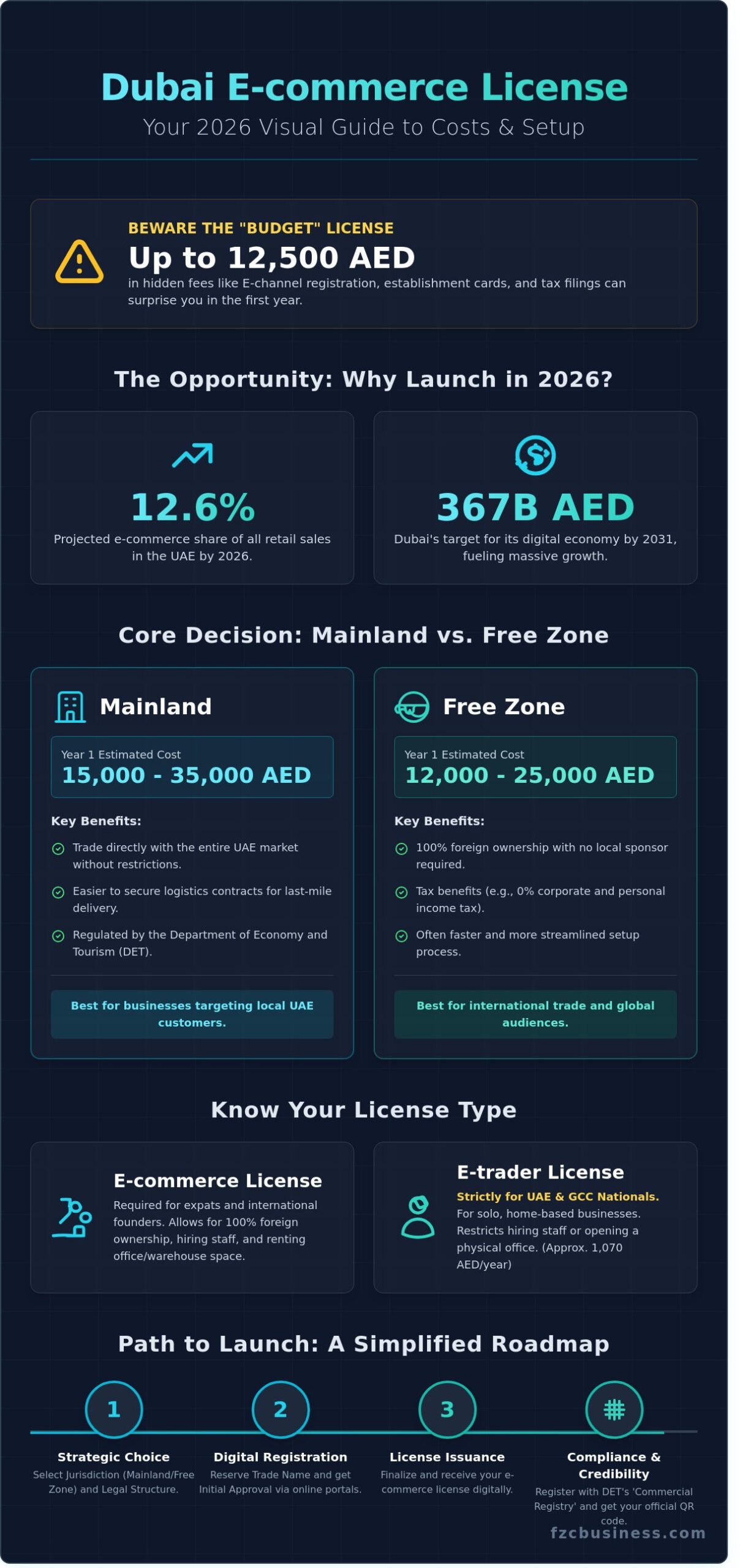
What if the cheapest e-commerce license you find today actually costs you an extra 12,500 AED in hidden administrative fees before your first anniversary? Many entrepreneurs discover too late that a “budget” package often excludes mandatory costs like E-channel registration, establishment cards, or the 9% UAE Corporate Tax compliance filings. You want to focus on scaling your brand, not spending weeks untangling bureaucratic red tape or worrying if you picked the wrong jurisdiction for your business model.
Your digital storefront also carries transaction costs. Payment gateways like Stripe, Telr, or Checkout.com are standard for UAE e-commerce. These providers generally charge a setup fee of AED 1,000 to AED 2,000, plus transaction fees averaging 2.2% to 2.9% plus AED 1 per order. When you aggregate these operational needs with a budget for customer acquisition through Performance Marketing, the initial e-commerce license dubai cost is just one piece of a larger financial puzzle. Planning for these variables early ensures your cash flow remains healthy during the critical first year of growth.
We’re providing a transparent, line-item breakdown of the e-commerce license dubai cost for 2026 to ensure you don’t face any financial surprises. This guide offers expert guidance on every dirham required to launch, whether you’re looking at Free Zone setups starting around 5,700 AED or comprehensive Mainland structures. We’ll outline a complete year-one budget, compare the benefits of different zones, and show you how to maintain full legal compliance. You’ll gain the clarity needed to make a confident decision and ensure a smooth, hassle-free start for your online venture.
Key Takeaways
- Discover why 2026 is the strategic year to launch your online venture within the UAE’s rapidly growing and paperless digital economy.
- Gain a clear comparison of the e-commerce license dubai cost between Mainland and Free Zone jurisdictions to optimize your initial investment.
- Follow a streamlined, step-by-step roadmap to navigate legal structures and trade name registrations for a hassle-free setup experience.
- Identify often-overlooked operational expenses, such as corporate tax compliance and bank account requirements, to prevent future financial surprises.
- Learn how expert guidance can safeguard your business from costly penalties while providing a comprehensive solution for visas and licensing.
The E-commerce Landscape in Dubai: Why 2026 is the Year to Start
Dubai’s digital economy isn’t just growing; it’s accelerating toward a 2031 target of AED 367 billion. By 2026, the e-commerce sector is projected to account for 12.6% of all retail sales in the UAE, driven by a tech-savvy population and high mobile penetration. This rapid expansion creates a massive opportunity for founders looking to capture a share of the high-spending local market. Understanding the UAE Economic Overview is vital because it highlights the nation’s successful pivot from oil-dependency to a global tech-driven powerhouse.
The 100% Paperless Dubai strategy has transformed the setup process for new entrepreneurs. You can now secure your business credentials via digital portals like ‘Invest in Dubai’ in less than 15 minutes. This digital efficiency reduces the initial e-commerce license dubai cost by eliminating redundant administrative fees and physical paperwork. Dubai remains the top choice for 90% of regional startups because of its world-class logistics infrastructure and the presence of over 50 commercial banks that cater specifically to digital trade.
To better understand the financial requirements for setting up your online business, watch this helpful video:
Choosing the right legal structure is your first major hurdle. An e-commerce license specifically permits the sale of goods and services over social media or websites. It differs from a general trading license, which carries a higher annual fee and is designed for diverse physical import-export activities. For most online retailers, the specialized e-commerce path offers a more affordable entry point and a faster route to market. Calculating your total e-commerce license dubai cost requires looking at both the registration fees and the mandatory ‘Commercial Registry’ deposits.
E-commerce vs. E-trader License: Which Do You Need?
The DED E-trader license, often called Tajer Dubai, is strictly for UAE and GCC nationals who want to run solo, home-based businesses. It costs approximately AED 1,070 annually but restricts the holder from opening a physical office or sponsoring employees. Expats and international founders must opt for a full E-commerce license. This structure allows for 100% foreign ownership in both mainland and Free Zone jurisdictions, providing the scale needed to hire staff and rent warehouse space for inventory.
The Role of the Department of Economy and Tourism (DET)
The DET regulates all mainland digital trade in Dubai. In 2026, the DET has deepened its integration with Free Zone authorities to create a unified ‘Commercial Registry.’ This registry acts as a digital trust mark for your customers. When you register with the DET, your business is assigned a unique QR code. This code proves to payment gateways and shoppers that your brand is a legal, tax-compliant entity. It’s a critical step for building long-term credibility in the competitive Middle Eastern market.
E-commerce License Dubai Cost: Mainland vs. Free Zone Comparison
Choosing between a Mainland and Free Zone setup is the most significant factor affecting your initial investment. For 2026, the baseline e-commerce license dubai cost in a Free Zone typically ranges from AED 12,000 to AED 25,000. In contrast, a Mainland license starts higher, generally between AED 15,000 and AED 35,000. These figures represent the entry-level administrative fees and don’t account for mandatory deposits or additional visas.
While Free Zones offer 100% foreign ownership and tax benefits, the Mainland allows you to trade directly with the local UAE market without a distributor. This distinction is vital because the eCommerce Market in the UAE is expanding rapidly, and Mainland companies often find it easier to secure logistics contracts for last-mile delivery. Your choice depends on whether you’re targeting a global audience or the local domestic population.
Free Zone E-commerce Costs: Popular 2026 Options
Free Zones remain the top choice for startups due to their streamlined processes. Meydan Free Zone is a leader in 2026, offering zero-visa packages starting around AED 12,500. If you need a multi-visa setup for a growing team, expect to pay approximately AED 3,500 to AED 5,000 per additional visa. IFZA (International Free Zone Authority) is another powerful contender, specifically designed for remote founders who want to manage their e-commerce license dubai cost without physical office overheads. For those on a tighter budget, SHAMS (Sharjah Media City) provides a cost-effective alternative just outside Dubai, with packages often priced 15% lower than Dubai-based zones while still offering full access to Dubai’s logistics hubs.
Mainland E-commerce Costs: When is the Premium Worth It?
Mainland setups involve a different fee structure that includes “Market Fees,” which are calculated as 5% of your annual office rent. This is a recurring cost that Free Zone companies typically avoid. You’ll also need to budget for a Local Service Agent (LSA). While 100% foreign ownership is now common for e-commerce, the LSA handles government liaisons for a fixed annual fee, usually ranging from AED 7,000 to AED 15,000. A Mainland license is essential if you plan to bid on B2G (Business-to-Government) contracts, as government entities rarely partner with Free Zone entities for domestic procurement.
The number of visas you request will drastically change your upfront capital requirements. Each visa involves medical fitness tests, Emirates ID fees, and e-vision permits. For 2026, budgeting AED 6,000 per employee is a safe estimate to cover these administrative hurdles. Additionally, consider the office requirement. Free Zones allow for “Virtual Desks” or “Flexi-desks,” which are included in the license fee. However, if your e-commerce model requires a physical warehouse for inventory, a Mainland license is often more practical. Renting a 1,000-square-foot warehouse in areas like Al Quoz or Dubai Investment Park can add AED 50,000 to AED 80,000 to your annual operating budget.
Understanding these variables ensures you don’t face unexpected bills during the registration process. If you’re unsure which jurisdiction fits your 2026 growth plan, you can book a free consultation with our team to get a customized quote. Our expert guidance helps you identify the most efficient path to market entry while keeping your initial costs predictable and transparent.
Step-by-Step Guide to Securing Your E-commerce License
Securing your setup in Dubai requires a methodical approach to ensure compliance with the Department of Economy and Tourism (DET) or your chosen Free Zone authority. Our expert guidance streamlines this journey, turning a complex bureaucratic process into a smooth experience for your brand. We focus on efficiency so you can launch your platform without unnecessary delays.
First, you’ll choose your legal structure. An LLC offers limited liability protection for multiple partners, while a Sole Establishment allows 100% ownership for a single individual. In 2026, approximately 85% of new digital startups opt for an LLC structure to facilitate easier corporate banking and future scaling. Once decided, you’ll register your trade name and obtain initial approval, which serves as the government’s “no objection” to your business start. This initial approval is valid for six months, giving you time to finalize your documentation.
The next phase involves drafting the Memorandum of Association (MOA) for mainland companies or the Local Service Agent (LSA) agreement. You’ll then finalize your physical or virtual office lease. Mainland businesses require an Ejari certificate, while Free Zone entities typically utilize a Flexi-desk or a smart office solution. Finally, after paying the calculated e-commerce license dubai cost, which generally ranges from AED 14,500 to AED 28,000 depending on your specific jurisdiction and visa requirements, you’ll receive your digital trade license and can begin operations immediately.
Trade Name Reservation and Activity Selection
Naming your business involves more than just branding; it’s a legal requirement with strict parameters. Avoid using “Global,” “International,” or “Middle East” unless you’re prepared for additional government fees, often exceeding AED 2,000. You must also select the correct activity code. Choosing ‘Portal’ versus ‘Retail Sale via Internet’ changes your operational scope and your e-commerce license dubai cost significantly. For detailed regulatory requirements, consult the Official UAE Government eCommerce Guidelines to ensure your chosen activity matches your business model. Adding more than three activities usually adds AED 1,000 per activity to your total invoice.
The Golden Visa and Residency Link
In 2026, an e-commerce license is a primary gateway to long-term residency. Entrepreneurs who meet specific revenue benchmarks, such as a documented annual turnover of AED 2 million or a certified business valuation, can qualify for the 10-year Golden Visa. This provides unparalleled stability for your family and team. Standard residency costs include AED 320 for medical fitness tests and AED 370 for Emirates ID processing. If you’re managing family sponsorship, expect to budget approximately AED 4,500 per dependent for entry permits and status adjustments. Our team ensures these steps are hassle-free, allowing you to focus on your digital growth while we handle the PRO services and government liaisons.
Beyond the License: Hidden Costs and Operational Expenses
Calculating the total e-commerce license dubai cost requires looking past the initial government registration fees. While your license is the legal foundation, operational expenses and compliance mandates dictate your actual first-year budget. Entrepreneurs often overlook the financial commitments required to keep a business active and compliant with UAE regulations. You’ll need to account for tax registrations, banking maintenance, and the technical infrastructure that facilitates online sales.
Tax compliance is a primary factor in 2026. Since the implementation of Corporate Tax, businesses must register with the Federal Tax Authority (FTA). You’ll face a 9% tax rate on net profits exceeding AED 375,000. Even if you don’t reach this profit level, annual filing is mandatory. Separately, Value Added Tax (VAT) registration becomes compulsory once your taxable turnover hits the AED 375,000 threshold. Many startups opt for voluntary registration at AED 187,500 to reclaim VAT on setup expenses. Professional accounting services to manage these filings typically range from AED 1,500 to AED 5,000 per month depending on transaction volume.
Banking and Financial Compliance
Opening a corporate bank account is often the most time-consuming part of the setup. Banks in the UAE frequently categorize new e-commerce entities as “high-risk” due to the nature of digital transactions and potential for chargebacks. This classification can lead to monthly service fees or the requirement of a high minimum average balance, often ranging from AED 25,000 to AED 100,000. Utilizing PRO services helps expedite these approvals by ensuring your documentation meets specific KYC (Know Your Customer) standards. In 2026, jurisdictions like DMCC and DIFC mandate annual audits, which add an extra AED 3,000 to AED 7,000 to your yearly overhead.
Logistics and Warehousing Costs
If you’re selling physical goods, logistics will be your largest recurring expense. “Last Mile” delivery partnerships in Dubai, involving providers like Aramex or Fetchr, cost between AED 18 and AED 30 per delivery. For storage, a third-party logistics (3PL) provider is usually more cost-effective than renting a private warehouse, which requires a minimum of 1,000 square feet in most industrial zones. Don’t forget the Import/Export code registration with Dubai Customs. This costs approximately AED 1,070 and is essential for moving goods across the UAE border.
Your digital storefront also carries transaction costs. Payment gateways like Stripe, Telr, or Checkout.com are standard for UAE e-commerce. These providers generally charge a setup fee of AED 1,000 to AED 2,000, plus transaction fees averaging 2.2% to 2.9% plus AED 1 per order. When you aggregate these operational needs, the initial e-commerce license dubai cost is just one piece of a larger financial puzzle. Planning for these variables early ensures your cash flow remains healthy during the critical first year of growth.
Ready to build a realistic budget for your online venture? Book a free consultation today to get a customized cost breakdown for your specific business model.
Why Professional Assistance is the Most Cost-Effective Choice
Saving money on your e-commerce license dubai cost doesn’t mean choosing the lowest sticker price you find on a flyer. Real savings come from avoiding administrative errors that drain your capital before you’ve even made your first sale. Many entrepreneurs attempt the DIY route only to find themselves caught in a “fine trap” where incorrect activity selection or late document submissions result in penalties exceeding AED 10,000. In 2025, data showed that 18% of new startups faced avoidable fines simply because they missed a regulatory update or filed paperwork in the wrong jurisdiction.
Fast Zone Business acts as your one-stop destination for growth. We don’t just hand you a trade license; we manage the entire ecosystem required to trade legally and effectively. This includes managing your residency visas, securing your establishment card, and navigating the complexities of corporate bank account opening. Currently, self-filed bank applications in the UAE face a 65% rejection rate due to incomplete compliance profiles. Our team ensures your profile meets specific banking criteria on the first attempt, saving you months of delays and lost revenue.
Customization is the key to long-term financial health. A “cheap” AED 6,000 package often balloons during the second year when hidden renewal fees or mandatory office requirements surface. We analyze your 2026 business goals to ensure your setup is scalable. If you plan to hire five employees by December, a setup that limits you to two visas will cost you more in amendment fees later. We provide a transparent breakdown so your e-commerce license dubai cost remains predictable from day one through your first renewal.
The Fast Zone Methodology
Our approach is built on speed and direct access. We utilize direct government relations to bypass bureaucratic delays, often securing your initial approval for e-commerce activities within 48 hours. You won’t find hidden “consultancy fees” added midway through our process. Our pricing is fixed and transparent, ensuring you can allocate your budget toward inventory and marketing rather than unexpected legal costs. We’ve optimized every step to move your application through the Department of Economy and Tourism or specific Free Zone authorities with zero friction.
Start Your Journey Today
Before you pay any government fees, it’s vital to secure a free expert consultation to verify your business structure. We help you evaluate over 40 UAE Free Zones to find the one that fits your specific budget and logistical needs. For 2026 founders, the process begins with a simple document checklist: a clear passport copy, a brief business description, and three proposed company names. Our experts take it from there, ensuring your path to a Dubai e-commerce license is smooth, efficient, and entirely hassle-free.
The UAE market moves fast, and the regulatory environment for digital trade is constantly evolving. Don’t let paperwork hold you back. By partnering with Fast Zone Business, you’re not just buying a service; you’re gaining a strategic partner dedicated to your success. We handle the bureaucracy so you can focus on building your brand and capturing the growing Middle Eastern digital market. Your business deserves a foundation built on expert knowledge and professional precision.
Secure Your Dubai E-commerce Future for 2026
Success in the UAE’s digital economy requires more than just a great product; it demands a strategic legal foundation. You’ve learned that the e-commerce license dubai cost varies significantly based on whether you choose a Mainland or Free Zone jurisdiction. By 2026, the market will favor businesses that optimized their setup early to leverage Dubai’s world-class logistics infrastructure. Don’t let bureaucratic hurdles stall your growth. Fast Zone Business provides expert guidance across 40+ Free Zones to ensure your setup is efficient and compliant from day one. We’ve helped thousands of entrepreneurs navigate these complex regulations without the typical stress of local paperwork.
Our team acts as your dedicated partner, utilizing official government and banking affiliations to accelerate your application process. We provide 100% transparent pricing with no hidden fees, so you can manage your startup capital with total confidence. It’s time to turn your entrepreneurial vision into a profitable reality in the world’s most dynamic trade hub. You’ll find that our streamlined, hassle-free process saves you both time and money, letting you focus on scaling your brand. We’re ready to build your business together.
Book a FREE Consultation with Fast Zone Business Experts
Frequently Asked Questions
What is the absolute minimum cost for an e-commerce license in Dubai in 2026?
The absolute minimum e-commerce license dubai cost in 2026 starts at AED 5,500 for a zero-visa package in specific Northern Emirates Free Zones like SHAMS. This entry-level price covers the basic license fee and registration for a single shareholder. You should budget an additional AED 1,500 for mandatory e-channel registration and initial administrative filings to ensure full compliance from day one.
Can I run an e-commerce business from home in Dubai?
You can run an e-commerce business from home if you opt for a Free Zone license that includes a virtual desk or flexi-desk arrangement. For UAE and GCC nationals, the DED E-Trader license allows home-based operations for a fee of approximately AED 1,070 per year. Foreign expats must utilize Free Zone flexi-desk options to meet legal requirements without renting a separate physical apartment for commercial use.
Do I need a physical office for an e-commerce license?
You don’t need a physical brick-and-mortar office to secure your license because most Free Zones provide flexi-desk or smart office solutions. These virtual spaces satisfy the legal requirement for a registered business address in the UAE. However, if you plan to hire more than 3 employees, the Ministry of Human Resources and Emiratisation requires 10 square meters of physical space per visa issued to your company.
How long does it take to get an e-commerce license in the UAE?
You can obtain your e-commerce license in as little as 24 hours through Free Zones like IFZA or Meydan using their digital portals. Mainland licenses typically take 3 to 5 working days to process once you’ve secured initial approval and name reservation. Our PRO services team speeds this up by handling all document uploads and government interactions to ensure a smooth experience for your startup.
Is a corporate bank account mandatory for an online store?
Yes, a corporate bank account is essential for any online store to legally process customer payments and manage business expenses. UAE payment gateways like Telr or Stripe require a valid corporate account for fund settlements. While the application process takes 2 to 4 weeks, having a dedicated account ensures you comply with Central Bank Anti-Money Laundering regulations and maintain professional financial transparency.
What are the 2026 tax obligations for a small e-commerce business in Dubai?
In 2026, small e-commerce businesses face a 9% Corporate Tax on net profits exceeding AED 375,000. You must also register for 5% VAT if your taxable turnover surpasses the AED 375,000 threshold within a 12-month period. Even if your profit is below these limits, you’re required to maintain accurate financial records and file annual tax returns with the Federal Tax Authority to avoid penalties.
Can foreigners own 100% of an e-commerce business in Dubai Mainland?
Foreigners can own 100% of an e-commerce business in Dubai Mainland following the 2021 amendments to the UAE Commercial Companies Law. You no longer need a local Emirati partner to hold 51% of your shares for retail and digital trade activities. This change allows you full operational control and 100% repatriation of profits while operating directly in the local market without any middleman.
Which Free Zone is best for a Shopify store in 2026?
Meydan Free Zone is the top choice for Shopify stores in 2026 due to its seamless integration with major payment gateways and its dedicated digital solution. It offers a 100% digital setup process and an e-commerce license dubai cost that remains competitive for startups. Dubai CommerCity is another excellent alternative if you require specialized fulfillment centers and last-mile delivery infrastructure for physical goods.
