

FZC vs FZE: The Complete Guide to UAE Free Zone Company Setup in 2026
Data from 2024 licensing trends shows that choosing the cheapest license today might cost your business over AED 50,000 in restructuring fees by 2027. Most entrepreneurs rush into a setup based on price alone, only to realize their chosen structure blocks them from adding partners or scaling operations. Deciding between an fzc and an FZE is the single most important legal decision you’ll make this year. It’s not just about the number of shareholders; it’s about building a foundation that survives the UAE’s evolving 9% Corporate Tax landscape.
You likely feel overwhelmed by the alphabet soup of UAE business regulations and worry about making a mistake that limits your future growth. We understand that clarity is your priority. This guide provides expert guidance to help you master the critical differences between these structures so you can choose the most tax-efficient and scalable setup for your goals. You’ll gain a clear decision framework, a step-by-step formation roadmap, and a complete understanding of 2026 compliance requirements to ensure a smooth experience from day one.
Key Takeaways
- Distinguish between multi-shareholder and single-owner structures to choose a setup that aligns with your long-term scalability and ownership goals.
- Review current capital requirements across premier zones like IFZA and RAKEZ to accurately plan your initial setup investment in AED.
- Understand how to position your fzc to potentially qualify for the 0% Corporate Tax rate under the latest 2026 UAE regulatory framework.
- Follow a proven step-by-step roadmap for document attestation and activity selection to ensure a smooth and efficient registration process.
- Learn why a customized, “one-stop destination” approach is essential for navigating complex compliance and substance requirements without bureaucratic delays.
Understanding the UAE Business Landscape: What is an FZC?
Launching an fzc is a decisive step for partners who want to combine the benefits of 100% foreign ownership with a multi-shareholder corporate structure. An FZC, or Free Zone Company, acts as a multi-shareholder limited liability entity where the company’s debts are separate from the shareholders’ personal assets. This structure is central to the UAE’s 2026 economic diversification targets. The government aims to increase non-oil foreign trade to AED 4 trillion by 2031, and these specialized zones are the engines driving that growth. With over 40 UAE free trade zones currently operating, investors can choose specialized hubs that cater to specific industries like technology, media, or heavy manufacturing.
The primary draw for global investors remains the ability to retain full control of the business without a local Emirati partner. While mainland companies offer different advantages, the free zone model provides a streamlined entry point for those focusing on international trade or specific service sectors. Our expert guidance ensures you select a jurisdiction that aligns with your operational needs, providing a smooth experience from the initial application to the final visa stamping. This clarity is essential because the choice between a mainland LLC and a free zone entity dictates where you can physically trade and how you handle customs duties.
To better understand the nuances of these business structures, watch this helpful video:
FZC vs FZE: The Fundamental Differences
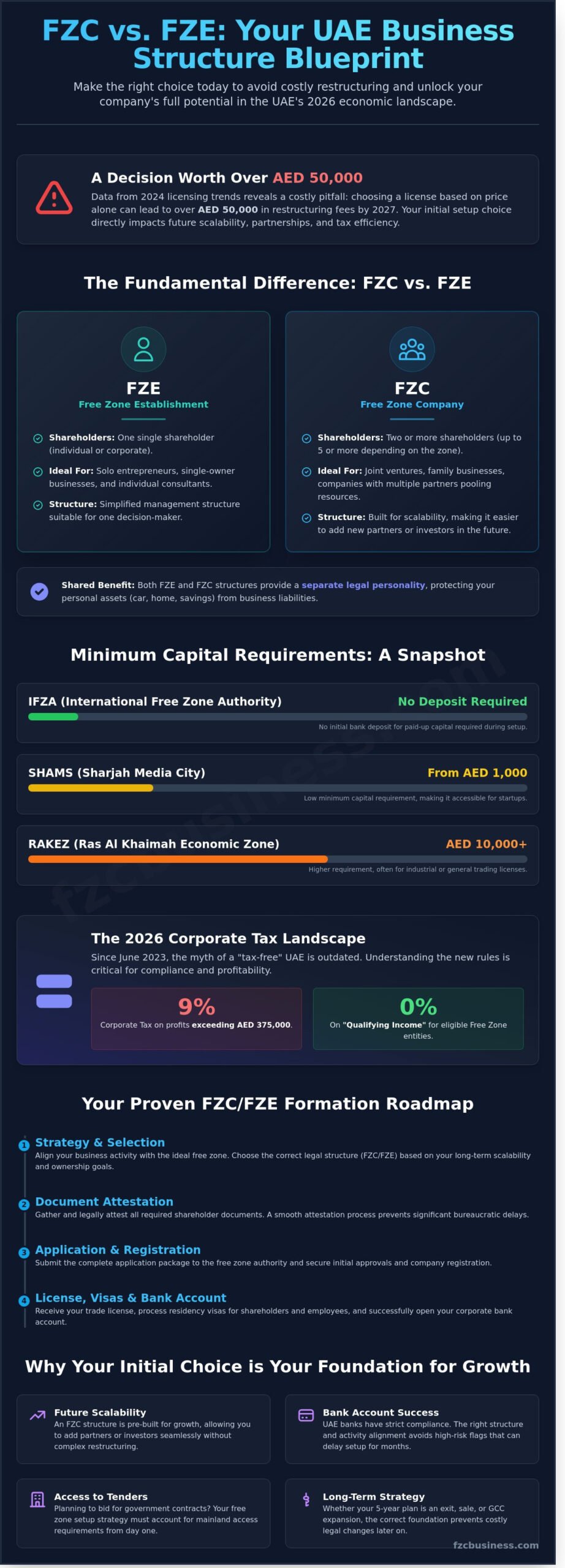
Shareholder count is the primary divider between these two structures. An FZE is designed for solo entrepreneurs, while an FZC requires two or more partners. Both provide a separate legal personality, which means your personal car, home, or savings stay protected if the business faces financial trouble. Don’t fall for the myth that free zones are entirely tax-free now. Since June 2023, the UAE has implemented a 9% corporate tax on profits exceeding AED 375,000. Many businesses still benefit from a 0% rate on qualifying income, but maintaining compliance requires in-depth knowledge of the latest federal tax authority rulings.
Why Structure Choice Matters for Your 2026 Strategy
Your choice of structure directly impacts your ability to secure a corporate bank account. UAE banks have strict compliance protocols, and certain activities or structures can trigger high-risk flags that delay your setup for months. If your 5-year plan involves bidding for government tenders, you must realize that free zone entities usually need a mainland branch or a local distributor to compete for federal contracts. We help you align your license type with your long-term exit or expansion goals. Whether you plan to sell the company in 2028 or expand across the GCC, setting the right foundation today prevents expensive and time-consuming legal restructuring later. Our affordable pricing plans and hassle-free process allow you to focus on growth while we handle the bureaucratic hurdles.
FZC vs FZE: A Technical Comparison for Investors
Choosing the right legal structure is the first step toward a successful UAE setup. While both entities offer 100% foreign ownership, the primary distinction lies in the number of stakeholders involved. An FZE is a single-shareholder entity, whereas an fzc requires multiple shareholders, usually ranging from 2 to 5 individuals or corporations. This multi-partner structure is the standard choice for joint ventures or family-owned businesses looking to pool resources and expertise.
Capital requirements are a major consideration for any serious investor. In the International Free Zone Authority (IFZA), you don’t need to show a bank deposit for paid-up capital during the initial setup stages. Sharjah Media City (SHAMS) generally sets a minimum capital requirement of AED 1,000. In contrast, RAKEZ often requires AED 10,000 or more for specific industrial or general trading licenses. These figures aren’t just bureaucratic hurdles; they define the financial foundation of your enterprise and are recorded in your company’s official documents.
Management in an fzc is structured to ensure clear accountability. Every company must appoint a Manager, a Director, and a Secretary. While one person can hold all three positions in many zones, larger firms often separate these roles to improve corporate governance. Share transferability is governed strictly by the Free Zone Authority (FZA). You can’t simply trade shares privately; every change in ownership requires an official amendment to the corporate registry and a fee that typically starts around AED 2,100 depending on the jurisdiction. The Ministry of Economy on free zone benefits provides a broader look at how these regulations protect foreign investors and maintain market integrity.
Shareholder Flexibility and Corporate Entities
Corporate entities can act as shareholders in an FZC, which simplifies the creation of subsidiary structures. This is a common strategy for multinational brands entering the Middle East through a holding company. Adding a partner after incorporation involves a formal process of board resolutions and updated legal filings. You’ll need a Memorandum of Association (MOA) that clearly outlines voting rights and exit strategies. This document acts as your primary defense against future internal conflicts. For a smooth experience in drafting these complex documents, you can get expert guidance from our business setup specialists.
Operational Capabilities and Office Requirements
Office requirements are evolving rapidly. While a Flexi-desk is cost-effective for startups, upcoming 2026 compliance standards emphasize the need for verifiable physical addresses for tax residency and Economic Substance Regulations (ESR). An FZC license typically grants you 2 to 3 visas on a virtual lease, but physical offices allow for much higher quotas. Usually, you’re granted one visa for every 9 square meters of space. If you want to sell products directly to the UAE mainland, remember that you’ll need a local distributor. Free zone companies operate within a specific customs zone, meaning goods entering the local market are subject to a 5% customs duty. This ensures you remain compliant with the UAE’s dual-tier economic system while maximizing your international trade potential.
The 2026 Regulatory Landscape: Tax, VAT, and Compliance
The UAE regulatory environment in 2026 requires every fzc to maintain strict adherence to evolving fiscal policies. The Ministry of Finance now enforces a 9% Corporate Tax on “Non-Qualifying Income” for all entities. To benefit from the 0% incentive, your entity must meet the criteria of a “Qualifying Free Zone Person.” This status depends on maintaining adequate substance and ensuring your income doesn’t derive from “Excluded Activities” like banking or insurance. Economic Substance Regulations (ESR) remain a cornerstone of local compliance. Companies engaged in “Relevant Activities” such as shipping, distribution, or service centers must file annual notifications. Failure to demonstrate local management or physical presence results in administrative fines starting at AED 20,000.
VAT compliance is equally critical for sustained operations in the Emirates. Any fzc with taxable supplies and imports exceeding AED 375,000 over a 12-month period must register with the Federal Tax Authority (FTA). International traders often leverage zero-rated exports to manage cash flow effectively, but they must keep precise documentation for every shipment. Beyond tax, the UAE has intensified Anti-Money Laundering (AML) oversight to align with global standards. Businesses must register on the GoAML portal and report suspicious transactions immediately. You’re also required to maintain an updated Ultimate Beneficial Owner (UBO) register at your registered office. Non-compliance with UBO reporting can lead to administrative penalties reaching AED 100,000.
Tax Compliance for Free Zone Entities
Qualifying Income for a 2026 setup includes transactions with other Free Zone entities or income from “Qualifying Activities” like manufacturing and fund management. Maintaining audited financial statements is now a mandatory requirement for all Free Zone companies seeking the 0% tax rate, regardless of their annual turnover size. This ensures transparency and aligns with international OECD standards. As of 2026, UAE businesses must pay a 9% Corporate Tax on taxable income exceeding AED 375,000, while income below this amount remains subject to a 0% rate.
Banking and Financial Credibility
Banks in the UAE perform rigorous KYC (Know Your Customer) checks on new entities to mitigate financial risk. This process often takes 4 to 12 weeks depending on your business activity and ownership complexity. Leveraging the expertise of Fast Zone Business simplifies this journey through pre-screened applications and direct introductions to tier-1 banks. We ensure your documentation meets the high standards required by compliance officers. For digital entrepreneurs, integrating the ‘Paypal UAE’ ecosystem requires a valid trade license and a local AED bank account. This setup allows you to withdraw funds efficiently while avoiding the 2.5% to 4% conversion fees often associated with foreign currency accounts. It’s a vital step for maintaining profitability in the global market.
- Corporate Tax: 9% on income above AED 375,000.
- VAT Registration: Mandatory at AED 375,000 turnover; voluntary at AED 187,500.
- ESR Filings: Required for companies in shipping, intellectual property, and distribution.
- AML Compliance: Registration on the GoAML portal is essential for high-risk sectors.
Step-by-Step Guide to Setting Up Your FZC in the UAE
Launching an fzc requires a methodical approach to satisfy the requirements of the Federal Decree-Law No. 32 of 2021 on Commercial Companies. The first step involves selecting your specific business activity. This choice dictates which Free Zone Authority (FZA) will govern your operations. For example, if you choose the Sharjah Media City (SHAMS), you’ll find over 200 permitted activities tailored for creative professionals. You must ensure your chosen activity aligns with the specific license types offered by the jurisdiction to avoid application rejection.
Document attestation is the second critical phase. If your shareholders are based outside the UAE, documents must be notarized and attested by the UAE Embassy in the home country. Following this, they require legal translation and certification by the UAE Ministry of Foreign Affairs (MOFA). For local shareholders, the process is faster, often requiring only a valid Emirates ID and a digital signature via UAE Pass. This step ensures your corporate structure is recognized under local law and is ready for the registry.
You’ll then need to reserve your trade name and secure initial approval from the FZA. This stage usually takes 24 to 48 hours. Once you have the initial approval, you’ll draft the Memorandum of Association (MOA) and sign a lease agreement for your office space. In jurisdictions like RAKEZ, you can choose between a physical warehouse or a “Flexi-desk” setup. These virtual office solutions often start at approximately AED 11,000 per year, providing a cost-effective way to meet the physical address requirement.
The final phase is visa processing and Emirates ID issuance. This includes the entry permit, medical fitness test, and biometrics. Under the current ICA smart services system, the process is largely digitized. This has reduced the issuance time for an E-visa to just 3 to 5 business days. Once the medical results are cleared, the residency stamp is issued, and your physical Emirates ID arrives via Emirates Post shortly after.
Choosing the Right Free Zone for Your FZC
Strategic location impacts your bottom line. SHAMS is the premier choice for media and creative sectors due to its low-cost entry points. Meydan Free Zone attracts e-commerce entrepreneurs because of its proximity to Downtown Dubai and simplified digital payment integrations. RAKEZ serves over 15,000 companies and is ideal for industrial setups due to its proximity to Saqr Port. Setup costs vary widely; a basic package in the Northern Emirates might start at AED 12,500, while Dubai-based zones often begin at AED 18,000 or higher. Logistical firms should prioritize zones near Jebel Ali Port or Al Maktoum International Airport to minimize transport overheads.
The Role of PRO Services in a Hassle-Free Setup
Navigating the Ministry of Human Resources and Emiratisation (MOHRE) and the Federal Authority for Identity, Citizenship, Customs and Port Security (ICP) is complex. Our PRO services act as your expert liaison, managing government approvals and ensuring 100% compliance with the latest labor laws. We handle document clearances and labor card renewals, preventing fines that can reach up to AED 50,000 for non-compliance with Wage Protection System (WPS) regulations. This expert guidance allows you to focus on growth while we manage the bureaucratic hurdles.
Ready to begin your journey? Book a free consultation with our specialists today to streamline your setup.
Scaling with Fast Zone Business: Your FZC Growth Partner
Establishing an fzc is only the first step toward regional dominance. Scaling a business in the UAE requires a partner who understands that growth isn’t a linear path. Our one-stop destination model is vital for foreign entrepreneurs because it eliminates the need to coordinate with multiple consultants, government departments, and legal firms. By consolidating every requirement into a single point of contact, we remove the friction that typically stalls international expansion. We’ve seen that 85% of startups that fail in their first year do so because of administrative bottlenecks or compliance errors. We ensure you aren’t part of that statistic.
Our approach involves customizing services for every stage of your journey. A startup needs a cost-effective flexi-desk and a basic trade license, while a scaling enterprise requires warehouse space, complex PRO services, and corporate tax structuring. We also integrate Golden Visa applications directly into your company formation strategy. Since the 2022 updates to residency laws, entrepreneurs can secure 10-year residency by meeting specific investment or professional criteria. This long-term stability allows you to plan your business trajectory with confidence, knowing your right to remain in the UAE is secure.
The regulatory environment in the Emirates is evolving rapidly. On June 1, 2023, the UAE implemented a 9% Corporate Tax on business profits exceeding AED 375,000. Expert guidance is no longer a luxury; it’s a survival requirement. We provide the in-depth knowledge necessary to structure your fzc operations so you remain compliant while maximizing your tax efficiency under the new laws.
Comprehensive Support Beyond the License
Success requires more than just a piece of paper from the authorities. We provide assistance with mandatory VAT registration, which is required once your taxable supplies and imports exceed AED 375,000 per year. We also handle trademark registration to ensure your brand identity is legally protected across the GCC. The Fast Zone Business team guarantees a hassle-free setup process that handles every administrative detail, ensuring your startup begins its journey on a solid legal foundation.
Next Steps: Launching Your UAE Venture
Your first 90 days are critical for building momentum. During this period, you should focus on three primary objectives:
- Financial Setup: Opening a corporate bank account, a process that can take 4 to 12 weeks depending on your business activity and risk profile.
- Operational Infrastructure: Finalizing your physical or virtual office space and hiring your initial team under the correct visa quotas.
- Community Integration: Building a local network through Free Zone communities like Dubai Silicon Oasis or DMCC to find partners and clients.
Don’t let the complexities of UAE regulations slow your progress. You need a partner who anticipates challenges before they become obstacles. Our team is ready to provide the clarity and action-oriented support your business deserves.
Launch Your 2026 UAE Business Venture With Confidence
Choosing the right corporate structure is the foundation of your success in the Emirates. By 2026, the distinction between an fzc and an FZE remains critical for multi-partner entities aiming to navigate the 9% corporate tax landscape for taxable profits above AED 375,000. Success depends on more than just choosing a name; it requires precise alignment with the specific regulations found across 40+ UAE Free Zones. Fast Zone Business eliminates the guesswork by providing expert guidance through every technical stage of the setup process.
Our specialists prioritize your operational readiness by managing specialized tasks like Corporate Bank Account opening and full PRO support. We also provide dedicated assistance for Golden Visa applications, ensuring your team has the long-term residency needed to thrive. You don’t have to tackle the complexities of VAT registration or compliance alone. Our efficient, action-oriented approach saves you time and protects your investment from common setup errors. The UAE market offers unparalleled growth opportunities for those who move quickly and correctly.
Start your hassle-free FZC setup with Fast Zone Business to secure your competitive edge in the region. It’s time to build your legacy in a world-class business hub.
Frequently Asked Questions
What is the main difference between FZE and FZC in the UAE?
The primary difference is the number of shareholders; an FZE has a single shareholder, while an FZC requires two or more partners. Both structures offer limited liability protection for owners. In an FZC, you can have up to 50 individual or corporate members, making it the preferred choice for joint ventures and larger partnerships within UAE free zones.
Can an FZC have corporate shareholders?
Yes, an FZC can have corporate shareholders as part of its ownership structure. This allows existing local or international companies to hold shares in the new entity. You’ll need to provide attested board resolutions and certificates of incorporation for any corporate entity joining the company. Our team provides expert guidance to ensure all legal documentation meets the specific requirements of your chosen jurisdiction.
Is 100% foreign ownership guaranteed for an FZC in 2026?
Yes, 100% foreign ownership remains a guaranteed benefit for every fzc operating within a UAE Free Zone through 2026 and beyond. This regulation is a core pillar of the UAE investment law, specifically designed to attract global entrepreneurs. You don’t need a local Emirati partner or agent to maintain full control of your business operations, assets, or capital.
How much does it cost to set up an FZC in a Dubai Free Zone?
Setting up an fzc in a Dubai Free Zone typically starts from AED 12,900 for a basic license, excluding visa costs and office space. Prices vary based on the specific authority; for instance, a license with one visa allocation often ranges between AED 18,500 and AED 24,000. We offer affordable pricing plans that bundle registration fees, municipality charges, and administrative costs into one transparent package.
Does an FZC need to pay Corporate Tax in the UAE?
An FZC must register for UAE Corporate Tax and pay a 9% rate on taxable income exceeding AED 375,000. However, many companies qualify for a 0% rate if they meet the criteria for a Qualifying Free Zone Person under Federal Decree-Law No. 47 of 2022. It’s essential to maintain audited financial records to prove compliance and benefit from these specific tax incentives.
Can an FZC trade directly with the UAE Mainland?
An FZC cannot trade directly with the UAE Mainland without a local distributor or a licensed commercial agent. To sell goods outside the free zone, you must pay a 5% customs duty on the products. Alternatively, you can establish a mainland branch or work with a logistics partner to navigate these regulatory boundaries while maintaining your tax-efficient free zone status.
How long does the FZC registration process take?
The registration process for an FZC generally takes between 3 and 7 working days once all documents are submitted. Some jurisdictions like IFZA or Meydan offer even faster approvals, sometimes within 48 hours for specific business activities. We ensure a smooth experience by handling the bureaucracy, allowing you to focus on your core business goals while we secure your trade license quickly.
What documents are required for an FZC setup for foreigners?
Foreigners must provide clear passport copies, a UAE entry stamp or visa page, and a formal application form to start an FZC. If you’re already a UAE resident, you might need a No Objection Certificate (NOC) from your current sponsor. For corporate shareholders, you’ll need legalized documents from the home country, including a Certificate of Incumbency dated within the last 6 months.
