
Mainland License Dubai: The Comprehensive 2026 Setup Guide
Why are 65% of international entrepreneurs still hesitating to launch in the UAE despite the landmark 2021 decree allowing 100% foreign ownership? You’ve likely felt the frustration of opaque government fee structures or the persistent challenge of opening a corporate bank account in a shifting regulatory environment. It’s common to feel that the path to a mainland license dubai is cluttered with bureaucratic hurdles and hidden costs that drain your initial capital before you even start.
At Fast Zone Business, we provide the expert guidance needed to turn these obstacles into a smooth experience. Our 2026 setup guide ensures you gain total clarity on the latest regulations while securing strategic advantages like unrestricted trade and eligibility for lucrative government contracts. We’ve simplified the process so you can focus on growth rather than paperwork. This guide breaks down the exact steps to secure unlimited employee visas and establish a robust corporate presence that commands respect in the local market.
Key Takeaways
- Understand how the shift to 100% foreign ownership for a mainland license dubai offers unprecedented control and onshore market access under the DET.
- Learn the step-by-step 2026 methodology for selecting business activities and securing a compliant trade name to ensure a smooth registration process.
- Discover the strategic advantages of mainland setups over free zones, including unrestricted trade within the local UAE market and superior visa quota flexibility.
- Get a transparent breakdown of essential setup costs in AED, from DET government fees to often-overlooked market fees calculated at 5% of office rent.
- Identify how to navigate the evolving 2026 regulatory updates and Corporate Tax landscape through a specialized, one-stop business setup model.
What is a Dubai Mainland License and Why Does it Matter in 2026?
A mainland license dubai represents an onshore business entity registered directly with the Dubai Department of Economy and Tourism (DET). This license is the primary gateway for investors who want to operate across the entire UAE market without the geographical constraints often found in free zones. Understanding this structure is vital because the Economy of the United Arab Emirates has evolved rapidly, positioning Dubai as a global hub for high-growth sectors like AI, fintech, and green energy. By 2026, these entities will play a central role in the Dubai Economic Agenda (D33), which aims to generate 32 trillion AED in economic value over the next decade.
The landscape for international investors shifted significantly following the 2021 ownership reforms. You’re no longer restricted by the old mandate that required a local partner to hold the majority of shares. This paradigm shift has turned the mainland into the most attractive option for those seeking long-term stability and direct access to the local consumer market. It’s about more than just starting a shop; it’s about integrating into a world-class business ecosystem that values efficiency and expert guidance.
To better understand this concept, watch this helpful video:
The primary benefits of a mainland license dubai are tangible and immediate. First, you face no geographic restrictions on where you can trade or lease office space. Whether you’re targeting clients in Downtown Dubai or expanding to Abu Dhabi, your license remains valid. Second, mainland companies are eligible to bid for lucrative government tenders. These contracts are often the lifeblood of large-scale operations in construction, tech, and consultancy. This level of market access is a “hassle-free” way to ensure your business isn’t capped by free zone boundaries.
The Legal Framework of Onshore Entities
The DET, formerly known as the DED, acts as the regulatory anchor for all mainland activities. They issue three main categories: professional licenses for service-based experts, commercial licenses for traders, and industrial licenses for manufacturers. Choosing “onshore” status is particularly beneficial for global banking compliance. Banks in the UAE and internationally often view onshore entities as lower risk during KYC and AML checks, making your corporate account opening process much smoother. Our in-depth knowledge of these regulations ensures you stay compliant with the latest DET mandates.
100% Ownership vs. Local Service Agents
Since the landmark Commercial Companies Law amendment of 2021, foreign investors can now own 100% of their business across more than 1,000 commercial and industrial activities. This change removed the need for a 51% local shareholder in most cases. For professional licenses, such as legal or medical consultancies, you still require a Local Service Agent (LSA). The LSA doesn’t own any equity; they simply facilitate government interactions for a fixed annual fee. The Commercial Companies Law amendment of 2021 regarding ownership officially abolished the requirement for a UAE national to hold 51% of shares in many mainland companies. This change offers a smooth experience for entrepreneurs who want full control over their vision and profits.
The 2026 Step-by-Step Process to Securing Your Mainland License
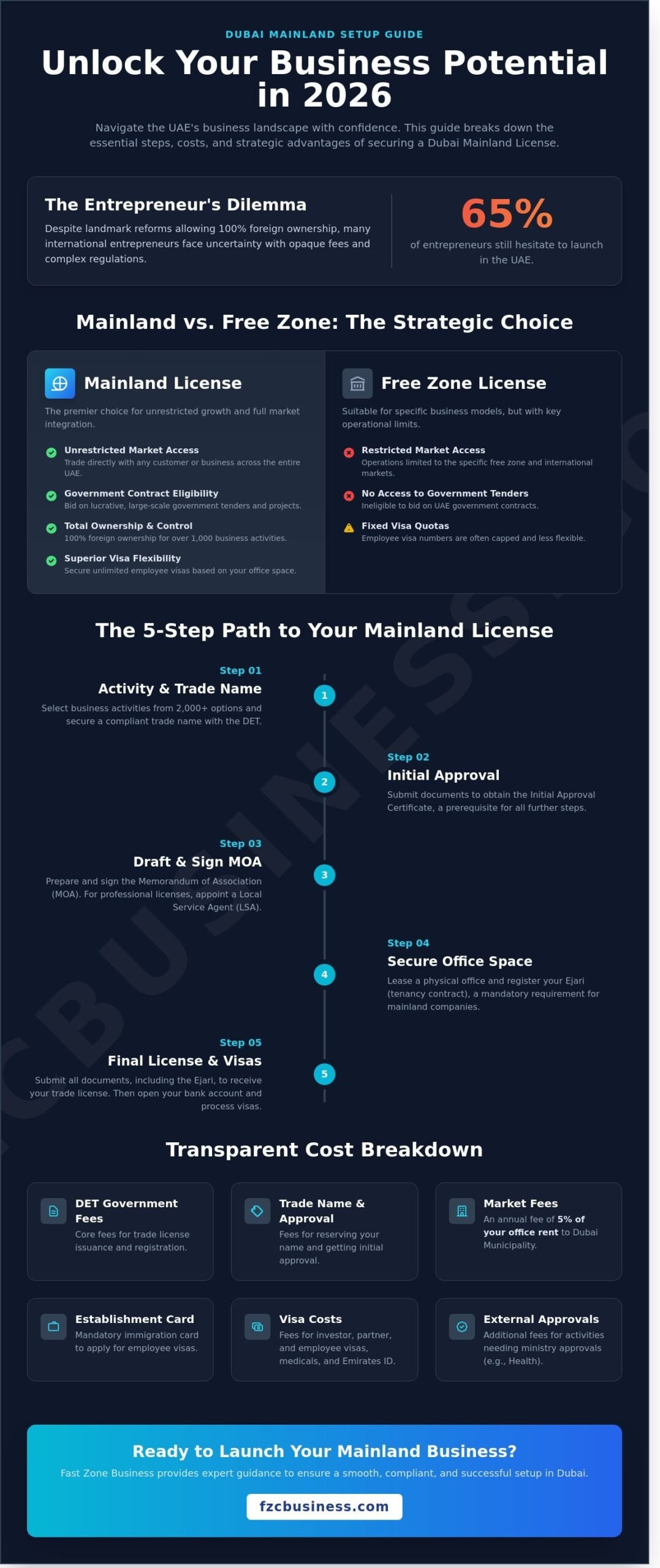
Securing a mainland license dubai in 2026 requires a methodical approach to satisfy the Department of Economy and Tourism (DET) requirements. Your first task involves selecting the correct business activity from a comprehensive list of over 2,000 options. This choice is foundational. It dictates your legal structure and the specific approvals needed from external regulators like the Dubai Health Authority or the Knowledge and Human Development Authority. For instance, a consultancy firm follows a different regulatory path than a manufacturing unit or a high-tech laboratory. Most entrepreneurs find that grouping related activities under one license saves on administrative costs, as adding activities later can incur fees of approximately AED 2,000 per amendment.
Trade Name Registration and Initial Approval
The UAE maintains strict naming conventions to ensure cultural and professional standards are upheld. You can’t use religious references, political affiliations, or names of established global brands. Names must also avoid offensive language and shouldn’t start with words like “Global” or “International” unless specific capital requirements are met. You’ll apply for your trade name and initial approval simultaneously through the Invest in Dubai portal. This digital-first approach has streamlined the process significantly. According to the World Bank ‘Doing Business’ Report for UAE, the efficiency of starting a venture in the Emirates remains a top global benchmark. In 2026, you can expect the initial approval certificate within 24 to 48 hours of submission, granting you six months to finalize the remaining legal steps.
The MOA and Legal Structure Selection
Choosing between a Limited Liability Company (LLC) and a Sole Establishment is a strategic decision that impacts your liability and tax obligations. An LLC allows for multiple shareholders and protects personal assets from business debts. For professional services, you might opt for a Sole Establishment while appointing a Local Service Agent (LSA). The LSA doesn’t own equity but facilitates government relations for a fixed annual fee, often starting around AED 5,000. You’ll notarize the MOA or LSA agreement through the Dubai Courts e-notary. This document is the foundation for your corporate bank account application, as compliance departments scrutinize it to understand the ultimate beneficial ownership. If you’re unsure which structure fits your five-year growth plan, you can consult with our setup experts for a tailored roadmap.
Office Space and the Ejari Requirement
A physical office is a mandatory requirement for a mainland license dubai to ensure businesses are legitimate and reachable. While the “Instant License” provides a one-year grace period for startups to operate without a lease, you’ll eventually need a registered Ejari. Ejari is the system used to attest your commercial tenancy contract with the Dubai Land Department. The size of your premises dictates your growth capacity. Consider these factors for your 2026 planning:
- Visa Quotas: Typically, the DET allows one employment visa for every 80 to 100 square feet of office space.
- Sustainability: New 2026 regulations favor energy-efficient commercial buildings, which may offer reduced utility registration fees.
- Compliance: Failing to maintain a physical space or a valid Ejari can lead to license suspension or fines starting from AED 2,000.
Ensuring your office meets the specific requirements for your activity is vital. For example, food-related businesses require additional approvals from Dubai Municipality regarding kitchen layout and ventilation before the Ejari can be finalized.
Mainland vs. Free Zone: Choosing the Right Path for Growth
Deciding between a mainland license dubai and a free zone setup is the most critical choice you’ll make for your UAE venture. While free zones offer 100% foreign ownership in specific clusters, a mainland setup provides an unrestricted gateway to the entire local market. You can trade directly with the UAE public without hiring a local distributor—a key advantage for service companies like Marble Pro that work with clients across the city. This approach saves you the 5% to 15% commission fee typically charged by third-party agents. For businesses aiming for maximum reach, the mainland provides a level of market penetration that restricted zones cannot match.
Geographic and Operational Flexibility
A mainland license dubai grants you the freedom to open multiple branches across all seven Emirates under a single corporate umbrella. This isn’t possible with a free zone license, which limits your physical operations to the specific zone of registration. If your business model involves bidding for high-value government contracts or working with state-owned enterprises (SOEs) like DEWA or ADNOC, a mainland structure is mandatory. These entities rarely award tenders to free zone companies because of jurisdictional limitations and procurement regulations.
Visa and Residency Advantages
Mainland companies offer superior scalability for growing teams. Unlike free zones that cap visas based on rigid package tiers, mainland entities can secure as many visas as their physical office space allows. The standard requirement is 100 square feet of office space for every visa requested. This flexibility is vital for labor-intensive industries or rapidly expanding tech startups. Additionally, mainland investors and high-skilled employees often qualify for the UAE Golden Visa, which provides long-term residency for 10 years. You also gain a smoother path when sponsoring family members and domestic staff, as the mainland residency permit is issued directly by the General Directorate of Residency and Foreigners Affairs (GDRFA).
Financial transparency and long-term scalability also differentiate these two paths. While many free zones have their own specific audit requirements, mainland companies must adhere strictly to UAE Federal Tax Authority (FTA) regulations. This includes the 9% Corporate Tax on profits exceeding AED 375,000. While this involves more rigorous reporting, it builds a robust financial history that is essential for certain growth milestones:
- Banking Relationships: Mainland companies often find it easier to open corporate bank accounts with local lenders like Emirates NBD or Mashreq due to their perceived stability.
- IPO Readiness: If you plan to list your company on the Dubai Financial Market (DFM) or the Abu Dhabi Securities Exchange (ADX), a mainland structure is the standard legal vehicle required.
- International Expansion: Having a mainland license makes it simpler to establish subsidiaries abroad, as the company is recognized as a fully integrated UAE entity rather than a zone-specific firm.
Choosing the mainland path isn’t just about where you work today; it’s about where you want your business to be in five years. The structure supports complex corporate hierarchies and is better suited for companies that plan to raise venture capital or seek institutional investment. By eliminating the need for a local agent to reach the UAE public, you retain full control over your brand’s customer experience and profit margins. It’s a strategic move for any entrepreneur who views the UAE as a primary market rather than just a regional hub.
Calculating the Cost of Setting Up a Business in Dubai Mainland
Calculating the total investment for a mainland license dubai requires looking beyond the initial application fee. Entrepreneurs often overlook the layers of government charges and operational costs that define the first year of trading. At Fast Zone Business, we prioritize transparent pricing to ensure you don’t encounter unexpected “hidden” fees that can derail your financial planning. A clear budget allows you to focus on growth rather than bureaucratic surprises.
Government Fees and Mandatory Deposits
The Department of Economy and Tourism (DET) manages the primary fee structure. For a standard LLC setup in 2026, budget approximately AED 18,500 to AED 30,000 for government costs alone. This includes name reservation (AED 620), initial approval (AED 120), and the license issuance fee which varies based on your activity. Professional licenses usually cost less than commercial ones, but they may require a local service agent fee. Remember, while some fees are one-time payments, your trade license and office lease require annual renewal to maintain legal standing.
Tax and Compliance Obligations
UAE’s fiscal environment changed significantly with the introduction of federal Corporate Tax. Mainland companies now face a 9% tax rate on taxable profits exceeding AED 375,000. By 2026, compliance will be a standard operational pillar for every mainland license dubai holder. Additionally, if your taxable supplies and imports exceed AED 375,000 per year, VAT registration is mandatory. Managing these filings requires precision. Utilizing professional Tax Compliance Services ensures you avoid the heavy penalties associated with late filings or incorrect data entry, which can reach thousands of dirhams per instance.
Operational costs also include “hidden” government levies. You must account for:
- Market Fees: This is a 5% charge on your annual office rent, typically added to your monthly DEWA utility bills.
- Administrative Service Fees: Small localized charges for electronic signatures and file openings that usually total around AED 2,000.
- Knowledge and Innovation Fees: Small mandatory contributions (approx. AED 20 each) attached to every government transaction.
The Value of Professional PRO Services
Outsourcing your PRO needs is often more cost-effective than hiring an in-house expert. An in-house PRO requires a monthly salary between AED 8,000 and AED 15,000, plus visa costs and insurance. In contrast, partnering with a firm like Fast Zone Business provides a “one-stop destination” for managing labor files, immigration portals (e-channel), and visa processing at a fraction of the cost. We use our in-depth knowledge to bypass delays, ensuring your staff is on the ground and productive faster. Our team handles the complex paperwork, so your experience remains smooth and entirely hassle-free.
Understanding the financial landscape of the Dubai mainland is the first step toward a sustainable business. Don’t let complex fee structures slow your momentum. Get a detailed cost breakdown for your specific business activity today.
Why Fast Zone Business is Your Strategic Partner for Mainland Setup
Fast Zone Business operates as a comprehensive one-stop destination for entrepreneurs entering the UAE market. We manage every phase of the journey, beginning with initial name reservation at the Department of Economy and Tourism (DET) and concluding with corporate bank account activation. Our team handles the heavy lifting, so you don’t have to worry about bureaucratic delays. Securing a mainland license dubai involves coordinating with multiple government bodies. We streamline this by providing in-house PRO services that cut processing times by up to 30% compared to independent filings.
Compliance is non-negotiable in the current UAE market. Since June 2023, the 9% Corporate Tax on taxable income exceeding AED 375,000 has changed how businesses must structure their accounts. Our consultants provide expert guidance on these fiscal requirements. We also prepare your business for the 2026 regulatory updates regarding labor laws and Emiratization targets. If your business activity is complex, such as industrial manufacturing or specialized medical services, we leverage our proven track record to secure approvals from the Ministry of Industry and Advanced Technology or the Dubai Health Authority.
Our customized setup packages are designed to scale with your business journey. Whether you’re a solo consultant or a large-scale distributor, we tailor our services to match your operational needs. We’ve helped over 1,500 companies establish their presence in Dubai, providing them with the agility needed to compete in a global hub. By choosing us, you gain a partner that understands the nuances of local legislation and the specific requirements of different business sectors.
Beyond the License: Banking and Visas
Obtaining your mainland license dubai is just the first step. We facilitate corporate bank account openings with top-tier UAE institutions like Emirates NBD, Mashreq Bank, and Wio. Our relationships often reduce the typical 4-to-6-week waiting period for account approval. For investors seeking long-term stability, we manage Golden Visa applications for those meeting the AED 2 million property or business investment threshold. We also handle employee sponsorship and family visa renewals to ensure your team stays focused on growth. Our ongoing support ensures your administrative tasks never stall your commercial progress.
Start Your Hassle-Free Journey Today
Efficiency and transparency define the Fast Zone commitment to our clients. We offer customized setup packages starting from competitive rates, ensuring you only pay for the services your specific scale requires. Our commitment is to provide a smooth experience that transforms complex legal requirements into a clear roadmap. Book your free consultation today to receive a personalized breakdown of costs and timelines. Let our experts turn your business vision into a functional UAE entity without the stress of administrative hurdles. Your success in the Dubai mainland starts with a single, expert-led conversation.
Take the Next Step Toward Your Dubai Mainland Success
Securing a mainland license dubai provides your business with unrestricted access to the local UAE market and the ability to bid for lucrative government contracts. By 2026; the regulatory framework has evolved to make 100% foreign ownership a standard for over 1,000 commercial and industrial activities. You now understand the step-by-step process and the importance of calculating setup costs in AED to maintain a healthy bottom line from day one. Fast Zone Business acts as your strategic partner, serving as an authorized PRO service provider to navigate every legal requirement with precision. We offer expert guidance on 100% foreign ownership and provide hassle-free bank account opening assistance to get your corporate finances moving quickly. Don’t let administrative complexities or bureaucratic hurdles slow your growth. Our team is ready to transform your vision into a fully operational UAE enterprise, providing the clarity and confidence you need to scale. The future of your business starts with a single, decisive action. We’re here to ensure your transition into the Dubai market is smooth, efficient, and fully compliant.
Book Your FREE Consultation with Fast Zone Business Today
Frequently Asked Questions
How much does a mainland license cost in Dubai in 2026?
A mainland license dubai typically costs between AED 18,500 and AED 35,000 in 2026 for standard commercial or professional setups. This total includes Department of Economy and Tourism (DET) registration fees, initial approvals, and administrative costs. Your final investment depends on your specific business activities and whether you choose a virtual office or a dedicated physical retail space.
Can a foreigner own 100% of a mainland company in Dubai?
Foreign investors can own 100% of their mainland company for more than 1,000 commercial and industrial activities. The 2021 amendment to the Commercial Companies Law removed the general requirement for a local Emirati partner to hold 51% of shares. This allows you to maintain full operational control and 100% capital ownership in most business sectors across the emirate.
How long does it take to get a mainland trade license?
You can obtain a mainland trade license in as little as 15 minutes using the “Instant License” portal for eligible business activities. For standard applications that require external approvals from specific ministries, the process usually takes 3 to 5 working days. Our team manages all document submissions and government interactions to ensure a smooth experience and rapid turnaround for your setup.
Do I need a physical office for a mainland license?
Yes, a physical address is a mandatory legal requirement for a mainland license dubai, but flexible options are available for new startups. You can utilize a “Sustainability Contract” or a co-working desk space starting at approximately AED 5,000 per year to meet this obligation. This provides you with a registered Ejari, which is essential for processing employee visas and opening a corporate bank account.
What is the difference between a mainland license and a Free Zone license?
The primary difference is geographic flexibility; a mainland license allows you to trade directly with the local UAE market and government entities without restrictions. Free Zone companies are generally restricted to operating within their specific zone or internationally unless they use a local distributor. Mainland entities also have no limit on the number of visas they can issue, provided they have sufficient office space.
What are the corporate tax implications for mainland companies in 2026?
Mainland companies are subject to a standard corporate tax rate of 9% on taxable profits that exceed AED 375,000. For businesses earning below this threshold, a 0% rate applies to support small business growth and entrepreneurship. You must register for corporate tax with the Federal Tax Authority (FTA) regardless of your profit levels to ensure your business remains compliant with national regulations.
Is a local sponsor still required for a Dubai mainland business?
A local sponsor is no longer required for the majority of commercial and professional business activities in Dubai. While specific strategic sectors like oil and gas or defense still necessitate Emirati participation, most entrepreneurs now choose the 100% ownership model. For professional licenses, you may still need a Local Service Agent (LSA) to handle government relations for a fixed annual fee without giving up equity.
Can I trade anywhere in the UAE with a mainland license?
You can trade freely across all seven emirates and participate in lucrative government tenders with a mainland license. This jurisdiction removes the “gatekeeper” requirement found in Free Zones, where you might need a local agent to sell goods in the UAE mainland. It’s the most versatile option for businesses aiming for a nationwide presence and direct access to the local consumer market.
