

The Real Cost of Setting Up a Business in Dubai: A Comprehensive 2026 Guide
Navigating the financial landscape of a Dubai business launch can be a complex challenge, often clouded by opaque quotes and the persistent fear of unexpected renewal fees. This uncertainty makes it difficult to accurately budget the true cost of setting up a business in Dubai. If you are seeking a clear, actionable financial plan instead of confusing estimates, this guide is engineered to provide the clarity you need for a confident investment.
Prepare for a transparent, line-by-line breakdown of every potential expense you will encounter in 2026. We deliver expert guidance on everything from initial trade license fees in AED to visa processing, office space, and the critical financial distinctions between a Mainland and Free Zone establishment. Arm yourself with the in-depth knowledge required to create a predictable budget, forecast your return on investment, and ensure your launch is smooth, compliant, and perfectly aligned with your business goals.
Key Takeaways
- Identify the foundational government charges, including initial approval and trade name fees, to accurately forecast your starting capital requirements in AED.
- Compare the financial trade-offs between a Mainland and Free Zone setup to determine which jurisdiction offers the best long-term value for your business model.
- Uncover the complete cost of setting up a business in Dubai by planning for often-overlooked expenses like visa processing, office rentals, and mandatory annual fees.
- Learn how the 9% UAE Corporate Tax impacts initial structuring decisions and how to plan for maximum financial efficiency from day one.
- Discover how expert guidance prevents costly errors and government penalties, ensuring a smooth, budget-efficient company formation process.
The 2026 Economic Landscape: Why Dubai Setup Costs Have Evolved
As we navigate 2026, the framework for establishing a business in Dubai has matured significantly. The landscape is now defined by digital-first government services, streamlined processes, and a new regulatory era marked by the introduction of the 9% UAE Corporate Tax. These shifts have fundamentally altered the components that make up the total cost of setting up a business in dubai. Understanding this evolution is crucial for any entrepreneur aiming to budget accurately and build a sustainable enterprise within Dubai’s diverse and evolving economy.
For a detailed breakdown of the financial components, our expert guide provides valuable insights:
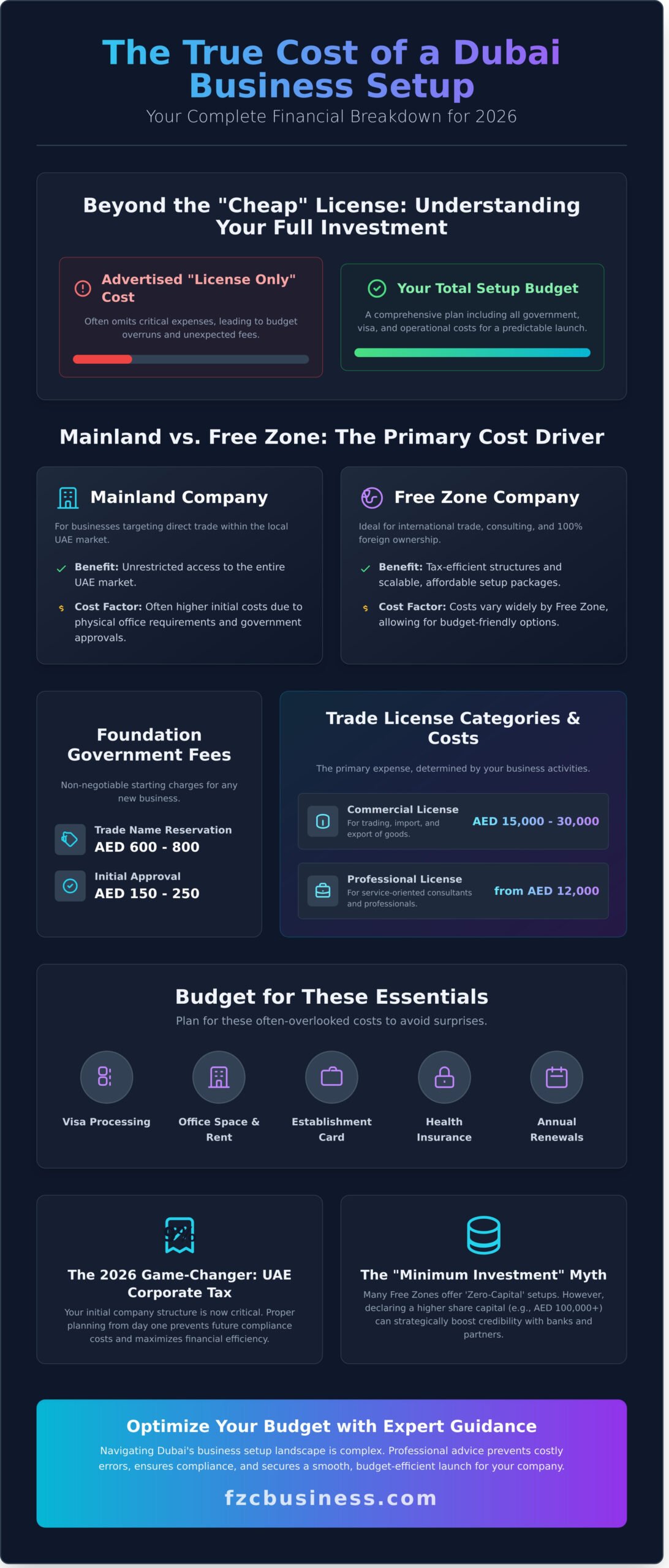
It is essential to distinguish between a simple ‘License Cost’ and your ‘Total Setup Budget’. Many advertised “cheap” packages only cover the trade license fee, omitting critical expenses like establishment cards, visa applications, office rent, and mandatory health insurance. The introduction of Corporate Tax also means that initial structuring decisions carry more weight; choosing the right jurisdiction from day one can prevent significant compliance costs down the line. Our expert guidance ensures you see the full picture, avoiding hidden fees and securing a hassle-free launch.
Mainland vs. Free Zone: The Primary Cost Driver
Your choice between a Mainland and a Free Zone company is the most significant factor influencing your initial investment. A Mainland license offers unrestricted access to the local UAE market but often involves higher initial compliance costs for physical office space and government approvals. Conversely, Free Zones provide benefits like 100% foreign ownership and tax-efficient structures ideal for international trade, frequently with more affordable and scalable setup packages.
Understanding the ‘Minimum Investment’ Myth
The belief that you need millions in capital to start a business in Dubai is outdated. Many Free Zones today offer ‘Zero-Capital’ setups, meaning you are not required to deposit a large sum of paid-up share capital. However, declaring a substantial share capital (e.g., AED 100,000 or more) can be strategically beneficial. It enhances your company’s profile, improves credibility with banks and partners, and can be a prerequisite for engaging in certain high-value commercial activities.
Core License Fees: A Breakdown of Government Charges
Understanding the government-mandated fees is the first step in accurately forecasting the cost of setting up a business in Dubai. These charges form the foundation of your initial investment and are non-negotiable, whether you opt for a Mainland or Free Zone jurisdiction. The process begins with two essential preliminary steps: Trade Name Reservation, typically costing between AED 600 to AED 800, and Initial Approval, which adds approximately AED 150 to AED 250 to your upfront costs.
Your choice of jurisdiction will be the primary driver of your license fee. For a Mainland company, the Dubai Economy and Tourism (DET) governs the fee structure, offering direct access to the local UAE market. In contrast, Dubai’s numerous Free Zones, along with those in the Northern Emirates, each have a unique Free Zone Authority (FZA) with its own pricing, packages, and regulations. This variation allows entrepreneurs to find a cost structure that aligns with their specific business model and budget.
Trade License Categories and Their Price Points
The nature of your business activity directly dictates the type of license you require and its associated cost. The UAE government categorizes licenses to ensure proper regulation and compliance for all commercial activities. For a complete list of business activities and their corresponding license types, the official UAE government business setup portal offers the most current and comprehensive guidance. The three primary categories are:
- Commercial License: Required for businesses involved in trading, importing, and exporting physical goods. In 2026, expect initial fees to range from AED 15,000 to AED 30,000, depending on the specific trading activities selected.
- Professional License: Designed for service-oriented consultants, artisans, and professionals. These licenses are often more affordable, with starting costs around AED 12,000, as they are based on professional expertise rather than physical products.
- Industrial License: For companies engaged in manufacturing, production, and industrial activities. These carry the highest costs due to the need for additional approvals related to environmental impact, safety protocols, and land use.
Many new businesses in Dubai fall under the professional services category, covering everything from consulting to creative services. For instance, companies that document the city’s vibrant corporate scene are a great example of this sector; to see one in action, you can discover Constantin Photography.
Annual Renewal Expectations
Budgeting for the cost of setting up a business in Dubai must extend beyond the first year. Your trade license is an annual commitment that requires renewal to maintain legal standing. While Year 2 costs are typically lower because one-time registration and issuance fees are not repeated, several recurring charges must be anticipated:
- Core License Renewal Fee: The fundamental government charge for renewing your business license.
- Office Space Renewal: The annual cost of maintaining your registered physical office or virtual desk, which is a mandatory requirement.
- Chamber of Commerce Fees: For Mainland companies, an annual membership fee to the Dubai Chamber of Commerce (approximately AED 1,200 for commercial licenses) is mandatory.
Mainland vs. Free Zone: A Financial Cost-Benefit Analysis
Choosing between a Mainland and a Free Zone license is a critical strategic decision that directly influences the total cost of setting up a business in Dubai. While Free Zones often appear more affordable with bundled packages, a Mainland license offers significant long-term financial advantages for businesses targeting the local UAE market. A thorough analysis reveals costs and benefits beyond the initial license fee.
Mainland Cost Advantages for Local Trade
Operating on the Mainland provides unrestricted access to trade directly with the lucrative UAE market. This structure allows you to avoid costly distributor or agent fees, directly boosting your profit margins. For businesses like retail stores, restaurants, or logistics companies that require a physical presence, a Mainland location is more cost-effective and operationally efficient. To understand the specific financial commitments for your venture, our experts can provide a detailed and custom Mainland quote.
Free Zone Value Propositions
Free Zones are engineered for efficiency, offering streamlined, all-in-one packages that bundle the trade license, visa eligibility, and workspace into a single, predictable annual fee. This simplifies budgeting and accelerates the setup process. Premium zones like IFZA or SHAMS provide extensive facilities, while others offer more specialized, cost-effective solutions. The primary value for international businesses remains 100% foreign ownership and, for 2026, powerful tax optimization strategies with 0% corporate tax on qualifying income.
When comparing the ongoing operational costs, workspace and trade duties are major factors:
- Office Space: A Mainland DED license requires an Ejari-registered physical office, with annual rents often starting from AED 20,000. In contrast, Free Zones offer cost-effective flexi-desks or co-working spaces, sometimes included in the license package for under AED 10,000 annually.
- Customs Duties: A Free Zone company selling goods directly into the UAE Mainland must pay a 5% customs duty. This is a crucial calculation for import/export businesses, as it can significantly impact the final price and profitability, adding a recurring expense not faced by Mainland entities.
Ultimately, a detailed financial forecast is essential to determining the true cost of setting up a business in Dubai and which jurisdiction offers the best return on investment for your specific business model.
The ‘Hidden’ Costs: Visas, Office Space, and Overheads
While the trade license fee is a primary expense, a comprehensive budget must account for operational and regulatory necessities that significantly influence the total cost of setting up a business in Dubai. Strategic planning for these recurring and one-time expenses is essential for a smooth, sustainable launch.
The Residency Visa Budget
Securing residency is a critical step, with costs varying based on visa type. An investor or partner visa typically involves higher initial fees than an employee visa, reflecting the holder’s stake in the business. For long-term stability, the UAE Golden Visa, though requiring a more substantial upfront investment, offers a 10-year residency, eliminating the need for frequent renewals.
- Investor Visa (2-year): Approximately AED 4,000 – AED 5,500, including entry permit, medical test, Emirates ID, and visa stamping.
- Employee Visa (2-year): Approximately AED 3,500 – AED 5,000, with costs often covered by the company.
- Family Sponsorship: Budget an additional AED 3,000 – AED 4,000 per dependent for their residency process.
Additionally, an e-channel registration fee of around AED 5,000 and an annual maintenance fee are mandatory for the company’s immigration file.
Physical vs. Virtual Office Costs
Your choice of office directly impacts your overheads. While many free zone setups can utilize a cost-effective ‘Smart Office’ or flexi-desk, certain mainland licenses and specific business activities mandate a physical office with a registered Ejari (tenancy contract). For a physical space, you must budget for:
- DEWA connection: A refundable deposit of approximately AED 2,000.
- Utilities & Internet: Monthly costs vary but are a significant operational expense.
A Smart Office, starting from AED 15,000 annually, provides a legitimate business address and access to facilities without the high cost of a traditional lease, making it an ideal solution for startups and service-based companies.
For those seeking a premium and centrally located workspace, premier coworking spaces like the one found at theco-spaces.com offer an excellent alternative to traditional leases, combining professional amenities with flexible terms.
Finally, factor in mandatory health insurance (basic plans for investors start around AED 2,500 per year), the potential for minimum balance requirements for corporate bank accounts, and the eventual need for accounting software to manage VAT and Corporate Tax compliance. Navigating these variables requires expert guidance to ensure your financial planning is accurate and complete. For a detailed, personalized quote, book a free consultation with our setup specialists.
Optimizing Your Budget with Fast Zone Business
Understanding the individual fees is only the first step. The most significant factor in managing the total cost of setting up a business in Dubai is avoiding unforeseen expenses. A ‘trial and error’ approach to licensing, visas, and compliance can quickly lead to costly mistakes, delays, and financial penalties that inflate your initial budget. Partnering with a professional consultancy is not an added expense; it is a strategic investment in efficiency and financial predictability.
At Fast Zone Business, we believe in transparent, customized solutions. Generic, one-size-fits-all packages often include services you do not need or omit critical steps, leading to surprise costs later. Our experts analyze your specific business activity, visa requirements, and long-term goals to build a tailored plan, ensuring you only pay for what is essential for a successful 2026 launch.
The Value of Expert PRO Guidance
Navigating government approvals and maintaining compliance requires dedicated expertise. Our in-house Public Relations Officer (PRO) services manage all your documentation, submissions, and clearances with government bodies, saving you the expense of hiring an internal team. We ensure your business remains fully compliant with the latest 2026 regulations, including complex Anti-Money Laundering (AML) and Ultimate Beneficial Ownership (UBO) requirements, protecting you from fines that can amount to thousands of Dirhams. This expert management provides a seamless, Fast Zone Business hassle-free experience, allowing you to focus on your core operations.
Next Steps: Your 2026 Launch Roadmap
To ensure your Dubai business setup stays on schedule and within budget, follow this final checklist:
- Verify Current Pricing: Costs and regulations can be updated. Book a free, no-obligation consultation with our team to receive an accurate, current-month quote tailored to your needs.
- Prepare Key Documents: Avoid delays and re-submission fees by gathering essential paperwork in advance. This typically includes passport copies for all shareholders, a business plan summary, and proof of address.
- Execute with Confidence: With a clear plan and expert support, you can move forward efficiently. Our team will guide you through every step, from trade name reservation to visa stamping.
By investing in professional guidance, you transform a potentially complex process into a streamlined and cost-effective launch. Start your Dubai journey today with Fast Zone and build your business on a foundation of certainty and compliance.
Your Strategic Partner for a Cost-Effective Dubai Launch
Understanding the true cost of setting up a business in Dubai in 2026 requires looking beyond the initial license fee. As we’ve explored, factors like your choice between a Mainland or Free Zone jurisdiction, visa processing, and operational overheads are critical components of your budget. A clear financial roadmap is the first step toward a successful and sustainable launch in the UAE’s dynamic market.
Navigating these complexities doesn’t have to be a challenge. At Fast Zone Business, we provide expert guidance to ensure a smooth and transparent process. As your one-stop destination, we offer comprehensive support for both Mainland and Free Zone setups, specialized PRO and Golden Visa services, and leverage our proven track record with trusted UAE banking partners to streamline your financial operations.
Take control of your investment and ensure a hassle-free launch. Book a FREE Consultation with Fast Zone Business today and let our experts build a customized, cost-effective plan for your success in Dubai.
Frequently Asked Questions About Business Setup Costs in Dubai
What is the absolute minimum cost to start a business in Dubai in 2026?
The most affordable entry point for a Dubai business in 2026 is typically a Free Zone license without a visa, which can start from approximately AED 12,500. This basic package generally includes your trade license, registration, and use of a shared desk facility. It’s crucial to understand that this is a starting figure. The total cost of setting up a business in Dubai will increase significantly when you add residence visas, a physical office, and other essential services.
Are there any hidden fees in Dubai free zone packages?
While reputable consultants provide transparent pricing, entrepreneurs should be aware of mandatory government fees often listed separately from the main package. These can include costs for the Establishment Card (approx. AED 2,000), e-channel registration (approx. AED 2,500), and specific visa-related expenses like medical tests and Emirates ID fees. We provide a detailed, all-inclusive quotation to ensure there are no surprises, offering you a smooth and predictable setup experience.
Do I need a local sponsor for a mainland business in 2026?
As of 2026, the requirement for a local Emirati sponsor holding 51% of shares has been abolished for the vast majority of mainland business activities, allowing for 100% foreign ownership. However, for professional licenses (e.g., consultancies), you will still need a Local Service Agent (LSA). The LSA does not hold shares but acts as your official representative for government dealings for a fixed annual fee, ensuring full operational control remains with you.
How much does a 2-year investor visa cost in Dubai?
The total cost for a 2-year investor visa in Dubai is approximately AED 4,500 to AED 6,000. This amount typically covers the entry permit, status change, medical examination, Emirates ID application, and the final visa stamping in your passport. This figure does not include the one-time fees for the company’s Establishment Card and e-channel registration, which are prerequisites for sponsoring visas. Our team manages this entire process efficiently for you.
Can I open a business in Dubai without a physical office?
Absolutely. You can establish your business in Dubai without leasing a traditional physical office, which is a key factor in managing your initial setup expenses. Most Free Zones offer affordable flexi-desk or virtual office packages that provide a registered address and access to shared facilities. For mainland businesses, certain license types and activities are also eligible for virtual office solutions, providing flexibility and significant cost savings for new entrepreneurs and startups.
What are the recurring annual costs I should budget for?
To ensure smooth operations, it is vital to budget for several recurring annual costs. The primary expense is the renewal of your trade license, which is typically similar to the initial license fee. Other annual costs include the renewal of your office lease or flexi-desk facility, Establishment Card renewal (approx. AED 2,000), and any Local Service Agent fees for mainland professional licenses. Proactive financial planning is key to long-term success in the UAE.
How does the 9% Corporate Tax affect my setup costs?
The 9% UAE Corporate Tax does not directly impact your initial business setup fees, such as license registration or visa processing. It is an operational tax applied to your company’s net profit above a threshold of AED 375,000. However, from the moment you set up, you must maintain proper accounting records and register with the Federal Tax Authority (FTA). We can provide expert guidance on tax registration and compliance to ensure a seamless start.
How long does the setup process take, and does time affect the cost?
With expert guidance, the business setup process in Dubai is remarkably efficient. Initial approvals and trade license issuance can often be completed within a few working days. The entire process, including visa stamping, typically takes between 2 to 4 weeks. While the standard government fees are fixed, delays caused by incorrect documentation can lead to additional costs. Partnering with an experienced firm like Fast Zone Business ensures a hassle-free process, saving you both time and money.
