

Company Incorporation in UAE: The Ultimate Guide for 2026
Company Incorporation in UAE: The Ultimate Guide for 2025
Dreaming of launching your business in the UAE but feeling lost in a maze of terms like ‘Mainland,’ ‘Free Zone,’ and ‘LLC’? You’re not alone. The process of company incorporation in uae can seem daunting, filled with complex bureaucracy and the fear of hidden costs that can stall your vision before it even starts.
This ultimate guide for 2025 is designed to eliminate that uncertainty and provide a clear, action-oriented path forward. We deliver expert, step-by-step guidance to help you master the entire journey with confidence-from demystifying the critical choice between a Mainland and Free Zone setup to successfully opening your corporate bank account. You will gain a realistic understanding of the requirements, timelines, and costs involved, ensuring a smooth and efficient launch.
Consider this your definitive roadmap to transforming your entrepreneurial ambition into a registered, operational reality in the Emirates. Let’s begin.
Key Takeaways
- Learn the fundamental differences between Mainland and Free Zone jurisdictions to make the single most important decision for your new UAE company.
- Follow a clear, step-by-step roadmap for a smooth company incorporation in uae, ensuring you have all essential documents prepared in advance.
- Gain a transparent breakdown of the factors influencing setup costs, from license fees to office space, to accurately budget for your business launch.
- Understand the crucial post-license procedures, including securing investor visas and opening a corporate bank account, to ensure your business is fully operational.
Why Incorporate a Company in the UAE? Key Benefits for Entrepreneurs
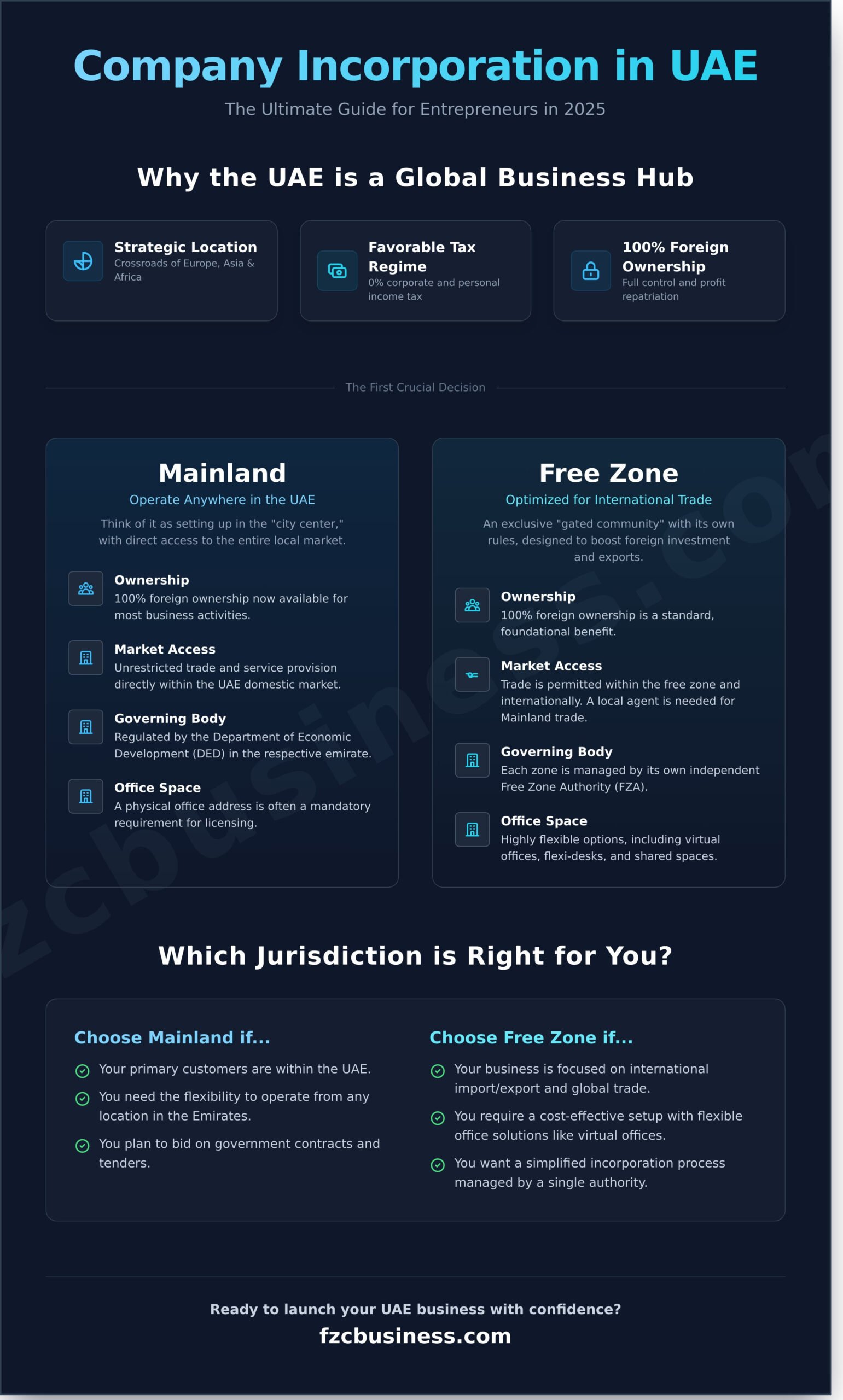
The United Arab Emirates has firmly established itself as a premier global business hub, offering entrepreneurs a dynamic and prosperous environment for growth. Its strategic location, pro-business government policies, and world-class infrastructure make it an unparalleled choice for international investors. The process of company incorporation in UAE is designed to be efficient, unlocking a wealth of benefits that drive success and profitability.
For a clear overview of the setup process, watch this helpful guide:
Beyond its global reputation, the UAE offers tangible advantages including political stability, a high quality of life, and access to a diverse, international talent pool. These factors combine to create an ideal ecosystem for startups and established corporations alike.
Strategic Location and Market Access
Positioned at the crossroads of Europe, Asia, and Africa, the UAE provides businesses with unmatched access to major emerging markets. This geographic advantage is supported by world-class logistics infrastructure, including Dubai International Airport (DXB) and Jebel Ali Port, ensuring seamless global trade and supply chain operations for your enterprise.
Favorable Tax and Economic Environment
One of the most compelling reasons for setting up a business is the UAE’s highly attractive tax regime. Most businesses enjoy 0% corporate and personal income tax, allowing you to retain maximum profits. The stable, business-friendly environment is further reinforced by a currency (AED) pegged to the US Dollar and a robust, diversified Economy of the United Arab Emirates, which inspires investor confidence.
Full Ownership and Business Control
Recent landmark legal reforms now permit 100% foreign ownership for a wide range of business activities on the Mainland, a benefit once exclusive to Free Zones. This gives entrepreneurs complete control over their operations. Furthermore, the UAE guarantees the freedom to repatriate 100% of your capital and profits without restrictions, providing the financial security and flexibility essential for a successful company incorporation in UAE.
The First Crucial Decision: Mainland vs. Free Zone Company
Before any other legal steps are taken, the most foundational decision in your journey of company incorporation in UAE is choosing your business jurisdiction. This choice dictates your company’s ownership structure, operational scope, and regulatory obligations. The two primary options are Mainland and Free Zone, and understanding their core differences is essential for long-term success.
To simplify the concept, think of the UAE’s business landscape like a city. A Mainland company operates ‘in the city’ itself, with unrestricted access to the entire local market. In contrast, a Free Zone is like an exclusive ‘gated community’ within that city, designed with specific rules and benefits to attract foreign investment and foster industry-specific growth.
Mainland vs. Free Zone: At a Glance
Mainland Company
Free Zone Company
100% Foreign Ownership (most activities)
100% Foreign Ownership
Unrestricted trade within UAE
Trade within zone & internationally
Department of Economic Development (DED)
Independent Free Zone Authority
Physical office often mandatory
Flexible options (including virtual offices)
Ownership Structure and Liability
Historically, a key advantage of Free Zones was 100% foreign ownership. However, recent legal reforms now permit 100% foreign ownership for most commercial and industrial activities on the Mainland as well. In both jurisdictions, the most common and recommended legal structure is the Limited Liability Company (LLC), which protects your personal assets by separating them from the company’s liabilities.
Business Scope and Market Access
Your target market is a critical factor. A Mainland company has complete freedom to trade directly with any customer or business anywhere in the UAE and is eligible to bid on lucrative government contracts. A Free Zone company is primarily permitted to conduct business within its designated zone and internationally. To sell products or services directly in the UAE Mainland market, a Free Zone entity typically requires a local distributor.
Regulatory Body and Licensing
Each jurisdiction operates under a different regulatory authority. Mainland companies are licensed and governed by the Department of Economic Development (DED) in their respective emirate. This unified approach is part of what makes the country’s business environment so robust, a fact often highlighted in the U.S. Department of State’s analysis of the UAE investment climate. In contrast, each of the 40+ Free Zones is managed by its own independent authority (e.g., IFZA, SHAMS), which often results in a faster, more streamlined setup process.
Visa Eligibility and Office Requirements
On the Mainland, your company’s visa eligibility is often directly linked to the size of your physical office space. Free Zones provide greater flexibility, offering tailored visa packages that can be secured with or without a physical office, making them an efficient choice for startups, freelancers, and international entrepreneurs. This flexibility is a key part of the hassle-free company incorporation in UAE that Free Zones offer.
The right decision ensures a smooth and successful business journey. Need help choosing? Get expert guidance on your UAE company setup.
The UAE Company Incorporation Process: A 7-Step Guide
The journey from a business idea to a fully operational entity in the UAE follows a structured and well-defined path. While timelines can vary based on your chosen jurisdiction and business activity, this 7-step guide provides a clear, chronological roadmap. Navigating these legal requirements demands precision, but with expert guidance, the entire procedure can be a smooth and efficient experience, ensuring full compliance from day one.
Steps 1-3: Planning and Initial Approvals
The foundation of a successful company incorporation in UAE lies in meticulous planning and securing preliminary government permissions. This initial phase sets the stage for all subsequent steps.
- 1. Define Business Activity & Choose a Legal Structure: First, clearly identify all intended business activities. This crucial decision determines the type of license you require and helps in selecting the most suitable legal structure, such as a Limited Liability Company (LLC), which is a popular choice for entrepreneurs.
- 2. Select a Unique Company Name: Choose a trade name for your business that is unique and adheres to the UAE’s official naming conventions. The name must be approved and reserved with the relevant authority.
- 3. Obtain Initial Approval: You must secure an Initial Approval Certificate from the governing body-either the Department of Economy and Tourism (DET) for a mainland company or the specific Free Zone authority. This document signifies that the UAE government has no objection to your proposed business venture.
Steps 4-5: Legal Documentation and Physical Presence
With initial approval secured, the next stage involves preparing core legal documents and establishing your company’s official address, a mandatory requirement for all businesses in the UAE.
- 4. Prepare and Notarize the Memorandum of Association (MOA): The MOA is a foundational legal document that outlines your company’s objectives, shareholding structure, and operational framework. It must be drafted, finalized, and notarized before a public notary.
- 5. Secure a Business Address: Every company requires a registered physical address. Options range from leasing a dedicated office to utilizing a cost-effective flexi-desk. For mainland companies, a registered tenancy contract, known as an Ejari, is mandatory proof of your physical location.
Steps 6-7: Final Submission and Post-License Formalities
This final phase brings your business to life by securing your license and completing the essential post-incorporation tasks needed to begin operations legally.
- 6. Submit All Documents and Pay Fees: Compile all approved documents, including the notarized MOA and tenancy contract, and submit them for final review. Upon approval, you will receive a payment voucher to settle the required trade license fees.
- 7. Receive Your Trade License: Once payment is confirmed, your official trade license is issued. With this license, you can proceed with critical next steps like applying for your company’s Establishment Card, processing residency visas, and opening a corporate bank account. Let us handle the paperwork for a hassle-free incorporation process, allowing you to focus on launching your business.
Essential Documents and Legal Requirements
Meticulous preparation of your legal documents is the cornerstone of an efficient and hassle-free business setup. To streamline the process, it is crucial to gather all required paperwork in advance. A complete and accurate submission prevents delays and ensures your company incorporation in UAE proceeds smoothly. Our expert guidance can help you navigate these requirements with confidence.
The necessary documents are typically divided into two categories: personal documents for the individuals involved and corporate documents related to the new business entity.
Personal Documents for Shareholders & Managers
Each shareholder, director, and the appointed General Manager must provide a set of personal identification documents. Ensuring these are clear, valid, and meet the specific criteria is a critical first step.
- Passport Copies: A clear, color copy of the passport for all shareholders and the manager. The passport must have at least six months of validity remaining.
- UAE Residence Visa & Emirates ID: If any shareholder or the manager is already a UAE resident, a copy of their residence visa and Emirates ID is required.
- Passport-Sized Photographs: Recent, high-quality photographs with a white background, adhering to UAE government standards.
- No Objection Certificate (NOC): For UAE residents sponsored by another company or individual, an NOC from their current sponsor may be required, granting permission to establish a new business.
Corporate and Application Documents
These documents form the legal foundation of your company and its registration with the relevant authorities, whether on the mainland or in a free zone.
- Completed Application Form: The official registration form from the chosen licensing authority (e.g., Department of Economy and Tourism or a specific free zone authority).
- Trade Name Reservation Certificate: Proof that your chosen company name has been approved and reserved.
- Initial Approval Letter: A formal letter from the authorities confirming their preliminary approval for your business activities and setup.
- Memorandum of Association (MOA) / Articles of Association (AOA): The legal document outlining the company’s constitution. This must be drafted, typed in both English and Arabic, and notarized by a UAE notary public.
- Tenancy Contract (Ejari): A valid tenancy contract for the company’s physical office address, registered through the Ejari system in Dubai or the relevant system in other emirates.
Important Note on Attestation: For corporate shareholders or when documents originate from outside the UAE, legal attestation is mandatory. Documents such as a parent company’s Certificate of Incorporation or a Power of Attorney must first be notarized in the country of origin, then attested by the UAE Embassy there, and finally attested by the Ministry of Foreign Affairs (MOFA) in the UAE. Proper attestation is essential for legal compliance and acceptance by UAE authorities.
Understanding the Costs of Company Setup in the UAE
One of the primary considerations for any entrepreneur is the total investment required for business setup. The cost of company incorporation in the UAE varies significantly based on your chosen jurisdiction (Mainland or Free Zone), business activity, visa requirements, and office type. To provide a clear financial roadmap, we’ve broken down the costs into two main categories: one-time setup fees and recurring annual expenses.
One-Time Incorporation Fees
These are the initial, non-recurring charges required to legally establish your company. While figures can range from approximately AED 15,000 to over AED 50,000 depending on complexity, a typical setup includes:
- Trade License & Initial Approvals: Fees paid to the relevant economic department or Free Zone authority.
- Notarization Fees: Costs associated with legalizing your Memorandum of Association (MOA).
- Establishment Card: A mandatory card that allows your company to sponsor visas.
- External Approvals: Certain business activities may require approvals from specific government ministries, which incur additional fees.
Annual Renewal Costs
To maintain your company’s legal standing, you must budget for annual renewals. These recurring costs are crucial for compliance and continued operations.
- Trade License Renewal: This is the largest annual expense, ensuring your business remains legally licensed.
- Office/Flexi-Desk Rental: Renewal of your registered office address, whether it’s a physical office or a more affordable flexi-desk solution.
- Establishment Card Renewal: The immigration card for your company must also be renewed annually.
- Consultancy Fees: If you retain a firm like Fast Zone Business for PRO services and administrative support, these professional fees will be part of your annual budget.
Visa and Other Related Costs
Beyond the core setup, several other costs contribute to the overall budget. These often depend on your specific staffing and operational needs.
- Residence Visas: Each visa for an owner or employee involves fees for the entry permit, medical test, and Emirates ID, typically ranging from AED 3,500 to AED 6,000 per visa.
- Corporate Bank Account Opening: While some banks offer free account opening, assistance from a consultant to ensure a smooth process may involve a professional fee.
- Document Attestation: Personal and corporate documents from your home country may require attestation, which incurs separate costs.
Navigating these costs requires expert guidance. The total investment for your company incorporation in the UAE depends on your unique business model. For a precise and transparent quote tailored to your requirements, we invite you to get a free, detailed cost breakdown for your business.
Life After Incorporation: Visas, Banking, and Compliance
Securing your trade license is a significant achievement, but it marks the beginning of your operational journey in the Emirates, not the end. The successful completion of your company incorporation in UAE is the foundation upon which you build your business. To operate legally, efficiently, and to grow, you must navigate three critical post-incorporation stages: immigration, corporate banking, and ongoing compliance. Managing these steps effectively from the outset ensures a smooth and sustainable business future.
Securing Residence Visas for Yourself and Staff
With your company officially registered, you can now apply for UAE residence visas for yourself, your partners, and your employees. This process unlocks your ability to live and work legally in the country. The typical visa application process involves several key steps:
- Obtaining the company’s Establishment Card.
- Applying for an entry permit for the individual.
- Completing a mandatory medical fitness test.
- Registering for an Emirates ID card, including biometrics.
- Receiving the final visa stamp in your passport.
Once your investor or employee visa is secured, you can then proceed to sponsor your direct family members, such as your spouse and children.
Opening a Corporate Bank Account
Opening a corporate bank account in the UAE can be a challenging process for new enterprises due to strict due diligence and anti-money laundering (AML) regulations. Banks require a comprehensive set of documents to verify your business’s legitimacy. Be prepared to submit your trade license, Memorandum of Association (MOA), passport and visa copies for all shareholders, and a detailed business plan. Choosing the right banking partner and presenting a professional and transparent company profile is essential for a successful application.
Ongoing Compliance: Tax and Auditing
Maintaining regulatory compliance is non-negotiable for long-term success. All businesses must maintain accurate financial records. Depending on your revenue, you may be required to register for Value Added Tax (VAT) if your taxable supplies exceed AED 375,000 annually. Furthermore, all businesses are subject to UAE Corporate Tax. Most free zone and mainland authorities also require companies to submit annual audited financial statements for license renewal. Staying on top of these obligations is crucial to avoid penalties and operate with integrity. Our experts provide complete support for all your business needs, from visa processing to compliance management.
Understanding the financial health of your new company from day one is fundamental. For a deeper dive into core accounting principles and how they apply to your business, you can visit CTC Tax & Accounting.
Turn Your UAE Business Vision into Reality
The United Arab Emirates offers an unparalleled platform for ambitious entrepreneurs. As this guide has shown, your journey begins with the critical decision between a Mainland or Free Zone setup and a clear understanding of the required steps and documentation. Navigating the legal and administrative landscape is the key to unlocking your venture’s full potential.
Don’t let procedural complexities slow your momentum. At Fast Zone Business, we transform the intricate process of company incorporation in uae into a streamlined, hassle-free experience. Our team provides expert guidance on the ideal jurisdiction for your business model and ensures a smooth process for acquiring visas and opening corporate bank accounts. With our commitment to transparent pricing and no hidden fees, you can invest in your future with complete confidence.
Are you ready to take the decisive step? Book a FREE Consultation with Our UAE Setup Experts Today! Let us handle the paperwork so you can focus on what truly matters-building your success story.
Frequently Asked Questions About Company Incorporation in UAE
Can a foreigner own 100% of a company in the UAE?
Yes, recent amendments to the UAE Commercial Companies Law now permit 100% foreign ownership for most mainland businesses, a benefit previously exclusive to Free Zone companies. This has significantly simplified market entry for international entrepreneurs. While certain strategic sectors may still require an Emirati partner, our experts can provide clear guidance on the optimal ownership structure for your specific business activity, ensuring a compliant and efficient setup process.
How long does it take to incorporate a company in the UAE?
The timeline for company incorporation in the UAE depends on the chosen jurisdiction and complexity of the business activity. A Free Zone company can often be established in just a few working days, offering a rapid route to market. A mainland company setup typically takes between one to two weeks, subject to all necessary approvals from government departments. Fast Zone Business streamlines this entire process to ensure your registration is completed as efficiently as possible.
Do I need a physical office space to set up a company in the UAE?
A physical office is not always mandatory. The requirement depends on your jurisdiction, business activity, and the number of visas you need. Many Free Zones provide cost-effective flexi-desk or virtual office packages that satisfy licensing requirements. For mainland companies, a registered office address is required, which can be secured with a tenancy contract (Ejari). We can advise on the most suitable and economical office solution to meet your business needs and ensure full compliance.
What is the difference between a Free Zone Establishment (FZE) and a Free Zone Company (FZCO)?
The key distinction between an FZE and an FZCO is the number of shareholders. A Free Zone Establishment (FZE) is a legal entity designed for a single shareholder, who can be an individual or a corporate body. In contrast, a Free Zone Company (FZCO) is structured for businesses with two or more shareholders. Both legal forms offer the same core benefits, including 100% foreign ownership, making the choice dependent entirely on your company’s ownership structure.
Is it difficult for a new company to open a corporate bank account in the UAE?
Opening a corporate bank account can be a meticulous process due to strict due diligence and compliance regulations from the UAE Central Bank. Banks carefully assess the company’s physical presence, business plan, and shareholder profiles. However, with proper documentation and expert guidance, the process becomes significantly smoother. Our established relationships with leading UAE banks and expertise in preparing robust applications help our clients navigate this crucial step with confidence and a higher rate of success.
What is a trade license and how long is it valid for?
A trade license is the official legal permit issued by the relevant economic authority that authorizes your company to conduct specific business activities in the UAE. Common types include Commercial, Professional, and Industrial licenses. This license is typically valid for one year from the date of issue and must be renewed annually to maintain legal standing and operational legitimacy. Timely renewal is critical to avoid fines and ensure uninterrupted business operations.
