

Business Setup in Dubai: The Ultimate Guide for Entrepreneurs (2026)
Embarking on your entrepreneurial journey in Dubai is an exciting prospect, yet the path is often clouded with uncertainty. Are you weighing the critical differences between a Mainland and Free Zone company? Concerned about navigating complex legal paperwork or facing hidden costs that could derail your budget? These common hurdles can make the process feel daunting. This is your definitive guide to achieving a smooth and efficient business setup dubai, meticulously crafted to provide the clarity and confidence you need to launch successfully in 2026.
Within this comprehensive resource, we provide a step-by-step roadmap that demystifies every stage of company formation. You will gain an expert understanding of the best legal structure for your specific goals, receive a transparent breakdown of all potential costs in AED, and learn the exact process for securing your trade license and visas. Prepare to move forward with the in-depth knowledge required to make informed decisions and transform your ambition into a thriving reality in the UAE.
Key Takeaways
- The most critical first step is choosing the right jurisdiction-Mainland, Free Zone, or Offshore-as this decision directly impacts your market access and operational scope.
- A successful business setup in Dubai follows a clear, multi-stage process involving specific documentation and government approvals for a smooth experience.
- Accurately budgeting for your company formation is crucial, as costs vary significantly based on your chosen license type, jurisdiction, and physical office requirements.
- Securing your trade license is a major milestone, but essential post-setup steps like visa processing and opening a corporate bank account are required to operate legally.
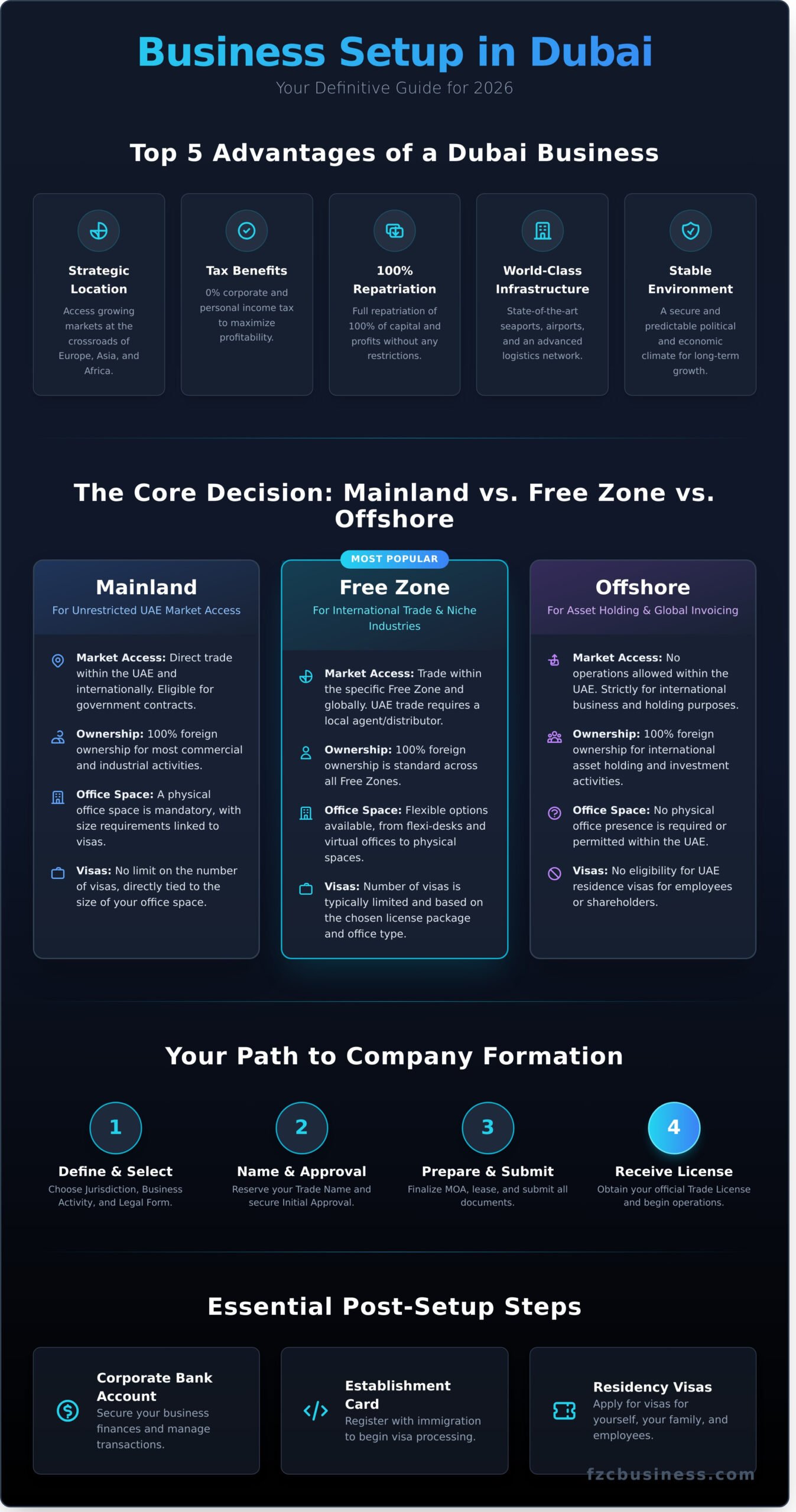
Why Set Up a Business in Dubai? Top 5 Advantages
Dubai has firmly established itself as a premier global destination for entrepreneurs and multinational corporations. Its visionary leadership and strategic planning have created an environment where businesses not only launch but thrive. For any investor considering the next step, a business setup in Dubai offers a unique combination of financial incentives, market access, and an unparalleled lifestyle, making it a leading choice for international expansion.
To better understand the financial landscape for entrepreneurs in the emirate, this video provides a helpful overview:
The emirate’s appeal is built on several key pillars that provide a solid foundation for sustainable growth and profitability. Let’s explore the top five advantages that make Dubai a strategic choice for your business venture.
Strategic Location and Market Access
Positioned at the crossroads of Europe, Asia, and Africa, Dubai offers businesses unparalleled access to some of the world’s fastest-growing emerging markets. The government’s pro-business policies, streamlined regulations, and high rankings in ease of doing business reports create a thriving ecosystem. This dynamic environment supports a diverse range of companies, from innovative startups to established global enterprises, fostering collaboration and growth opportunities.
Tax Benefits and Financial Incentives
One of the most compelling reasons for a business setup in Dubai is its highly favorable tax regime. The financial benefits are clear and designed to maximize your profitability:
- 0% Corporate Tax: Most businesses enjoy a 0% tax rate on their profits, allowing for significant reinvestment and growth.
- 0% Personal Income Tax: Employees and residents are not subject to any personal income tax, which helps attract and retain top global talent.
- Full Repatriation of Profits: Businesses are permitted to repatriate 100% of their capital and profits to their home country without restrictions.
Beyond taxation, Dubai boasts world-class infrastructure that facilitates seamless global trade and operations. Its state-of-the-art seaports, including Jebel Ali Port, and world-leading airports like Dubai International (DXB), are supported by an advanced logistics and transport network, ensuring efficient supply chain management.
Furthermore, the UAE’s stable political and economic climate provides a secure and predictable environment for long-term investment. The well-diversified Economy of Dubai has successfully moved beyond oil dependency, focusing on trade, tourism, real estate, and financial services. This resilience offers businesses the confidence to plan for a sustainable future. Coupled with a high quality of life, excellent healthcare, and a safe, multicultural society, Dubai is not just a place to do business-it’s a place to build a life and attract a world-class, international workforce.
The Core Decision: Mainland, Free Zone, or Offshore Company?
The first and most critical step in your business setup dubai journey is choosing the right legal jurisdiction. This decision directly impacts your company’s operational scope, ownership structure, and long-term growth potential. The optimal choice between a Mainland, Free Zone, or Offshore company is determined entirely by your specific business activities and your target market. To simplify this crucial decision, we’ve outlined the key differences below.
While historically, a local sponsor was required for mainland companies, recent legal amendments now permit 100% foreign ownership for the majority of business activities, making it a more attractive option than ever. For a detailed breakdown of activities, the official Dubai business setup portal provides comprehensive and up-to-date information directly from the source.
.comparison-table table { width: 100%; border-collapse: collapse; margin: 2em 0; }
.comparison-table th, .comparison-table td { border: 1px solid #dddddd; text-align: left; padding: 12px; }
.comparison-table th { background-color: #f2f2f2; font-weight: bold; }
.comparison-table tr:nth-child(even) { background-color: #f9f9f9; }
| Feature | Mainland Company | Free Zone Company | Offshore Company |
|---|---|---|---|
| Trading Scope | Directly within UAE & internationally | Within Free Zone & internationally | Holding company; outside UAE only |
| Foreign Ownership | Up to 100% (for most activities) | 100% Guaranteed | 100% Guaranteed |
| Office Location | Anywhere in Dubai | Restricted to the specific Free Zone | No physical office required |
| Visa Eligibility | Yes, linked to office size | Yes, linked to business package | No |
Dubai Mainland Company
A Mainland company is the ideal structure if your primary objective is to trade directly with the UAE’s local market. This setup grants you the flexibility to operate from any location in Dubai and uniquely positions you to bid on lucrative government contracts. All Mainland businesses are licensed and regulated by the Department of Economy and Tourism (DET), ensuring full integration into the local economy.
Dubai Free Zone Company
For businesses focused on international trade, import/export, or providing services across borders, a Free Zone company is the preferred choice. These entities operate within designated economic zones like DMCC or JAFZA and benefit from guaranteed 100% foreign ownership and a 0% corporate tax rate. While you can trade internationally without restriction, accessing the UAE mainland market requires partnering with a local distributor.
Offshore Company (JAFZA, RAK ICC)
An Offshore company, also known as an International Business Company (IBC), serves a very specific purpose. It is not a trading entity but rather a legal tool used primarily as a holding company to own assets, real estate, or shares in other corporations. An offshore setup cannot conduct business within the UAE, does not require a physical office, and does not grant visa eligibility, making it a cost-effective solution for asset protection and international investment.
Your Step-by-Step Guide to Company Formation in Dubai
Navigating the company formation process in Dubai requires a clear, methodical approach. While the exact requirements can vary between Mainland and Free Zone jurisdictions, this proven process outlines the core milestones for a hassle-free business setup Dubai. Each stage involves specific documentation and government approvals, where even minor errors can cause significant delays. Partnering with a PRO services expert can accelerate this timeline, ensuring compliance and efficiency from start to finish.
Step 1: Define Business Activity & Choose a Legal Structure
Your first critical decision is to precisely define your business activities. You must select them from an approved list provided by the relevant authority, such as the Department of Economic Development (DED) for the mainland. This choice directly influences the type of license you can obtain and the legal structure available to you. Concurrently, you will decide on a legal form-such as a Limited Liability Company (LLC) or a Sole Establishment-which determines factors like shareholder liability and minimum capital requirements. As publications like Forbes have noted, understanding these key steps for setting up a business is fundamental to building a solid foundation.
Step 2: Reserve a Trade Name and Get Initial Approval
Once your activity and structure are defined, you must select and register a unique trade name for your company. The name must adhere to the UAE’s strict naming conventions, avoiding any restricted terms or similarities to existing businesses. After your trade name is approved, you will submit the necessary documents-including passport copies of shareholders-to obtain an Initial Approval Certificate. This certificate confirms that the UAE government has no objection to your proposed business, allowing you to proceed with the next steps.
Step 3: Draft MOA, Secure Office Space, and Get License
With initial approval secured, the next phase involves preparing and notarizing your company’s legal documents, such as the Memorandum of Association (MOA). You must also secure a registered physical or virtual office address, which requires an official tenancy contract registered with Ejari. Finally, all completed documents, approvals, and the tenancy contract are submitted to the relevant authorities. Upon payment of the required fees, you will be issued your official trade license, legally permitting you to operate in Dubai.
Let us handle the paperwork. See how our expert team can streamline your journey and ensure every detail is managed correctly.
Beyond the Trade License: Essential Post-Setup Steps
Receiving your trade license is a significant milestone in your entrepreneurial journey, but it is not the final step. To operate legally and efficiently in the UAE, you must complete several critical post-incorporation procedures. This next phase transitions your company from a registered entity to a fully operational business, covering essential areas like immigration, banking, and tax compliance. A comprehensive PRO services provider is invaluable here, managing these complexities to ensure a smooth launch.
Company Immigration and Visa Processing
Once your company is registered, you must secure the necessary immigration documents to live and work in the UAE. This is a multi-step process that includes:
- Applying for the Establishment Card: This document is mandatory for your company to hire staff and sponsor visas.
- Investor or Partner Visa Application: Securing your own residency visa is a top priority, granting you the legal right to reside in the UAE.
- Employee and Dependant Visas: Your PRO partner will manage the entire process of obtaining visas for your staff and sponsoring family members.
Opening a Corporate Bank Account
A corporate bank account is the backbone of your business operations, yet opening one can be a challenging hurdle in the business setup dubai process. UAE banks conduct a thorough Know Your Customer (KYC) process and often require a detailed business plan and proof of business activity. Expert assistance from a setup agent with strong banking relationships can significantly simplify this step, ensuring your application is prepared correctly to avoid delays.
Registering for Corporate Tax
As per UAE federal law, all businesses are required to register for Corporate Tax with the Federal Tax Authority (FTA) and obtain a Tax Registration Number (TRN). Understanding your obligations, from registration deadlines to tax liability, is crucial for compliance. This also necessitates maintaining proper accounting and bookkeeping records from the very beginning. Failing to comply can result in significant penalties, making professional guidance essential for navigating this new regulatory landscape.
Navigating these post-setup requirements demands precision and in-depth local knowledge. Fast Zone Business provides end-to-end support for every stage of your business setup dubai journey, ensuring your company is fully compliant and operational without hassle.
Understanding the Costs of Business Setup in Dubai
A clear financial plan is the foundation of a successful launch in the UAE. Budgeting accurately for your business setup in Dubai is critical, as costs can vary significantly based on your chosen business activity, jurisdiction (mainland vs. free zone), and office space requirements. One of the most significant advantages of partnering with an experienced firm like Fast Zone Business is receiving a fully transparent cost breakdown from the outset. This protects you from unexpected expenses and hidden charges that can derail your plans when working with less reputable consultants.
To provide clarity, we have outlined the primary cost categories you should anticipate.
One-Time Government and Registration Fees
These are the initial, mandatory fees required to formally establish your company. While exact amounts depend on the governing authority, they typically include:
- Trade Name Reservation & Initial Approval: Fees paid to the Department of Economy and Tourism (DET) or relevant free zone authority to secure your business name and get initial permission to operate.
- Trade License Issuance: This is the primary government fee, generally ranging from AED 15,000 to over AED 30,000 depending on the complexity of your business activities.
- Notarization Fees: Costs associated with legally attesting your company’s Memorandum of Association (MOA) and other foundational documents.
Visa and Immigration Costs
For entrepreneurs planning to reside and work in the UAE, visa processing is a key expense. These costs are calculated per person and cover:
- Establishment Card Fee: A one-time fee of approximately AED 2,000 to register your company with the immigration authorities.
- Investor or Partner Visa: Each visa typically costs between AED 3,000 and AED 5,000. This fee includes the mandatory medical fitness test, Emirates ID application, and visa stamping in your passport.
Ongoing and Operational Costs
Beyond the initial setup, it is crucial to budget for recurring annual expenses to ensure your business remains compliant and operational. These include:
- Annual Trade License Renewal: A yearly fee to maintain your company’s legal standing.
- Office Rent: Costs can range from cost-effective virtual office packages to leasing a physical office space.
- Corporate Tax & Accounting: Professional fees for bookkeeping, financial reporting, and ensuring compliance with UAE Corporate Tax regulations.
Navigating these financial requirements demands expert guidance. For a detailed, no-obligation quote tailored to your specific business needs, we invite you to book a free consultation with our specialists today.
Embark on Your Dubai Business Journey with Confidence
Dubai presents a landscape of unparalleled opportunity for entrepreneurs. As this guide has detailed, a successful launch hinges on strategic decisions-primarily choosing the right jurisdiction between mainland, free zone, or offshore. Understanding the complete process, from legal formalities to post-setup requirements, is the foundation of a successful business setup dubai experience.
While the path to incorporation is clear, navigating the intricacies requires in-depth knowledge and precision. Partnering with a specialist removes the complexity, ensuring a smooth, compliant, and efficient launch that saves you both time and valuable resources. At Fast Zone Business, we provide that expert guidance.
As your one-stop solution, we manage your trade license, visas, and corporate banking with a firm commitment to transparent pricing and a truly hassle-free process. Take the definitive step towards your entrepreneurial goals. Book a FREE Consultation with Our Dubai Business Setup Experts and let us pave the way for your success. Your Dubai venture awaits.
Frequently Asked Questions About PRO Services & Business Setup
How long does it take to set up a business in Dubai?
The timeline for a business setup in Dubai varies based on the jurisdiction and business activity. A free zone company can often be established in just a few days, offering a swift and efficient process. A mainland company setup typically takes one to two weeks, depending on external approvals. Our expert PRO services are designed to expedite this entire process, ensuring all documentation is submitted correctly to avoid unnecessary delays and ensure a smooth experience for you.
Can a foreigner own 100% of a business in Dubai Mainland?
Yes, following recent legal amendments, foreign investors can now own 100% of a mainland company in Dubai for most commercial and industrial activities. This has eliminated the previous requirement for a majority Emirati shareholder for over 1,000 business activities. However, certain strategic sectors may still have specific ownership restrictions. Our consultants can provide expert guidance on the specific requirements for your chosen business activity, ensuring full compliance with UAE law.
What is the cheapest free zone for business setup in the UAE?
While free zones like Ras Al Khaimah Economic Zone (RAKEZ) and International Free Zone Authority (IFZA) are known for their cost-effective packages, the “cheapest” option depends entirely on your specific needs. Factors such as license type, number of visas, and facility requirements all influence the final cost. We recommend a consultation to analyze your business goals, which allows us to provide a customized, affordable package that offers the best value for your investment.
Do I need a local Emirati sponsor to start a business in Dubai?
For the majority of mainland business activities, the requirement for a local Emirati sponsor holding 51% of shares is no longer mandatory. However, for certain professional service licenses, you may still need a Local Service Agent (LSA). An LSA does not hold any shares in your company but acts as your representative for governmental administrative purposes for an annual fee. Our team will clarify the precise requirements based on your business license type.
What documents are required to start a business in Dubai?
The core documents for a business setup in Dubai typically include passport copies for all shareholders, a copy of your entry stamp or residence visa, and a completed application form. Depending on your business activity and jurisdiction, you may also need a detailed business plan and No Objection Certificate (NOC) if you are already a UAE resident. Our dedicated team ensures all your paperwork is meticulously prepared and submitted for a hassle-free registration process.
Can I get a residence visa by setting up a company in Dubai?
Yes, setting up a company in Dubai is a direct and popular pathway to obtaining a UAE residence visa for yourself, your family, and your employees. As the owner of the company, you are eligible to apply for an investor or partner visa. The number of visas your company can issue is generally determined by the size of your office or facility and the nature of your business. We provide end-to-end assistance with all visa processing and immigration formalities.
What is the difference between a trade license and a commercial license?
While often used interchangeably, there is a key distinction. A Commercial License is specifically for companies engaged in trading activities, including the import, export, and sale of goods and commodities. “Trade License” is a broader, more general term for any business license issued by the economic department. This umbrella term includes Commercial Licenses, Professional Licenses (for service-based providers), and Industrial Licenses (for manufacturing and production activities).
