

Company Registration in Dubai: The Ultimate Step-by-Step Guide 2026
The prospect of launching your business in Dubai is exhilarating, yet the path is often obscured by a maze of complex decisions and bureaucratic hurdles. If you’re feeling overwhelmed by terms like ‘Mainland’ and ‘Free Zone,’ uncertain about foreign ownership laws, or concerned about hidden costs derailing your budget, you are not alone. The fear of a simple paperwork error causing significant delays is a valid concern for any entrepreneur. This is precisely why we created this guide-to replace uncertainty with clarity and provide expert guidance for your company registration in Dubai.
This comprehensive, step-by-step guide for 2025 is your definitive roadmap to a smooth and successful launch. We will demystify the entire process, breaking down the exact legal requirements, comparing Mainland and Free Zone jurisdictions, and providing a transparent overview of all potential costs in AED. By the end, you will have the confidence and a clear action plan to turn your business vision into a registered, operational reality in the UAE, hassle-free.
Key Takeaways
- Learn the critical differences between a Mainland and Free Zone company to determine the right jurisdiction for your business goals.
- Master the complete, step-by-step process for a smooth company registration in Dubai, from initial approval to receiving your trade license.
- Get a clear overview of the essential documents required and the estimated costs in AED to budget for your company setup accurately.
- Discover the crucial post-registration steps, including securing investor visas and opening a corporate bank account, to become fully operational.
Why Register a Company in Dubai? Key Benefits for Global Entrepreneurs
Dubai has firmly established itself as a premier global business hub, offering a dynamic and secure environment for entrepreneurs and established corporations alike. Its strategic geographical location serves as a vital bridge between Eastern and Western markets, providing unparalleled access to billions of consumers. This advantage is supported by a stable political landscape, a forward-thinking government, and pro-business policies designed to facilitate growth and innovation. For investors seeking a seamless path to international expansion, the process of company registration in Dubai is the first step toward unlocking immense potential.
To better understand the setup process for non-residents, this video offers a helpful overview:
A Favorable Tax Environment
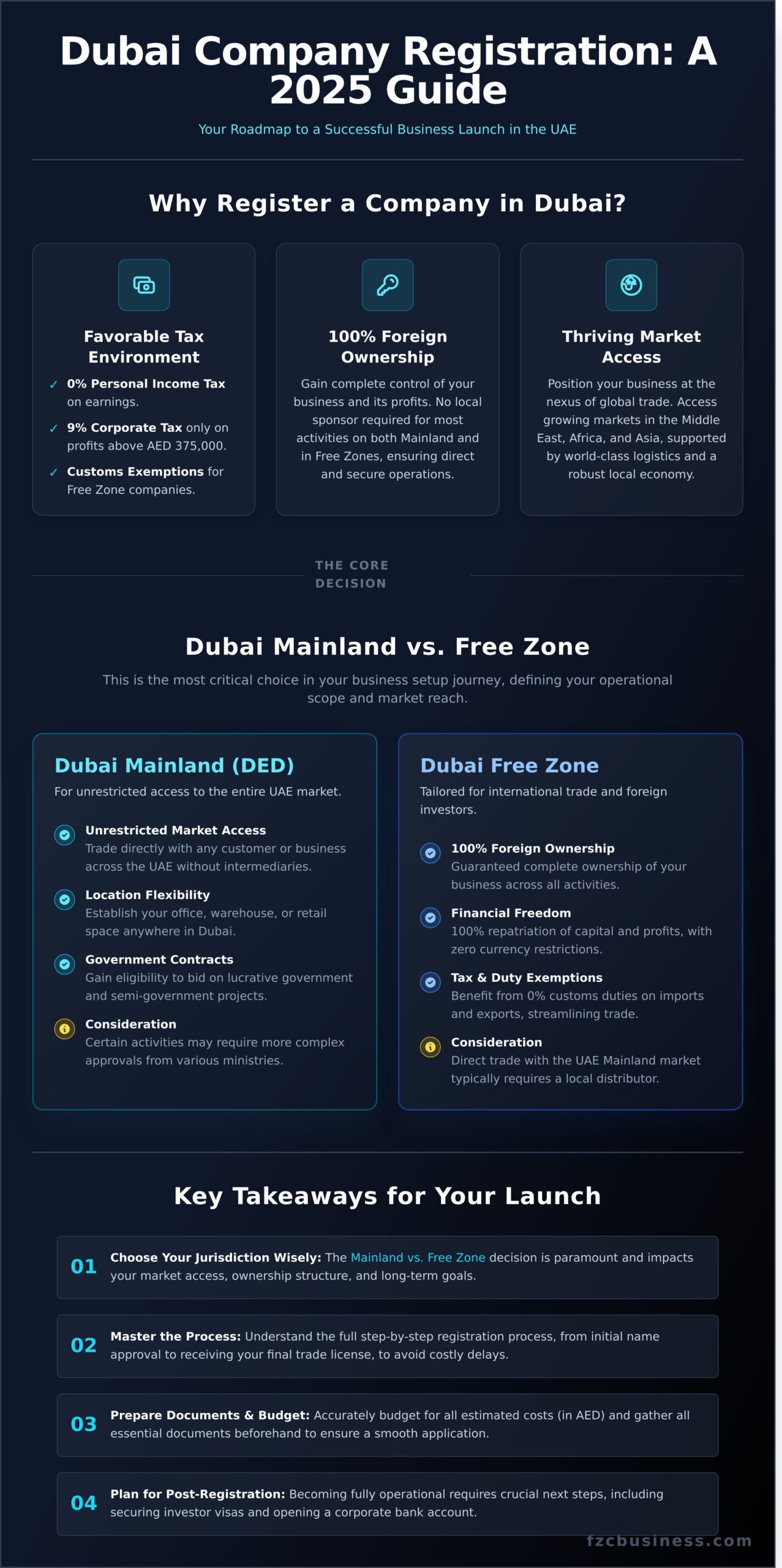
One of the most compelling reasons for company registration in Dubai is its highly attractive tax regime. Key benefits include:
- 0% Personal Income Tax: Retain all of your personal earnings without any deductions.
- Low Corporate Tax: A competitive 9% corporate tax is applied only to taxable income exceeding AED 375,000, leaving small businesses and startups exempt.
- Customs Exemptions: Companies operating within Dubai’s numerous Free Zones benefit from exemptions on import and export duties, streamlining trade operations.
100% Foreign Ownership Opportunities
The UAE has made significant regulatory advancements, moving away from past requirements for local sponsorship. Today, entrepreneurs can enjoy 100% foreign ownership for businesses in both Free Zones and for a vast range of activities on the Mainland. This modern approach provides complete control over your business operations and profits, making the setup process more direct and secure than ever before.
Access to a Thriving Market
Setting up in Dubai places your business at the nexus of global trade. You gain direct access to rapidly growing markets across the Middle East, Africa, and Asia. The local market itself is robust, driven by a diverse, high-income expatriate population. This access is powered by Dubai’s diversified economy and supported by world-class logistics infrastructure, including Jebel Ali Port and Dubai International Airport, ensuring the efficient movement of goods and services worldwide.
The First Crucial Decision: Dubai Mainland vs. Free Zone
Before you proceed with your company registration in Dubai, you must make a foundational choice: will you operate on the Mainland or within a Free Zone? This decision is the most critical step in your business journey, as it dictates your company’s legal structure, operational scope, and market access. Think of it this way: a Mainland company is like a local shop with the freedom to trade anywhere in the city, while a Free Zone company is a specialized store within a high-tech business park, designed for specific, often international, activities.
Dubai Mainland (DED) Company: The Pros and Cons
A Mainland company, registered with the Dubai Department of Economy and Tourism (DED), offers unparalleled access to the local UAE market and is the traditional route for most businesses.
- Unrestricted Market Access: Trade directly with any customer or business across the UAE without intermediaries.
- Location Flexibility: Establish your office, warehouse, or retail space anywhere in Dubai.
- Government Contracts: Gain the eligibility to bid on lucrative government and semi-government projects.
- Potential Drawback: Certain business activities may require more extensive approvals from various government ministries, which can add complexity to the setup process.
Dubai Free Zone Company: The Pros and Cons
Free Zones are designated economic areas offering specific benefits, primarily geared towards foreign investors and international trade. There are over 40 Free Zones in Dubai, each often catering to a specific industry.
- Complete Foreign Ownership: Enjoy 100% ownership of your business without the need for a local partner, a standard benefit across all activities.
- Financial Freedom: Benefit from 100% repatriation of capital and profits, with zero currency restrictions.
- Efficient Setup: The registration process is typically faster and more streamlined within a dedicated Free Zone authority.
- Key Limitation: Direct trade with the UAE mainland is restricted; a local agent or distributor is required to sell products or services outside the zone.
How to Choose: Which Jurisdiction is Right for You?
Your business model is the ultimate guide. If your primary target market is within the UAE, a Mainland license is the logical choice. If your focus is on international exports, imports, or a niche industry catered for by a specific Free Zone (like media or tech), then a Free Zone setup is ideal. Here is a simple comparison:
- Ownership: Mainland offers up to 100% foreign ownership for most activities, while Free Zones offer it as a standard for all.
- Scope of Business: Mainland allows trade across the entire UAE and internationally. Free Zone trade is limited to within the zone and internationally.
- Office Location: A Mainland company can be located anywhere in Dubai, whereas a Free Zone company must operate from within its designated zone.
- Visas: Mainland visa eligibility is generally tied to office space, while Free Zones offer a pre-approved number of visas that can be increased.
Navigating this choice is critical for a smooth and successful business setup. The wrong decision can lead to operational limitations and unnecessary costs. Our expert consultants provide in-depth knowledge to help you make the right choice from day one. Book a FREE Consultation today for clear, professional guidance.
The Step-by-Step Company Registration Process in Dubai
Navigating the official process for company registration in Dubai involves a series of structured, sequential steps. While the core framework is consistent, specific requirements can differ between Mainland, Free Zone, and Offshore jurisdictions. Executing each stage correctly is crucial to prevent costly delays and ensure a smooth launch. Partnering with a business setup expert streamlines this entire journey, transforming a complex procedure into a hassle-free experience.
Steps 1-2: Determine Business Activity and Legal Form
The foundation of your business setup begins with selecting your business activities from the official list provided by Dubai’s Department of Economy and Tourism (DET). This choice directly influences the legal forms available to you, such as a Limited Liability Company (LLC), a Sole Establishment, or a Branch Office. Aligning your chosen activity with the correct legal structure is a critical first step for compliance and future operations.
Steps 3-4: Trade Name Reservation and Initial Approval
Next, you must select and reserve a unique trade name for your company. The name must adhere to UAE guidelines-it cannot violate public morals or contain religious references. Once your name is approved and reserved, you will apply for the Initial Approval Certificate (IAC). This document serves as a preliminary consent from the authorities, confirming they have no objection to you establishing the business and allowing you to proceed with the next steps.
Steps 5-6: Draft MOA and Secure a Business Address
With initial approval secured, you must draft a Memorandum of Association (MOA). This legal document outlines the company’s constitution, shareholding structure, and objectives. For Mainland companies, the MOA must be typed in both English and Arabic and notarized by a public notary. Concurrently, you must secure a physical business address and obtain an Ejari (tenancy contract registration), which is mandatory proof of your office location.
Step 7: Final Submission and License Issuance
The final stage involves submitting all your collated documents to the relevant authority. Key documents typically include:
- The Initial Approval Certificate (IAC) and trade name reservation
- A copy of the notarized Memorandum of Association (MOA)
- Passport copies of all shareholders and managers
- Your registered office address lease agreement (Ejari)
Upon successful submission, the authority will issue a payment voucher for the final license fees. Once paid, you will receive your official Trade License, which legally permits you to commence business operations in Dubai.
Essential Documents and Estimated Costs for Registration
Navigating the requirements for your company registration in Dubai boils down to two fundamental questions: “What documents do I need?” and “How much will it cost?” While the exact figures vary based on your chosen business activity, jurisdiction (Mainland or Free Zone), and visa requirements, this guide provides a clear and practical overview to help you plan effectively.
The total investment can range from approximately 15,000 AED to over 50,000 AED. For this reason, working with an expert consultant is crucial. A detailed, itemized quote eliminates ambiguity and ensures there are no financial surprises, allowing you to budget with confidence for a smooth setup process.
Required Documents Checklist for Shareholders
To ensure an efficient and hassle-free application process, preparing your documentation in advance is essential. While specific requirements may differ slightly between authorities, the core documents for all shareholders and appointed managers typically include:
- A clear, colour copy of your passport.
- Your current UAE visa status page and Emirates ID copy (if you are a resident).
- A comprehensive business plan (often required for specialised licenses or certain Free Zones).
- A No Objection Certificate (NOC) from your current sponsor if you are employed in the UAE on a residence visa.
A Breakdown of Typical Registration Costs
Your total setup cost is comprised of several key components. Business setup packages often bundle these for simplicity, but it is important to understand the individual elements. Key expenses include:
- One-Time Government Fees: This covers essential approvals like your Trade Name Reservation, Initial Approval, and the final issuance of your Trade License.
- Visa-Related Costs: If you require residency, budget for the company Establishment Card, visa application, entry permit, medical fitness test, and Emirates ID processing.
- Office and Premises Costs: Every company needs a registered address. Options range from affordable virtual office packages and flexi-desks to fully-serviced physical offices, with costs varying accordingly.
Potential Hidden Costs to Be Aware Of
Transparency is key to a successful business launch. Our expert guidance helps you anticipate all potential expenses, including those that are less obvious. Be mindful of possible additional costs such as external government ministry approvals for specialised activities (e.g., healthcare or education), fees for legal translation and notarization of corporate documents, and refundable security deposits for office leases or certain visa categories.
To move forward with clarity and confidence, it is vital to have a complete financial picture. Get a transparent, no-obligation quote for your Dubai business setup from our experts today.
Life After Registration: Visas, Bank Accounts, and Compliance
Securing your trade license is a significant milestone, but it marks the beginning of your operational journey, not the end. The steps that follow your official company registration in Dubai are critical for transforming your business from a legal entity into a fully functional enterprise. Managing these post-setup requirements efficiently is essential for long-term success and compliance.
At Fast Zone Business, our role extends beyond the initial paperwork. We provide comprehensive support to ensure a seamless transition into the UAE business landscape, handling every critical task so you can focus on growth.
Securing Your UAE Residency Visa
Your new company license is your gateway to obtaining residency in the UAE for yourself, your family, and your employees. The process is systematic and requires careful coordination with government departments. Key steps include:
- Applying for the company’s Establishment Card.
- Issuing an entry permit (employment visa) for the applicant.
- Completing a mandatory medical fitness test.
- Attending an appointment for Emirates ID biometrics.
The number of visas your company is eligible for typically depends on factors like your office size and business activity, ensuring your staffing capabilities align with your operational needs.
Opening a Corporate Bank Account
Navigating the corporate banking sector can be a common challenge for new entrepreneurs. UAE banks have stringent due diligence processes, and preparing a complete and professional application is vital. While requirements vary slightly between banks, you will generally need:
- Your company’s Trade License and Certificate of Incorporation.
- The Memorandum of Association (MOA).
- Passport and visa copies for all shareholders.
- A detailed business profile or plan.
Choosing the right bank and maintaining a healthy relationship is crucial for your financial operations. Our expert banking assistance ensures you are fully prepared, simplifying what can often be a complex account opening process.
Ongoing Compliance: PRO Services and Tax
Staying compliant with UAE regulations is a non-negotiable aspect of running a business. This is where professional Public Relations Officer (PRO) services become invaluable. Our PRO team acts as your government liaison, managing essential administrative tasks such as license renewals, visa processing, and any necessary amendments to your company structure.
Furthermore, all businesses must adhere to federal tax laws. This includes registering for Corporate Tax with the Federal Tax Authority (FTA) and, if your revenue exceeds the mandatory threshold of AED 375,000, registering for Value Added Tax (VAT). Proactive compliance is key to avoiding significant fines and ensuring your business maintains a flawless legal standing.
Turn Your Dubai Business Vision into a Reality
You now have the roadmap to establishing your presence in one of the world’s most dynamic economies. From choosing between a Mainland and Free Zone setup to understanding the required documentation, the path is clear. The process of company registration in dubai is the critical final step in transforming your ambition into a tangible, operational enterprise.
Navigating this landscape alone, however, can be complex. This is where expert partnership makes all the difference. Fast Zone Business is your one-stop solution, offering expert guidance for both Mainland and Free Zone setups. We manage the entire process-from trade licenses and visas to corporate bank accounts-with transparent pricing and no hidden fees, ensuring a smooth, efficient, and hassle-free experience for you.
Don’t let administrative hurdles delay your success. Book a FREE Consultation to Start Your Dubai Business Journey today. Let’s build your future in Dubai, together.
Frequently Asked Questions
How long does the company registration process take in Dubai?
The timeline for company registration in Dubai can be remarkably efficient, often taking as little as a few days to a few weeks. The exact duration depends on the chosen jurisdiction (mainland or free zone), the complexity of the business activity, and the prompt submission of all required documentation. With expert guidance from Fast Zone Business, we streamline every step, from name approval to license issuance, to ensure a swift and hassle-free setup experience for our clients.
Can I register a Dubai company remotely from my home country?
Absolutely. One of the key advantages of the UAE’s business environment is the ability to complete the entire registration process remotely. Our team at Fast Zone Business can act on your behalf through a power of attorney, managing all document submissions, government liaisons, and legal formalities. This efficient process allows you to establish your company in Dubai and secure your trade license without the immediate need for you to travel, ensuring a smooth and convenient start to your venture.
What is the minimum share capital required to start a business in Dubai?
For most Dubai mainland Limited Liability Companies (LLCs), there is no longer a legally mandated minimum share capital. However, you must state a sufficient and credible amount in your company’s Memorandum of Association (MOA). Many free zones also offer zero or very low minimum share capital requirements, sometimes starting from AED 1,000. Our consultants will advise on the optimal capital structure for your specific business activity and jurisdiction to ensure full compliance and operational readiness.
Do I need a local Emirati sponsor to register a company in Dubai?
Following recent legal reforms, 100% foreign ownership is now permitted for over a thousand commercial and industrial activities on the Dubai mainland, eliminating the need for a local Emirati sponsor. For professional service licenses, a Local Service Agent (LSA) is required, but they hold no shares or managerial control in your business. This ensures you maintain full ownership while meeting all regulatory requirements. Our team provides in-depth knowledge to navigate these ownership structures.
What is the difference between a trade license and company registration?
Company registration is the foundational process of establishing your business as a legal entity with the relevant authorities, such as the Department of Economy and Tourism. The trade license, on the other hand, is the official document issued upon successful completion of the company registration in Dubai. This license legally permits your company to conduct the specific commercial, industrial, or professional activities listed in your application. In short, registration is the process, and the license is the official approval to operate.
How many visas can I get with my new Dubai company?
The number of employment visas your company is eligible for is not fixed but depends primarily on your business jurisdiction and the size of your physical office space. As a general rule, authorities often allocate one visa per 80-100 square feet of office space. Many free zones also offer business setup packages with a pre-approved visa allocation, which can be increased as your company grows. We provide expert guidance to help you secure the optimal visa quota for your operational needs.
