

Offshore Business Setup in Dubai: The Ultimate 2026 Guide
Navigating the landscape of UAE business structures can feel overwhelming. The terms ‘Offshore,’ ‘Free Zone,’ and ‘Mainland’ often create more questions than answers, leaving entrepreneurs uncertain about the right path for asset protection and international growth. For global investors seeking confidentiality and tax efficiency, the answer often lies in an offshore business setup in Dubai. Yet, misconceptions about legality and the perceived complexity of the process, from incorporation to opening a corporate bank account, can be significant deterrents.
This definitive 2026 guide is designed to provide you with actionable clarity. We will demystify the entire process, empowering you to confidently decide if a Dubai offshore company is the optimal structure for your international trade or holding company needs. Inside, you will master the distinct benefits, gain a complete step-by-step breakdown of the formation process, and receive a transparent overview of all required documents and costs in AED. Prepare to transform confusion into a clear, strategic advantage for your global operations.
Key Takeaways
- Discover how a Dubai offshore company provides a powerful structure for international trade, asset protection, and 100% foreign ownership while operating outside the UAE.
- Understand the critical differences between Offshore, Free Zone, and Mainland setups to confidently select the right corporate structure for your global business goals.
- Master the streamlined 5-step process for your offshore business setup in Dubai, ensuring a smooth and efficient registration from start to finish with expert guidance.
- Navigate the essential post-registration steps, from successfully opening a corporate bank account to managing annual renewals and compliance for long-term success.
What Exactly Is a Dubai Offshore Company?
An offshore company in Dubai is a legal business entity registered in the United Arab Emirates but structured to operate exclusively outside the country’s borders. Its primary purpose is to serve as a strategic tool for international entrepreneurs and corporations engaging in global trade, asset protection, and investment management. It provides a secure and tax-efficient base in a globally recognized financial hub.
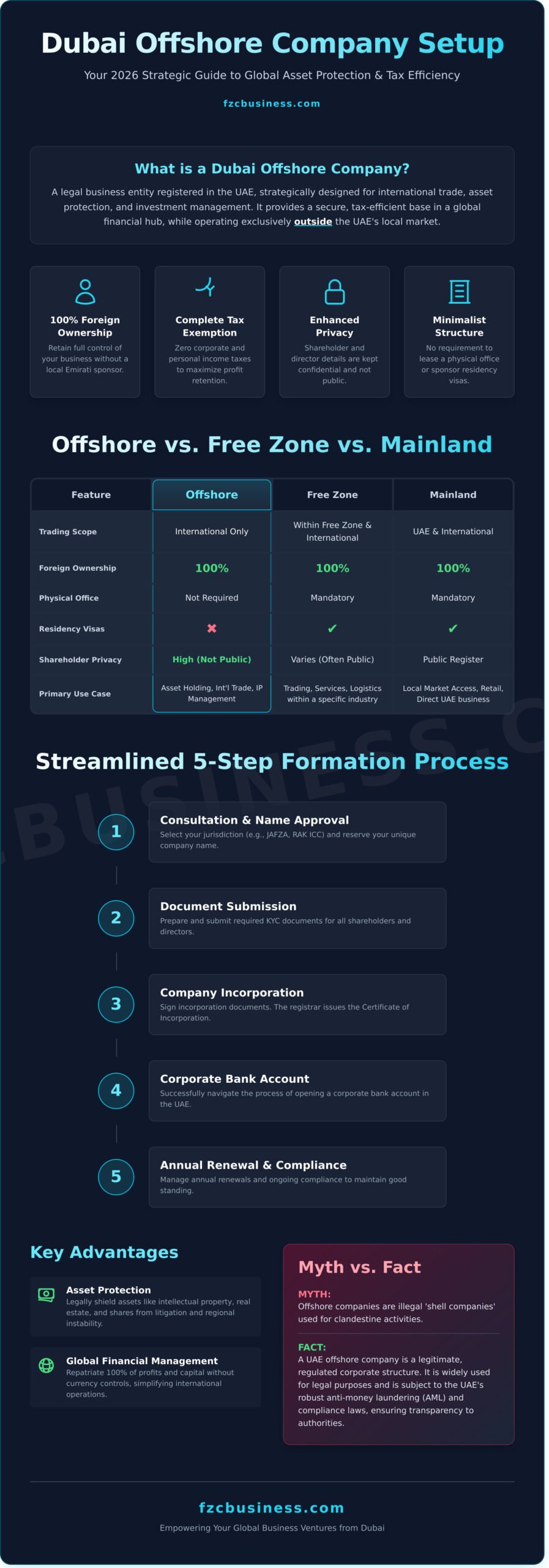
To provide a clearer visual understanding of the benefits, consider this expert overview:
Crucially, it is vital to understand what an offshore company is not. This corporate structure is legally prohibited from trading directly within the UAE market, leasing physical office space, or applying for staff visas. For a foundational understanding of the global concept, it’s helpful to know What is an Offshore Company? In the UAE, the most prominent and trusted jurisdictions for an offshore business setup in Dubai and the wider Emirates are the Jebel Ali Free Zone (JAFZA) and the Ras Al Khaimah International Corporate Centre (RAK ICC).
Key Characteristics of an Offshore Company
The structure of a UAE offshore company is designed to offer maximum benefits for international business activities. Key features include:
- 100% Foreign Ownership: Entrepreneurs retain full control of their business without the need for a local Emirati sponsor or partner.
- Complete Tax Exemption: Offshore companies are exempt from corporate and personal income taxes, maximizing profit retention.
- Enhanced Privacy: Shareholder and director details are not part of a public register, ensuring a high degree of confidentiality.
- Minimalist Structure: There is no requirement to lease a physical office, and the company is not eligible to sponsor residency visas.
Myth Busting: Offshore vs. ‘Shell Company’
A common misconception is equating an offshore company with a clandestine ‘shell company’. This is incorrect. A UAE offshore company is a legitimate and regulated corporate structure with powerful, legal applications. It is widely used as a holding company to own global assets, manage international consulting services, or hold property in approved freehold areas of Dubai. The UAE maintains a robust regulatory framework with stringent anti-money laundering (AML) and compliance standards, ensuring these entities are reputable and transparent to authorities.
Top 5 Benefits of Setting Up an Offshore Company in Dubai
For international entrepreneurs and investors, an offshore business setup in Dubai offers a strategic vehicle for global trade, asset protection, and tax optimization. The UAE has meticulously crafted a legal framework that supports international business, reinforcing Dubai’s position as a global business hub and making it a premier destination for offshore incorporation. These entities, while not permitted to trade within the UAE mainland, provide a powerful and flexible corporate structure. Here are the top five benefits you can leverage.
1. Complete Tax Exemption and Full Profit Repatriation
The most significant financial advantage is the complete exemption from corporate and personal taxes. This zero-tax environment ensures that your profits are maximized. Furthermore, Dubai imposes no restrictions on capital and profit repatriation. You are free to transfer 100% of your earnings to your home country or any other jurisdiction without facing complex regulations or currency controls, simplifying your international financial management.
2. Enhanced Privacy and Asset Protection
Confidentiality is a cornerstone of Dubai’s offshore jurisdictions. The details of company shareholders and directors are not part of any public register, providing a critical layer of privacy. This structure legally shields your assets from external risks such as litigation, creditors, or regional instability. Many entrepreneurs use an offshore company as a secure holding entity for valuable assets, including:
- Intellectual property (trademarks, patents)
- Real estate investments
- Shares in other companies
3. Simplified Operations and Global Trading
An offshore business setup in Dubai is designed for operational efficiency. The administrative burden is minimal, with no mandatory annual auditing and simplified financial reporting requirements. This allows you to focus on core business activities rather than extensive compliance. These companies are ideal for facilitating international invoicing, managing global trade, and holding consulting agreements. With the support of a registered agent, maintaining the company’s good standing is a straightforward and hassle-free process, ensuring your global operations run smoothly.
Offshore vs. Free Zone vs. Mainland: Which Is Right for You?
One of the most critical decisions for any entrepreneur entering the UAE market is selecting the correct jurisdiction. The terms Offshore, Free Zone, and Mainland represent distinct legal structures, each with specific advantages and limitations. Understanding these differences is the first step toward a smooth and successful business launch. Our expert guidance is designed to provide you with the clarity needed to make the optimal choice for your venture.
Scope of Business: The Core Difference
Your company’s ability to trade is the primary distinction between these three jurisdictions. The right choice depends entirely on where your clients are located.
- Offshore: An offshore company is a legal entity registered in the UAE but is not licensed to conduct any business within the United Arab Emirates. It is strictly for international trade, asset holding, and investment purposes.
- Free Zone: A free zone company can trade within its designated free zone and conduct business internationally. To trade directly in the UAE mainland market, it typically requires a local distributor.
- Mainland: A mainland company offers the most flexibility, with unrestricted permission to trade directly with any client or business across the entire UAE and internationally.
Visa Eligibility and Physical Presence
Your plans for relocation and physical operations are a key determining factor. An offshore business setup in Dubai is structured as a non-resident company, meaning it does not grant eligibility for UAE residency visas. It also does not require a physical office, operating instead with a registered agent’s address. In contrast, both Free Zone and Mainland companies require a physical address and allow you to apply for residency visas for yourself, your family, and your employees, making them the required choice if you plan to live and work in the UAE.
Quick Comparison Table: Dubai Company Structures
| Feature | Offshore Company | Free Zone Company | Mainland Company |
|---|---|---|---|
| Trading Scope | International only | Within Free Zone & International | Unrestricted (UAE & International) |
| Residency Visas | Not permitted | Permitted | Permitted |
| Physical Office | Not required (Registered Agent) | Required within the Free Zone | Required in Mainland Dubai |
| Foreign Ownership | 100% | 100% | 100% (for most activities) |
| Shareholder Anonymity | High (details not public) | Varies by Free Zone | Low (details on public record) |
The 5-Step Process for Offshore Company Formation in Dubai
Navigating an offshore business setup in Dubai can seem complex, but with expert guidance, it is a streamlined and efficient process. As your registered agent, Fast Zone Business demystifies each stage, ensuring a smooth and compliant formation. This actionable roadmap outlines the key milestones, allowing you to focus on your global business objectives while we handle the administrative details.
Step 1: Choose Your Jurisdiction & Company Name
The first crucial decision is selecting the right jurisdiction. The two primary options in the UAE are Ras Al Khaimah International Corporate Centre (RAK ICC), known for its cost-effectiveness and flexibility, and Jebel Ali Free Zone Authority (JAFZA), a prestigious choice ideal for holding companies and international trade. Following this, you must select a unique company name that complies with registrar rules, such as ending in ‘Limited’ or ‘Ltd.’. We will verify its availability to ensure a swift approval.
Step 2: Finalize Business Activities & Corporate Structure
Next, you must define your company’s intended activities, which typically include international trading, consulting, asset holding, or property ownership. You will also finalize the corporate structure by appointing directors and shareholders. UAE offshore regulations offer excellent flexibility, permitting a single individual to act as the sole shareholder and director, simplifying governance for solo entrepreneurs and investors.
Step 3: Prepare and Submit Required Documents
Compiling the correct documentation is essential for a successful application. Our team will guide you in preparing and submitting all necessary paperwork to the relevant authorities. Key documents generally include:
- Passport copies for all shareholders and directors
- Proof of residential address (e.g., a recent utility bill)
- A brief Curriculum Vitae (CV) for each shareholder
In some instances, a concise business plan may be required. Let our experts provide a hassle-free business setup in Dubai by managing this entire documentation process for you.
Step 4: Company Incorporation & Document Issuance
Once your application and documents are approved by the registrar, your offshore company is officially incorporated. You will receive a set of legal documents that certify your company’s existence and legal standing. These include the Certificate of Incorporation, the Memorandum and Articles of Association (MOA & AOA), and the share certificates. This step concludes the legal formation of your new entity.
Step 5: Open a Corporate Bank Account
With your company legally formed, the final step is to open a corporate bank account in the UAE. This is critical for managing finances and conducting international transactions. Navigating bank compliance for offshore entities can be challenging, but our established relationships with leading UAE banks ensure a smooth and efficient account opening process, making your company fully operational.
Life After Setup: Banking, Compliance, and Renewal
Successfully registering your company is a significant milestone, but the journey doesn’t end there. Understanding the post-incorporation steps is crucial for leveraging your new entity effectively and ensuring it remains in good legal standing. The focus now shifts from formation to operation, starting with the most critical task: securing your corporate bank account.
Opening a Corporate Bank Account
While the company formation can be swift, opening a corporate bank account in the UAE is often the most challenging step for an offshore entity. UAE financial institutions adhere to strict international compliance standards, conducting rigorous due diligence (KYC) on offshore companies to prevent financial crime. Navigating these requirements without expert guidance can lead to delays or rejection. Professional assistance is paramount for a smooth experience. Our team has strong relationships with leading UAE banks. Contact us for help to navigate this process efficiently.
Annual Renewal and Compliance
Maintaining your offshore company is a straightforward and cost-effective process. The ongoing requirements are minimal, designed to ensure your entity remains active without imposing a significant administrative burden. To keep your company in good standing, you simply need to manage two annual tasks:
- Payment of the annual government renewal fees to the relevant authority.
- Payment of your registered agent’s service fees for maintaining your company’s official address and records.
A key advantage of the offshore business setup in Dubai is that most structures are not required to file annual audits or submit financial statements, which greatly simplifies long-term compliance.
Using Your Offshore Company: Practical Scenarios
An offshore company is a powerful and versatile tool for international entrepreneurs and investors. Here are a few real-world examples of how it can be used:
- Holding Dubai Real Estate: Use your offshore company to own property in approved freehold areas. This structure provides enhanced asset protection and can simplify future inheritance and succession planning.
- International Consulting: As a global consultant or digital nomad, you can invoice international clients through your offshore company, centralizing your income in a tax-efficient jurisdiction.
- A Holding Company: An offshore entity can act as a holding company to own shares, intellectual property, or other valuable assets, separating them from the operational risks of your other businesses.
Secure Your Global Advantage with a Dubai Offshore Company
Embarking on your offshore business setup in dubai is a strategic move that unlocks unparalleled tax efficiency, asset protection, and complete confidentiality. As this guide has shown, understanding the key differences between jurisdictions and following the correct formation process is vital for long-term success. While the steps are clear, navigating them efficiently requires in-depth knowledge and precision.
The path to a successful offshore entity doesn’t have to be complex. At Fast Zone Business, we provide the expert guidance needed for a hassle-free process. We leverage strong partnerships with leading UAE banks to ensure smooth account opening and guarantee complete confidentiality and privacy for your venture, allowing you to focus on your global growth.
Ready to take the definitive step? Book Your FREE Consultation to Start Your Offshore Company Setup and let our specialists create a seamless roadmap for you. Your international business success story starts here.
Frequently Asked Questions About Offshore Business Setup in Dubai
How much does it cost to set up an offshore company in Dubai?
The total cost for an offshore company setup in Dubai typically ranges from AED 15,000 to AED 25,000. This estimate generally covers registration fees, first-year registered agent fees, and essential administrative costs. The final price varies depending on the chosen jurisdiction (JAFZA or RAK ICC) and any additional services required, such as corporate bank account opening assistance. For a precise, customized quote, we recommend booking a free consultation with our experts.
Can I get a UAE residency visa with an offshore company?
An offshore company in Dubai does not grant eligibility for a UAE residency visa. These entities are designed for international business and asset holding, not for establishing a physical presence or employing staff within the UAE. If obtaining a residency visa is your primary objective, a Free Zone or Mainland company is the appropriate corporate structure. Our team can provide expert guidance on the best option to meet both your residency and business goals.
Is a Dubai offshore company legal and reputable?
Absolutely. A Dubai offshore company is a completely legal and internationally recognized corporate structure. Registered under reputable authorities like the Jebel Ali Free Zone Authority (JAFZA) or RAK International Corporate Centre (RAK ICC), these entities are governed by robust regulations. They are widely used by global entrepreneurs and corporations for legitimate purposes such as international trade, asset protection, and tax optimization, offering a secure and credible business vehicle for global operations.
What is the difference between JAFZA and RAK ICC offshore jurisdictions?
JAFZA (Jebel Ali Free Zone Authority) is Dubai’s original offshore jurisdiction, known for its premium reputation and direct link to the emirate. It is the only offshore authority that permits a company to own property in specific freehold areas of Dubai. RAK ICC (Ras Al Khaimah International Corporate Centre) is often more cost-effective and offers greater flexibility in its regulations and a wider range of company structures. The ideal choice depends on your specific business activities.
Can I use my offshore company to buy property in Dubai?
Yes, you can use an offshore company to purchase property in Dubai, but only under specific conditions. A JAFZA offshore company is permitted to own real estate within designated freehold areas approved by the Dubai Land Department. However, an offshore company registered with RAK ICC cannot directly own property in Dubai. Our experts can guide you through the correct structuring to ensure a smooth and compliant property acquisition process for your investment.
How long does the offshore company formation process take?
The offshore company formation process is remarkably efficient. Once all required documents are submitted correctly, the registration can typically be completed within 2 to 5 working days. The exact timeline depends on the jurisdiction’s processing speed and the completeness of your application. At Fast Zone Business, we manage the entire process to ensure all paperwork is in order, guaranteeing a swift and hassle-free incorporation for your new business venture.
Do I need to visit Dubai to set up my offshore company?
No, your physical presence in Dubai is not required for the company registration itself. The entire offshore business setup in Dubai can be managed remotely with the assistance of a registered agent like Fast Zone Business. We handle the document submission and liaise with the authorities on your behalf. However, a visit may be necessary later for certain bank account opening procedures, depending on the chosen bank’s specific compliance requirements for director verification.
